
On this page
Start here
Quick answer
A Samsung oven that trips a breaker should not be repeatedly reset or run to reproduce the fault. First note whether the trip occurs as soon as power is restored, when Bake or Broil starts, during preheat, when a fan or cleaning cycle begins, or after the oven has heated. If there is smoke, a burning or plastic smell, visible arcing, water near the appliance, a hot or damaged cord or outlet, or a gas odor, stop immediately and use the appropriate emergency or qualified-service path. With the appliance cool and dry, an ordinary external check can confirm the correct breaker, visible cord or outlet condition, recent installation, and whether other loads share the circuit; never use an extension cord or open the panel. Samsung identifies power connection, model-specific controls, Demo mode, door status, heating behavior, and service as separate troubleshooting paths. A single power reset is reasonable only when the manual permits it and there is no hazard; if the breaker trips again, keep the oven off and have a qualified electrician or appliance technician diagnose the circuit and oven.
Before you begin
Safety first
- This article covers only safe external observation and a single model-permitted reset when hazard-free. Do not use an extension cord, bypass protection, open panels, probe live wiring, move a built-in oven, open gas fittings, relight to test, or energize wet or damaged equipment.
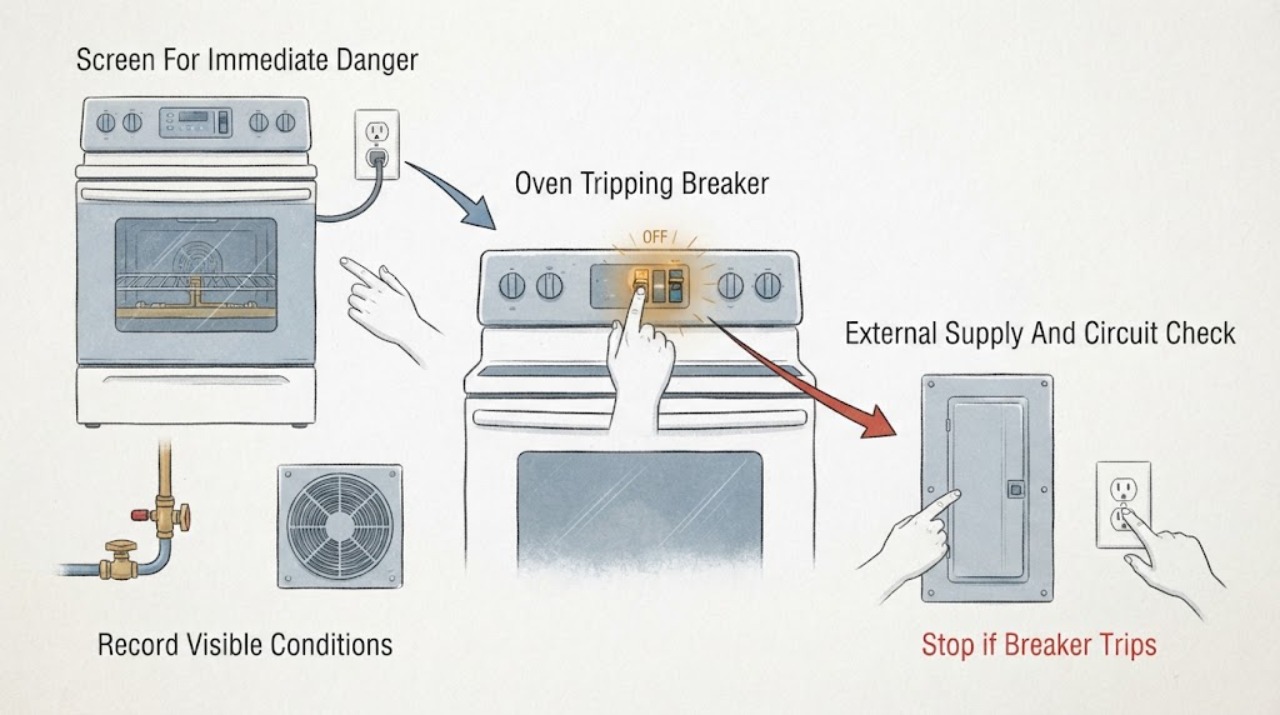
Work through in order
Diagnostic checks
Use only checks that match the exact appliance or system and its official guide.
-
Check 1
Stop operating the oven and assess from a safe position for smoke, flame outside a normal burner, burning or plastic odor, visible arcing, a hot or damaged cord or outlet, water near electrical parts, repeated trips, or a fuel-like odor.
Expected result: Record any gas smell or hissing, fuel-gas alarm, smoke, sparks, fire, burning smell, water, heat damage, exposed conductors, or breaker that trips again.
Next step: For gas odor or suspected leak, leave and use the gas-emergency path from a safe location. For smoke, fire, arcing, water, or heat damage, keep clear and obtain emergency or qualified electrical help. If none is present, continue only with the oven off and cool.
Stop if: Stop immediately for fuel odor or hissing, smoke, fire, sparks or arcing, burning odor, water near electrical parts, hot/discolored cord or outlet, or a second breaker trip.
Why this matters
Why: These are safety events, not normal breaker troubleshooting. Repeated energizing can worsen an electrical fault, and fuel gas can ignite while someone searches for its source.
-
Check 2
Without resetting the breaker again, record the last safe operating state and when the trip happened: immediately on power restoration, when a mode was selected, at Start, during preheat, when a fan or cleaning cycle began, after heating, or only with another load running.
Expected result: The trip is immediate, tied to one mode or heating stage, delayed until hot, associated with Self Clean or a fan, or correlated with other kitchen appliances on the same circuit.
Next step: Keep the oven off and give the timing to a qualified technician. Do not repeat the cycle to obtain a more precise time; use the last observed event only.
Stop if: Stop any attempt to reproduce the trip, especially if the first trip involved smoke, odor, heat, water, arcing, or a damaged cord/outlet.
Why this matters
Why: Timing narrows the handoff toward supply/connection, controls, a heating or fan load, a cleaning-cycle condition, or circuit loading, but it does not prove which internal component failed.
-
Check 3
With the oven cool and dry, inspect only the accessible plug, cord, receptacle, surrounding cabinet, and breaker label for looseness, discoloration, moisture, heat damage, or recent installation work; note whether other large loads share the circuit without changing wiring.
Expected result: The cord or outlet is hot, loose, wet, damaged, or discolored; the breaker is mislabeled or repeatedly trips; the oven was newly installed; or the visible supply appears normal and the trip is tied to oven operation.
Next step: For any damage, moisture, uncertainty, or repeat trip, do not move the oven or alter the circuit; arrange qualified electrical inspection. If the supply is visibly normal, keep the oven off and provide the mode timing for appliance diagnosis.
Stop if: Stop for moisture, heat, discoloration, buzzing, loose parts, exposed conductors, a breaker that trips again, or any need to open the panel, receptacle, appliance, or breaker enclosure.
Why this matters
Why: An external connection or circuit issue can trip before an oven component is proven faulty. Samsung's installation material lists different power arrangements by range type, so a generic outlet or cord assumption is unsafe.
-
Check 4
From the dry, de-energized or safely powered display state, record the complete model number and any code, lock icon, Demo indicator, door message, or selected function; consult only that model's Samsung guide for control-state interpretation.
Expected result: The panel shows Demo, Control Lock, a door or partition message, an exact error code, or no message; the same code returns after a documented normal power reset; or the panel is blank or frozen.
Next step: Clear only an applicable lock, Demo, door, or mode state documented for the exact model and do not start another high-load cycle. If the panel is blank, frozen, or the code returns, keep the oven off and request service.
Stop if: Stop for a recurring code, frozen or damaged panel, unexpected heating, smoke, odor, water, or any need to bypass a lock or safety input.
Why this matters
Why: Samsung documents that Demo mode prevents heating, door and partition conditions can inhibit functions, and code meanings differ. A control state may coexist with a circuit fault, while a recurring code or blank panel after a trip needs service.
-
Check 5
Only if the model documentation confirms a gas range and the surrounding air is clear, note whether the cooktop and oven ignition had been normal before the trip; do not relight, open a gas connection, or operate a burner to test the breaker.
Expected result: There is fuel odor, hissing, delayed ignition, burst or abnormal flame, soot, smoke, an alarm, or repeated failed ignition; or there is no gas warning and the trip timing points to an electrical operating stage.
Next step: For any gas warning, leave immediately without operating nearby switches, appliances, phones, or flames and contact emergency or fuel-gas help from a safe location. Without a gas warning, keep the appliance off and have a qualified gas-appliance and electrical professional assess it.
Stop if: Stop for any fuel odor, hissing, delayed ignition, burst or abnormal flame, soot, smoke, alarm, or failed ignition; never find a gas leak with a flame or relight to confirm the fault.
Why this matters
Why: Samsung separates gas-range ignition and pressure behavior from electrical power checks. A gas warning or abnormal combustion can be dangerous even if the breaker also trips.
-
Check 6
Only when the oven is cool, dry, hazard-free, and the exact Samsung guidance permits it, make at most one brief breaker reset from the normal household control point; do not start a cycle merely to test the result.
Expected result: The breaker holds and the display returns normally; or the breaker trips immediately or again, the panel remains blank, the same code returns, the oven unexpectedly heats, or smoke/odor appears.
Next step: If the breaker trips again or any abnormal symptom appears, leave it off and request qualified electrical/appliance service. If it holds, do not assume the fault is cured; follow the model guide and stop if the problem recurs.
Stop if: Stop for any repeat trip, smoke, burning odor, spark, unexpected heating, water, hot outlet, or damaged cord after reset.
Why this matters
Why: A single reset can clear a transient control condition, but a repeat trip indicates a fault or circuit condition that cannot be safely isolated by continued user testing.
Use your observations
Decision map
Find the observation that best matches what you see, then follow the next safe action.
-
PATH 01Next step
What you see
Smoke, fire, arcing, burning odor, water near electrical parts, a hot/damaged cord or outlet, or a second breaker trip occurs.
Do this next
Stop using the oven and do not reset or reproduce the fault. Obtain emergency help for fire or active arcing, and qualified electrical or appliance service for the remaining conditions.
-
PATH 02Next step
What you see
Fuel odor, hissing, fuel-gas alarm, delayed ignition, burst flame, abnormal flame, soot, or smoke occurs on a gas configuration.
Do this next
Do not operate switches, appliances, phones, or flames in the area. Leave immediately and contact emergency or fuel-gas help from a safe location. Do not return or restore gas until professionals clear it.
-
PATH 03Next step
What you see
The trip is immediate, the visible cord/outlet is damaged or wet, another load correlates with the trip, or the breaker trips again after one permitted reset.
Do this next
Leave the oven and circuit untouched and request qualified electrical inspection; do not use an extension lead, change circuits, open the panel, or move the appliance.
-
PATH 04Next step
What you see
The panel is responsive and shows Demo, Lock, door/partition, or a model-specific code, and no immediate hazard is present.
Do this next
Use only the exact model guide to clear the state or interpret the code. A returning code, blank/frozen panel, or another trip requires service without another test cycle.
-
PATH 05Next step
What you see
The circuit is visually normal but the trip occurs when a particular heating, fan, or cleaning stage begins or after the oven becomes hot.
Do this next
Keep the oven off and provide the exact stage and timing to a qualified appliance technician. Do not test separate modes to compare them.
Helpful context
Understand the symptom
A breaker trip is a safety signal, not a reset challenge
The timing of a trip is more useful than repeatedly switching the breaker. Record whether it trips immediately, when Bake or Broil is selected, during preheat, when a fan starts, during Self Clean, after a period of heating, or only when another kitchen load runs. A trip that happens again after one permitted reset can indicate an appliance fault, a circuit or connection problem, moisture, or an overloaded/shared circuit. The homeowner's safe role is limited to external observation and clear information for a qualified professional.
Separate electric, gas, and model-specific behavior
Samsung range installation requirements differ between electric and gas configurations, and gas ranges still use an electrical outlet for controls and ignition. Do not assume that a gas oven's breaker trip is only a gas problem, or that an electric oven can be checked with a generic voltage test. If the fuel type is not known, use the model documentation and the nameplate from a dry, safe position. A fuel odor or abnormal ignition is an emergency branch, not an invitation to inspect fittings.
Control states can look like electrical failure
A Samsung panel may show a lock, Demo state, door condition, or information code. Demo mode can leave controls responsive while the oven does not heat, and a door or partition condition can prevent an oven operation. Read the exact model guide and record the code or icon; do not apply a button sequence from another model. A code that returns after the model-approved reset is a service clue, not a reason to keep cycling power.
Do not test with an extension lead or live access
An oven is a high-load appliance with model-specific wiring and circuit requirements. Do not use an extension cord, power strip, improvised adapter, or a different circuit as a test. Do not remove the rear cover, probe terminals, tighten conductors, or work inside the breaker panel. If a cord, outlet, plug, cabinet, or surrounding floor is wet, hot, discolored, loose, or damaged, leave the circuit and appliance untouched and request qualified electrical service.
A complete service handoff prevents unsafe guessing
Give the electrician or appliance technician the complete model number, fuel type, installation age, breaker rating if already documented, trip timing, selected mode, whether the oven was preheating or cleaning, any display code, and what else was operating on the circuit. Include safe photos of the cord, outlet, breaker position, and visible damage without moving the appliance. Do not run another cycle for a video or to confirm the fault.
Safety boundary
Stop conditions
- Do not repeatedly reset the breaker or run another cycle to reproduce the trip.
- Stop for smoke, fire, visible sparks or arcing, burning or plastic odor, a hot/discolored cord or outlet, water near electrical areas, exposed conductors, or a second breaker trip.
- For gas odor, hissing, delayed ignition, abnormal flame, soot, smoke, or a fuel-gas alarm, do not operate switches, appliances, phones, or flames in the area; leave and contact emergency or fuel-gas help from a safe location.
- Do not use an extension cord, power strip, improvised adapter, alternate circuit, or bypassed protection; do not open the breaker panel, receptacle, oven cover, or live wiring.
- Do not move a built-in oven, relight a gas appliance, test with a flame, or perform live electrical or gas work.
Only after diagnosis
Potential parts
- oven heating or fan component
Only consider this category when the trip timing and qualified diagnosis identify a particular heating or fan load as the cause; a breaker trip alone does not identify a part.
Confirm the complete Samsung model and approved fit information after diagnosis; do not test or replace energized components. - oven control or power component
Only applicable after the circuit, connection, settings, door, and hazard checks are clear and a technician identifies a control or power fault.
A technician must confirm the exact model, electrical configuration, and repair path before any replacement. - gas ignition or burner component
Only for a confirmed gas configuration and only after qualified gas-safety assessment rules out supply, combustion, and leak hazards.
Do not order or install a gas component from a generic description; confirm model and professional compatibility.
When checks do not resolve it
Need a professional?
Request qualified electrical or appliance service after any repeat breaker trip, any trip tied to heating, fan, or cleaning operation, a blank or recurring-code panel, or any cord, outlet, moisture, door, or installation concern. Use emergency or fuel-gas help from a safe location for gas odor, hissing, smoke, fire, or abnormal combustion.
Safety scope: This article covers only safe external observation and a single model-permitted reset when hazard-free. Do not use an extension cord, bypass protection, open panels, probe live wiring, move a built-in oven, open gas fittings, relight to test, or energize wet or damaged equipment.
Common questions
FAQ
Should I keep resetting the breaker when my Samsung oven trips it?
No. If it trips again, keep the oven off. A single reset is appropriate only when the oven is cool, dry, hazard-free, and the exact model guidance permits it; repeated trips need qualified electrical or appliance diagnosis.
Can a Samsung gas range trip a breaker?
Yes, gas configurations still use electrical power for controls and ignition, but a breaker trip does not identify the cause. If there is any gas odor, hissing, delayed ignition, abnormal flame, smoke, or alarm, leave immediately and use the gas-emergency path from a safe location.
What does it mean if the breaker trips only during preheat?
The timing may help a qualified technician distinguish a heating-stage or circuit issue from an immediate supply problem, but it does not prove a specific component. Do not run another preheat to reproduce it.
Can I use an extension cord to see whether the Samsung oven works?
No. Do not use an extension cord, power strip, improvised adapter, or alternate circuit as a test. Samsung ranges have model-specific supply requirements, and an electrician should inspect an uncertain or damaged connection.
What information should I give the repair technician?
Provide the full model number, fuel type, breaker timing, selected mode, display code or icon, installation history, visible cord/outlet condition, and any smoke, odor, water, heat, or spark. Do not recreate the trip for a video.
Read the exact guide
Official sources
- Samsung range or wall oven error codesSamsung · Samsung's official model-dependent error-code guidance for Demo, power connection, door, temperature, communication, reset, and service
- Educational Messages Desk ReferenceNational Fire Protection Association · NFPA fuel-gas safety guidance for suspected leaks, alarms, evacuation, and professional clearance
- Self Clean or other buttons do not light up or respond, or panel is locked on Samsung ovenSamsung · Samsung's official guidance for function availability, hot panels, Control Lock, cleaning a touch panel, breaker reset, and service
- Samsung oven temperature issuesSamsung · Samsung's official troubleshooting guidance for no-heat conditions, door, Demo mode, gas-range behavior, breaker reset, and service
- Samsung range or wall oven panel is blank, blinking, or incorrectSamsung · Samsung's official guidance for power connection, blank or incorrect panel symptoms, a brief breaker reset, and service
- Install your Samsung gas or electric rangeSamsung · Samsung installation guidance distinguishing electric and gas range power and connection requirements
Community feedback
Share a repair observation
Share a plain-text repair observation. Accepted observations are published automatically; this page may take a moment to update.