
On this page
Start here
Quick answer
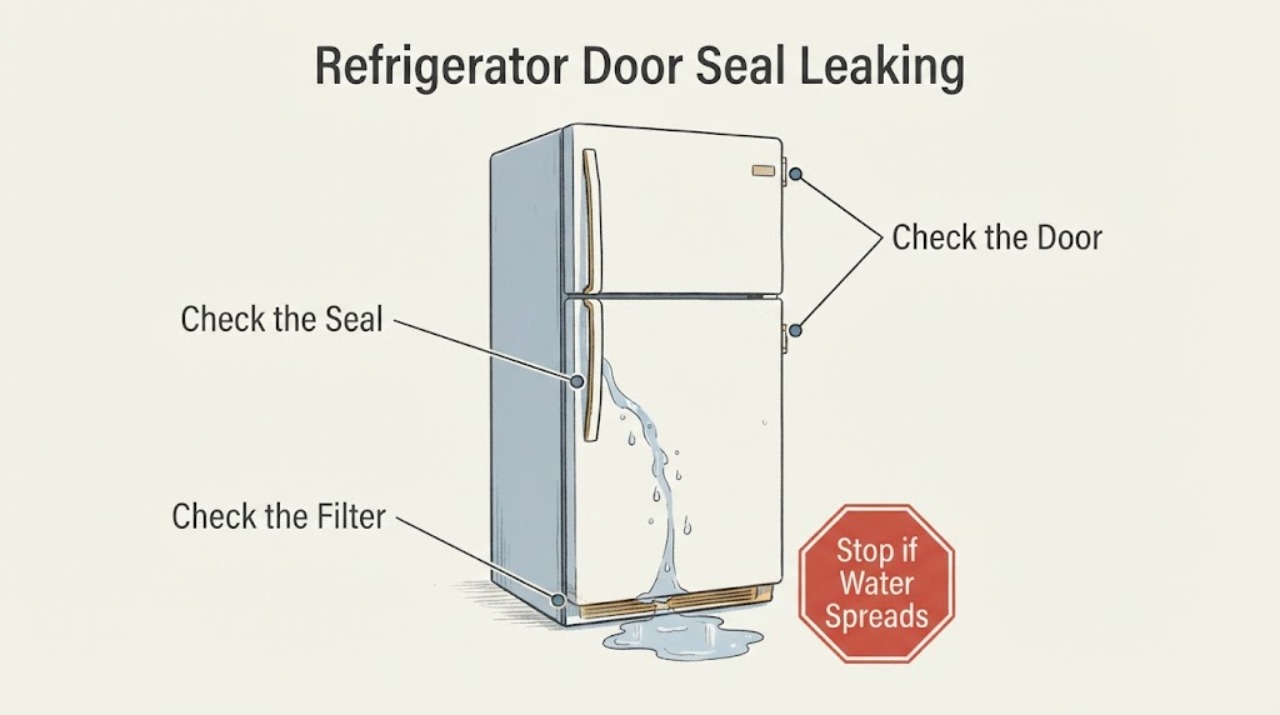
A door gasket does not carry water, so first separate condensation or frost at an imperfect seal from a water-supply, filter, drain or dispenser leak. Amana says a dirty or damaged gasket, a package or bin blocking closure, an unlevel refrigerator, incorrect door installation or a mispositioned French-door hinged seal can prevent a reliable seal and lead to moisture, frost or temperature changes. Clean the accessible gasket with warm water and mild detergent, dry it, clear obstructions, and check closure and level according to the exact model manual. If water is behind the refrigerator, under a door or near the filter, inspect only the visible supply/filter area and close the water shutoff if safely reachable. A cracked or warped gasket, persistent gap, rising temperature, repeated floor water or any leak requiring internal access needs qualified Amana service.
Work through in order
Diagnostic checks
Use only checks that match the exact appliance or system and its official guide.
-
Check 1
Locate the first wet or frosty point before moving the refrigerator: inspect the gasket and cabinet edge, the center mullion or door divider, the area under the door, the filter area and the floor or wall behind the unit. Wipe the area dry and watch where moisture returns without leaving the doors open.
Expected result: Moisture returns along a gasket gap, appears as general condensation/frost, starts under a door, or appears at the filter/back supply area.
Next step: If the wet point is at a door edge or gasket, continue with the seal checks. If it is at a filter or visible line, use the water-path branch and do not label the gasket as the cause.
Stop if: If the source cannot be located without pulling the refrigerator or opening a panel, stop and arrange service.
Why this matters
Why: Amana associates an improper gasket seal with humidity/frost, but its leak guide separately identifies filter and water-line connections. The first wet point determines whether this is a seal/moisture concern or a water-path concern.
-
Check 2
With the door open and the refrigerator safe to handle, inspect the full gasket perimeter for food particles, sticky residue, cracks, brittleness, warping or a section that does not touch the cabinet. Clean it with warm water and mild detergent on a soft cloth, rinse and wipe dry; do not use a sharp tool or adhesive.
Expected result: The gasket is dirty but intact, or it remains damaged, deformed or visibly separated after cleaning.
Next step: If cleaning restores full contact and the door closes normally, monitor moisture and temperature. If damage or a persistent gap remains, use the service branch and obtain the exact model before considering a replacement gasket.
Stop if: Do not stretch, glue, cut or heat-form the gasket, and do not order a generic seal from the symptom alone.
Why this matters
Why: Amana says dirt can create resistance and its cleaning guidance supports warm water, mild detergent, rinsing and drying. A cracked, brittle, warped or persistently separated gasket is not restored by cleaning alone.
-
Check 3
Clear the closure path: push bins, shelves and crisper covers fully into position, move tall containers away from the door, check for packaging or an object behind the refrigerator, and confirm that the door was not recently removed and reinstalled incorrectly.
Expected result: A package/bin/cover blocks closure, installation alignment is visibly wrong, a French-door vertical seal is folded outward, or nothing obstructs the door.
Next step: Remove only the accessible obstruction or fold a French-door hinged seal inward as Amana describes. If doors were removed, use the exact installation instructions for alignment; do not loosen hinges without the model procedure.
Stop if: If the door still leaves a gap with no obstruction, keep the refrigerator closed and arrange model-specific service.
Why this matters
Why: Amana lists interior obstructions, packaging, incorrect door installation and (on French-door models) a vertical hinged seal position as causes of poor sealing. These are external or model-manual adjustments, not proof of a damaged hinge or gasket.
-
Check 4
Check the refrigerator and floor level from side to side and front to back with a level; do not tilt or pull the appliance to reach hidden components. Compare the door’s natural closing and gasket contact after the level check.
Expected result: The cabinet or floor is out of level, the door swings or fails to sit flush, or the unit is level but the seal still leaks air or moisture.
Next step: If the model manual provides a user-level leveling adjustment, follow it without accessing water or electrical parts. If the unit is level and the gap remains, arrange service.
Stop if: Do not improvise shims or hinge adjustments; use the exact Owner’s Manual or service.
Why this matters
Why: Amana says leveling supports proper door operation and should be completed before French-door alignment. Leveling can explain a closure problem but cannot confirm that a gasket, hinge or drain is defective.
-
Check 5
If water is on the floor or behind the refrigerator, inspect only the visible filter cap, supply line and connection points for moisture, cracks or a loose connection; keep hands away from electrical parts and close the household water shutoff if safely reachable.
Expected result: Moisture starts at the filter/line/back connection, the line is damaged, or those visible areas are dry while water returns under the door.
Next step: Dry the area, stop the water supply if safe and arrange service or a qualified installer for a damaged connection; do not open panels or disconnect internal tubing.
Stop if: Do not continue pulling the refrigerator out or assume the gasket caused floor water; use the service branch for a hidden source.
Why this matters
Why: Amana identifies incorrect filter installation and water-line connections as separate leak sources. Water returning with dry visible connections may involve a drain, dispenser line or internal component outside a gasket check.
-
Check 6
Record the model/serial, refrigerator layout, first wet point, gasket condition, door obstruction/alignment, level result, frost or condensation pattern, compartment temperatures and any filter or supply-line work. Keep doors closed and limit use if temperature is rising or water continues.
Expected result: The seal remains open or damaged, moisture/frost persists, food temperature is unstable, water recurs, or the issue was resolved by cleaning or clearing an obstruction.
Next step: Arrange qualified Amana service for a damaged or persistent seal, recurring water, unstable temperature or any internal-access step. Move vulnerable food to safe cold storage and protect the floor while waiting.
Stop if: If the external obstruction or residue was the clear cause, monitor the seal and moisture over the next normal operating period using the exact model guidance.
Why this matters
Why: Amana says poor sealing can cause frost and temperature fluctuation, while persistent water may need service. The observations help a technician distinguish gasket/alignment from a separate leak path without a guessed part diagnosis.
Use your observations
Decision map
Find the observation that best matches what you see, then follow the next safe action.
-
PATH 01Next step
What you see
Moisture or frost follows the gasket perimeter, and a package, dirty gasket or misaligned door prevents full contact.
Do this next
Clean the gasket, clear the obstruction and follow the exact model’s level/alignment instructions; service is needed if the gap or moisture persists.
Why this path and its safety boundary
Why it matters: This pattern is consistent with a door-seal/closure problem in Amana’s guidance, but it does not prove the gasket itself is the only fault.
-
PATH 02Next step
What you see
The French-door hinged seal is folded outward, or the doors were removed and no longer align.
Do this next
Return the hinged seal inward and use the exact installation instructions for alignment; do not improvise hinge work.
Why this path and its safety boundary
Why it matters: Amana identifies hinged-seal position and incorrect door installation as layout-specific causes of poor sealing and moisture.
-
PATH 03Next step
What you see
The refrigerator is level and unobstructed, but the gasket is cracked, warped or still separated from the cabinet.
Do this next
Keep the door closed, monitor temperature/frost and arrange Amana service with the model/serial information; do not glue or heat the gasket.
Why this path and its safety boundary
Why it matters: Cleaning and leveling have not restored the seal; a model-specific gasket, hinge or door service assessment is required.
-
PATH 04Next step
What you see
Water begins at the filter, supply line, connection behind the refrigerator or a separate under-door point rather than along the gasket.
Do this next
Close the water shutoff if safe, dry the area and arrange qualified service or installer help; do not open internal water or electrical components.
Why this path and its safety boundary
Why it matters: Amana’s leak guide treats filter and water-line connections as separate sources, so the door seal is not established as the cause.
-
PATH 05Next step
What you see
The seal looks intact but condensation or frost occurs during high humidity, frequent door opening or blocked vents.
Do this next
Minimize door openings, clear only accessible vent obstructions and use the exact model’s control guidance; persistent frost or temperature change needs service.
Why this path and its safety boundary
Why it matters: Amana says humid air, prolonged/frequent openings and blocked airflow can cause moisture independently of a damaged gasket.
Helpful context
Understand the symptom
Decide whether the door seal is actually the source
Moisture on the gasket, cabinet edge, center mullion or nearby floor can result from warm humid air entering through a gap. Water behind the refrigerator or at a filter/connection points to a different path. Amana’s support material treats sealing and water-supply checks as related possibilities, not as one confirmed part failure, so locate the first wet point before choosing a repair.
Use the refrigerator layout that matches the model
Amana has separate guidance for top-freezer and French-door/bottom-freezer layouts. French-door models may have a vertical hinged seal between the doors, and the exact adjustment procedure belongs in the Owner’s Manual or Installation Instructions. The task has no model, so the article stays at cleaning, obstruction, visible alignment and level checks.
Protect food and flooring while checking
A failed seal can raise compartment temperature and produce frost or condensation; an actual water leak can damage flooring. Wipe water, protect nearby electrical areas, keep doors closed as much as practical and move perishable food to safe cold storage if temperatures are rising. Close the refrigerator water shutoff only if it is safely reachable; do not pull the appliance out or open panels to chase a hidden leak.
When checks do not resolve it
Need a professional?
Arrange qualified Amana service when the gasket is cracked or remains separated after cleaning and closure checks, doors need model-specific alignment, water recurs from a hidden source, the refrigerator temperature rises, frost keeps building, or the next step would require internal water, drain, hinge or electrical access.
Have this ready
- full model and serial information
- top-freezer, French-door, side-by-side or other layout
- first wet/frost point
- gasket condition and door-contact gap
- obstruction, installation and level findings
- filter/supply-line history and compartment temperature observations
Common questions
FAQ
Can a refrigerator door gasket itself leak water?
The gasket does not carry water. A poor seal can admit humid air and cause moisture or frost, while water on the floor may instead come from a filter, supply connection, drain or dispenser path. Locate the first wet point before naming the cause.
How should I clean an Amana refrigerator door gasket?
Amana’s guidance says to wash the gasket with warm water and mild detergent using a clean sponge or soft cloth, rinse well and wipe dry. Do not cut, glue or heat-form it.
What if cleaning the gasket does not stop the moisture?
Check accessible obstructions, door alignment and level using the exact model manual. A cracked, warped or persistently separated gasket, rising temperature or recurring moisture needs Amana service.
What should I do if water is behind the refrigerator?
Amana identifies filter installation and water-line connections as possible sources. Inspect only visible fittings and tubing, close the water shutoff if safely reachable, keep the area dry and arrange service for a damaged or hidden connection.
Read the exact guide
Official sources
- How to Help Eliminate Condensation and FrostAmana Product Help · Official Amana support article for condensation and frost; control locations vary by model.
- Door Hard to Open - RefrigeratorAmana Product Help · Official Amana support page for French-door refrigerator door operation; cleaning steps are limited to the accessible gasket.
- What to Do if There is Water on the FloorAmana Product Help · Official Amana leak guide for refrigerator water on the floor; exact model and line configuration govern any further access.
- Doors Not Closing ProperlyAmana Product Help · Official Amana installation-support article spanning refrigerator layouts; it is used for external cause identification, not part fitment.
- Doors Not Sealing - RefrigeratorAmana Product Help · Official Amana support page for top-freezer refrigerators; exact model instructions govern installation and leveling details.
- Doors Not Sealing - French Door RefrigeratorAmana Product Help · Official Amana support page for French-door refrigerators; door adjustment and hinged-seal procedures remain model-specific.
Community feedback
Share a repair observation
Share a plain-text repair observation. Accepted observations are published automatically; this page may take a moment to update.