
On this page
Start here
Quick answer
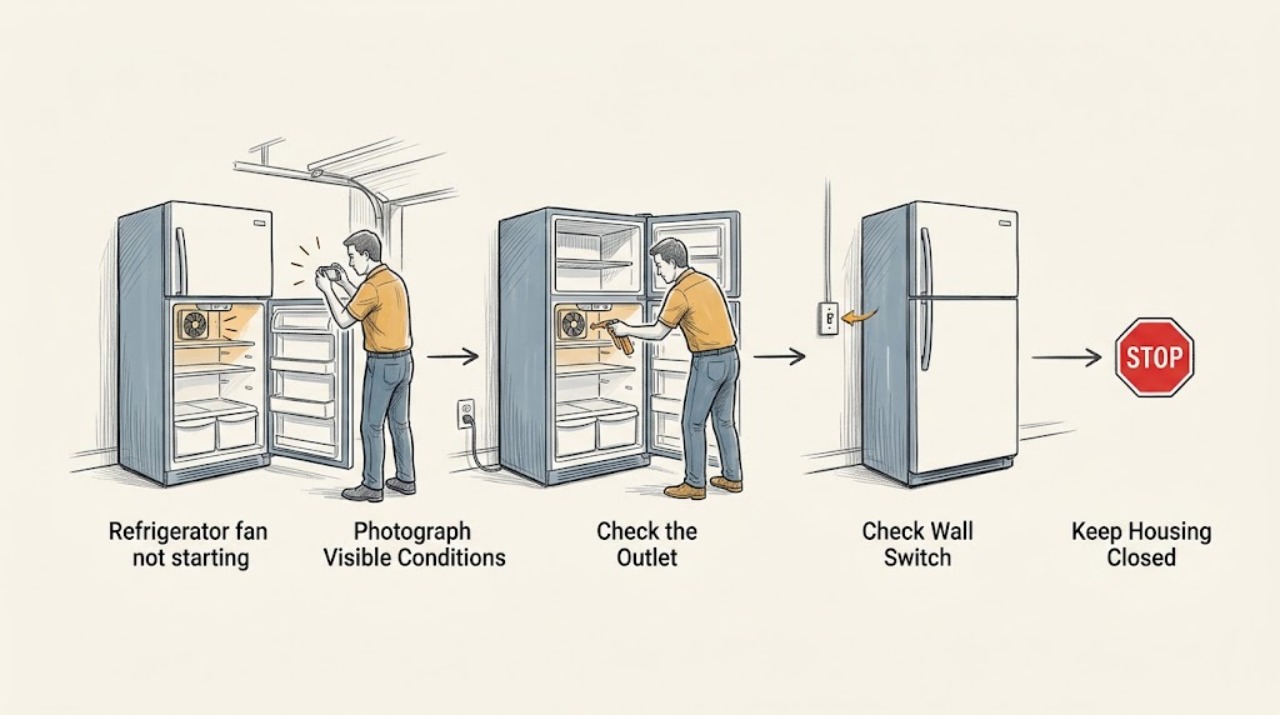
Do not push or spin the refrigerator fan by hand. BR18 is not enough to identify an exact Amana model or market, so first photograph the complete rating label and use that number to obtain the matching Owner's Manual. Then make only external observations: confirm the refrigerator has power and cooling enabled, record whether the compartments are warming, check the garage temperature against the manual, and verify that interior vents and doors are not obstructed. If the fan never operates during a normal cooling call, the refrigerator is warm despite a suitable environment, or there is frost, scraping, burning odor, water near electrical parts, or a damaged cord, stop and arrange qualified Amana appliance service; the symptom does not identify a fan motor, control, or wiring part.
Before you begin
Safety first
- Do not hand-start, repeatedly nudge, or block/bypass a door switch; do not insert tools or fingers into a fan; do not remove evaporator or rear covers, open electrical compartments, perform live tests, chip ice, or disturb sealed refrigeration tubing. Stop immediately for smoke, burning odor, a hot or damaged cord, water near electrical parts, repeated breaker trips, unsafe frost, or food temperatures rising.
Work through in order
Diagnostic checks
Use only checks that match the exact appliance or system and its official guide.
-
Check 1
Without moving the refrigerator, read and photograph the complete model and serial label inside the fresh-food compartment. Include every suffix, slash, or regional marking; BR18 may be a family or partial identifier rather than the service model.
Expected result: A complete model number is visible and matches the appliance, or only BR18/another partial marking is available.
Next step: Use the complete number in Amana's manual lookup and keep the market/voltage information with the service request. If the number remains incomplete, limit the work to the external checks below and do not order a fan or control.
Why this matters
Why: Amana's manual lookup asks for at least the first six model characters and identifies the refrigerator label on the upper-right interior wall. A partial identifier cannot establish the fan design, door-switch behavior, garage range, or correct service literature.
-
Check 2
Leave the appliance assembled and do not insert fingers, a tool, or a hand into any fan opening. From outside, note any burning smell, smoke, damaged cord, water near the outlet, unusual heat, or a breaker that trips.
Expected result: There is no hazard sign, or there is smoke, a burning/electrical odor, water by electrical parts, cord damage, unusual heat, or a repeated trip.
Next step: If a hazard is present, stop using the refrigerator, keep clear of wet electrical areas, and isolate power only from a safe accessible point if necessary. Arrange qualified appliance/electrical service; do not reopen or test the appliance.
Why this matters
Why: No hazard sign permits limited external observation. Any electrical, water, or overheating warning makes repeated operation and fan manipulation unsafe; it does not identify a failed fan motor.
-
Check 3
With the doors closed as much as possible, check the interior light/display, temperature controls, cooling indication, and compartment temperatures. Listen from outside for a normal cooling cycle; do not hold a door switch down or keep opening the freezer to chase a fan sound.
Expected result: The display/lights work but cooling is off, the unit is completely dark, the controls work and temperatures are stable, or the compartments are warming.
Next step: Record the exact display and temperature trend, then use only the matching Owner's Manual for any cooling or Demo-mode state. Do not use a reset or button sequence from another Amana model; escalate if cooling remains off or the same state returns.
Why this matters
Why: Amana says Demo/Showroom mode can leave lights and controls available while cooling is disabled, and a dark unit can point to an accessible supply problem. Working controls with rising temperatures require separating operating state and environment from an internal fan/control fault.
-
Check 4
Measure the garage air temperature near the refrigerator and record whether the space is below 55°F, between 55°F and 110°F, or above 110°F. Check the complete model's manual for a garage-ready rating or a model-specific garage mode before changing any control.
Expected result: The garage is outside the documented range, the full model confirms garage-ready operation, or garage suitability cannot be confirmed.
Next step: Move the diagnosis to a suitable controlled environment only if the owner/installer can do so safely and the manual permits it; otherwise correct the environment or arrange service. Do not select a fan part based on garage placement alone.
Why this matters
Why: Amana warns that operating outside the recommended range can cause temperature fluctuation and poor performance. Cold garages can reduce or stop normal cycling in standard units, while hot garages increase run time; this can imitate a fan-start complaint without proving a fan failure.
-
Check 5
Inspect only the visible shelf and compartment areas for blocked air vents, food pressed against the rear wall, a door that does not seal, or an obvious frost/ice obstruction. Do not remove panels, chip ice, or attempt to reach the evaporator fan.
Expected result: A vent is blocked, a door/gasket is visibly failing, frost is visible around an airflow opening, or the visible airflow path is clear.
Next step: Rearrange only loose items that clearly block an accessible vent and close the door. If frost returns, airflow remains absent, or internal access would be needed, stop and request model-specific service rather than scraping or disassembling.
Why this matters
Why: Amana states that blocked vents reduce airflow and can create temperature or moisture problems, while frequent openings and unsuitable conditions can worsen frost. Visible frost or a blocked path does not identify whether the underlying cause is a fan, defrost system, gasket, or control.
-
Check 6
After documenting the model, state, ambient temperature, and food-compartment temperature, observe one normal cooling cycle from outside. Record whether the fan sound/airflow is absent every time, returns without touching the fan, or changes when a door is opened and closed normally.
Expected result: The fan returns during normal operation, is absent only in one door position/state, or never returns while the refrigerator is warm and controls/cooling are enabled.
Next step: Do not bypass the switch, hand-start the blade, or run with covers removed. Give the service provider the complete model, market, temperature trend, ambient reading, exact display, and whether the fan ever resumed on its own.
Why this matters
Why: A change tied to normal door position or cooling state may reflect a door-switch or control sequence rather than a seized motor. A fan that never returns with warming compartments and a suitable ambient condition leaves internal fan, wiring, control, airflow, or sealed-system causes open; the observation cannot select one part.
Use your observations
Decision map
Find the observation that best matches what you see, then follow the next safe action.
-
PATH 01Next step
What you see
Only BR18 is available, the garage range or model platform cannot be confirmed, or the control layout does not match the retrieved manual.
Do this next
Stop model-specific diagnosis, photograph the complete label, and obtain the matching Amana literature or qualified service. Keep the refrigerator assembled and do not hand-nudge the fan.
Why this path and its safety boundary
Why it matters: The most important first decision is still appliance identity. Fan operation, garage limits, and any control procedure are model and market dependent, so the symptom cannot safely select a procedure or replacement part.
-
PATH 02Next step
What you see
Lights and controls work but the refrigerator is not cooling, or a Demo/Showroom indicator is present and fan/compressor activity is limited.
Do this next
Use only the exact model manual to clear or confirm the state. If it cannot be cleared or cooling does not resume, arrange service and protect perishable food.
Why this path and its safety boundary
Why it matters: A control state can explain available lights without normal cooling. This is distinct from proving that the evaporator fan is mechanically failed.
-
PATH 03Next step
What you see
The garage is below or above the full model's documented ambient range, or BR18 is not confirmed as garage-ready.
Do this next
Address the documented location requirement or move the unit only under the manual/installer's guidance. Recheck stable temperatures from a suitable environment; if the fan still never runs, call for model-specific service.
Why this path and its safety boundary
Why it matters: Ambient conditions can change compressor cycling and compartment temperatures, especially in a non-garage-ready refrigerator. That can make a fan seem inactive without establishing an internal fan defect.
-
PATH 04Next step
What you see
Visible vents are blocked or frost obstructs an airflow opening, but there is no electrical or water hazard.
Do this next
Move only loose items away from accessible vents and keep the doors closed. Do not chip frost or remove covers; arrange service if frost or poor airflow persists.
Why this path and its safety boundary
Why it matters: An external airflow obstruction is more actionable than naming a fan part, but the visible symptom does not distinguish a blocked vent from an underlying defrost, fan, gasket, or control problem.
-
PATH 05Next step
What you see
The refrigerator is warm, controls/cooling are enabled, the ambient temperature is suitable, and the fan never resumes on its own.
Do this next
Stop trying to start the fan, protect perishable food, and arrange qualified Amana appliance service with the model label, market, temperature log, and observed cycle behavior.
Why this path and its safety boundary
Why it matters: An internal fan, wiring, control, airflow, or sealed-system condition remains possible. A fan that starts after a hand nudge is not enough evidence to identify a motor or authorize a part order.
Helpful context
Understand the symptom
Why a fan that needs a nudge is not a safe DIY diagnosis
A fan that appears to start only after being nudged may be obstructed, affected by a door-switch or cooling-state condition, or have an internal electrical or mechanical fault. The available Amana material does not verify BR18 as a complete model number or define a BR18-specific fan test. Keep hands and tools out of the fan area, do not bypass a door switch, and do not remove an evaporator cover or rear electrical panel to force a diagnosis. A hand-starting symptom is evidence to record for service, not a repair method.
Garage conditions can mimic or worsen a cooling complaint
Amana says standard refrigerators are intended for about 55°F to 110°F (13°C to 43°C), while garage-ready behavior and any garage-mode setting are model dependent. In cold weather, a non-garage-ready refrigerator may cycle less or not at all; in hot weather it may run longer and struggle to maintain safe temperatures. Do not assume BR18 is garage-ready until the full model's documentation confirms it.
When checks do not resolve it
Need a professional?
Arrange qualified Amana appliance service when the complete model and market are recorded but the fan never resumes during a normal cooling cycle, the refrigerator remains warm after the garage/environment and visible-airflow checks, frost repeatedly returns, or the exact model manual is unavailable. In a rental, notify the owner or property manager before moving or dismantling the appliance.
Safety scope: Do not hand-start, repeatedly nudge, or block/bypass a door switch; do not insert tools or fingers into a fan; do not remove evaporator or rear covers, open electrical compartments, perform live tests, chip ice, or disturb sealed refrigeration tubing. Stop immediately for smoke, burning odor, a hot or damaged cord, water near electrical parts, repeated breaker trips, unsafe frost, or food temperatures rising.
Have this ready
- Provide the complete model and serial label, market/voltage if known, garage temperature range, fresh-food and freezer temperature trend, exact display or mode, whether lights and controls work, whether the fan ever resumes without touching it, visible frost/vent conditions, and any odor, water, cord, or breaker event.
Common questions
FAQ
Should I nudge the Amana refrigerator fan again if it stops?
No. Keep hands and tools out of the fan opening and do not bypass a door switch or remove a cover. Record whether it resumes by itself during a normal cooling cycle and give that information to qualified service.
Is BR18 a complete Amana refrigerator model number?
It cannot be confirmed from the available Amana material. Amana asks for at least the first six model characters in its manual lookup and places refrigerator labels on the upper-right interior wall, so photograph the full label before applying model-specific instructions.
Can a cold garage make the refrigerator fan seem not to start?
It can change normal cooling cycles in a standard refrigerator. Amana says standard units are intended for about 55°F to 110°F and that non-garage-ready units may cycle less or not at all in cold weather. Confirm the full model's location limits before blaming a fan.
Read the exact guide
Official sources
- Not Cooling - Top Freezer Refrigerator - Product Help | AmanaAmana · General Amana guidance for the refrigerator entity; it does not establish a BR18-specific fan or component diagnosis.
- Too Warm in Freezer Compartment - Top Freezer Refrigerator - Product Help | AmanaAmana · General Amana top-freezer guidance; use the exact Owner's Manual for BR18 because the complete model and market are unconfirmed.
- What is the Proper Location and Environment for a Refrigerator - Product Help | AmanaAmana · General Amana location guidance used only to explain why exact-model documentation is required for a garage installation.
- No Operation - Will Not Turn On - Top Freezer Refrigerator - Product Help | AmanaAmana · General external power guidance used only to distinguish a dark appliance from a fan-specific symptom; it does not diagnose BR18 internals.
- Demo Mode - Top Freezer Refrigerator - Product Help | AmanaAmana · General Amana top-freezer guidance; exit steps vary by exact model and are intentionally not prescribed for incomplete BR18.
- How Garage-Ready Refrigerators Work - Product Help | AmanaAmana · General Amana garage guidance; it expressly requires the Owner's Manual to confirm limits for the exact model, which is important because BR18 is incomplete.
- Manuals and Guides | AmanaAmana · Opened official Amana page; it supports confirming the complete model before applying model-specific instructions, but does not verify BR18 as a complete model or define fan operation.
Community feedback
Share a repair observation
Share a plain-text repair observation. Accepted observations are published automatically; this page may take a moment to update.