
On this page
Start here
Quick answer
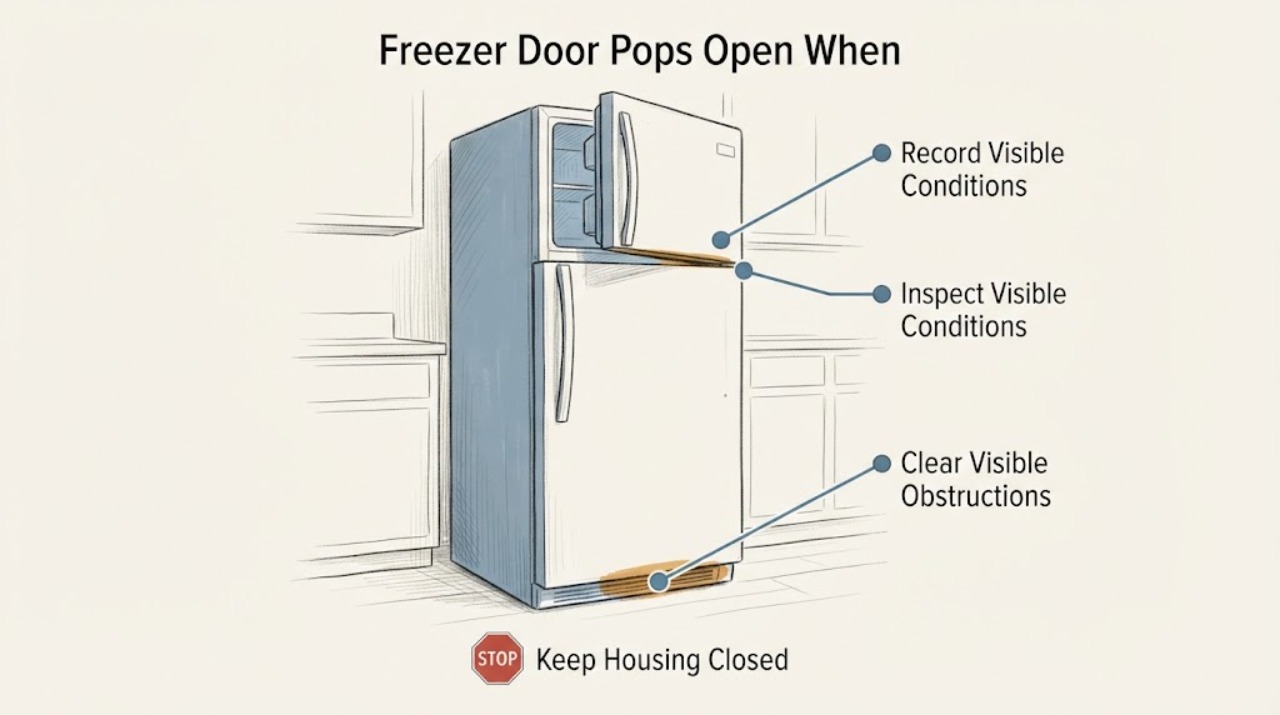
On an Amana A8TCNWFAWOO, a freezer door that opens slightly only when the refrigerator door is slammed or closed forcefully can be a normal air-pressure event: Amana says fast air movement between sections can push the other door open. Do not keep slamming the door to test it. Close the refrigerator gently once and see whether the freezer door immediately reseats and stays sealed. If it also pops open after a gentle close, leaves a visible gap, has a dirty or damaged gasket, shows frost or moisture, triggers a door alarm, or the freezer warms, treat it as a sealing or alignment problem. Check only for visible obstructions, gasket contact, and cabinet stability; do not remove the door, hinge, liner, or wiring. Arrange qualified Amana service when the gap persists or any temperature, frost, damage, or instability appears.
Before you begin
Safety first
- Do not remove or lift the refrigerator door, disassemble a hinge, pry or heat the gasket, access the door switch or wiring, or move an unstable refrigerator by guesswork. Stop for a damaged door or liner, water near electrical parts, exposed wiring, repeated electrical interruption, a persistent unsealed gap, or warming food.
Work through in order
Diagnostic checks
Use only checks that match the exact appliance or system and its official guide.
-
Check 1
Read the model plate on the inside refrigerator wall and record the complete identifier, country, and serial information. Compare the final characters with A8TCNWFAWOO, keeping the two ending characters as letter O only if that is what the plate shows. Record whether the freezer door opens only after a forceful refrigerator-door close or also after a gentle close.
Expected result: The plate clearly matches A8TCNWFAWOO and the freezer door only moves after a hard close, or the plate/code is different, unclear, or the door also moves after a gentle close.
Next step: Use the confirmed model for the owner's manual. If the door pops after gentle closure or the identity cannot be confirmed, continue with the seal and alignment checks instead of assuming a normal pressure event.
Stop if: Do not remove the door, hinge, trim, or interior panel to read the model plate.
Why this matters
Why: Amana's documentation lookup is model-number based, and the popping-door guidance applies to the described two-door behavior rather than every refrigerator layout. A different or uncertain identifier requires its own manual and closure guidance.
-
Check 2
Close the refrigerator door gently in normal use while standing clear of both door edges; do not slam it and do not repeat the event as a stress test. Observe whether the freezer door remains seated, opens a narrow amount and immediately reseats, or stays visibly ajar.
Expected result: The freezer door stays closed with a gentle close, opens briefly and reseats, opens after a gentle close, or remains open by a visible gap.
Next step: If it reseats and there is no frost or temperature change, stop testing and use gentle closure. If it opens gently or remains ajar, keep the door closed as far as it safely will go and continue with visible checks; arrange service if the gap persists.
Stop if: Do not slam either door, tape a defective door shut, or force the freezer door against resistance.
Why this matters
Why: A brief movement tied only to forceful closure is consistent with Amana's described air-pressure behavior. Movement or a gap after gentle closure makes a physical seal, obstruction, leveling, or alignment issue more likely.
-
Check 3
With both doors open only as needed and the refrigerator stable, inspect the freezer-door perimeter and mating cabinet surface for a package, bin, shelf, ice buildup, shipping material, or other visible obstruction. Wipe loose food residue from the gasket and cabinet contact surface with warm water and a soft cloth, then dry it; do not stretch, heat, glue, or pull the gasket from its channel.
Expected result: An item or ice buildup touches the door, the gasket is dirty or sticky, the gasket is cracked, brittle, warped, or folded, or the visible path is clear and the gasket looks intact.
Next step: Reposition only the plainly visible obstruction or clean the surface, then close gently once. If the gap, frost, or popping remains, do not order a gasket from appearance alone; arrange model-specific service.
Stop if: Do not pry out the gasket, melt ice with a heat gun, chip ice against the liner, or remove hinge hardware.
Why this matters
Why: Amana lists obstructions and dirty or damaged gaskets as causes of poor closure and sealing. A clean intact perimeter with no obstruction shifts attention toward cabinet level, door alignment, or a hinge condition rather than proving the gasket is defective.
-
Check 4
From a stable standing position, check the cabinet side-to-side and front-to-back with a reliable level and look at whether the freezer door sits flush or drifts open. Do not pull out the refrigerator or adjust feet, shims, hinges, or door height unless the confirmed A8TCNWFAWOO installation instructions specifically direct that user step.
Expected result: The cabinet rocks or is visibly out of level, the door has an uneven gap or sits high or low, the problem began after delivery or door work, or the cabinet and door appear stable and aligned.
Next step: If the unit is unstable or the problem followed installation, use the exact installation instructions or call the installer. If it is stable but the door remains unsealed, arrange qualified Amana service instead of moving the appliance or lifting the door.
Stop if: Do not lift, shim, pull forward, or disassemble a heavy refrigerator by guesswork.
Why this matters
Why: Amana says leveling and correct installation help doors close and seal and that incorrect door installation can cause misalignment, frost, moisture, temperature fluctuation, or switch-contact problems. A stable, aligned cabinet with persistent failure leaves a hinge, liner, or gasket diagnosis for service.
-
Check 5
After closing the freezer door as far as it safely will go, check the visible perimeter for continuous contact and note frost, condensation, a door-ajar alarm, an interior light that remains on, or a freezer temperature change. Protect perishable food if the freezer is warming and record when the symptom occurs.
Expected result: The gasket remains continuously seated and there is no frost, alarm, or warming, or a gap, frost, moisture, alarm, light, or temperature change is present.
Next step: For a stable seal with no secondary symptom, monitor normal gentle use. For any persistent gap or secondary symptom, keep the door closed as much as possible, protect food, and arrange qualified service.
Stop if: Do not access the door switch or wiring, bypass an alarm, or keep operating normally if food is warming or the door cannot seal.
Why this matters
Why: A brief force-related pop with a stable seal and normal temperatures is less concerning than a persistent gap. Frost, moisture, warming, or a door alarm indicates that the closure symptom is affecting operation or door-switch contact.
Use your observations
Decision map
Find the observation that best matches what you see, then follow the next safe action.
-
PATH 01Next step
What you see
The freezer door is fully closed, the freezer is otherwise sealed, and it opens only a small amount when the refrigerator door is slammed or closed forcefully, then immediately reseats with no frost, alarm, moisture, or warming.
Do this next
Stop forceful closure tests and close the refrigerator door gently. Monitor normal use; no part should be ordered for this pattern alone.
Why this path and its safety boundary
Why it matters: This matches Amana's description of air moving quickly between refrigerator sections and pushing the other door open. It is a normal pressure transient rather than evidence of a failed gasket or hinge.
-
PATH 02Next step
What you see
The freezer door pops open after a gentle refrigerator-door close, remains open by a visible gap, or the gasket does not contact continuously.
Do this next
Correct only a visible obstruction or clean the gasket surface. If the gap remains, keep the door closed as far as possible and arrange qualified Amana service.
Why this path and its safety boundary
Why it matters: Air pressure alone is no longer a sufficient explanation. An obstruction, dirty or damaged gasket, level problem, door alignment, or hinge/liner condition is more likely.
-
PATH 03Next step
What you see
The freezer door is clear of items, the gasket is clean and intact, but the cabinet rocks, is out of level, or the door sits unevenly, especially after delivery or door removal.
Do this next
Use the confirmed model's installation instructions or have the installer assess it. Do not lift the refrigerator or adjust a hinge or leveling mechanism without the model-specific procedure.
Why this path and its safety boundary
Why it matters: Installation or leveling is more likely than a refrigeration-system fault. Amana notes that alignment and leveling affect closure, sealing, frost, moisture, and switch contact.
-
PATH 04Next step
What you see
The door closes after a visible obstruction is removed or the gasket surface is cleaned, and no gap, frost, moisture, alarm, or warming returns.
Do this next
Continue gentle normal use and recheck the perimeter if the symptom returns. Arrange service for a recurring gap or damaged gasket.
Why this path and its safety boundary
Why it matters: A reversible obstruction or surface-contamination condition is more likely than a confirmed replacement part. The improvement should be monitored rather than used to infer a hinge or gasket part number.
-
PATH 05Next step
What you see
Frost or moisture builds near the freezer door, the interior light or door alarm indicates an open door, the freezer warms, the door or liner is damaged, or the refrigerator is unstable.
Do this next
Keep the appliance out of normal use as appropriate, protect perishable food, disconnect power only if safe for a damaged electrical area, and obtain qualified Amana service. Do not recreate the pop.
Why this path and its safety boundary
Why it matters: The door is not providing a reliable seal or there may be a structural or switch condition. This has moved beyond a harmless pressure transient and can threaten food temperature or create a physical hazard.
Helpful context
Understand the symptom
The useful first distinction is timing. If the freezer door is fully closed, the refrigerator door is closed hard, and the freezer door opens a small amount before reseating, Amana describes that as air moving quickly between sections and says it can be normal. That is different from a door that will not stay shut after a gentle close or has a visible perimeter gap.
Because the model number is easy to misread, verify A8TCNWFAWOO on the refrigerator's interior model plate. Amana's model lookup says refrigerator identifiers are on the inside wall. Check the final characters carefully: the assigned identity uses two letter O characters at the end, not the digit zero.
Only after diagnosis
Potential parts
- Amana freezer-door gasket or sealing surface
Consider this class only if a qualified technician confirms a damaged or persistently unseated gasket after the exact model and visible obstruction, level, and alignment checks are documented.
Confirm A8TCNWFAWOO, market, and the complete part revision before ordering; a brief force-related pop with a continuous seal is not evidence that a gasket needs replacement. - Amana freezer-door hinge, cam, or alignment hardware
A hinge or alignment component is conditional only when the door remains uneven or unsealed after visible obstruction and installation checks and a qualified technician isolates that path.
Do not infer a hinge or cam from the symptom or from a different Amana refrigerator family; use the exact model service documentation.
When checks do not resolve it
Need a professional?
Arrange qualified Amana service when the freezer door opens after a gentle close, remains ajar, has a damaged or persistently displaced gasket, is misaligned after installation, or is accompanied by frost, moisture, a door alarm, interior light, warming, or instability. A brief pop only after a forceful close with an immediate reseal and no secondary symptom can be monitored with gentle normal use.
Safety scope: Do not remove or lift the refrigerator door, disassemble a hinge, pry or heat the gasket, access the door switch or wiring, or move an unstable refrigerator by guesswork. Stop for a damaged door or liner, water near electrical parts, exposed wiring, repeated electrical interruption, a persistent unsealed gap, or warming food.
Have this ready
- Provide the complete model-plate identity A8TCNWFAWOO, including confirmation of the two final letter O characters, serial and market details, whether the door moved only after a hard close or also gently, the visible gap, gasket and obstruction findings, level or installation history, and any frost, alarm, moisture, or temperature change.
Common questions
FAQ
Is it normal for the Amana freezer door to pop open when the refrigerator door is slammed?
It can be. Amana says fast air movement between sections can push the other door open, especially when a door is slammed or closed forcefully. If the freezer reseats immediately and has no gap, frost, alarm, or warming, use gentler closure and monitor it.
What should I check if the freezer door pops open after a gentle close?
Check the visible closing path, gasket cleanliness and contact, cabinet stability and level, and whether the problem began after delivery or door work. Do not remove the door or hinge; a persistent gap needs model-specific service.
How do I confirm the Amana model A8TCNWFAWOO?
Amana says a refrigerator model number is on the inside wall. Read the complete plate instead of relying on the symptom or a search result, and verify whether the final two characters are letter O or the digit zero before locating a manual or part.
Read the exact guide
Official sources
- Model Number | AmanaAmana · Official Amana model lookup opened to confirm where a refrigerator model plate is located; the exact A8TCNWFAWOO characters must still be read from the appliance.
- Doors Not Closing ProperlyAmana Product Help · Official Amana closure guidance opened for full-size refrigerator doors; it is used for visible obstruction, gasket, level, and installation branches rather than a model-specific part claim.
- Door Hard to Open - Top Freezer RefrigeratorAmana Product Help · Official Amana top-freezer guidance opened for pressure equalization after door operation and for gasket, installation, and leveling distinctions; it does not establish the exact A8TCNWFAWOO platform.
- Door "Pops" Opens when Refrigerator Doors CloseAmana Product Help · Official Amana guidance opened for the exact reported symptom; it explains air movement, forceful closure, leveling, and gasket checks but does not identify a part for A8TCNWFAWOO.
- Preventing Frost or Ice Crystals on FoodAmana Product Help · Official Amana frost guidance opened for the consequence branch of a freezer door that does not seal; it does not define a hinge or gasket part for A8TCNWFAWOO.
Community feedback
Share a repair observation
Share a plain-text repair observation. Accepted observations are published automatically; this page may take a moment to update.