
On this page
Start here
Quick answer
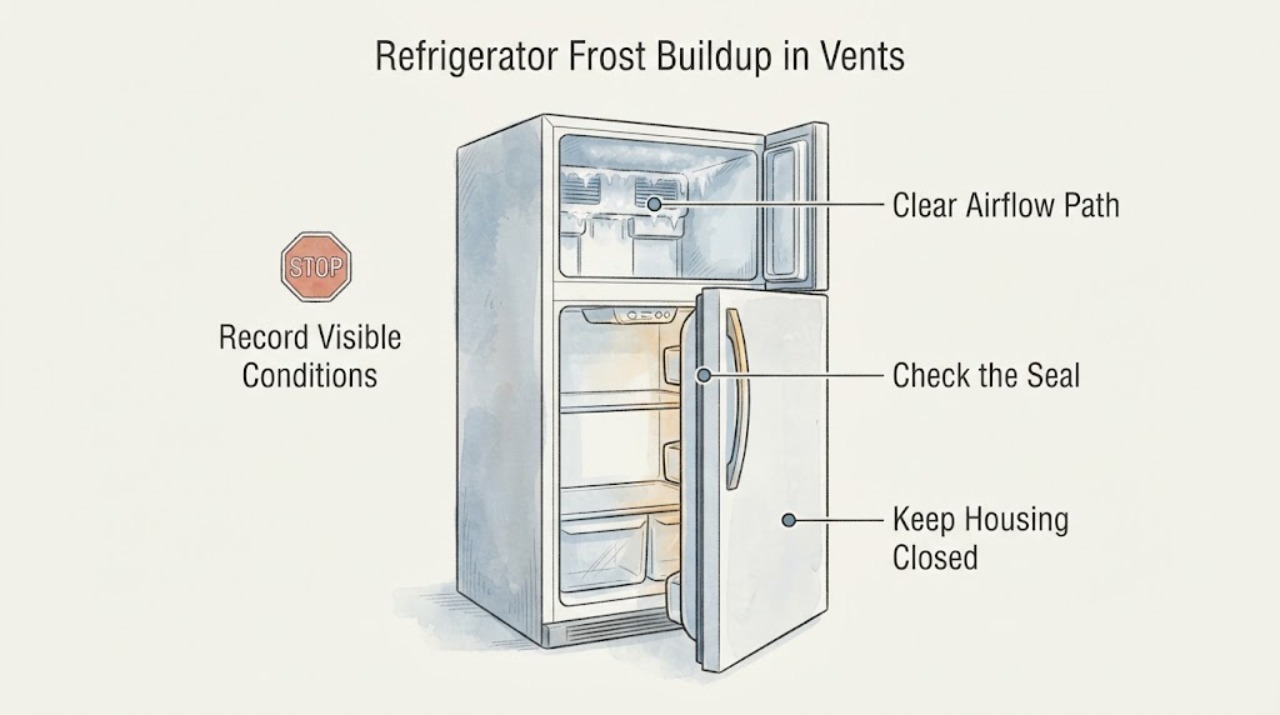
A light, even frost film near an Amana refrigerator vent can be normal during a defrost cycle, after humid air enters, or after a large warm grocery load. Frost that repeatedly covers an air vent is more useful as an airflow or moisture clue: check that containers are not blocking the vent, the doors close fully, the gaskets are clean and snug, and the temperature controls match your model manual. Do not chip ice with a sharp tool, heat the cabinet, remove an evaporator cover, or force a fan or damper. If frost returns quickly after the accessible checks, temperatures swing, food is freezing or warming, water leaks, or the vent is buried behind ice, protect perishable food and arrange Amana service with the exact model number.
Work through in order
Diagnostic checks
Use only checks that match the exact appliance or system and its official guide.
-
Check 1
With the doors closed except for a brief inspection, note whether the frost is a thin, even film or a thick layer that covers a vent, back panel or one localized area. Record whether it clears after normal operation or returns quickly.
Expected result: The frost is light and even, or it is thick, recurring, localized or blocking an air outlet/return.
Next step: For light frost, continue with the airflow and door-seal checks. For a thick obstruction, do not chip or heat the ice; protect food and use the exact model manual or service route for defrost evaluation.
Why this matters
Why: Amana says light frost near vents can occur during normal condensation and defrosting. Thick or recurring frost that blocks airflow is a moisture or airflow problem that needs more than a normal-frost explanation.
-
Check 2
Locate the supply and return vents in both compartments using the exact Amana manual, then move only food packages, bins or containers that are directly in the airflow. Leave space around the back wall and vent openings.
Expected result: A package or shelf blocks a vent, or the vents are clear but frost and uneven temperatures remain.
Next step: If a movable obstruction was present, allow the refrigerator to stabilize and observe temperatures. If vents are clear but frost remains or returns, do not remove covers; arrange model-specific service.
Why this matters
Why: Amana says blocked vents reduce airflow and can cause moisture, frost, warm spots or freezing near the cold-air path. Clear vents do not rule out a door-seal or internal refrigeration issue.
-
Check 3
Inspect the refrigerator and freezer gaskets for dirt, gaps or a section that is not contacting the cabinet. Check that shelves, bins and large containers do not prevent full closure, and minimize prolonged door openings. Clean the gasket only with the mild method in the Owner's Manual.
Expected result: The gasket is obstructed or not sealing evenly, the door closes fully with a snug gasket, or the door was recently left open/used frequently.
Next step: Correct only the external obstruction or cleaning issue and monitor frost. If a gasket remains loose/damaged or the door cannot close, stop relying on the refrigerator for temperature-sensitive food and schedule service.
Why this matters
Why: Amana links door openings and poor gasket sealing with humid-air entry and frost buildup. A good seal makes those causes less likely but does not prove a defrost or airflow component failure.
-
Check 4
Read refrigerator and freezer temperatures with an independent appliance thermometer if available, and compare the control settings with the exact Amana manual. Make only small model-supported adjustments and allow the stated stabilization period before judging the result.
Expected result: Temperatures are within the model's target range, the refrigerator section is freezing items, or the refrigerator/freezer is warming or fluctuating while frost blocks a vent.
Next step: Use the exact manual for any setting change and protect perishable food if temperatures are unsafe. If the condition persists after airflow and seal checks, arrange Amana service.
Why this matters
Why: Amana's current guidance uses general targets but says controls vary by model; over-cold settings and blocked airflow can freeze items near vents. Warming or fluctuating temperatures with heavy frost indicate a service concern rather than a guessed sensor or fan diagnosis.
-
Check 5
Record the full model number, refrigerator type, frost location, how quickly it returns, measured temperatures, door-seal observations and whether food is freezing or warming. Do not remove an evaporator cover, fan shroud or defrost assembly to investigate.
Expected result: The model tag and symptom history are available, or the model is missing and the frost pattern cannot be matched to a manual.
Next step: Give the complete tag and observations to Amana service. Keep the unit closed as much as possible and transfer or discard food according to safe temperature guidance if cooling is not reliable.
Why this matters
Why: Amana says vent locations, controls and instructions vary by model. Without the exact identity, an internal part or defrost procedure cannot be verified.
Use your observations
Decision map
Find the observation that best matches what you see, then follow the next safe action.
-
PATH 01Next step
What you see
If the frost is a thin, even layer or light dusting that clears after a normal defrost cycle and temperatures remain stable
Do this next
Keep vents clear, limit humid-air entry and monitor the pattern without scraping or heating the appliance.
Why this path and its safety boundary
Why it matters: Amana describes this as potentially normal condensation or frost rather than proof of a failure.
-
PATH 02Next step
What you see
If a package or bin is directly in front of a vent and moving it restores airflow
Do this next
Keep the airflow path clear and let the refrigerator stabilize; use the model manual if the frost does not recede.
Why this path and its safety boundary
Why it matters: The obstruction plausibly caused a local airflow and moisture problem.
-
PATH 03Next step
What you see
If frost is thick, repeatedly returns, covers a vent, or appears with warm spots, frozen food or temperature swings
Do this next
Protect perishable food, do not remove internal covers or chip ice, and arrange Amana service with the exact model.
Why this path and its safety boundary
Why it matters: The condition is outside a simple one-time frost explanation and may involve an internal airflow or defrost issue that is not verified here.
-
PATH 04Next step
What you see
If the door gasket is damaged or the door cannot close completely
Do this next
Keep the door closed as much as possible, do not force or tape the door, and schedule model-specific gasket or door service.
Why this path and its safety boundary
Why it matters: Humid room air can continue entering and make frost recur; food temperature may also become unsafe.
Helpful context
Understand the symptom
First separate normal frost from a blocked vent
Amana says a small amount of frost can be expected, including a light dusting near vents in an automatic-defrost unit that clears after a defrost cycle. Frost that is thick, returns quickly or prevents air movement is a different pattern. The frost itself does not identify a failed fan, heater, sensor or sealed-system part.
Keep food and containers out of the airflow path
Amana describes the vents as the route for cold air between the freezer and refrigerator sections. Shelves, bins and packages placed directly in front of a vent can disrupt circulation, create hot or frozen spots and contribute to moisture problems. Move only movable food or containers; do not remove vent covers or interior panels without the exact manual.
Moisture enters through doors and gasket gaps
Long or frequent door openings, warm unwrapped food and a gasket that does not seal can add humid air and make frost more likely. Check the gasket and door closure from the outside, clean it with the model-approved mild method, and make sure shelves or packages are not holding the door open.
Do not turn a frost observation into an internal repair
Amana notes that temperature controls and vent locations vary by refrigerator type and model. If frost returns after external airflow and sealing checks, or if food temperatures are unsafe, use the exact Owner's Manual and arrange service rather than scraping ice, applying heat, opening the evaporator area or ordering a fan or defrost part from a generic listing.
When checks do not resolve it
Need a professional?
Arrange Amana service for frost that rapidly returns or blocks vents, unsafe or fluctuating food temperatures, a damaged or non-sealing gasket, water leakage, a fan or defrost area that is inaccessible, or any need to remove interior covers or replace a component.
Have this ready
- Provide the exact model number, refrigerator style, frost location and pattern, time to return, measured compartment temperatures, door/gasket observations, food-freezing or warming symptoms, and any recent power outage or door-left-open event.
Common questions
FAQ
Is frost near an Amana refrigerator vent always a failure?
No. Amana says a light dusting near vents in an automatic-defrost unit may clear after a defrost cycle. Thick, recurring frost that blocks airflow or accompanies temperature problems needs model-specific evaluation.
What should I move when a refrigerator vent is frosted?
Move only food packages, bins or containers directly in front of the vent and leave room for airflow. Do not remove vent covers or interior panels without the exact Owner's Manual.
Can a bad door seal cause frost around vents?
Yes, Amana says an obstructed or improper gasket seal can admit humid air and contribute to frost or moisture. Check the external seal and closure, but do not assume the gasket is the only cause if frost returns after it seals.
Should I scrape the ice off the vent?
Do not use a knife or forceful tool, and do not apply heat to the cabinet. If the frost is thick or returns quickly, protect food and use the exact model manual or arrange Amana service for the defrost and airflow diagnosis.
Read the exact guide
Official sources
- What to Check if the Refrigerator Section is Too ColdAmana Product Help · Opened Amana's official temperature guidance. It explains that too-cold settings, blocked vents and some ice-maker conditions can freeze food near outlets, and says controls vary by model.
- What's Normal Condensation or FrostAmana Product Help · Opened Amana's current official guidance. It distinguishes light frost near vents that clears after a defrost cycle from persistent moisture, and gives model-bounded temperature and airflow guidance.
- How to Check the Air Vents for Blockage-Ensuring Proper Air FlowAmana Product Help · Opened Amana's official airflow guide. It explains supply/return vent circulation, lists excessive frost and temperature issues as blockage signs, and directs owners to locate and clear movable obstructions.
- How to Help Eliminate Condensation and FrostAmana Product Help · Opened Amana's official Product Help page. It lists normal moisture, door openings, gasket sealing and blocked vents as causes and says model controls/instructions vary.
- Doors Not Sealing - RefrigeratorAmana Product Help · Opened Amana's official door-sealing page. It links poor sealing with frost and temperature fluctuation, and gives external checks for obstructions, gasket cleanliness and leveling.
- Condensation in the Refrigerator Section - Side by Side RefrigeratorAmana Product Help · Opened Amana's official side-by-side guidance. It links prolonged door opening, gasket sealing and blocked vents with frost/moisture and routes persistent problems to service.
Community feedback
Share a repair observation
Share a plain-text repair observation. Accepted observations are published automatically; this page may take a moment to update.