
On this page
Start here
Quick answer
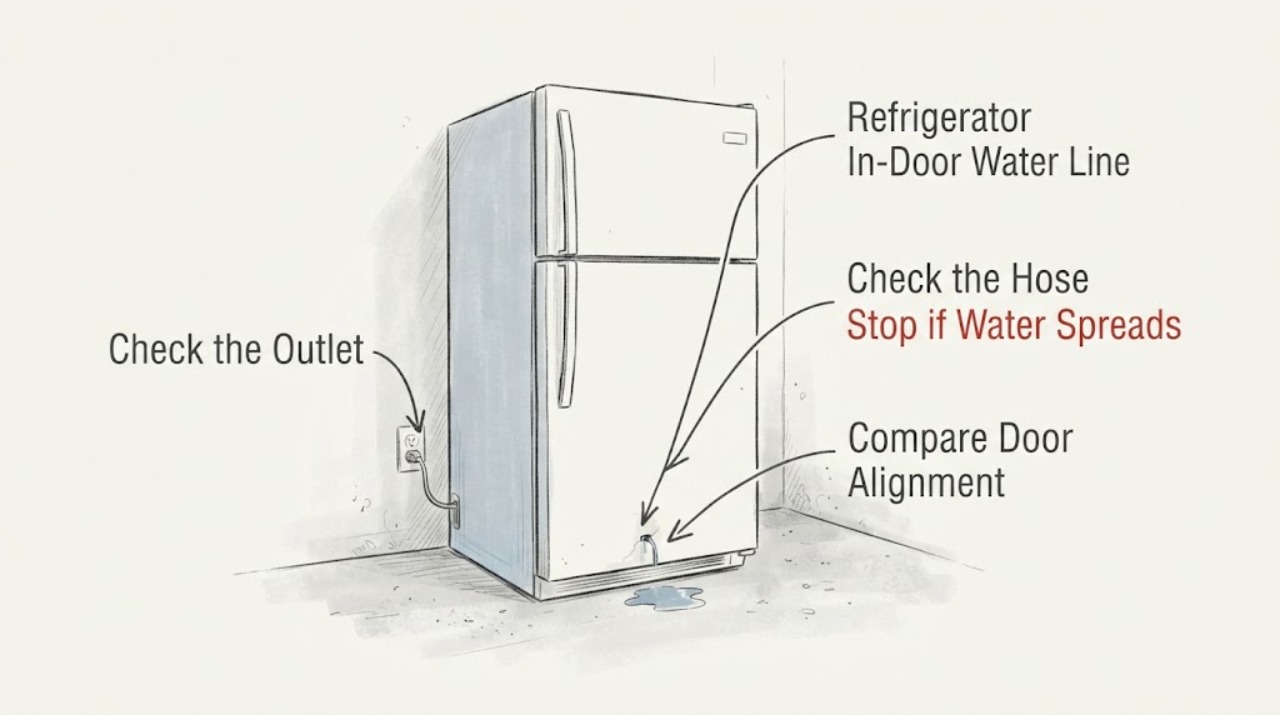
If an Amana 25MSSA has a profuse leak from the water line that runs into a door, stop using the dispenser and ice maker, close the accessible household water shutoff, and unplug the refrigerator only after the water is off and the floor and outlet area are safe. Amana's guidance identifies water under a door as potentially coming from the dispenser line and directs owners to inspect only accessible supply connections; it does not establish a generic in-door tubing, splice, or connector repair. The Amana record for 25MSSA is a refrigerator type listing, while Amana's manual lookup requires the fuller model number, so record the complete label before ordering anything. Do not heat, flare, cut, splice, pull tubing through the door, remove the door liner, or substitute a part. Keep the water supply closed and arrange model-matched Amana or qualified appliance service for a leak at the door or hinge area.
Work through in order
Diagnostic checks
Use only checks that match the exact appliance or system and its official guide.
-
Check 1
Stop dispensing water and making ice. Close the household refrigerator water shutoff or other accessible supply valve; if the valve cannot be closed, stop using the refrigerator and arrange service. Once the water is isolated and the floor and outlet area are dry, unplug the refrigerator without pulling on a wet cord or reaching through standing water.
Expected result: The leak stops when the household supply is closed, continues from trapped water, or the floor, plug, or outlet area is wet.
Next step: Keep the water supply closed and leave the refrigerator unplugged when water has reached the electrical area, the leak cannot be isolated, or the floor cannot be kept dry. Do not reconnect power to test the line.
Why this matters
Why: A leak that stops with the supply closed is still an active water-system failure, while wet electrical surroundings create an additional shock hazard. Amana directs users to unplug for safety before inspecting an accessible water supply line.
-
Check 2
After the water is off and the appliance is safe to approach, dry the floor and make one visual observation from outside the cabinet. Follow the moisture to the rear supply connection, the bottom of the cabinet, the hinge area, the dispenser outlet, or the point where tubing enters a door. Do not remove a door panel, hinge cover, liner, or tubing.
Expected result: Water is visible at a rear connection, only at the dispenser outlet, under the door or hinge, or at a hidden entry point with no visible external fitting.
Next step: Photograph the dry starting point and keep the supply closed. Use only the model-specific manual for an accessible connection check; route a door or hinge-area leak to Amana or qualified appliance service.
Why this matters
Why: A rear connection is an accessible supply-line path; a few drops after dispensing can be normal, but a continuous or profuse leak at the dispenser, hinge, or under-door area is not identified by the general rear-line check and may involve a hidden dispenser line.
-
Check 3
If the leak is visibly at the rear household supply connection and all parts remain accessible without moving the door or opening panels, inspect for a crack, kink, loose insertion, or moisture at the valve and refrigerator connection. Do not cut the tubing, heat it, create a new flare, or install a fitting whose model compatibility is unknown.
Expected result: The accessible tubing is cracked or kinked, a fitting is visibly wet or loose, or the rear connection is dry while water appears under the door.
Next step: Leave the supply shut off. Have the complete model and serial information ready for a model-matched supply-line or in-door-line decision; do not order a generic tube or connector from appearance alone.
Why this matters
Why: Amana treats a damaged or kinked accessible supply line and an insecure connection as possible leak causes. A dry rear connection does not clear a hidden door line, and it does not justify opening the door construction.
-
Check 4
Read the entire model and serial label from the refrigerator interior before requesting a part or service. Amana places refrigerator model information on the interior wall and its manual search asks for at least the first six characters; record every suffix, not only the 25MSSA family text.
Expected result: The label supplies a longer model number and serial number, or only the abbreviated 25MSSA text is available.
Next step: Use the complete label with Amana's manual/parts support or give it to a qualified technician. Until the exact document and line routing are matched, do not specify a part number, tubing size, fitting, or door-removal sequence.
Why this matters
Why: The opened Amana certificate confirms 25MSSA as a certified refrigerator type, but it is not a door-water-line parts diagram. The full label is needed to distinguish the exact product and documentation scope.
Use your observations
Decision map
Find the observation that best matches what you see, then follow the next safe action.
-
PATH 01Next step
What you see
Water continues to pool, reaches the plug or outlet, appears behind the door/hinge, or cannot be stopped at an accessible shutoff.
Do this next
Keep the water supply closed, keep the appliance unplugged when it is safe to do so, protect the floor without touching wet electrical equipment, and arrange qualified service.
Why this path and its safety boundary
Why it matters: The leak remains an active water and possibly electrical hazard; the source is not safe to localize by repeatedly dispensing or powering the refrigerator.
-
PATH 02Next step
What you see
The rear supply connection is visibly cracked, kinked, or wet, while the door and hinge area remain dry.
Do this next
Keep the valve off, document the connection, and use the complete model number to select any replacement through Amana or a qualified plumber/technician. Do not improvise a cut or flared repair.
Why this path and its safety boundary
Why it matters: The evidence points to the accessible household-supply path rather than proving a failed in-door tube.
-
PATH 03Next step
What you see
The rear connection is dry but water appears at the dispenser, hinge, under-door area, or a tube entering the door; the leak is continuous or profuse rather than a few normal drops after dispensing.
Do this next
Keep the water supply closed and do not cut, heat, splice, pull, or remove the door or liner. Provide the complete model and serial numbers to Amana or qualified appliance service for the model-matched repair.
Why this path and its safety boundary
Why it matters: The symptom is consistent with a hidden dispenser/in-door water path, but the opened general Amana pages do not verify the 25MSSA routing, door construction, or replacement part.
-
PATH 04Next step
What you see
Only a few drops appear after dispensing, the glass was not held under the outlet, and there is no moisture at the door, hinge, cabinet, or floor.
Do this next
Hold the glass under the dispenser for the documented short interval and monitor without opening panels. If dripping continues or moisture appears elsewhere, close the water supply and request service.
Why this path and its safety boundary
Why it matters: Amana documents a few residual drops after releasing the dispenser as normal; that observation does not explain a profuse or continuous leak.
Helpful context
Understand the symptom
Why a door-area leak should be treated differently from a rear supply-line leak
Amana's consumer guidance separates accessible household-supply connections at the rear from water that appears under the door, which may come from the dispenser water line. A line that disappears into a door or hinge is therefore not identified by looking at the rear connection alone. The general Amana refrigerator documents opened for this page do not provide a verified 25MSSA door-routing diagram or a model-specific in-door-line replacement procedure. The garage location explains where the appliance was moved, but it does not establish a different fitting, tubing size, or repair method.
Do not turn an improvised flare or splice into a hidden door repair
A heated, flared, glued, or quick-connect repair inside a refrigerator door can leak again where it cannot be seen and can wet insulation, flooring, or electrical parts. The official material supports shutting off the water and inspecting accessible connections; it does not support cutting the door tube, pulling it through the door, removing the door skin, or choosing a universal connector. Keep the water system isolated until the complete model number and the correct repair path are confirmed by Amana documentation or a qualified technician.
When checks do not resolve it
Need a professional?
Give the technician the full model number and serial number, the garage installation condition, where the first moisture appeared, whether the rear connection is dry, whether the leak occurs with the water supply closed, and photographs taken only after the area is safe and dry.
Common questions
FAQ
Is 25MSSA enough information to order the in-door water line?
No. Amana's manual search asks for at least the first six characters and its owner guidance relies on the model and serial numbers. The Amana/Whirlpool certificate lists 25MSSA as a refrigerator type, but it is not a parts diagram for the exact door. Record the full label before any part search.
Can I repair the broken door tube with heat, a flare, or a quick connector?
Do not make that repair from generic advice. The opened Amana pages support shutting off the water and checking accessible connections, but they do not verify the 25MSSA door route, tubing material, pressure, or connector fit. Keep the supply closed and have the exact model evaluated.
Does a garage location change the water-line repair?
The garage condition does not identify a different tube, fitting, or door procedure. It does make it important to close the water supply and protect the floor until the complete model and the leak path are confirmed. Any temperature or winterization decision requires the exact model documentation.
What should I do if the back connection is dry but water comes from under the door?
Keep the water supply closed and do not remove the door or liner. Amana notes that water under a door can come from the dispenser water line, but the general pages do not provide the exact 25MSSA internal route. Give the full model and serial numbers to Amana or a qualified appliance technician.
Read the exact guide
Official sources
- Manuals and Guides | AmanaAmana · Amana model-number lookup and refrigerator model-label location
- Owners | AmanaAmana · Amana owner support, model/serial information, manuals, parts, and service routing
- What to Do if There is Water on the FloorAmana · Amana full-size refrigerator water-source triage, including water under a door and accessible connection checks; general guidance
- The need to provide a certificate on refrigerators has been resolved by the CPSC public meeting on October 2Amana / Whirlpool Corporation · Identity evidence that 25MSSA is included in the certified refrigerator-type list; not a repair manual or parts-fit document
- Leaking from Dispenser - Side by Side RefrigeratorAmana · Amana side-by-side refrigerator dispenser drip and loose-connection guidance; exact 25MSSA applicability not confirmed
- How to Check the Water Supply LineAmana · Amana refrigerator household water-supply connection and accessible leak checks; general guidance, not an exact 25MSSA door manual
- Installation InstructionsAmana · Amana refrigerator installation/troubleshooting guidance for water supply, dispenser dripping, rear-line connections, and moving; exact 25MSSA applicability not confirmed
- Leaking at the Bottom - Side by Side RefrigeratorAmana · Amana side-by-side refrigerator accessible supply-line, connection, and filter leak checks; exact 25MSSA applicability not confirmed
Community feedback
Share a repair observation
Share a plain-text repair observation. Accepted observations are published automatically; this page may take a moment to update.