
On this page
Start here
Quick answer
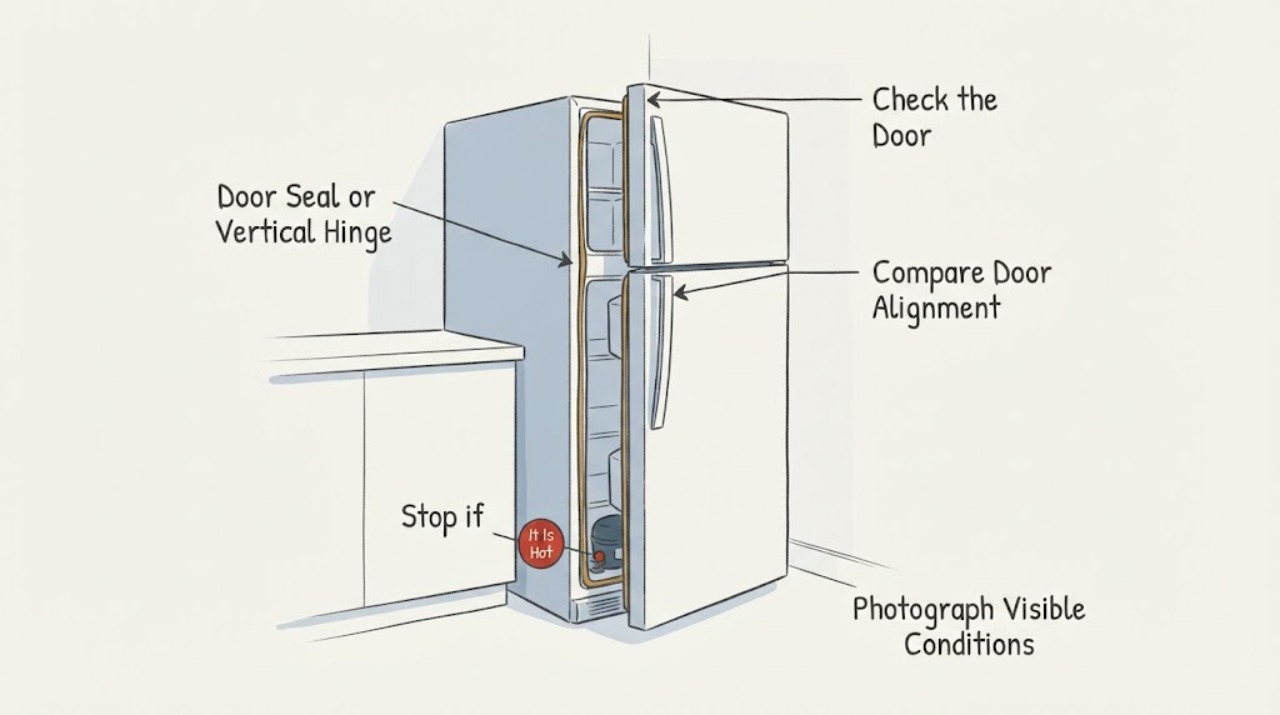
Do not glue, heat, stretch, or order a gasket or hinge by appearance for the Amana AFD2535DES. First photograph the model label and the full door gap, move only visible packages or mis-seated bins, and check whether the vertical center seal is folded outward or the perimeter gasket is dirty. Clean the gasket gently and check the cabinet and door alignment from a stable position without moving or lifting the refrigerator. If the seal is cracked, permanently deformed, the door remains ajar, frost or moisture builds up, the door-ajar light stays on, or food temperature is rising, keep the door closed as much as possible and arrange model-specific Amana service.
Before you begin
Safety first
- Do not glue, heat, stretch, or pry the gasket or vertical seal; do not remove the door, loosen hinges, lift or pull out the refrigerator, access door-switch wiring, or tape a defective door shut. Stop for instability, glass or liner damage, water near electrical parts, smoke, sparking, burning odor, or a damaged cord.
Work through in order
Diagnostic checks
Use only checks that match the exact appliance or system and its official guide.
-
Check 1
Photograph the complete model and serial label, the door edge, the vertical center seal, and the entire perimeter gap. Record whether the problem is on the left or right refrigerator door, the freezer drawer, or the center meeting edge; note whether the door was removed or adjusted during delivery or installation.
Expected result: The label confirms AFD2535DES and the gap is localized to the center seal, one gasket corner, the hinge side, or the door is generally low/high; or the label and door history remain uncertain.
Next step: Use the complete model in Amana's manual lookup and preserve the photos. Continue only with the visible checks below; if the model or door history cannot be confirmed, arrange service rather than copying a nearby model's instructions.
Stop if: Do not remove the door, loosen hinge screws, access wiring, or order a part from a visual match.
Why this matters
Why: A localized center-seal or gasket observation leads to a different check from an uneven hinge-side gap. Missing model or installation identity prevents safe selection of a gasket, hinge, shim, or adjustment procedure.
-
Check 2
Open the affected door only as far as needed and inspect the closing path: door bins, shelves, crisper covers, freezer-drawer contents, food behind the door, and any remaining packaging. Re-seat or move only a loose item that visibly projects into the path, then close the door gently without force.
Expected result: A tall container, overfilled bin, mis-seated shelf or drawer, displaced storage part, food package, or shipping material touches the door; or the path is clear and the gap remains.
Next step: Correct only the visible obstruction and recheck the perimeter once. If the door still stops or springs open with clear space, continue to the seal check and do not force it shut.
Stop if: Do not slam the door, bend the door, pull on the gasket, or move the refrigerator to reach behind it.
Why this matters
Why: A clear physical obstruction can prevent closure without a hinge or seal failure. A clear path with a persistent gap makes gasket contact, cabinet level, door alignment, or hinge condition more likely.
-
Check 3
With the door open, inspect the rubber gasket around its full perimeter and the mating cabinet surface. Wipe loose food residue with a soft damp cloth and dry it. If the model has a vertical French-door hinged seal, observe whether it folds inward when the door is open; return it inward by hand only if it is visibly folded outward and moves without resistance.
Expected result: The gasket is dirty but intact, the gasket is cracked/brittle/warped or has a permanent tear, the vertical seal is folded outward and returns inward freely, or the seal remains displaced/damaged.
Next step: If cleaning or the gentle position correction restores continuous contact, monitor the door and temperature. If a gap, tear, deformation, or displaced seal remains, keep the door closed as much as possible and arrange Amana service.
Stop if: Do not glue, heat, stretch, reshape, pry out, or replace the gasket or center seal without model-specific instructions.
Why this matters
Why: Amana identifies dirt as a source of resistance and damage or deformation as a cause of an incomplete seal. A vertical seal that returns inward can explain a closure obstruction; a seal that will not position or a damaged perimeter gasket needs the exact model procedure and part.
-
Check 4
From a stable position, observe whether the cabinet rocks, the door drifts open, the top and bottom gaps differ, or the door sits visibly low or high. Check the cabinet side-to-side and front-to-back with a level only if the refrigerator can be assessed without pulling it out or lifting it.
Expected result: The cabinet is unstable or out of level, the door has an uneven gap or drift, or the cabinet appears stable and level but the door still does not sit flush.
Next step: Use the exact AFD2535DES installation instructions or a qualified installer for leveling/alignment. If moving the refrigerator or adjusting a hinge would be required, stop and arrange service.
Stop if: Do not shim, lift, pull out, remove the toe grille, or loosen hinge hardware as a home test.
Why this matters
Why: Amana links leveling and floor conditions to doors that swing open or fail to sit flush. A stable, level cabinet with a persistent gap makes door alignment, hinge, liner, or seal damage more likely, but does not identify which part is compatible.
-
Check 5
After the brief external checks, close the door as far as it safely will go and record whether the gasket contacts continuously, the door-ajar light or alarm clears, frost or moisture is forming, and food or an appliance thermometer suggests warming. Keep the doors closed as much as possible while observing recovery.
Expected result: The door seals and the alarm/light behaves normally after repositioning or cleaning, or a gap, alarm/light issue, frost, moisture, or temperature rise persists.
Next step: Protect perishable food and arrange qualified Amana service for a persistent gap, alarm, frost, moisture, warming, damaged door, or any required hinge/door access. Do not tape over a defective hinge or keep changing the seal by trial and error.
Stop if: Stop immediately for glass or liner damage, instability, water near electrical parts, smoke, sparking, burning odor, or a damaged cord.
Why this matters
Why: Improved contact after a visible correction supports an obstruction or surface/position issue. Persistent gap or warming means the refrigerator may be admitting warm air and needs a door, switch, hinge, liner, or gasket diagnosis; temperature symptoms are not safe to ignore.
Use your observations
Decision map
Find the observation that best matches what you see, then follow the next safe action.
-
PATH 01Next step
What you see
The door closes after a bin, shelf, drawer, package, or shipping material is moved, and the gasket contacts continuously without damage.
Do this next
Keep the storage parts fully seated and monitor the same door for a recurring gap, frost, alarm, or temperature change. Do not force the door against a new obstruction.
Why this path and its safety boundary
Why it matters: A physical obstruction or storage part was more likely than a failed hinge or gasket.
-
PATH 02Next step
What you see
The vertical center seal is visibly folded outward and returns inward without resistance, or the perimeter gasket is dirty and closure improves after gentle cleaning.
Do this next
Use the door normally and confirm a continuous center and perimeter seal. If the seal will not stay positioned, is torn/warped, or the gap returns, arrange model-specific service rather than gluing or heating it.
Why this path and its safety boundary
Why it matters: Seal position or surface contamination was likely interrupting closure; this does not prove that the seal or hinge is damaged.
-
PATH 03Next step
What you see
The cabinet is stable and level, the closing path is clear, the gasket is clean, but the door remains low/high, has an uneven gap, or the hinge/door was disturbed during installation.
Do this next
Use the exact AFD2535DES installation literature or qualified Amana service. Do not lift the door, loosen hinges, or copy a reset procedure from another Amana refrigerator.
Why this path and its safety boundary
Why it matters: Door alignment, hinge, or installation is more likely than a simple cleaning issue, but no compatible adjustment or part can be selected from the symptom alone.
-
PATH 04Next step
What you see
A permanent gasket tear or deformation remains, the vertical seal cannot return to position, the door-ajar light/alarm persists, frost or moisture builds up, or food temperature is rising.
Do this next
Keep the door closed as much as practical, protect or relocate perishable food, and arrange qualified Amana refrigerator service for model-specific diagnosis and the correct gasket/hinge procedure.
Why this path and its safety boundary
Why it matters: The door is not reliably sealing or a door-switch/alignment issue may be present. Continued operation can waste cooling capacity and compromise food storage.
-
PATH 05Next step
What you see
The cabinet is unstable, the door or liner is damaged, water is near electrical parts, glass is broken, smoke/sparking/burning odor appears, or access would require removing the door or wiring.
Do this next
Stop using the refrigerator if safe cold storage cannot be maintained, keep clear of the hazard, isolate power only from a dry safe position when appropriate, and arrange qualified appliance or electrical help. Use emergency help for immediate danger.
Why this path and its safety boundary
Why it matters: This is a stability, injury, water, electrical, or fire safety boundary rather than an ordinary gasket adjustment.
Helpful context
Understand the symptom
Treat the AFD2535DES label and door construction as the identity gate
The assigned appliance is an Amana AFD2535DES bottom-freezer refrigerator, but the correct owner literature and parts depend on the complete model number and market. Amana's manuals page directs owners to enter the model number, and its label guide places refrigerator labels inside the cabinet. Confirm that exact label before using any gasket, hinge, or alignment instruction. A visible vertical strip at the meeting edge may be a French-door hinged seal, but a damaged strip is not proof that the hinge, door, or gasket part from a nearby AFD2535 variant will fit.
A door that will not seal is also a temperature problem
Amana warns that an unsealed refrigerator door can cause temperature fluctuations, frost or moisture, incorrect door-switch contact, and food spoilage. Use only short, safe observations with the door open. If the door cannot close or the cabinet is warming, protect perishable food and stop experimenting with the hinge; the correct next step is service, not a temporary glued seal or a guessed part.
When checks do not resolve it
Need a professional?
Arrange qualified Amana refrigerator service when the AFD2535DES door remains unsealed after visible obstruction removal and gentle cleaning, when the vertical seal is damaged or will not position, when the cabinet is level but the door is misaligned, when the door was removed or adjusted during installation, or when frost, moisture, door-ajar indication, or food warming persists.
Safety scope: Do not glue, heat, stretch, or pry the gasket or vertical seal; do not remove the door, loosen hinges, lift or pull out the refrigerator, access door-switch wiring, or tape a defective door shut. Stop for instability, glass or liner damage, water near electrical parts, smoke, sparking, burning odor, or a damaged cord.
Have this ready
- Provide the full model and serial information, door and seal photos, exact location of the gap or damage, whether the issue followed installation or door removal, obstruction and cleaning results, cabinet-level observation, alarm/light behavior, frost or moisture, and any temperature or food-safety concern.
Common questions
FAQ
Can I glue the damaged vertical refrigerator seal?
Do not glue or heat it. A temporary patch can change the seal profile and hide an alignment or hinge problem. Clean and reposition only a visibly displaced seal if it moves freely; a tear, deformation, or recurring gap needs the exact AFD2535DES procedure and service assessment.
Is the vertical strip a gasket or a hinge?
On French-door refrigerators, Amana describes a vertically hinged seal at the meeting edge of the left door. The visible strip alone does not prove whether the seal, hinge, door, or alignment is the failed part, so do not order a component by appearance.
What if the door closes but frost or moisture appears?
Treat that as a sealing concern. Check for a continuous visible gasket contact and any remaining obstruction, then keep the door closed and monitor temperature. Persistent frost, moisture, alarm/light behavior, or warming needs qualified service.
Can I remove the door to reset the hinge?
Not as a home diagnostic step. Amana's hinge-reset guidance involves supporting and removing the door, so it is outside the safe external checks in this article. Use the exact installation literature or arrange qualified service rather than lifting the door or loosening hinge hardware.
Read the exact guide
Official sources
- Doors Not Closing Properly - Product Help | AmanaAmana Product Help · Opened official Amana guidance used for AFD2535DES symptom-level door checks; it supports obstruction, gasket, level, installation, and vertical-seal observations but does not authorize a cross-model part or hinge adjustment.
- Where is my Model and Serial Number Located? - Product Help | AmanaAmana Product Help · Opened official Amana label-location guidance used to locate and photograph the complete AFD2535DES identity before ordering or adjusting a gasket or hinge.
- Doors Not Sealing - Refrigerator - Product Help | AmanaAmana Product Help · Opened official Amana door-seal guidance used only for symptom-level checks applicable to the AFD2535DES door complaint; the page is not used to transfer top-freezer-specific parts or procedures.
- Manuals and Guides | AmanaAmana · Opened official Amana manual portal used as the identity gate: enter the complete AFD2535DES model before using installation, door, gasket, hinge, or service instructions.
- How to Remove or Reset the Door Hinge - Soft Closure Feature - Product Help | AmanaAmana Product Help · Opened official Amana hinge guidance used only to establish that hinge reset involves door support and removal; it is not used as a DIY instruction for the AFD2535DES.
Community feedback
Share a repair observation
Share a plain-text repair observation. Accepted observations are published automatically; this page may take a moment to update.