
On this page
Start here
Quick answer
Start with visible causes: food, bins, shelves, a twisted or dirty gasket, a cabinet or wall touching the refrigerator, or an uneven floor. Electrolux also notes that leveling and frost can affect closing, but door alignment hardware and self-closing behavior vary by refrigerator style and model. Do not force the door or adjust hinges without the exact owner or installation instructions.
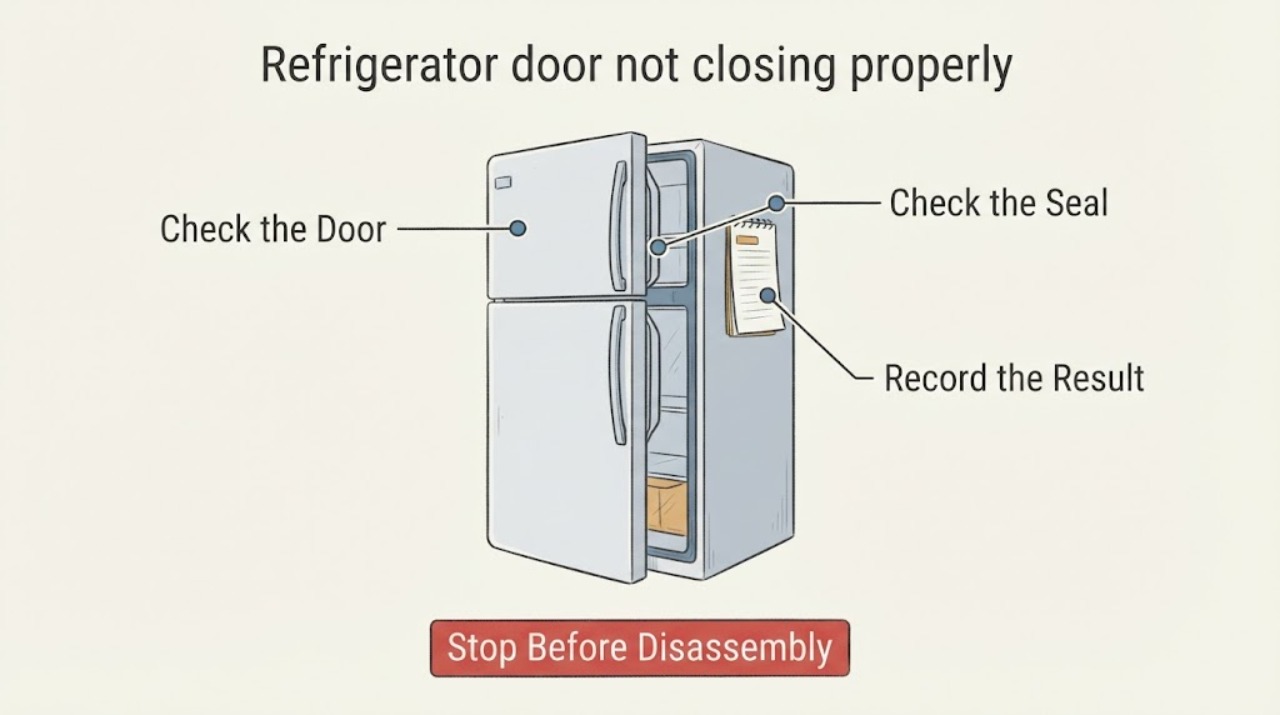
Work through in order
Diagnostic checks
Use only checks that match the exact appliance or system and its official guide.
-
Check 1
Open the door fully and check every shelf, bin, drawer, tall bottle, tray and package for contact with the door, cabinet, or another compartment; push correctly seated storage parts fully back.
Expected result: Electrolux identifies contents, bins, drawers, shelves and door compartments as possible obstructions, and notes that an appliance touching a wall or cabinet can affect closing.
Next step: Remove only the obstruction, close the door gently, and repeat the check with the appliance empty enough to see the gasket contact.
Why this matters
Why: If the door closes after removing one visible obstruction, the door mechanism has not been shown to be damaged.
-
Check 2
Inspect the full door gasket and the cabinet surface it contacts for dirt, food particles, frost, folds, or a section turned inward; clean and dry the accessible surfaces with the appliance manual's approved method.
Expected result: Electrolux says a dirty or twisted gasket can prevent proper closing, and frost on the seal may also interfere with the fit.
Next step: After cleaning or gently restoring only a visibly displaced seal, close the door and check whether the gasket contacts evenly; do not cut, heat, or order a replacement seal without the exact model.
Why this matters
Why: A gasket that is visibly obstructed or out of position can mimic a hinge or alignment fault without proving that the gasket needs replacement.
-
Check 3
Check whether the refrigerator rocks, sits against a wall or cabinet, or has a visibly uneven door; inspect the floor and installation clearance without pulling or tilting the appliance.
Expected result: Electrolux lists an unlevel refrigerator, an unsupported or uneven floor, and contact with surrounding cabinets as closing problems; some models are intended to sit slightly tilted back for self-closing.
Next step: Use the exact installation instructions for leveling or have the installer/service technician correct the setup; do not turn an adjustment screw based on a generic refrigerator layout.
Why this matters
Why: The cabinet position can change door swing and seal contact, but it does not identify a particular hinge or closing cam.
-
Check 4
Identify the refrigerator style and record the full model or product number before considering alignment hardware, a flipper mullion, or a hinge adjustment.
Expected result: Electrolux's alignment guidance is separated by side-by-side, French-door and four-door styles, and its support pages state that model manuals govern installation and alignment.
Next step: Consult the exact model manual or arrange authorized service; leave the door hardware untouched if the model-specific procedure is unavailable.
Why this matters
Why: A screw, tool, door stop, mullion, or self-closing feature cannot be assumed to apply across Electrolux refrigerators.
-
Check 5
If frost visibly blocks the freezer or refrigerator door, stop forcing the door and use the exact manual's defrost and food-protection instructions.
Expected result: Electrolux states that frost buildup can prevent a freezer or fridge-freezer door from closing properly.
Next step: Keep the door closed as far as safely possible, protect perishable food, and obtain service if frost returns or the door still will not seal after the model-approved defrost process.
Why this matters
Why: Frost can be the immediate obstruction, while the reason it formed may require separate investigation; it does not prove a hinge or seal failure.
-
Check 6
Stop and arrange authorized service if the door remains open, the gasket will not contact evenly, the door is sagging or damaged, or the visible installation checks do not restore closing.
Expected result: Electrolux directs unresolved closing problems to service and states that not all models have self-closing hinges.
Next step: Keep the appliance closed or unused as needed to protect food and prevent temperature loss, and provide the technician the model number and where the door stops.
Why this matters
Why: The remaining issue may involve model-specific hardware or installation work that cannot be selected safely from the symptom alone.
Use your observations
Decision map
Find the observation that best matches what you see, then follow the next safe action.
-
PATH 01Next step
What you see
If the door closes after removing a bin, shelf, package, wall contact, or cabinet obstruction
Do this next
Reposition the item, close the door gently, and monitor the gasket contact and temperature.
Why this path and its safety boundary
Why it matters: The immediate problem was visible interference rather than confirmed hinge or seal failure.
-
PATH 02Next step
What you see
If the gasket is dirty, folded inward, or covered with frost and the door does not contact evenly
Do this next
Clean and dry the accessible seal or follow the exact model manual for a displaced gasket; arrange service if it remains damaged or twisted.
Why this path and its safety boundary
Why it matters: The seal itself is preventing full closure or allowing the door to sit off the cabinet.
-
PATH 03Next step
What you see
If the refrigerator rocks, touches surrounding cabinetry, or the doors are visibly uneven
Do this next
Use the exact installation instructions or authorized service; do not improvise hinge adjustment or move a heavy connected appliance.
Why this path and its safety boundary
Why it matters: Installation level or model-specific alignment may be affecting the door swing and seal.
-
PATH 04Next step
What you see
If the door still will not close after visible obstructions, gasket, frost, and installation checks are addressed
Do this next
Keep the appliance from warming or running with an open door and arrange authorized service with the full model number.
Why this path and its safety boundary
Why it matters: The unresolved cause may be model-specific door hardware or a structural issue that cannot be diagnosed from a generic symptom.
Helpful context
Understand the symptom
A door that will not close can be blocked, mis-sealed, out of level, or affected by frost or installation clearance. Electrolux support treats these as separate checks and sends unresolved cases to authorized service. The correct hinge or adjustment method depends on the refrigerator style and model, so the visible checks should come before any alignment decision.
When checks do not resolve it
Need a professional?
Arrange authorized service if the door remains open, the seal is torn or will not contact evenly, the door is sagging or damaged, frost rapidly returns, or leveling/alignment is not covered by the exact manual. Do not force the door, remove hinge hardware, cut or heat the gasket, or move a heavy water-connected refrigerator without appropriate help.
Common questions
FAQ
Does a door that does not self-close prove the hinge is broken?
No. Electrolux says self-closing behavior varies by model; level, floor support, obstructions, seal condition and installation can also affect closing.
Can I order a generic Electrolux gasket?
No. Confirm the full model or product number first and use the exact manual or authorized service path; the visible symptom alone does not establish part compatibility.
Read the exact guide
Official sources
- The door of my fridge/freezer is not closing properlyElectrolux Support UK · Official Electrolux regional support guidance for freestanding refrigeration; regional model availability and instructions may vary.
- Refrigerator Door IssuesElectrolux · Official Electrolux US owner-support guidance for refrigerators without requiring a specific model.
- Refrigerators - How to align doorsElectrolux · Official Electrolux US alignment guidance that is explicitly limited to listed refrigerator styles; exact model instructions remain necessary.
- The door of my fridge/freezer is not closing properlyElectrolux Support Australia · Official Electrolux regional support guidance covering multiple refrigeration configurations; model installation instructions govern final adjustments.
Community feedback
Share a repair observation
Share a plain-text repair observation. Accepted observations are published automatically; this page may take a moment to update.