
On this page
Start here
Quick answer
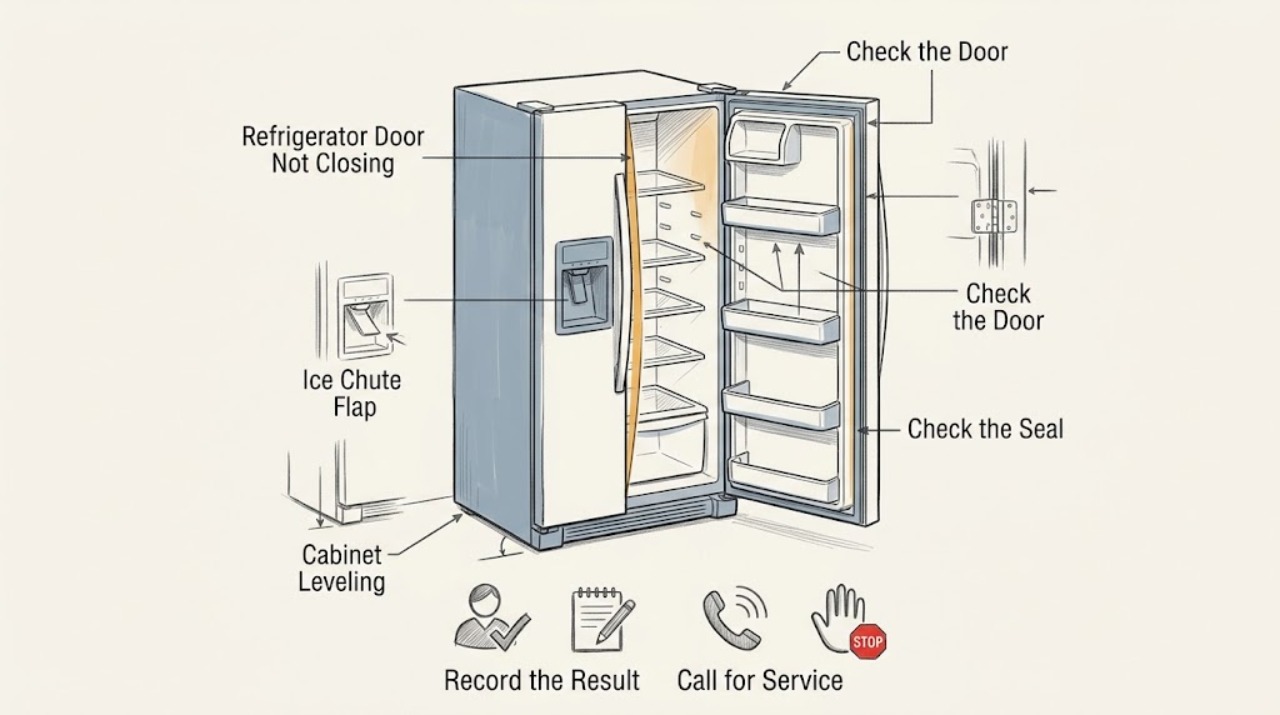
Start by identifying the exact Electrolux refrigerator model and whether the issue affects a top-freezer, side-by-side, French-door, or other design. Remove any food, shelf, bin, ice, or packaging that is stopping the door, then inspect the gasket all the way around for dirt, folds, displacement, cracks, or a section caught behind the door. Electrolux says a blocked door or dirty gasket can prevent complete closing; its frost guidance also calls out a door gasket or door that cannot seal, and an ice-chute flap that remains open. Clean an accessible gasket with warm soapy water and dry it, then close the door normally without forcing it. If the door is visibly low, rubs the cabinet, springs back, or will not stay shut, use only the alignment procedure for the exact model—Electrolux publishes different adjustment steps for side-by-side and French-door designs. Do not loosen hinges, remove door hardware, chip away heavy ice, or keep operating a door that is cracked, unstable, pinching, or leaving the refrigerator warm. If the simple obstruction and gasket checks do not restore a seal, or the appliance was recently installed, contact the installer or qualified Electrolux service with the model and symptom pattern.
Before you begin
Safety first
- The user may identify the model, remove obvious loose obstructions, clean and dry an accessible gasket, and observe the door gap. Door removal, hinge or height adjustment, cabinet leveling, sealed-gasket replacement, defrost diagnosis, electrical work, and any heavy-door support are for qualified personnel or the installer.
Work through in order
Diagnostic checks
Use only checks that match the exact appliance or system and its official guide.
-
Check 1
Read the rating label and record the full Electrolux model. Identify whether the refrigerator is a side-by-side, French-door, four-door, top-freezer, or another layout, and note whether one door or a drawer is affected, where it stops, and whether it rebounds or leaves a visible gap.
Expected result: The model and door style are known, and the door stops on an object, rubs the cabinet, sits low, or closes but leaves a gasket gap; alternatively, the model or style is unknown.
Next step: Use the model-matched manual for any alignment or door-removal information. If the door is unstable, cracked, or heavy, stop at observation and arrange service rather than attempting to support or remove it.
Stop if: Do not loosen hinges, remove set screws, or order a gasket or hinge part from the Electrolux name alone.
Why this matters
Why: The stopping pattern separates an external obstruction from a seal or alignment issue. The adjustment procedure and even the presence of a documented adjustment screw depend on refrigerator style and model, so an unknown identity prevents safe hardware assumptions.
-
Check 2
With the door opened normally, inspect the front edges of shelves, drawers, door bins, food packages, ice containers, and any packing material. Remove only an obvious loose item that is blocking the door, then close it gently once without leaning on it or forcing the hinge.
Expected result: The door closes and the gasket contacts the cabinet after an item is removed, or the door still stops, rebounds, or leaves the same gap with the interior clear.
Next step: If clear, continue to a gasket and seal check. If not clear, leave the door in its safest position and use the model information to arrange service; do not remove shelves, drawers, or door hardware that require tools unless the manual explicitly identifies them as user-removable.
Stop if: Do not force the door against an obstruction, overload a bin to test it, or use tools to pry an item or ice loose.
Why this matters
Why: A resolved symptom makes an interior or door-bin obstruction the likely cause. A persistent stop with a clear interior shifts attention to the gasket, ice chute, door alignment, installation, or a damaged door/hinge.
-
Check 3
Inspect the complete door gasket for dirt, a folded or rolled lip, displacement from its channel, cracking, tearing, or a section trapped behind the door. If it is intact and accessible, clean it with warm soapy water as Electrolux recommends, wipe it dry, and close the door normally.
Expected result: The gasket was dirty or folded and the door now closes evenly, or it remains distorted, damaged, loose, or fails to contact the cabinet around part of the perimeter.
Next step: Monitor only when the gasket meets the cabinet evenly and the door stays closed. If it is damaged or still leaves a gap, keep the door closed as much as possible and contact qualified service with the model; do not glue, stretch, or heat-form the gasket.
Stop if: Do not pull the gasket out of its channel, cut it, use a heat gun, or substitute a seal without model confirmation.
Why this matters
Why: Improvement supports a gasket-surface or seating problem. A damaged, displaced, or persistently non-contacting gasket can prevent a seal and may require a model-specific replacement or door diagnosis.
-
Check 4
On a refrigerator with an ice dispenser, inspect the visible ice chute flap and surrounding opening for an ice cube or flap that is visibly held open. Also look for frost buildup at the door edge or gasket and for food blocking internal vents. Clear only loose, accessible material using the exact model instructions; do not chip ice or insert a tool into the chute or liner.
Expected result: The chute flap closes and the visible frost or obstruction is removed, or the flap remains open, ice is embedded, frost returns, or the door still does not seal.
Next step: If the model permits a simple user-level clearing procedure, follow it and make one normal closure check. If ice is embedded, frost is extensive, or the gap persists, stop and arrange model-specific service; keep the door closed as far as practical.
Stop if: Do not use knives, screwdrivers, heat, water, or force to remove ice, and do not bypass an ice-chute flap or door interlock.
Why this matters
Why: An open ice chute, warped gasket or door, and blocked airflow are documented contributors to frost or an incomplete seal. Embedded ice or returning frost can indicate a seal, defrost, or door issue that cannot be safely identified from the outside.
-
Check 5
With the refrigerator unloaded only as needed for safe observation, look at the door gaps, top and bottom alignment, hinge-side rub marks, cabinet contact, and whether the door remains closed on its own. If the model manual specifically documents door alignment for this style, compare the observed pattern with that procedure; do not start adjustment without the required model instructions and tools.
Expected result: The door is visibly low or uneven, rubs at one corner, contacts the upper or lower cabinet, will not stay shut, or is properly aligned but still has a damaged seal; the unit may also be newly installed.
Next step: For an installation or alignment issue, contact the installer or qualified Electrolux service with the model and photos of the gap. For a persistent seal issue, request a model-matched gasket and hinge/door diagnosis rather than selecting a part yourself.
Stop if: Do not remove the door, loosen hinge hardware, remove a height set screw, lift a heavy door, or perform cabinet leveling without the exact manual and appropriate qualified support.
Why this matters
Why: A style-specific alignment or installation issue is more likely than a dirty gasket when the gap or rubbing changes around the door's travel. A properly aligned door with a persistent perimeter gap makes gasket or door-surface damage more likely. Recent installation should be handled by the installer under Electrolux's support guidance.
Use your observations
Decision map
Find the observation that best matches what you see, then follow the next safe action.
-
PATH 01Safety boundary
What you see
The door was stopped by a shelf, bin, food package, ice container, or packing item and closes evenly after that loose obstruction is removed.
Do this next
Rearrange the item so it cannot contact the door and make one normal closure check. Monitor temperature and frost; escalate if the gap returns with a clear interior.
Why this path and its safety boundary
Why it matters: The physical obstruction is more likely than a hinge or gasket failure, provided the gasket now contacts the cabinet around the full perimeter.
Safety stop: Do not force the door or remove fixed shelves, bins, or hardware to make space.
-
PATH 02Safety boundary
What you see
The interior is clear, but the gasket has dirt, a fold, or a displaced section; cleaning and gently restoring only an obvious external fold allows an even seal.
Do this next
Keep the gasket clean and dry and follow the model manual for any user-accessible seal care. If it becomes loose, cracked, torn, or fails to contact, arrange model-specific service.
Why this path and its safety boundary
Why it matters: A gasket-surface or seating issue is more likely than a door-alignment fault, although the seal should still be checked around all sides.
Safety stop: Do not glue, cut, stretch, heat, or replace the gasket without model confirmation.
-
PATH 03Safety boundary
What you see
A dispenser model has a visibly open ice-chute flap or loose ice at the chute, or frost/ice is preventing the gasket or door edge from meeting the cabinet.
Do this next
Follow only the exact model's user-level clearing instructions. Stop and arrange service for embedded ice, extensive frost, a flap that will not close, or a gap that remains after safe clearing.
Why this path and its safety boundary
Why it matters: The ice chute, frost, or seal path is more likely to be holding the door open. Returning or embedded frost needs more than a simple surface clearing.
Safety stop: Do not chip, melt, pry, or drill ice, and do not insert tools into the dispenser chute or liner.
-
PATH 04Safety boundary
What you see
The door rubs at one corner, sits lower than its mate, touches the upper or lower cabinet, springs open, or will not stay closed despite a clear interior and intact clean gasket.
Do this next
Use the full model to obtain the correct manual and contact the installer if recently fitted or qualified Electrolux service otherwise. Provide photos of the door gap and the point of rubbing.
Why this path and its safety boundary
Why it matters: A style-specific door-alignment, hinge, closer, cabinet-level, or installation issue is more likely than a simple obstruction. Electrolux's published adjustment steps apply only to stated refrigerator styles and models.
Safety stop: Do not loosen hinges, remove a set screw, lift the door, or force it into alignment without model-matched instructions and appropriate support.
-
PATH 05Safety boundary
What you see
The door appears aligned and the interior is clear, but a perimeter gap, damaged gasket, warm cabinet, unstable temperature, or recurring frost remains.
Do this next
Keep the door closed as much as possible, protect food appropriately, and arrange model-matched service for gasket, hinge, door surface, defrost, or cabinet diagnosis.
Why this path and its safety boundary
Why it matters: The seal or door system is not reliably closed; continued operation can admit warm air and worsen frost or food-temperature problems. A part cannot be selected safely from symptoms alone.
Safety stop: Do not keep forcing the door shut, tape over a failed seal, or dismantle the door or cabinet.
Helpful context
Understand the symptom
Find the physical point that prevents closure
A door that stops before the cabinet, rebounds, or appears closed but leaves a gap can have different causes. Look first for a bin, shelf, package, ice, or liner obstruction rather than assuming the hinge is bad. Then inspect the gasket without pulling it out: dirt, a fold, a displaced corner, or a visibly damaged section can keep the magnetic seal from meeting the cabinet. Electrolux's direct door guidance starts with removing blockers and cleaning the gasket.
Separate a closure problem from an alignment or ice problem
If the door closes after an external obstruction is removed and the gasket is clean, the original problem was likely at the contact point. If it is lower on one side, rubs the cabinet, or will not stay shut, alignment or installation may be involved. On models with an ice and water dispenser, an ice-chute flap that cannot close or visible ice at the chute can also hold the door open. Check only accessible surfaces and follow the exact model manual; do not pry ice or adjust a hinge by guesswork.
Protect the seal and food while arranging service
A door that does not seal can let warm air in, destabilize temperature, and promote frost. Keep the door closed as much as possible while documenting the model and the gap, and move temperature-sensitive food to safe cold storage if the refrigerator is no longer maintaining temperature. Electrolux's alignment instructions are style-specific, and its support page directs owners to service when the basic door and gasket checks do not resolve the issue. Internal hinges, cams, closers, cabinet leveling, wiring, and control diagnosis should be left to a qualified technician.
Safety boundary
Stop conditions
- Stop and arrange qualified service for a cracked or unstable door, loose hinge, heavy door that cannot be safely supported, sharp metal or glass damage, a pinching hazard, or water near electrical components.
- Do not force a door against an obstruction, lift or remove the door, loosen hinges, remove height set screws, or alter alignment without the exact model instructions and appropriate support.
- Do not chip, drill, pry, or heat ice, pour water into the liner, or insert tools into an ice chute, gasket channel, vent, or other opening.
- Do not glue, cut, stretch, heat-form, or substitute a door gasket; confirm the exact model before any part is considered.
- If the door cannot seal and the refrigerator is warming, keep the door closed as much as possible, protect perishable food, and contact the installer or qualified Electrolux service.
Only after diagnosis
Potential parts
- refrigerator door gasket
Consider only when the exact model's gasket is cracked, torn, displaced, or still fails to seal after safe cleaning and obstruction checks.
Confirm the full model, door side, dimensions, and manufacturer fit information before ordering; do not assume a brand-level match. - door hinge or closing hardware
Consider only after qualified diagnosis finds a worn, bent, or damaged hinge, cam, or closing component causing a verified alignment or return problem.
Hinge and closing hardware vary by refrigerator style and model; use the model-matched parts list or service diagnosis.
When checks do not resolve it
Need a professional?
Contact the installer for a refrigerator installed within the past 30 days, as Electrolux directs. For older units, arrange qualified Electrolux service when clearing obstructions and cleaning the gasket do not restore an even seal, the door is low or rubbing, a hinge or closer appears loose, the gasket is damaged, frost or the ice chute repeatedly prevents closure, or the refrigerator is no longer maintaining temperature.
Safety scope: The user may identify the model, remove obvious loose obstructions, clean and dry an accessible gasket, and observe the door gap. Door removal, hinge or height adjustment, cabinet leveling, sealed-gasket replacement, defrost diagnosis, electrical work, and any heavy-door support are for qualified personnel or the installer.
Common questions
FAQ
Why will my Electrolux refrigerator door not close all the way?
Start with an item blocking the door or a dirty, folded, displaced, or damaged gasket. On dispenser models, an ice-chute flap or ice can also hold the door open. If the door is low, rubs, or remains unsealed after those checks, the alignment or door hardware needs model-specific service.
How can I clean an Electrolux refrigerator door gasket?
Electrolux recommends warm soapy water for the gasket. Wipe it clean and dry, then close the door normally and check for even contact around the perimeter. Do not pull the gasket out, glue it, stretch it, or use heat to reshape it.
Can I adjust the doors myself?
Only follow the exact model's instructions. Electrolux publishes different procedures for side-by-side and French-door refrigerators, including different access and adjustment details. Do not loosen hinges, remove a height set screw, or lift a door based on another model's guide.
Can frost or an ice dispenser stop the refrigerator door from closing?
Yes. Electrolux identifies a warped door or gasket, an ice-chute flap that does not close, and blocked airflow as contributors to frost and sealing problems. Clear only loose accessible material using the model instructions; do not chip or pry embedded ice.
When should I call Electrolux service for a door that will not close?
Call the installer for a unit installed within the past 30 days. Otherwise arrange qualified service when the interior is clear and the gasket is clean but the door still rubs, sits low, will not stay shut, has a damaged seal, repeatedly frosts, or the refrigerator is warming.
Read the exact guide
Official sources
- Refrigerators - How to align doorsElectrolux · Supports style-specific alignment boundaries and examples; it does not authorize applying those adjustment steps to an unidentified model or another refrigerator design.
- Refrigerators - Not CoolingElectrolux · Supports the effect of a non-sealing door on temperature and the warm-soapy-water gasket check; it does not identify a particular gasket or hinge part.
- Refrigerator Door IssuesElectrolux · Directly applies to Electrolux refrigerators with doors that do not close completely; it provides the initial obstruction and gasket-cleaning checks and service escalation.
- Where can I find my model and serial number?Electrolux · Supports identifying the rating-label model before applying model-specific refrigerator guidance; exact label location varies by refrigerator type.
- Refrigerators / Freezer - Frost Build UpElectrolux · Supports the relationship between a non-sealing door or gasket, an open ice-chute flap, blocked airflow, and frost; it is not a substitute for a model-specific defrost procedure.
Community feedback
Share a repair observation
Share a plain-text repair observation. Accepted observations are published automatically; this page may take a moment to update.