
On this page
Start here
Quick answer
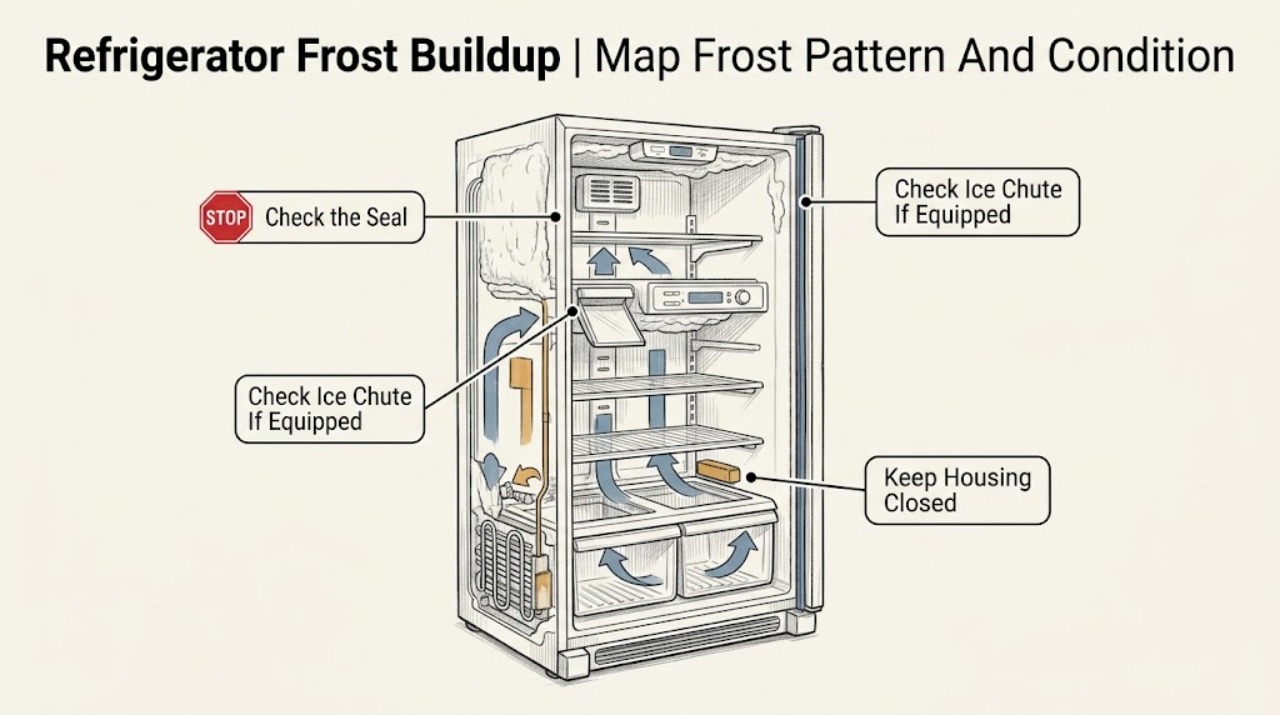
Electrolux explains that frost forms when warm air and cold air meet in a below-freezing area. Start by locating the frost: a thin patch near a door edge, chute, or a blocked vent points toward warm-air entry or restricted airflow, while a thick or recurring blanket can also prevent the door from sealing and needs service if the external checks do not resolve it. Make sure the door closes completely, nothing in a bin or on a shelf holds it open, and the gasket contacts the frame; clean the gasket with warm soapy water if needed. If the refrigerator has an ice dispenser, check that the chute flap closes fully and that no accessible ice holds it open. Move food away from vents and avoid setting the freezer colder than the model recommends; Electrolux lists 0°F as its suggested freezer setting and 37°F for the refrigerator, but the exact manual controls the model. Do not chip frost with a knife, apply direct heat, remove interior covers, or work on the sealed system or defrost wiring. If frost returns quickly, blocks airflow, the door or gasket is warped, temperatures rise, water leaks, or the unit needs internal defrost or cooling diagnosis, leave it operating only as safely instructed by the manual and arrange qualified service.
Before you begin
Safety first
- This article covers external door, gasket, chute, loading, vent, and control observations only. Qualified personnel must handle internal covers, defrost components, fans, wiring, controls, refrigerant lines, and sealed-system work.
Work through in order
Diagnostic checks
Use only checks that match the exact appliance or system and its official guide.
-
Check 1
With the refrigerator operating normally and the doors open only briefly, note where frost is visible: along a door edge or gasket, around the ice chute, on food or a nearby vent, across a rear wall, or as a thick blanket. Record whether the affected compartment is a freezer, fresh-food section, or a convertible area, and whether temperatures or water leaks have changed.
Expected result: Frost is localized at the door/chute, concentrated around a blocked vent or product, widespread across a cold surface, thick enough to affect shelves or airflow, or accompanied by warming, water, or a door that cannot close.
Next step: Follow the matching door, chute, airflow, or temperature branch. If frost prevents closure, food is warming, water is leaking, or a hazard is present, protect the contents and arrange service rather than forcing the unit.
Stop if: Do not scrape, pry, or remove covers to expose the frost source.
Why this matters
Why: A localized edge or chute pattern makes warm-air entry more likely; a vent or product pattern makes airflow obstruction more likely. Widespread or recurring frost is not enough to identify a failed part and may involve defrost or cooling service, especially if airflow or temperature is affected.
-
Check 2
Inspect the accessible door frame and gasket for a warped door, fold, gap, soil, torn section, or a bin, shelf, package, or drawer stopping full closure. Close each affected door normally and look for an even gasket contact around the frame. Clean visible gasket soil with warm soapy water and a soft cloth if the model manual permits; do not pull or reshape the seal.
Expected result: The door is held open by contents, the gasket is dirty but intact, the gasket or door is warped/torn, a gap remains after normal closure, or the door seals evenly with no obstruction.
Next step: Remove only the external obstruction or clean the accessible gasket, then close the door normally and observe whether frost stops increasing. Arrange service for a warped, torn, loose, or persistently gapped seal or door.
Stop if: Do not tape the door shut, bend hinges, stretch the gasket, remove door hardware, or keep operating with a door that cannot seal.
Why this matters
Why: An incomplete seal lets warmer moist air meet the cold interior and makes frost more likely; Electrolux specifically lists a warped gasket or door as a cause. A clean, even seal makes loading, temperature, chute, defrost, or cooling causes more likely, but does not prove any internal component.
-
Check 3
If the refrigerator has a through-the-door ice dispenser, inspect the chute opening from outside and confirm the flap closes flush after dispensing. Look only for accessible ice or debris preventing closure; do not disassemble the dispenser or reach behind the flap.
Expected result: The chute flap closes fully, ice is visibly holding it open, the flap remains ajar or damaged, or the refrigerator has no ice chute.
Next step: Remove only loose accessible ice that is preventing closure, close the flap normally, and monitor the frost pattern. If it will not close or frost returns at the chute, arrange qualified appliance service.
Stop if: Do not force, wedge, tape, heat, or disassemble the chute flap or dispenser housing.
Why this matters
Why: Electrolux identifies an ice-chute flap that does not close as a frost source because it admits warmer air. A flap that remains open or is damaged needs service; a refrigerator without a chute should be evaluated through the door, airflow, temperature, and frost-pattern checks instead.
-
Check 4
Move food and containers away from the interior vents and cold-air outlet, leaving the airflow path clear and avoiding a product directly in the cold-air stream. Check the displayed refrigerator and freezer settings against the exact model manual; as general Electrolux guidance, the suggested settings are 37°F for the refrigerator and 0°F for the freezer. Do not change several controls at once.
Expected result: A package or shelf load blocks a vent, food is directly in the cold-air stream, the setting is unusually low, the setting is at the model's recommendation, or airflow and settings appear normal.
Next step: Rearrange only accessible contents and return the control to the model-recommended setting, then monitor temperature and frost rather than making repeated adjustments. If frost persists or the compartment warms, arrange service.
Stop if: Do not block vents deliberately, remove duct covers, change hidden service settings, or diagnose a defrost or sealed-system component from inside the cabinet.
Why this matters
Why: Blocked or poorly arranged airflow can make frost accumulate on products and can reduce circulation. An extremely low setting can over-freeze contents, while a normal setting with clear vents makes a sealing, chute, defrost, or cooling issue more likely.
-
Check 5
After the safe external corrections, document the model or product number, compartment affected, frost location and thickness, door/gasket and chute results, control settings, vent clearance, food temperature, leaks, alarms, and whether frost returns. Use the exact Electrolux manual for any model-approved defrost or shutdown procedure; do not improvise one.
Expected result: Frost stops increasing after a seal, chute, loading, or setting correction; frost returns quickly; the door will not seal; airflow is blocked by internal ice; food is warming; water leaks; or the refrigerator shows an alarm or abnormal sound.
Next step: Keep the record and arrange qualified Electrolux/appliance service when frost recurs, affects temperature or closure, or requires internal access. Follow the manual's food-storage and shutdown guidance while waiting.
Stop if: Do not remove evaporator or vent covers, melt frost with direct heat, pierce ice, touch refrigerant lines or wiring, or continue if there is smoke, burning odor, electrical heat, or water near electrics.
Why this matters
Why: A stable improvement supports an air-leak, chute, loading, or setting cause. Rapid recurrence, solid internal ice, warming, leaks, or an unresolved seal points toward defrost, airflow, sensor, or cooling-system diagnosis that cannot be confirmed safely by an external observation.
Use your observations
Decision map
Find the observation that best matches what you see, then follow the next safe action.
-
PATH 01Safety boundary
What you see
Frost is concentrated at a door edge or gasket, the door is held open by a package or bin, the gasket is dirty, or the door/gasket is warped or leaves a visible gap.
Do this next
Remove only the visible obstruction or clean the accessible gasket, close the door normally, and monitor. Arrange service for a warped, torn, loose, or non-sealing door or gasket.
Why this path and its safety boundary
Why it matters: Warm moist air entering through incomplete closure is more likely than an immediate defrost diagnosis. A damaged or persistently gapped seal cannot be corrected safely by reshaping it.
Safety stop: Do not tape, force, bend, or remove the door or gasket.
-
PATH 02Safety boundary
What you see
A refrigerator with an ice dispenser has frost around the chute and its flap remains open, has accessible ice behind it, or does not close flush.
Do this next
Clear only loose accessible ice, close the flap normally, and monitor. Arrange service if the flap remains open or frost returns at the chute.
Why this path and its safety boundary
Why it matters: Electrolux identifies a chute flap that does not close as a source of frost because the opening admits warm air. The flap or dispenser mechanism may need service if a loose accessible obstruction is not the cause.
Safety stop: Do not disassemble, force, heat, or wedge the chute flap.
-
PATH 03Safety boundary
What you see
Frost is on food or near a vent, a package blocks an air path, food sits directly in a cold-air stream, or the freezer setting is colder than the model recommends.
Do this next
Clear only accessible vent obstructions, rearrange contents, and return settings to the exact manual's recommendation. Monitor before making another change; service is appropriate if frost or temperature problems persist.
Why this path and its safety boundary
Why it matters: Loading and airflow obstruction or an overly cold setting is more likely. Electrolux warns that blocked airflow can cause frost and gives general suggested temperatures, but exact settings remain model-specific.
Safety stop: Do not remove internal ducting or use hidden service settings to compensate for frost.
-
PATH 04Safety boundary
What you see
The door seals, chute closes or is not present, vents are clear, and settings are reasonable, but frost rapidly returns, forms a solid internal blanket, reduces airflow, raises food temperature, causes water leakage, or requires internal access.
Do this next
Use the exact model manual for food protection and any approved shutdown/defrost procedure, then arrange qualified Electrolux/appliance service. Provide the frost pattern and recurrence record.
Why this path and its safety boundary
Why it matters: A defrost, airflow, sensor, or cooling-system fault is more likely after the user-level checks. Frost pattern alone cannot identify a heater, sensor, fan, control, or sealed-system part.
Safety stop: Do not chip frost, apply direct heat, remove covers, touch wiring or refrigerant tubing, or attempt sealed-system or defrost repair.
Helpful context
Understand the symptom
Frost is an air and temperature clue
Frost is not automatically evidence of a failed refrigerator. Electrolux describes it as ice crystals created when warm and cold air meet below 32°F. The useful distinction is where it forms and what else is happening: a door-edge or chute patch suggests an air-seal path, frost around a product or vent suggests loading or airflow, and frost that keeps returning after those checks deserves service rather than repeated scraping.
Match temperature and controls to the model
Electrolux lists 37°F as a suggested refrigerator setting and 0°F as a suggested freezer setting, with an acceptable range that varies by compartment and model. Treat those values as the manufacturer's general guidance, not a license to override the rating-label manual. A control setting that is unusually cold can promote over-freezing, but a normal setting with persistent frost shifts the decision toward sealing, airflow, defrost, or cooling service.
Protect the liner and the cooling system
Keep user checks to the door, gasket, chute, vents, shelf loading, and controls. Do not use a knife, screwdriver, boiling water, hair dryer, or other direct heat to attack frost, and do not remove an evaporator cover or probe a defrost component. If frost has become a solid mass or is affecting food temperature, use the exact model manual or qualified service for the defrost decision.
Safety boundary
Stop conditions
- Stop and arrange service for a warped or damaged door/gasket, frost that prevents closure, rapidly recurring solid ice, food warming, active water leakage, smoke, burning odor, abnormal electrical heat, or water near electrical parts.
- Do not chip, puncture, pry, or scrape frost with a knife or tool, and do not apply a hair dryer, heat gun, boiling water, or other direct heat inside the refrigerator.
- Do not remove evaporator, vent, ice-maker, or control covers; touch defrost wiring, fans, refrigerant tubing, or sealed-system components; or perform live electrical tests.
- If the external door, chute, airflow, and setting checks do not stop recurrence, use the model manual or qualified service rather than repeatedly resetting or manually defrosting the appliance.
When checks do not resolve it
Need a professional?
Safety scope: This article covers external door, gasket, chute, loading, vent, and control observations only. Qualified personnel must handle internal covers, defrost components, fans, wiring, controls, refrigerant lines, and sealed-system work.
Common questions
FAQ
Why is my Electrolux refrigerator building frost?
Electrolux lists warm-air entry through a warped door or gasket, an ice-chute flap that does not close, an extremely low setting, and blocked airflow as causes. Check the frost location, door seal, chute if equipped, vents, loading, and model temperature setting before arranging service for recurrence.
What temperature should an Electrolux refrigerator and freezer use?
Electrolux gives general suggested settings of 37°F for the refrigerator and 0°F for the freezer, with model-dependent acceptable ranges. Use the rating-label manual for the exact appliance and avoid changing settings repeatedly while diagnosing frost.
Can blocked vents cause frost in an Electrolux refrigerator?
Yes. Electrolux says food blocking airflow pathways or sitting directly in a cold-air stream can allow frost to accumulate. Move only accessible items away from vents and leave circulation space; if frost or temperature problems persist, arrange service.
Can an Electrolux ice chute cause frost?
Yes. Electrolux identifies an ice-chute flap that does not close completely as a frost source. Remove only loose accessible ice that prevents closure and arrange service if the flap remains open or frost returns.
Should I use a knife or hair dryer to remove refrigerator frost?
No. Do not chip, puncture, scrape, or apply direct heat, and do not remove internal covers. Use the exact model manual for any approved defrost or shutdown procedure; solid or recurring frost, warming, leaks, and internal access require qualified service.
When should I call service for Electrolux refrigerator frost?
Arrange service when frost returns rapidly after the door, gasket, chute, airflow, and setting checks; prevents closure; blocks internal airflow; accompanies warming or leaks; or requires covers, wiring, fans, defrost parts, or refrigerant-system access. Stop immediately for smoke, burning odor, abnormal heat, or water near electrics.
Read the exact guide
Official sources
- Book an Electrolux Appliance RepairElectrolux · Electrolux USA service route; regional eligibility and availability vary.
- Support for RefrigeratorsElectrolux · Support-category route; articles, controls, and procedures vary by market and model.
- Refrigerators / Freezer - Frost Build UpElectrolux · General Electrolux refrigerator guidance; door, chute, temperature, and airflow details vary by model.
- Refrigerator Too ColdElectrolux · General Electrolux refrigerator and freezer guidance; exact controls and acceptable ranges vary by model.
Community feedback
Share a repair observation
Share a plain-text repair observation. Accepted observations are published automatically; this page may take a moment to update.