
On this page
Start here
Quick answer
If the Amana BB20V1S fresh-food section is cold but the bottom freezer is soft, first protect any thawing food and confirm the Deepfreeze control is on. Then check the rear air grille behind the left Garden Fresh crisper, the visible door seal, and any recent loading or long-door-open event. A hot or frequently running compressor by itself does not prove compressor failure; if the freezer does not recover after these external checks, stop before removing panels and arrange qualified refrigerator service.
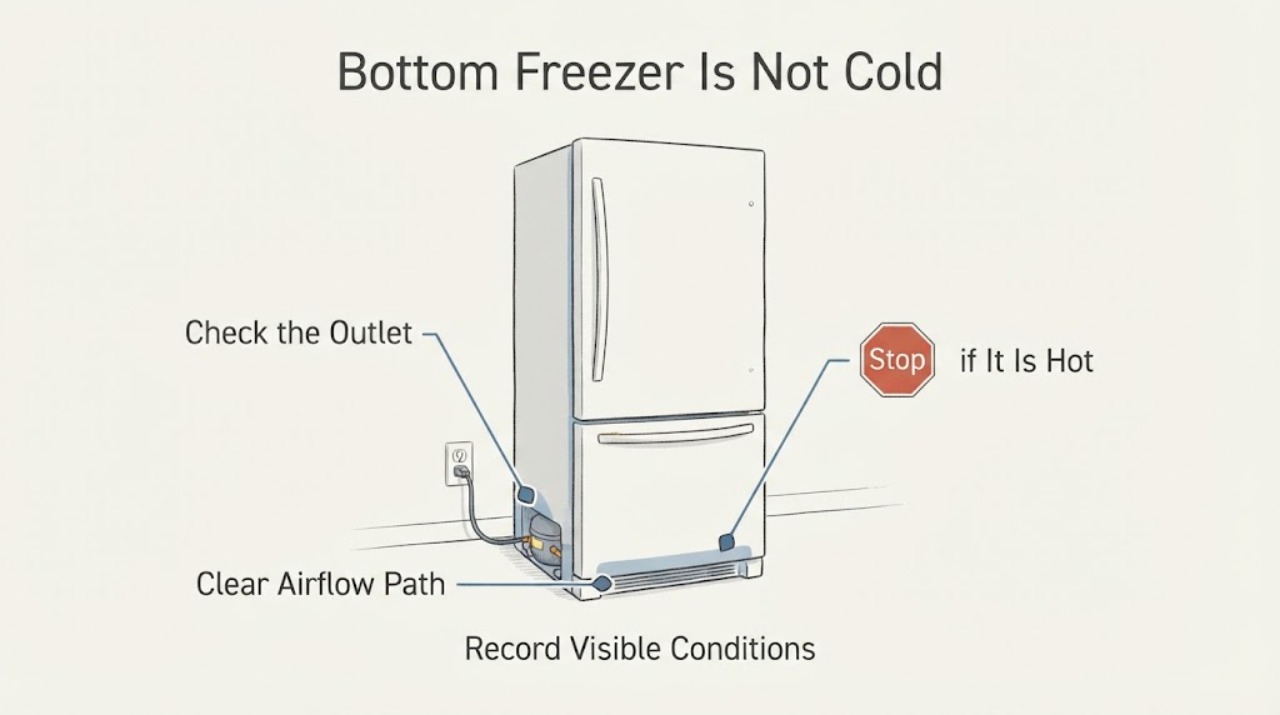
Work through in order
Diagnostic checks
Use only checks that match the exact appliance or system and its official guide.
-
Check 1
Keep the freezer door closed as much as practical, move clearly thawing food to a working cold-storage location, and record whether the fresh-food section is cold while the bottom freezer has soft ice cream, no new ice, or other soft frozen food. If an appliance thermometer is already available, record the freezer reading without leaving the door open.
Expected result: The fresh-food section remains cold but frozen food is soft, or the freezer temperature is visibly rising; alternatively, the whole appliance is warm or food is still hard and the complaint is intermittent.
Next step: Photograph any visible frost and note the freezer symptom before continuing. If food is thawing or the cabinet is unsafe, stop troubleshooting and follow local food-safety guidance while arranging service.
Stop if: Stop for smoke, burning odor, sparking, damaged wiring, water near electrical parts, a dangerously hot cabinet, or food that may no longer be safe.
Why this matters
Why: A freezer-only temperature problem is a useful branch toward freezer airflow, control, frost, or cooling-capacity checks; it does not by itself identify a compressor or ice-maker failure. A whole-appliance temperature rise needs faster food protection and service triage.
-
Check 2
Confirm that the Deepfreeze control is on and that the refrigerator is plugged into a working outlet; note any recent power interruption, large load of warm food, unusually long door opening, or control change. After correcting only that use or setting issue, close the door and allow several hours for the temperature to settle instead of repeatedly changing settings.
Expected result: The control was off, power was interrupted, a large warm load was just added, or the door was open for a long time; or the control and power are normal and the freezer has been warm during ordinary use.
Next step: Restore only the documented control setting, close the door, and monitor recovery. If the freezer stays soft after the recovery period, continue to the visible airflow and seal checks rather than assuming the compressor has failed.
Stop if: Do not open electrical covers, test live parts, bypass a defrost or temperature control, or keep changing settings while food temperatures are unsafe.
Why this matters
Why: The first pattern can explain a temporary temperature rise or recovery delay. The second makes a persistent airflow, frost, fan, control, or cooling-system problem more likely and means a setting change alone is not an adequate diagnosis.
-
Check 3
With the appliance safe and the door open only briefly, inspect the rear air grille behind the left Garden Fresh crisper and the visible freezer/refrigerator airflow path. Move only loose packages, shelves, or drawers that visibly block the grille or airflow; do not remove a grille or rear panel and do not reach toward a fan.
Expected result: A package, drawer, or food load blocks the grille or a visible vent, or the path is clear but ice or a rear cover is obstructing airflow.
Next step: Leave clearance around the model-specific grille and monitor temperature recovery. If ice blocks the cover or fan area, stop and arrange qualified service instead of forcing the obstruction open.
Stop if: Do not chip ice, remove the evaporator or fan cover, reach into a running fan, or apply direct heat.
Why this matters
Why: A loose loading obstruction can restrict circulation and create a freezer-only warm area. Ice or a blocked internal cover points beyond ordinary loading toward an internal airflow or defrost fault.
-
Check 4
Check that the bottom-freezer door closes fully, then inspect the visible gasket for dirt, tears, flattening, a gap, or a package caught at the edge. Clean only as the owner's manual directs; if the rear of the unit is accessible without moving it unsafely, perform only the manual-approved external condenser-coil check.
Expected result: The gasket contacts the cabinet continuously and the door closes without force, or a corner leaks, the gasket is damaged, or the accessible coils are heavily soiled.
Next step: Remove only an obstruction and restore the door arrangement. If contact remains uneven, the door will not align, or the freezer stays warm after the visible checks, book model-specific service rather than pulling the gasket or opening panels.
Stop if: Do not pull the gasket from its channel, force hinges, reshape the seal with heat, or move the appliance if doing so could damage wiring or the floor.
Why this matters
Why: A poor seal admits humid air and can cause frost and temperature loss; accessible dust can also reduce efficiency. A sound seal and clean accessible area do not rule out an internal fan, defrost, control, or sealed-system issue.
-
Check 5
After the external checks, listen from a safe position during normal operation and monitor whether freezer temperature begins to recover; do not touch the compressor or use its surface temperature as a test. Record whether the unit runs for long periods, cycles normally, makes a new loud or abnormal sound, or never improves.
Expected result: The freezer begins to recover after the load, control, airflow, or seal correction; the compressor runs longer but cooling improves; or the freezer remains warm despite normal power, clear visible airflow, and a closed door.
Next step: For improvement, keep the corrected loading and monitor the same symptom. For no improvement, provide the technician with the model, temperature history, frost location, grille result, gasket result, and sound/run observations.
Stop if: Stop using the appliance and seek prompt qualified help for smoke, burning odor, sparking, damaged wiring, severe overheating, or unsafe food temperatures.
Why this matters
Why: Long run time can accompany warm food, door opening, or recovery and is not proof of a failed compressor. No recovery after the safe external checks makes an internal fan, defrost/control, or sealed-system diagnosis more likely.
Use your observations
Decision map
Find the observation that best matches what you see, then follow the next safe action.
-
PATH 01Next step
What you see
The fresh-food section is cold, the bottom freezer is soft, and the rear air grille or visible vent was blocked by a package or drawer.
Do this next
Clear only the loose obstruction, close the door, and monitor recovery. Arrange service if the freezer remains warm or ice blocks an internal cover.
Why this path and its safety boundary
Why it matters: A compartment-specific airflow restriction is more plausible than an immediate compressor conclusion.
-
PATH 02Next step
What you see
The grille and door seal are visibly clear, the Deepfreeze control and power are normal, and the freezer remains warm after a normal recovery period.
Do this next
Stop before panel removal or live testing and arrange qualified Amana appliance service with the recorded observations.
Why this path and its safety boundary
Why it matters: The remaining possibilities include an internal fan or defrost/control fault or a cooling/sealed-system problem that cannot be distinguished safely from external checks.
-
PATH 03Next step
What you see
The compressor seems to run for a long time but the freezer temperature improves after a warm load, door-open event, or control correction.
Do this next
Continue normal use with the door closed and monitor. Escalate if the freezer loses temperature again or never reaches a stable condition.
Why this path and its safety boundary
Why it matters: The run time may reflect recovery or normal temperature maintenance; compressor replacement is not justified by heat or run time alone.
-
PATH 04Next step
What you see
Food is thawing, the appliance cannot maintain safe cold storage, or there is smoke, a burning smell, sparking, damaged wiring, or water near electrical parts.
Do this next
Protect or relocate food, stop using the appliance for the hazard conditions, and arrange prompt qualified service.
Why this path and its safety boundary
Why it matters: Food safety or electrical risk takes priority over diagnosis.
Helpful context
Understand the symptom
The BB20V1S is identified in Amana's specification sheet as a 20-cubic-foot freezer-on-bottom refrigerator; the S suffix is the stainless-steel finish variant. That identity matters because a bottom freezer can have a different visible airflow layout than a top-freezer page.
Use the checks below in order. They are external observations only: do not remove an interior rear panel, reach into a fan, bypass a control, or try to melt ice with a heater, hair dryer, steamer, boiling water, or sharp tool.
A failed ice-making symptom is useful only as a temperature clue. It does not identify the ice maker, compressor, defrost system, or sealed system as the failed part without further model-specific testing.
Only after diagnosis
Potential parts
- Amana refrigerator evaporator fan or airflow component
Only if a qualified diagnosis finds that airflow is absent or an internal fan/air path is faulty.
- Amana refrigerator defrost system component
Only if recurring ice or an iced internal air path is confirmed and a qualified diagnosis identifies the defrost cause.
- Amana refrigerator sealed-system or compressor service
Only after power, controls, airflow, seal, and permitted external checks pass and a qualified technician confirms inadequate cooling capacity.
When checks do not resolve it
Need a professional?
Call a qualified refrigerator technician when the freezer stays warm after the Deepfreeze control, power, visible grille, door seal, and permitted external checks are normal; when frost or ice blocks an internal cover; or when the unit has abnormal noise, unstable temperature, smoke, burning odor, sparking, damaged wiring, water near electrical parts, or unsafe food temperatures. Do not remove interior panels, bypass controls, or attempt sealed-system or compressor work as a home test.
Read the exact guide
Official sources
- Freezer is not cold enough - Help me troubleshoot!Exact model and symptom match for reported observations only; no verified repair outcome and no community repair suggestion is treated as safe user guidance.
- Freezer Not Freezing? Solve This and Other Freezer ProblemsAmana · Amana general freezer temperature, door-seal, airflow, loading, and service guidance
- Use & Care GuideAmana · Amana refrigerator use, care, and troubleshooting guidance applicable to the BB20V1 family context
- Model Spec Sheet - 1722Amana · Amana BB20V1 bottom-freezer refrigerator family and BB20V1S stainless finish variant
Community feedback
Share a repair observation
Share a plain-text repair observation. Accepted observations are published automatically; this page may take a moment to update.