
On this page
Start here
Quick answer
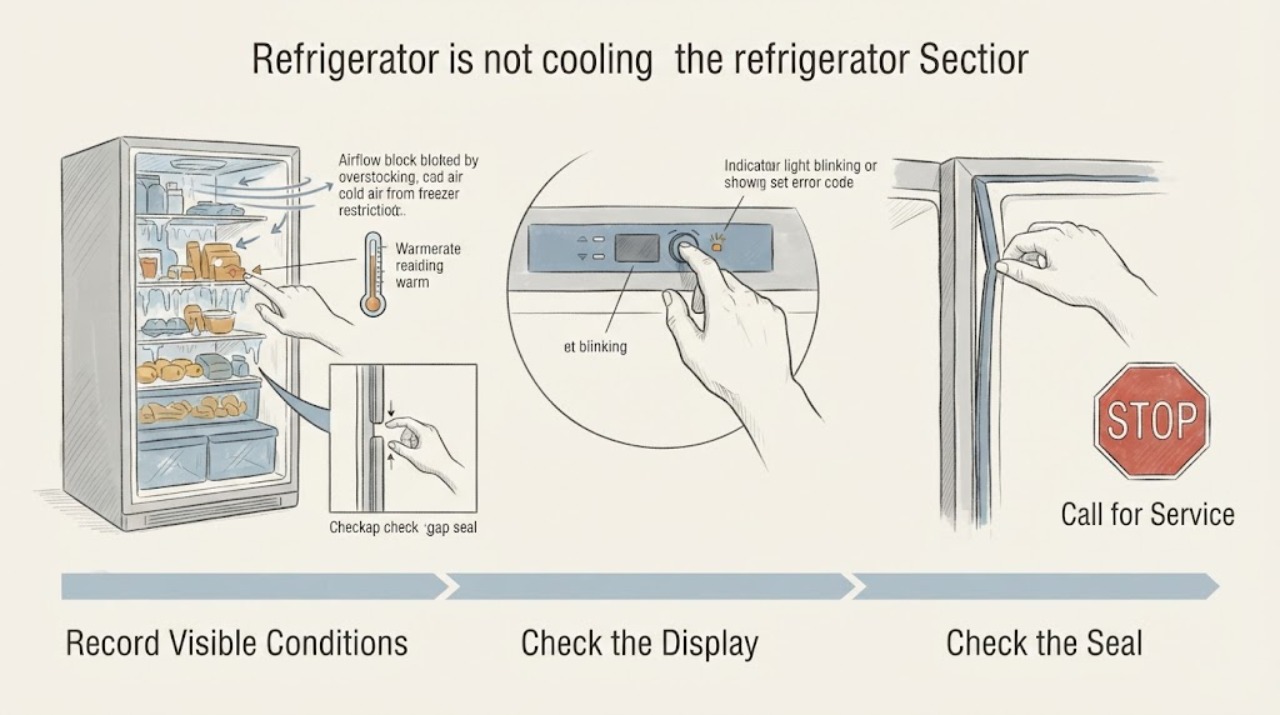
A freezer that still feels cold does not prove that the thermostat is bad. For the assigned Amana BRD18V1S P1326502WS, first measure the refrigerator and freezer separately, confirm cooling is on and the controls are not set incorrectly, and allow the temperature to stabilize after any small setting change. Check only accessible shelves, vents and door sealing for blocked airflow or a gap. Amana explains that many refrigerators move cold air from the freezer through vents, so a blocked return path can leave the refrigerator section warm, but the exact airflow design for this model must come from its model-specific manual. Do not order a thermostat from the symptom alone. If the refrigerator remains warm after the external checks, arrange service and provide the complete model, temperatures and observations; Amana reserves model-specific tech-sheet testing for trained repair personnel.
Work through in order
Diagnostic checks
Use only checks that match the exact appliance or system and its official guide.
-
Check 1
Measure and record the refrigerator-section and freezer-section temperatures separately with a suitable appliance thermometer, and note the measurement location and time. Check the food for signs of unsafe warming and move perishable food to a known-safe cold location if needed.
Expected result: The refrigerator section is measurably warmer than intended while the freezer remains cold, or the two compartments have not been measured independently.
Next step: Continue with the external setting and airflow checks only if the appliance is safe to use. If food safety is in doubt, protect the food first and arrange service rather than repeatedly opening the appliance.
Why this matters
Why: Separate measurements confirm the reported distribution pattern and give service a useful baseline; a hand-feel comparison or a single display setting cannot identify a failed thermostat.
-
Check 2
Confirm from the controls and the model's use-and-care guide that cooling is turned on, the refrigerator control is not set unusually warm, and no showroom/demo or vacation feature is active. Make only the documented small setting change, then leave the appliance closed long enough for the temperature to stabilize.
Expected result: Cooling is off, a mode is active, the setting is clearly wrong, or the controls are on a normal documented setting.
Next step: Correct only a clearly documented setting or mode and recheck after the manual's stabilization interval. If the section remains warm, stop adjusting controls and move to airflow/service evaluation.
Why this matters
Why: Amana lists an accidentally disabled refrigerator, incorrect controls and showroom/demo mode as non-part causes of inadequate cooling. A normal setting after stabilization makes a control-setting explanation less likely but does not prove a thermostat failure.
-
Check 3
Look inside the refrigerator and freezer without removing panels: keep food and containers away from visible air openings, avoid packing shelves against the rear wall, and check that the refrigerator and freezer doors close against their gaskets without an obvious gap. Do not probe an opening or dismantle a duct.
Expected result: A visible vent or return path is blocked, the cabinet is overpacked, or a door gasket does not close evenly; alternatively, the accessible airflow and seal look normal.
Next step: Rearrange only loose items that clearly block a visible opening and close the doors normally. If airflow and seals look normal, do not buy a thermostat; record the result for service.
Why this matters
Why: Amana explains that on many units cold air moves from the freezer through vents and that blocked return airflow can leave the refrigerator compartment warm. The exact BRD18 internal layout is not confirmed by the opened official manual, so this is an external possibility rather than a model-specific diagnosis.
-
Check 4
Check the accessible exterior for a heat source immediately beside the refrigerator, an obstructed base or rear air path, unusual noise, frost, water or a fan that is visibly not moving when the appliance is operating. Do not remove the rear cover, reach toward a fan or touch refrigerant tubing.
Expected result: The refrigerator is beside a heat source, the external air path is blocked, or there is visible frost/noise/water; alternatively, no external abnormality is visible.
Next step: Correct only a clearly external obstruction or move heat sources away if practical without moving the refrigerator unsafely. For frost, water, abnormal noise or persistent warmth, keep the unit's panels closed and arrange qualified service.
Why this matters
Why: Amana lists nearby heat sources as a possible cooling problem and directs unresolved cases to professional repair. Frost, noise or water may narrow the service conversation but cannot identify a thermostat without model-specific testing.
-
Check 5
Prepare the service handoff: complete model and serial information, both temperature readings and locations, control settings, time since adjustment, visible vent/seal findings, frost or water, and whether the compressor or fan behavior changed. Do not perform resistance, voltage, forced-defrost or service-mode tests from a generic guide.
Expected result: The external checks do not restore the refrigerator section, or the appliance shows a safety concern that prevents further use.
Next step: Arrange Amana-qualified or other qualified refrigerator service and provide the recorded evidence. Keep perishable food protected and stop using the appliance if there is a burning odor, damaged cord, water near electrical parts or another safety hazard.
Why this matters
Why: Persistent compartment-specific warming needs model-specific diagnosis. Amana says technical sheets can include wiring and component testing and are intended for trained appliance repair personnel; the symptom alone does not establish a thermostat fault.
Use your observations
Decision map
Find the observation that best matches what you see, then follow the next safe action.
-
PATH 01Next step
What you see
Cooling was off, showroom/demo mode was active or the refrigerator control was clearly set incorrectly, and the temperature improves after the documented correction and stabilization period.
Do this next
Leave the documented setting in place and continue monitoring temperatures; do not replace a thermostat unless later model-specific diagnosis supports it.
Why this path and its safety boundary
Why it matters: The reported warmth was consistent with a control or operating-mode condition rather than proof of a failed thermostat.
-
PATH 02Next step
What you see
The freezer is cold, the refrigerator compartment is warm, and visible food or containers block an air opening or return path.
Do this next
Clear only the visible obstruction without removing panels, close the doors and recheck after stabilization. If the compartment remains warm, arrange service.
Why this path and its safety boundary
Why it matters: The pattern is consistent with restricted compartment airflow on refrigerator designs that circulate cold air from the freezer, but it does not prove the exact BRD18 air path or any failed part.
-
PATH 03Next step
What you see
Settings are documented as normal, visible airflow and door sealing are unobstructed, and the refrigerator section remains warm after stabilization.
Do this next
Stop parts shopping and provide the model, temperatures and observations to qualified service for model-specific diagnosis.
Why this path and its safety boundary
Why it matters: An unresolved cooling-distribution problem remains; the thermostat is one unconfirmed possibility among several and cannot be selected from the symptom alone.
-
PATH 04Next step
What you see
There is a burning odor, damaged power cord, water near electrical parts, severe frost or another immediate safety concern.
Do this next
Stop using it, keep people away from the hazard and arrange qualified appliance/electrical service. Do not open the cabinet or perform service-data tests.
Why this path and its safety boundary
Why it matters: The appliance should not be further tested as a normal temperature problem.
Helpful context
Understand the symptom
Separate the symptom from the thermostat question
The reported pattern is a warm refrigerator compartment while the freezer remains cold. That pattern identifies a temperature-distribution problem, not a confirmed thermostat failure. Amana's public guidance starts with power, controls, settings, room conditions and airflow; none of those observations proves that a thermostat, damper, fan or control has failed.
Keep the exact model boundary
The assigned identity is Amana BRD18V1S-P1326502WS, but the exact official owner manual was not available in the opened public pages. Amana says to use the complete model number for product manuals and tech sheets. Its tech-sheet guidance says wiring, component tests and service data are intended for trained appliance repair personnel, so the public checks here stay outside the cabinet and do not select a replacement thermostat.
When checks do not resolve it
Need a professional?
Arrange qualified refrigerator service when the refrigerator compartment remains warm after documented settings, visible airflow and door-seal checks, or when frost, water, abnormal noise or a safety concern is present. Provide the complete BRD18V1S-P1326502WS model identity and temperature evidence.
Have this ready
- Provide the complete model and serial, both compartment temperatures and measurement locations, control settings, stabilization time, airflow/seal observations, frost or water, noise and power history, and any visible safety issue.
Common questions
FAQ
Does a cold freezer prove the refrigerator thermostat is bad?
No. The pattern can also involve settings, cooling mode, restricted airflow, door sealing, frost or another model-specific condition. The public symptom does not select a thermostat replacement.
What should I check before requesting service?
Measure both compartments, confirm cooling and settings, allow the documented stabilization time, inspect only visible vents and door sealing, and note external frost, water, noise or heat-source conditions. Keep the cabinet closed.
Why can a freezer stay cold while the refrigerator section warms?
On many refrigerator designs, cold air is generated in the freezer and distributed through vents. A blocked return path or other airflow problem can affect the refrigerator compartment, but the exact BRD18 internal layout and failed component require model-specific evidence.
Can I use the Amana tech sheet to test the thermostat?
Amana says tech sheets can contain wiring and component testing information intended for trained appliance repair personnel. Do not perform internal electrical or service-mode tests from that material unless you have the required training.
Read the exact guide
Official sources
- Find Your Model NumberAmana · Supports confirming the complete assigned model from the appliance label before retrieving model-specific documents.
- Where Can I Find the Tech Sheet for My Appliance?Amana · Supports the model-specific/professional service boundary; it does not provide a thermostat diagnosis for BRD18V1S-P1326502WS.
- Refrigerator Not Cooling? 5 Reasons WhyAmana · General Amana refrigerator guidance; it does not diagnose the assigned model's thermostat or internal airflow components.
- Not Cooling - Freezer Section - Side by Side RefrigeratorAmana · The page is labeled side-by-side and is not proof of the exact BRD18 configuration; only the conditional external airflow principle is used.
Community feedback
Share a repair observation
Share a plain-text repair observation. Accepted observations are published automatically; this page may take a moment to update.