
On this page
Start here
Quick answer
For an Amana ASD2522WRW06 side-by-side refrigerator in a garage, measure the freezer and room temperatures before changing settings. Amana says standard refrigerators are intended for indoor conditions and that cold garage temperatures can change compressor cycling and cause freezer fluctuations or partial thawing; this model should not be assumed to be garage-ready without checking its exact owner documentation. Then verify the controls, visible airflow, and door seal. If the freezer remains above its normal target while the garage is within the documented range, or food has begun to thaw, protect the food and arrange qualified service rather than guessing at a compressor, fan, defrost, or sealed-system part.
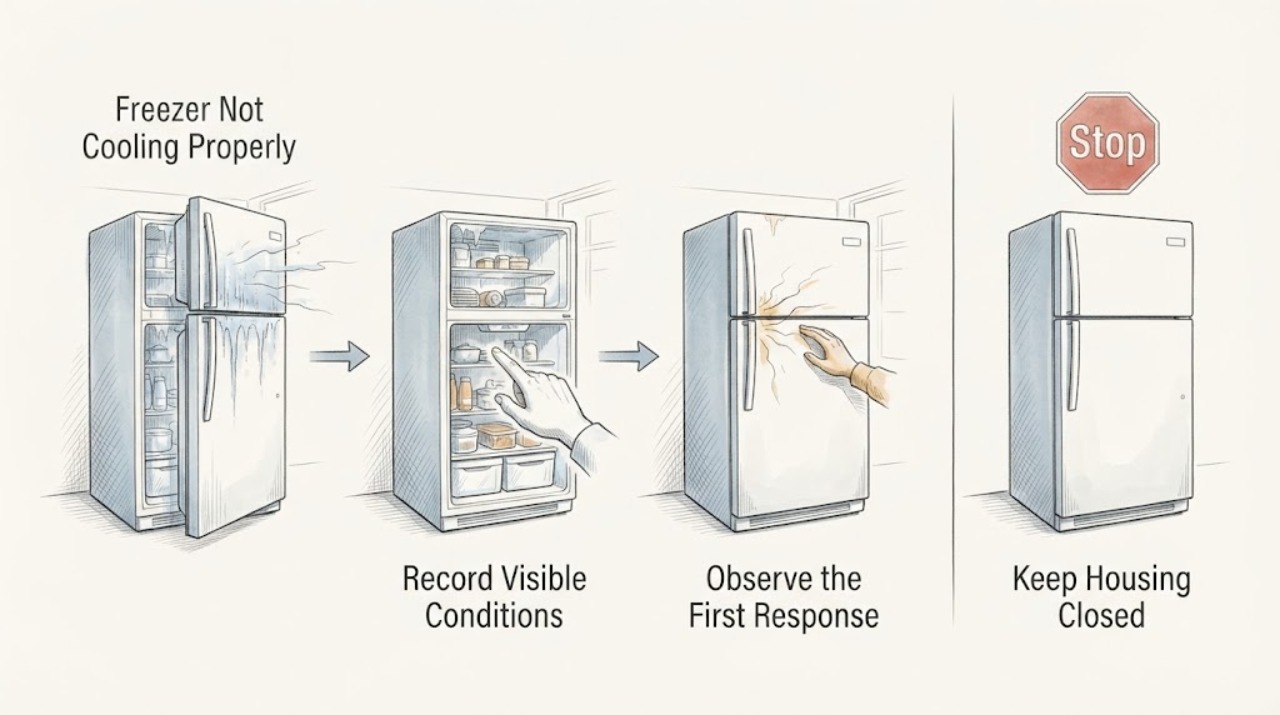
Work through in order
Diagnostic checks
Use only checks that match the exact appliance or system and its official guide.
-
Check 1
With the doors closed as much as possible, place an appliance thermometer in the freezer and record the freezer temperature, fresh-food temperature, and garage temperature at the same time. Confirm the label reads ASD2522WRW06 and note whether the garage is heated or unheated.
Expected result: The garage is below 55°F or above 110°F, the freezer reading fluctuates or is above its normal target while the refrigerator seems acceptable, or both compartments are warm.
Next step: If the room is outside the documented range, move the appliance to a climate-controlled location when practical and monitor there; if food is warming, protect it immediately. If the room is in range, continue with the external checks below.
Stop if: Do not keep perishable food in a freezer that is not maintaining a safe temperature, and do not remove an interior panel to inspect coils.
Why this matters
Why: Amana's side-by-side guidance describes 55°F to 110°F as the intended indoor range, and its garage guidance warns that cold conditions can alter compressor cycling and cause freezer fluctuations or partial thawing. A temperature trend is more useful than a single cold or warm touch test.
-
Check 2
Read the refrigerator and freezer controls from the front and verify that cooling is on and no showroom or demo indication is present. If a setting is clearly wrong, return it to the model-approved recommended setting and leave it unchanged while the thermometer records the trend.
Expected result: Cooling was off, a showroom/demo indication was present, or a control had been changed; alternatively, the controls were normal while the freezer remained warm.
Next step: Use only the exact ASD2522WRW06 owner instructions to change a mode or setting, then allow the appliance to stabilize before evaluating it again. Do not repeatedly turn controls to colder positions.
Stop if: Do not bypass a control, reset a breaker repeatedly, or open an electrical cover to prove that the compressor is receiving power.
Why this matters
Why: A disabled mode or changed control can explain warm compartments without proving a mechanical fault. Normal controls with a persistently warm freezer shift attention to the environment, airflow, seal, or a service-level cooling problem.
-
Check 3
From inside each compartment, identify the visible supply and return vents and check that packages are not pressed against them. Rearrange only food that is visibly blocking an opening, and keep both doors closed afterward.
Expected result: A package blocks a vent, the freezer has a concentrated frost or moisture area near an opening, or all visible openings are clear while the freezer stays warm.
Next step: Restore space around the openings and monitor the measured temperatures. Arrange service if frost blocks an inaccessible path or the freezer does not recover after the model's stabilization period.
Stop if: Do not chip ice, use a sharp tool, reach into a fan, or remove an evaporator cover.
Why this matters
Why: Amana explains that crowded loading can obstruct airflow between the freezer and fresh-food sections and create uneven temperatures. Clearing a visible obstruction can help; clear vents with persistent warmth or heavy inaccessible frost point beyond an ordinary loading fix.
-
Check 4
Inspect the freezer and refrigerator doors from a dry, visible position. Remove only a package that is holding a door open, then check that each gasket contacts the cabinet around the perimeter without an obvious gap. Also check that the appliance is not pressed against a heat source or blocking its base grille.
Expected result: A door does not close fully, a gasket has a visible gap or damage, the base grille is obstructed, or both doors seal and the grille is clear.
Next step: Remove only the obvious external obstruction and allow the unit to stabilize. If a gasket is damaged or the freezer remains warm, record the result for qualified Amana service.
Stop if: Do not pry out the gasket, remove door panels, move a heavy appliance alone, or work near live wiring.
Why this matters
Why: Warm, moist air entering through a door gap can cause frost and poor cooling; restricted ventilation or a heat source can also lengthen run time. A properly sealed unit with a clear grille and a warm freezer needs deeper diagnosis rather than a gasket or grille guess.
-
Check 5
After the external checks, keep a written temperature trend and note compressor or fan sounds, frost or condensation, recent power loss, and whether the fresh-food section stayed cold while the freezer warmed. Do not use a sound or frost impression to name a part.
Expected result: The freezer returns to a stable normal temperature after the garage environment or an obvious external issue is corrected, or it repeatedly warms despite normal room temperature, settings, airflow, and sealing.
Next step: For persistent or recurring warming, move food to safe storage and arrange qualified Amana appliance service with the full model, temperature trend, garage conditions, and observations.
Stop if: Stop using the refrigerator if there is a burning odor, repeated breaker trip, overheating, leaking, exposed wiring, or food-safety uncertainty; do not open the sealed system or perform live tests.
Why this matters
Why: Recovery after an environmental or external correction supports that explanation. Repeated freezer warming with a normal refrigerator section can still involve controls, defrost, airflow, compressor, or sealed cooling components, but the pattern does not identify which one.
Use your observations
Decision map
Find the observation that best matches what you see, then follow the next safe action.
-
PATH 01Next step
What you see
The garage is cold or otherwise outside Amana's stated indoor range, the freezer temperature fluctuates or partially thaws, and the fresh-food section appears colder.
Do this next
Confirm the exact model's allowed environment, move the unit to a climate-controlled location when possible, and monitor with a thermometer before authorizing parts or repair.
Why this path and its safety boundary
Why it matters: The environment is a credible explanation for a freezer-only pattern on a standard refrigerator; it is not proof that the compressor or thermostat has failed.
-
PATH 02Next step
What you see
The garage is within the documented range, the settings are normal, vents and doors are clear, and the freezer remains warm on repeated measurements.
Do this next
Protect food and request qualified Amana service with the model number and temperature trend; leave sealed-system and electrical diagnosis to the technician.
Why this path and its safety boundary
Why it matters: An appliance-level cooling, control, airflow, or defrost problem becomes more likely, but these observations do not select a specific component.
-
PATH 03Next step
What you see
A visible package or gasket gap explains warm-air entry, or a grille obstruction is corrected and the freezer steadily recovers.
Do this next
Keep the doors closed, preserve normal clearance, and recheck temperatures after stabilization. Escalate if the symptom returns.
Why this path and its safety boundary
Why it matters: The result supports an external airflow or sealing cause rather than proving a failed internal part.
-
PATH 04Next step
What you see
Heavy frost blocks an inaccessible air path, food has thawed, or the appliance shows a burning odor, repeated breaker trip, leak, or overheating.
Do this next
Protect the food and people, isolate power only from a dry safe location if necessary, and arrange qualified appliance service. Do not chip ice or restore power just to test it.
Why this path and its safety boundary
Why it matters: The issue has crossed the ordinary observation boundary and includes food, electrical, or cooling-system risk.
Helpful context
Understand the symptom
This side-by-side symptom is not automatically a freezer-part diagnosis. A cold garage can make a standard refrigerator cycle differently, while a warm garage, blocked grille, poor seal, or a real cooling fault can produce a similar reading. The complete ASD2522WRW06 label and the measured temperatures matter more than a guess based on the model family.
Use the observations below to separate an environment problem from a persistent appliance problem. Move food to a known-safe cold location if the freezer is warming, and do not remove panels or disturb the sealed refrigeration system to obtain a frost pattern.
When checks do not resolve it
Need a professional?
Arrange qualified Amana appliance service when the freezer remains warm after the room, controls, airflow, and door seal are normal; when temperatures fluctuate repeatedly; or when diagnosis would require electrical, fan, defrost, compressor, refrigerant, or sealed-system access. Provide the complete ASD2522WRW06 model label, both compartment readings, garage temperature, and the trend.
Common questions
FAQ
Does putting the ASD2522WRW06 in a garage explain a warm freezer?
It can, especially in a cold garage, because Amana warns that standard refrigerators may cycle differently and the freezer may fluctuate or partially thaw outside the intended environment. Verify the garage temperature and the exact model documentation before treating the garage as the only cause.
Should I replace the thermostat, fan, or compressor based on this pattern?
No. A freezer-only temperature pattern does not identify a part. Record the temperatures and external observations, protect food, and use qualified service when the issue persists after safe environment, setting, airflow, and seal checks.
Read the exact guide
Official sources
- How Garage-Ready Refrigerators WorkAmana · Amana garage-ready versus standard refrigerator operating guidance
- Manuals and Guides | AmanaAmana · Amana owner-manual lookup for the topic model ASD2522WRW06; model-specific settings and limits must be confirmed by entering the full model number
- Dimension GuideAmana · Amana ASD2522WR side-by-side refrigerator family and location requirements; W06 suffix still requires exact manual confirmation
- Refrigerator working intermittentlyReddit r/appliancerepair
- Not Cooling - Refrigerator Section - Side by Side RefrigeratorAmana · Amana side-by-side refrigerator temperature, garage, controls, airflow, door, and service guidance; exact model settings require the owner manual
- What is the Proper Location and Environment for a RefrigeratorAmana · Amana refrigerator location, ventilation, ambient temperature, and garage environment guidance
Community feedback
Share a repair observation
Share a plain-text repair observation. Accepted observations are published automatically; this page may take a moment to update.