
On this page
Start here
Quick answer
For an Amana refrigerator that appears not to defrost, start with the visible causes Amana documents: a door gasket that is obstructed or not sealing and blocked interior air vents. Keep the door closed while checking, protect food if temperatures are rising, and stop short of removing panels or testing defrost components because no model was supplied. If frost returns or the refrigerator cannot hold temperature after the external checks, use the exact model manual and arrange qualified service.
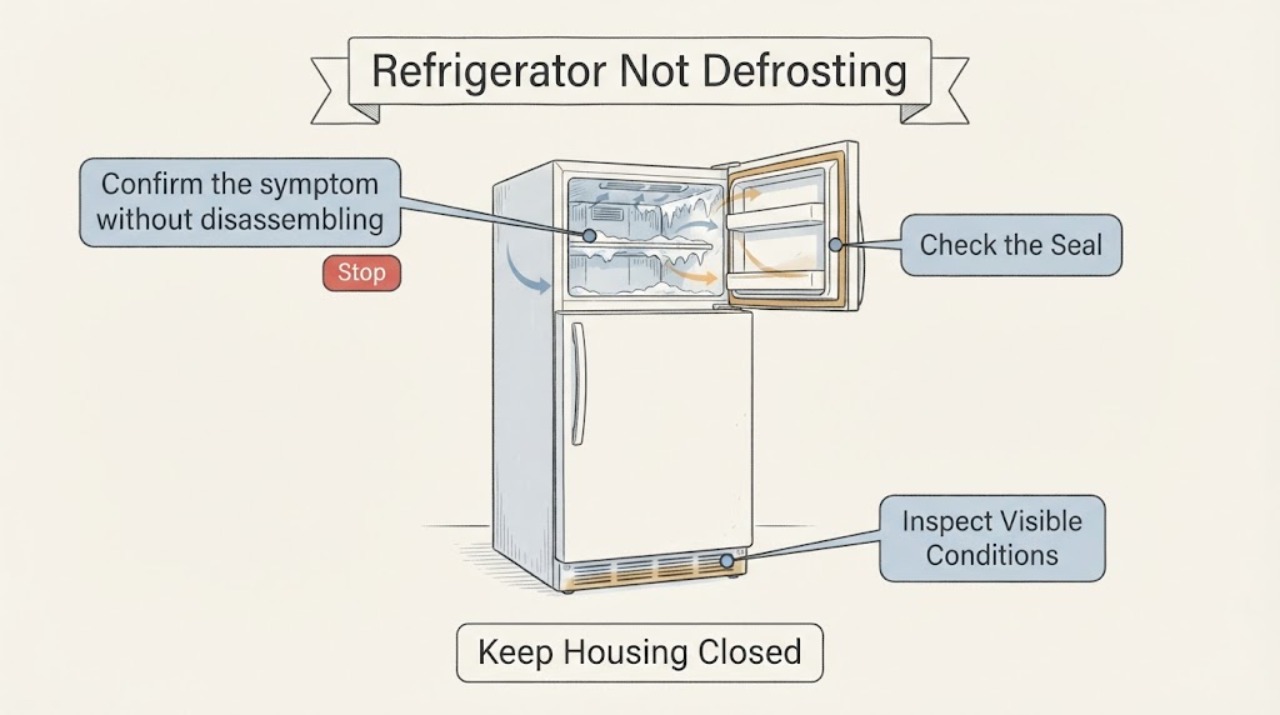
Work through in order
Diagnostic checks
Use only checks that match the exact appliance or system and its official guide.
-
Check 1
Confirm the symptom without disassembling the refrigerator: note where frost is visible, whether the freezer is still cold, and whether food is soft or warming.
Expected result: A light, localized frost condition with normal cooling is different from heavy frost that blocks vents or a cabinet that is warming.
Next step: Protect perishable food if temperatures are rising, then continue only with the external checks below; arrange service if cooling is not maintained.
Why this matters
Why: A warming cabinet or frost that blocks airflow needs prompt service attention; the observation does not prove which defrost component failed.
-
Check 2
With the door closed and the appliance unplugged only if you need to safely look at the gasket edge, check that food packages, shelves, or ice are not preventing the door from closing and that the door gasket is not visibly obstructed.
Expected result: The door closes evenly around the gasket, or there is a gap, obstruction, torn section, or frost at the sealing edge.
Next step: Remove only the accessible obstruction and close the door fully; monitor whether new frost stops.
Stop if: Do not force or reshape the gasket. Use the exact model documentation or qualified service if the seal is damaged or the gap remains.
Why this matters
Why: An obstructed or poorly sealing door can admit warm, moist air and promote frosting; a clear, intact seal makes this external cause less likely.
-
Check 3
Inspect the freezer's user-accessible air vents and keep them clear of packages or accumulated ice; reduce unnecessary door openings while the appliance is being observed.
Expected result: Air passages are clear, or frost/packages are covering a vent and restricting circulation.
Next step: Rearrange only movable packages and follow the exact model's approved defrost instructions. Do not pry ice loose or remove panels.
Why this matters
Why: Blocked airflow can worsen uneven temperatures and frost; a clear vent does not rule in or rule out an internal defrost fault.
-
Check 4
Find the refrigerator model number before looking for a reset, defrost procedure, or replacement part.
Expected result: The model label is available on the upper-right interior wall, or it cannot be read.
Next step: Enter the exact model in Amana's manual lookup. If the label is missing or unreadable, give the model and symptom to an authorized technician rather than borrowing instructions from another refrigerator.
Why this matters
Why: The model number controls which manual, user-serviceable instructions, and parts are applicable; without it, a generic heater/timer/sensor procedure would be speculation.
Use your observations
Decision map
Find the observation that best matches what you see, then follow the next safe action.
-
PATH 01Next step
What you see
The gasket is obstructed or the door is not closing evenly, and frost is concentrated near the door edge.
Do this next
Clear the obstruction, close the door fully, and monitor cooling. Escalate if the gasket is damaged or frost returns.
Why this path and its safety boundary
Why it matters: Warm, moist room air may be entering and creating the frost pattern; this is an external sealing issue to correct first.
-
PATH 02Next step
What you see
The gasket and visible vents are clear, but heavy frost returns or blocks airflow.
Do this next
Stop short of panel removal or live testing, obtain the exact model manual, and arrange qualified appliance service.
Why this path and its safety boundary
Why it matters: The visible checks did not identify the cause; the pattern is compatible with a defrost or airflow problem but does not identify a failed component.
-
PATH 03Next step
What you see
The freezer or refrigerator is warming, food is softening, or the cabinet cannot hold its normal temperature.
Do this next
Protect perishable food and arrange service promptly; do not keep repeatedly operating an appliance that is not maintaining temperature.
Why this path and its safety boundary
Why it matters: This is a cooling and food-safety concern, regardless of whether frost is present.
Helpful context
Understand the symptom
What this symptom does and does not establish
The supplied lead's searchable text describes a 24-year-old Amana refrigerator whose freezer is not defrosting, but the exact Reddit page could not be opened for public citation. The symptom is therefore kept at the freezer-frost/defrosting level. Frost alone does not identify a heater, timer, sensor, fan, or control-board failure. This page stays with checks that are visible to the owner and identifies when the exact model manual or service is needed.
Before you inspect
Keep the refrigerator door closed as much as practical. If the freezer or refrigerator is warming, move perishable food to a reliably cold appliance or other safe cold storage rather than repeatedly running a refrigerator that cannot hold temperature. Do not chip at ice, apply a heat gun or hair dryer, pierce an ice bank, remove an interior panel, or make live electrical measurements.
When checks do not resolve it
Need a professional?
Call qualified Amana appliance service when frost returns after the accessible door and vent checks, cooling is deteriorating, the gasket is damaged, the model-specific procedure is unclear, or any panel/electrical/ sealed-system work would be required.
Common questions
FAQ
Does frost prove the Amana defrost heater is bad?
No. Frost can be associated with a door-sealing or airflow condition, and the frost symptom alone cannot identify a heater, timer, sensor, fan, or control-board failure. Use the exact model documentation or qualified service for component diagnosis.
Where do I find the Amana refrigerator model number?
Amana's manual lookup guidance places the refrigerator model number on the upper-right interior wall. Use that exact number to retrieve the applicable manual or troubleshooter.
Should I keep using the refrigerator while it is warming and frosting?
Protect perishable food if the cabinet is warming and arrange service. Avoid repeated test runs, ice removal with tools, direct heat, panel removal, and live electrical testing.
Read the exact guide
Official sources
- Troubleshooting Refrigerator Temperature IssuesAmana · Opened official Amana general refrigerator guidance. It supports external frost, gasket, and airflow checks, not a model-specific defrost-component diagnosis.
- Manuals and GuidesAmana · Opened official Amana manual lookup page. The assigned task supplies no exact refrigerator model.
Community feedback
Share a repair observation
Share a plain-text repair observation. Accepted observations are published automatically; this page may take a moment to update.