
On this page
Start here
Quick answer
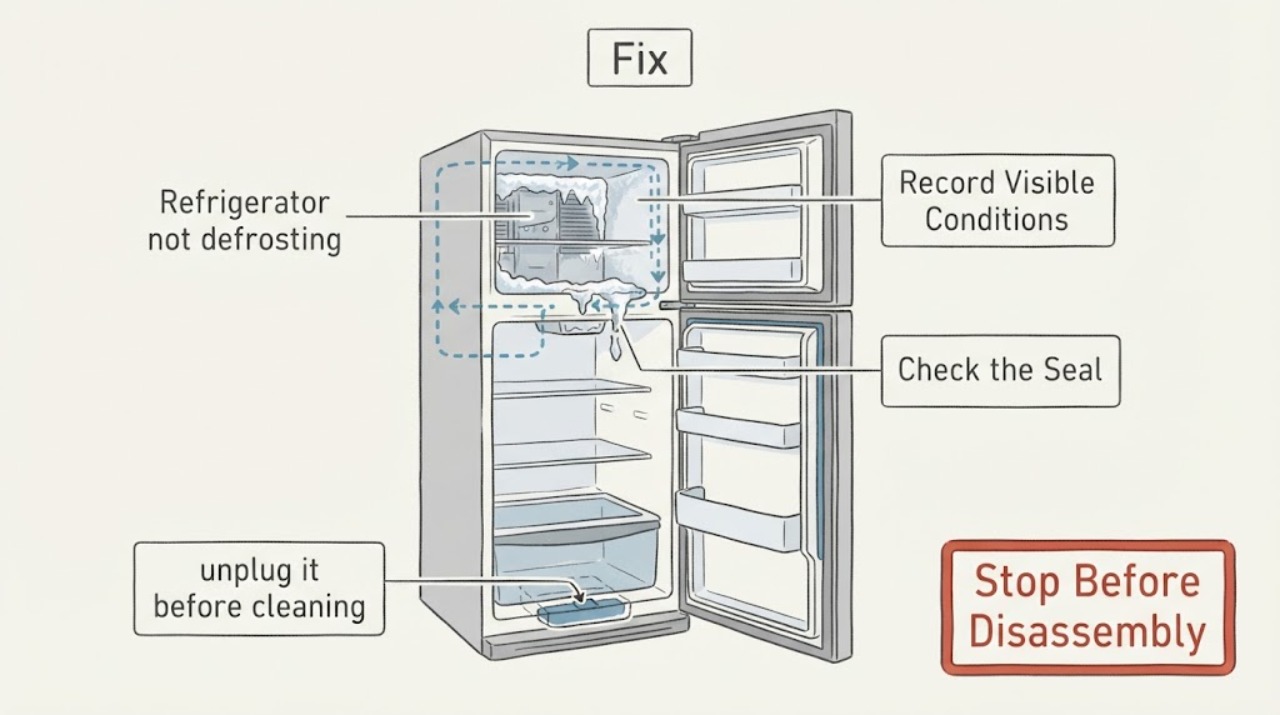
First determine whether the Haier model is manual, semi-automatic or automatic/frost-free defrost. Haier says some refrigerators need manual defrost, while frost-free models can still show some frost; a thin back-wall frost that melts and drains can be normal, while repeated heavy ice, blocked airflow or a frost sheet that returns after thawing needs model-matched service. Follow only the exact manual for a manual-defrost cycle, unplug before cleaning, let ice thaw naturally, and never chip ice with a sharp tool or apply an unapproved heat source. If water reaches electrical parts, the refrigerator cannot be safely powered down, food temperature is unsafe, or heavy frost repeatedly returns on an automatic model, stop and call Haier service.
Work through in order
Diagnostic checks
Use only checks that match the exact appliance or system and its official guide.
-
Check 1
Record the complete model number and read the matching Haier manual or product page to identify whether the refrigerator is manual, semi-automatic, frost-shield or automatic/frost-free defrost; do not infer the design from the word “no frost” alone.
Expected result: The manual identifies a manual/semi-automatic cycle, or it identifies an automatic/frost-free system; the model information is missing or does not match.
Next step: Use only the matching manual’s defrost and cleaning instructions. If the model cannot be identified, stop before removing panels or selecting a repair procedure.
Why this matters
Why: Haier states that some refrigerators need manual defrost and that frost-free does not mean zero frost. A specific Haier product page also labels a model as semi-auto defrost, so defrost behavior is model-dependent.
-
Check 2
With the doors closed between observations, inspect the visible back wall, freezer floor, air openings, door gasket and food clearance without scraping or dismantling anything; note whether frost is a thin patch that later melts or a thick sheet that remains and returns.
Expected result: A thin back-wall frost appears intermittently and drains, or heavy frost blocks space/airflow and persists or returns quickly.
Next step: For the intermittent thin pattern, reduce door-open time, keep the door fully sealed and keep high-moisture food covered and away from the back wall. For persistent heavy frost, use the exact manual-defrost branch or arrange service; do not chip the ice.
Why this matters
Why: Haier describes intermittent back-wall frost that melts to the discharge outlet as a normal humidity-related phenomenon, while recurring or extensive frost is not the same condition and can require service.
-
Check 3
If the matching manual says the unit is manual or semi-automatic defrost, unplug it before cleaning and follow only that manual’s food-removal and thawing instructions; use towels for meltwater and allow the ice to thaw without a knife, pick, scraper, hair dryer, heat gun, boiling water or other unapproved heat source.
Expected result: Ice clears during the manual’s permitted thaw and stays clear, or the frost returns, will not clear, or the manual does not authorize the proposed method.
Next step: If the approved thaw does not resolve the condition or frost returns, keep the appliance off as needed to protect food and arrange Haier service. Do not open the evaporator or electrical compartment.
Why this matters
Why: A manual-defrost appliance is not evidence of a failed automatic heater or sensor. Recurrent frost after a correct model-approved thaw needs diagnosis rather than a sharper tool or hotter method.
-
Check 4
If the model is automatic/frost-free, check only door closure, door-open frequency, covered high-moisture food and whether stored items obstruct visible air openings; do not remove an interior cover or test a heater, sensor, fan or control board.
Expected result: Frost is linked to a door/seal or moisture pattern, or a thick layer returns despite a closed door and normal loading.
Next step: Correct only the visible loading/closure condition and monitor. If heavy frost returns, cooling falls, food is warming or the model manual gives no user check, stop and request model-matched service.
Why this matters
Why: Haier identifies humidity, door closure and high-moisture storage as frost contributors, but repeated heavy frost on an automatic model is not proof of a specific failed component.
-
Check 5
If meltwater or a reservoir is visible at the back, do not reach beside the compressor or electrical parts and do not remove a cover or reservoir unless the exact manual explicitly permits it; keep water away from the electrical area.
Expected result: Water is near electrical parts, a rear reservoir overflows, or the leak source is not the visible defrost path.
Next step: Keep the refrigerator off if water can reach wiring or the outlet, isolate the water safely, protect food, and arrange qualified Haier service.
Why this matters
Why: Haier explains that defrost water normally goes to a reservoir, but warns about nearby electrical parts and says other causes require service.
Use your observations
Decision map
Find the observation that best matches what you see, then follow the next safe action.
-
PATH 01Next step
What you see
If the model manual identifies manual or semi-automatic defrost
Do this next
Use only the manual’s permitted unplugged thaw/cleaning process; never chip ice or apply an unapproved heat source.
Why this path and its safety boundary
Why it matters: The presence of frost alone does not show an automatic defrost failure.
-
PATH 02Next step
What you see
If the model is automatic/frost-free and frost is thin on the back wall, intermittent and able to melt/drain
Do this next
Improve door closure and moisture control, then monitor; persistent or spreading frost requires service.
Why this path and its safety boundary
Why it matters: Haier describes this as a potentially normal humidity/evaporator pattern rather than proof of a failed defrost part.
-
PATH 03Next step
What you see
If thick frost returns quickly, blocks airflow, warms food, or is accompanied by water near electrical parts
Do this next
Stop using the refrigerator when unsafe and arrange qualified Haier service with the complete model number and frost/temperature history.
Why this path and its safety boundary
Why it matters: The issue is outside a safe model-free user adjustment and may involve drainage, defrost or another protected system.
Helpful context
Understand the symptom
Normal frost and failed defrost are different decisions
Haier’s official guidance distinguishes manual and automatic defrost designs and describes some intermittent back-wall frost as normal. The exact model and its manual control whether any thaw or cleaning step is permitted.
When checks do not resolve it
Need a professional?
Stop and arrange Haier service if heavy frost returns after the exact manual’s permitted thaw, cooling or food temperature is affected, the model is automatic but repeatedly ices, water reaches electrical parts, the plug/outlet is wet, or a cover/internal part would need removal. Do not use knives, picks, sharp scrapers, hair dryers, heat guns, boiling water, live tests or improvised bypasses.
Common questions
FAQ
Does frost prove that a Haier refrigerator is failing to defrost?
No. Haier says all refrigerators/freezers can frost, some defrost automatically and others manually, and frost-free does not mean zero frost. The location, thickness, recurrence and model defrost design must be identified first.
Can I scrape or heat the ice away?
Do not use a knife, pick, sharp scraper or unapproved heat source. Unplug and follow only the exact model manual’s permitted thaw/cleaning method; if the method is unknown or frost returns, use qualified service.
Read the exact guide
Official sources
- Icing up in the refrigerator compartmentHaier India · Opened Haier’s official troubleshooting page. It explains that some back-wall frost can melt and drain normally, identifies humidity/door/food-placement contributors, and sends unresolved cases to service. The article does not copy its model-unknown hole-clearing suggestion.
- Haier HR-225MDSHaier Iraq · Opened Haier’s official product page only to verify that a concrete Haier refrigerator is labeled Semi Auto Defrost. This is an example of model variation, not a claim that the assigned refrigerator is HR-225MDS.
- No frostHaier India · Opened Haier’s official support page. It clarifies that frost-free does not mean zero frost and that frost-shield/manual-defrost behavior varies by model; no universal timing is applied to this task.
- Refrigerator defrostHaier India · Opened Haier’s official refrigerator troubleshooting page. It states that some refrigerators defrost automatically while others require manual defrost, and gives general door/moisture precautions. Exact model instructions still control.
- Water leakage from the back of the refrigeratorHaier India · Opened Haier’s official support page. It explains that defrost water normally reaches a reservoir, warns about nearby electrical parts, and directs other causes to service. Its model-specific reservoir access suggestions are not generalized here.
Community feedback
Share a repair observation
Share a plain-text repair observation. Accepted observations are published automatically; this page may take a moment to update.