
On this page
Start here
Quick answer
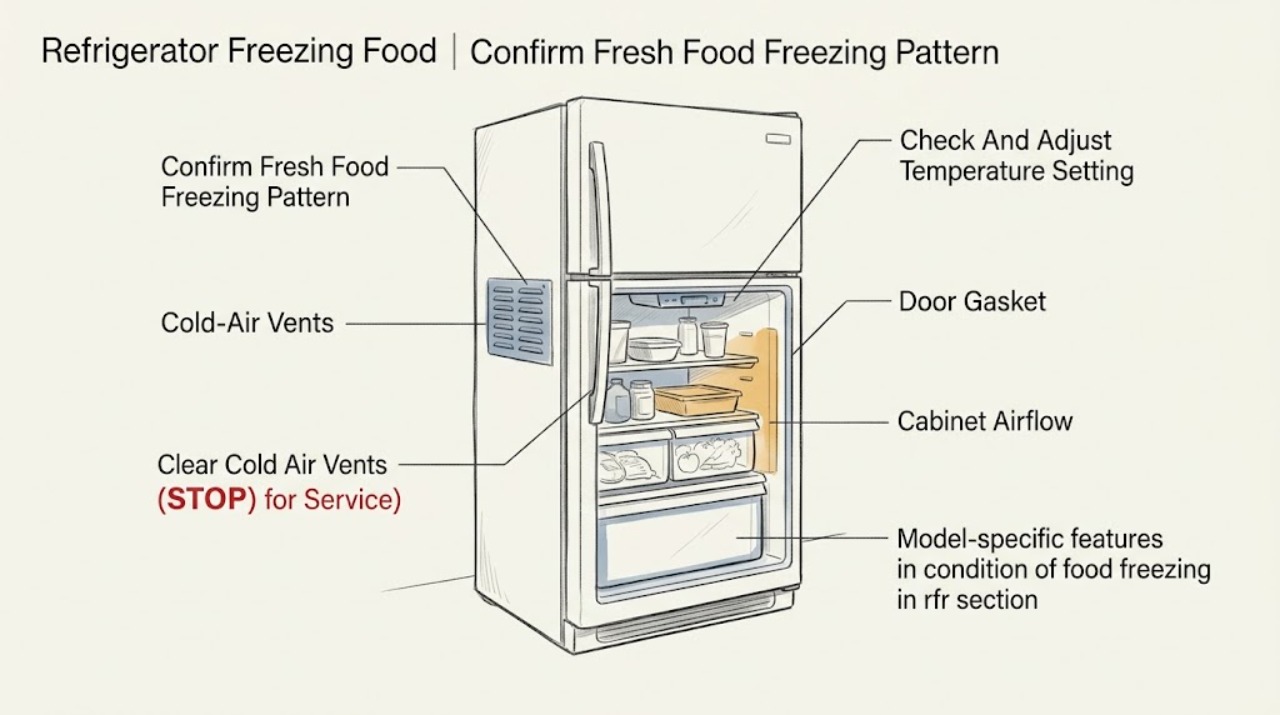
If food is freezing in the fresh-food section—not simply in the freezer—Haier's first checks are a temperature setting that is too cold and food blocking the cold-air outlet or return vent. Move food away from the vents, set the refrigerator slightly warmer using the exact model controls, and allow the unit to stabilize before judging the result; Haier gives 35–40°F as a general fresh-food target but notes that ranges vary by product. Check whether only items next to one vent freeze or the whole section does, and inspect the door gasket and door-opening pattern for an air leak. Do not block a vent, dismantle the liner, scrape ice with a sharp tool, or change a sensor or damper yourself. If the entire fresh-food section keeps freezing after the model setting, airflow, food placement, and gasket checks are correct, arrange qualified appliance service.
Before you begin
Safety first
- The owner may relocate food, inspect accessible vents and gasket, make one model-documented warmer setting adjustment, and monitor after stabilization. Internal air channels, sensors, dampers, controls, fans, electrical parts, and sealed refrigeration components require qualified service.
Work through in order
Diagnostic checks
Use only checks that match the exact appliance or system and its official guide.
-
Check 1
Identify the frozen item and its exact location in the fresh-food/refrigerator compartment. Note whether it touches the rear wall, sits beside a cold-air vent, is in a door bin or crisper, or whether many shelves and containers are freezing. If available, record a stable compartment temperature with a suitable appliance thermometer rather than guessing from one item.
Expected result: Only items near one outlet or wall freeze, several areas freeze, the entire fresh-food section is freezing, or the freezer is the only compartment affected.
Next step: For fresh-food freezing, continue with the setting and vent checks. If only the freezer is involved, use freezer-specific guidance instead of changing the refrigerator control.
Stop if: Do not use an ice pick, knife, heat gun, or other tool to remove ice or open a vent; do not insert a thermometer into a sealed component.
Why this matters
Why: A local cold spot makes placement or concentrated airflow more likely. Widespread fresh-food freezing points toward the setting, a control/airflow imbalance, or a model-specific fault. Freezer-only freezing is expected operation and is outside this topic.
-
Check 2
Read the exact Haier model's refrigerator temperature control and confirm it is not at an unusually cold setting or in a model-specific rapid-cooling mode. If the control is clearly too cold, make one slightly warmer adjustment using the documented controls, then leave it unchanged for the model's stabilization period.
Expected result: The setting was too cold, the setting is correct but food still freezes, the control or mode is unclear, or the refrigerator has not yet had time to stabilize after a change.
Next step: Allow the setting to stabilize before making another judgment. Retrieve the manual if the control or rapid-cooling state is unclear; if freezing continues at the documented setting, continue to vents and food placement rather than making repeated adjustments.
Stop if: Do not repeatedly move the control to extremes, enter service mode, or replace a thermostat or sensor based on the symptom alone.
Why this matters
Why: Haier lists an overly cold setting as the first fresh-food freezing cause. A correct setting with persistent freezing is less likely to be solved by further dial changes and may involve airflow, sensing, damper, or control diagnosis.
-
Check 3
Inspect the accessible fresh-food air outlet and return areas identified by the manual. Move containers, bags, and produce away from the vents and rear wall without removing interior covers; leave space for air circulation and avoid placing a sensitive item directly in a cold-air stream.
Expected result: A package was against a vent or rear wall, an outlet or return was blocked, only vent-adjacent items freeze, or the vents and placement are clear but freezing is widespread.
Next step: Keep the vents clear and monitor after the temperature setting stabilizes. If the same areas freeze despite clear airflow and appropriate placement, arrange service rather than opening the air channel.
Stop if: Do not remove the evaporator cover, fan shroud, damper, or liner, and do not force food into a vent to test airflow.
Why this matters
Why: Haier directly links fresh-food freezing to blocked cold-air outlets or returns. A local improvement after repositioning supports concentrated airflow or placement as the cause; no improvement with clear vents makes a control or sensor issue more plausible.
-
Check 4
Visually inspect the door gasket all around for a tear, split, fold, dirt, or a section that does not contact the cabinet. Note frequent or prolonged door opening, wet or unwrapped food, packages holding the door open, and frost or moisture on the rear wall. Do not pull the gasket out or use heat to reshape it.
Expected result: The gasket has a gap or damage, the door is held open by packages, frost follows prolonged opening or wet food, or the door and gasket appear sound.
Next step: Remove an accessible package obstruction and clean an intact gasket only with the model-approved method. Arrange model-confirmed gasket or appliance service for a tear, split, persistent gap, or continued freezing after the door closes normally.
Stop if: Do not glue, oil, stretch, heat, or substitute a gasket, and do not disable the door switch or leave the door propped open.
Why this matters
Why: Haier associates poor gasket sealing and warm, wet air entering the compartment with frost and moisture; an air-infiltration pattern can make local cold spots worse. A sound seal makes the temperature setting and internal airflow/control branches more important.
-
Check 5
After the one permitted setting adjustment has stabilized and the vents, food placement, door, and gasket are correct, compare the same locations again. Record the model number, setting, temperature pattern, frozen locations, frost or moisture, and whether the freezer remains normal.
Expected result: Freezing stops after repositioning or the warmer setting, only one local cold spot remains, the entire fresh-food section still freezes, or frost and temperature problems continue.
Next step: Monitor a stable refrigerator without further control changes. For persistent or widespread fresh-food freezing, arrange qualified Haier appliance service and provide the recorded pattern; protect food that has been frozen or warmed as appropriate.
Stop if: Do not dismantle the liner, bypass a sensor or damper, puncture tubing, or continue using the refrigerator if it cannot maintain safe food conditions.
Why this matters
Why: A corrected local issue supports placement, airflow, or setting as the cause. Persistent whole-compartment freezing or continuing frost after external checks may require diagnosis of a temperature sensor, damper, control, or other inaccessible component.
Use your observations
Decision map
Find the observation that best matches what you see, then follow the next safe action.
-
PATH 01Safety boundary
What you see
Only food in the freezer compartment is frozen; the fresh-food section remains within its intended range.
Do this next
Use freezer-specific temperature or frost guidance if needed; do not raise the refrigerator setting for a freezer symptom.
Why this path and its safety boundary
Why it matters: Freezing is expected in the freezer and does not establish a fresh-food overcooling problem.
Safety stop: Do not disable freezer cooling or block the freezer vents.
-
PATH 02Safety boundary
What you see
Only items beside a cold-air outlet or rear wall freeze, and a package or container is restricting the outlet, return, or circulation.
Do this next
Move items away from the vent and rear wall, keep the air path clear, and reassess after the setting stabilizes.
Why this path and its safety boundary
Why it matters: Concentrated airflow or food placement is more likely than whole-compartment overcooling.
Safety stop: Do not remove internal vent covers or pack food against the liner to shield it.
-
PATH 03Safety boundary
What you see
The fresh-food control is colder than the model's recommended setting or a rapid-cooling mode is active, with no widespread frost or gasket issue.
Do this next
Make one modest warmer adjustment using the exact manual and allow the documented stabilization period before changing it again.
Why this path and its safety boundary
Why it matters: The control setting is a plausible direct cause of fresh-food freezing.
Safety stop: Do not turn the control repeatedly or use an unverified service-mode setting.
-
PATH 04Safety boundary
What you see
The gasket has a gap or damage, packages hold the door open, or frost/moisture follows frequent opening, wet food, or unwrapped food.
Do this next
Remove the accessible obstruction and clean an intact gasket as directed; arrange service for gasket damage or a persistent seal gap.
Why this path and its safety boundary
Why it matters: Air and moisture infiltration is more likely and can create frost and temperature instability.
Safety stop: Do not heat, glue, stretch, or remove the gasket, and do not leave the door propped open.
-
PATH 05Safety boundary
What you see
The entire fresh-food section freezes after the setting has stabilized and vents, placement, door, and gasket are correct.
Do this next
Stop owner troubleshooting, record the exact model and temperature pattern, and arrange qualified appliance service.
Why this path and its safety boundary
Why it matters: An internal airflow, temperature-sensing, damper, or control fault remains possible; external checks no longer explain the symptom.
Safety stop: Do not open the evaporator area, bypass a sensor, add refrigerant, or scrape ice with sharp or heated tools.
Helpful context
Understand the symptom
Define the symptom as fresh-food freezing
A freezer should freeze food. This page concerns milk, produce, drinks, or other items freezing in the refrigerator/fresh-food compartment. Record whether the ice is limited to items touching the rear wall or a cold-air outlet, or whether the whole compartment is below its intended range. That location changes the next check.
Use the model control, then wait before changing it again
Haier's general guidance places the fresh-food target around 35–40°F, but controls and actual ranges vary by product. Start from the exact manual's recommended setting, make one modest warmer adjustment when appropriate, and allow the documented stabilization time. Rapidly changing the control makes the result harder to interpret and does not repair a persistent sensor or airflow fault.
A local cold spot and whole-compartment freezing are different branches
Items immediately beside an outlet or against the rear wall can freeze while the rest of the compartment is normal if airflow or placement concentrates cold air. Widespread freezing after the setting is corrected is a stronger reason to stop owner adjustments and have the model's temperature sensing, damper, or control system diagnosed.
Safety boundary
Stop conditions
- Stop owner troubleshooting if the fresh-food section remains frozen after the exact setting, clear vents, correct placement, and sound gasket have been verified.
- Do not use knives, picks, heat guns, or other mechanical or heated tools to remove frost or access the air channel.
- Do not bypass or replace a temperature sensor, damper, thermostat, control, fan, or sealed-system component without qualified diagnosis and exact model fitment.
- Protect food and arrange service if the refrigerator cannot maintain a safe, stable fresh-food temperature or if water, electrical damage, smoke, or burning odor appears.
Only after diagnosis
Potential parts
- door gasket
Consider only when the exact model's gasket is torn, split, warped, or fails to seal after permitted cleaning and seating.
Gaskets are model-specific. Fresh-food freezing alone does not prove gasket failure, and the gasket should not be glued, heated, or stretched. - temperature sensor, damper, or control assembly
Consider only after qualified diagnosis finds widespread fresh-food freezing with correct setting, unobstructed vents, sound gasket, and correct food placement.
Sensor, damper, control, fan, and sealed-system parts vary by model. Do not order or replace one from the freezing symptom alone.
When checks do not resolve it
Need a professional?
Arrange qualified Haier appliance service when the whole fresh-food section continues freezing at the model-recommended setting, when clear vents, correct placement, and a sound gasket do not resolve the issue, or when frost and temperature fluctuations persist. Use the exact model manual for controls and settings. Stop immediately for smoke, burning odor, water near electrical parts, damaged wiring, or another electrical hazard.
Safety scope: The owner may relocate food, inspect accessible vents and gasket, make one model-documented warmer setting adjustment, and monitor after stabilization. Internal air channels, sensors, dampers, controls, fans, electrical parts, and sealed refrigeration components require qualified service.
Common questions
FAQ
Why is food freezing in my Haier refrigerator but not the freezer?
For fresh-food freezing, check whether the refrigerator setting is too cold and whether a package blocks a cold-air outlet or return. Move food away from vents, make one modest warmer adjustment using the model manual, and allow stabilization before judging the result.
What temperature should a Haier refrigerator be?
Haier gives 35–40°F as a general ideal fresh-food range but says actual ranges vary by product. Use the exact model's recommended setting and allow the refrigerator to stabilize before making another adjustment.
Can a door gasket cause food to freeze in the refrigerator section?
A poor gasket can let warm, moist air in and create frost or temperature instability, but a gasket alone does not prove why fresh food is freezing. Inspect its contact and damage, clear door obstructions, and arrange service for a persistent gap or continued freezing after external checks.
Read the exact guide
Official sources
- Haier - Temperature Control SettingsHaier Appliances · Supports one-change-at-a-time and stabilization reasoning; exact control positions and ranges are model-specific.
- Haier - Normal Refrigerator TemperaturesHaier Appliances · Supports the distinction between fresh-food freezing and normal freezer operation; Haier notes that actual ranges vary by product.
- Haier - Refrigerator Too Cold / Food FreezingHaier Appliances · Directly supports the assigned fresh-food freezing topic for full-size and compact refrigerators; exact controls vary by model.
- Haier Refrigerator - Ice or Frost Forming on Back WallHaier Appliances · Supports the door-seal and moisture branch when fresh-food freezing is accompanied by frost or ice; frost-free behavior varies by model.
- Haier - Refrigerator Running but Not CoolingHaier Appliances · Supports general airflow, gasket, and door-pattern reasoning; it is used here only for relevant fresh-food symptoms.
Community feedback
Share a repair observation
Share a plain-text repair observation. Accepted observations are published automatically; this page may take a moment to update.