
On this page
Start here
Quick answer
First determine whether the flicker is the interior lamp, a dual-drawer lamp, or only the control-panel LEDs, then record the exact model and whether the symptom follows a door or drawer movement. Haier says standard refrigerator interior LEDs are designed to last for the life of the refrigerator and that a failed LED should be handled by a qualified technician. On Haier dual-drawer models, the drawer lights respond to drawer opening and closing and the light system depends on magnets, so do not remove or reposition those magnets. Some Haier compact refrigerators use a replaceable interior bulb; only for that exact architecture, disconnect power before checking that the bulb is tight or replacing it with the same type specified by the manual. A light that turns off after a door has been left open for more than about seven minutes can be normal on applicable models, while electronic control-panel LEDs may go dark after inactivity and relight when a button or door is operated. If interior lights, display, cooling, or other appliances flicker together, or there is heat, a burning smell, smoke, water near electrical parts, sparking, or a tripping breaker, stop using the refrigerator and arrange qualified appliance or electrical service. Do not remove panels, probe live wiring, splice an LED, bypass a door or drawer sensor, or force a door closed.
Before you begin
Safety first
- This article covers model identification, normal door and drawer observation, display-timeout observation, and the narrowly conditional power-off check for a confirmed Haier compact-refrigerator bulb. Do not remove LED lenses or refrigerator panels, bypass sensors or magnets, test live circuits, splice wiring, or access internal controls.
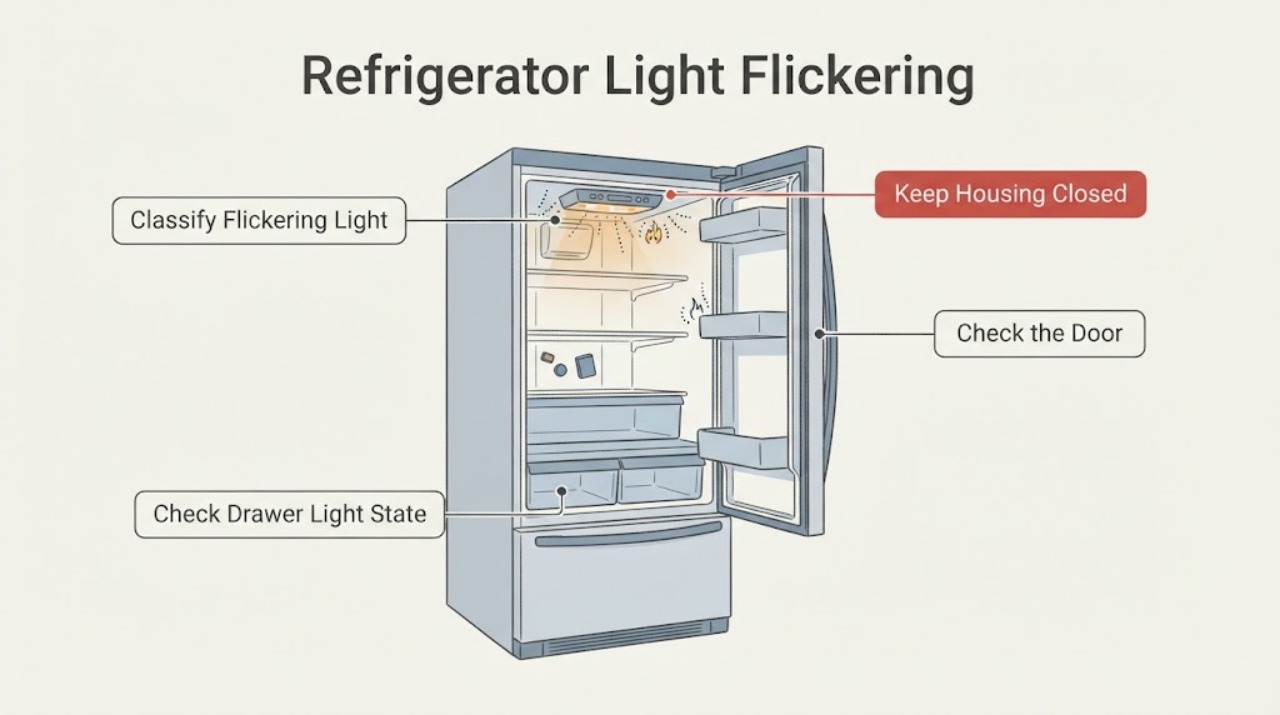
Work through in order
Diagnostic checks
Use only checks that match the exact appliance or system and its official guide.
-
Check 1
From a dry, safe position, identify the exact model and observe the symptom with the door or drawer opened normally. Record whether the flickering source is the interior lamp, a drawer lamp, the outside control display, or more than one of these, and whether cooling or the refrigerator's other functions change at the same time.
Expected result: Only one interior light flickers; the light changes when a door or drawer moves; only the display sleeps or wakes; several lights or the display reset together; or cooling and household power also change.
Next step: Use the matching branch below and the exact Haier manual. Do not copy a compact-bulb procedure to a full-size LED refrigerator or a dual-drawer product.
Stop if: Stop immediately for smoke, sparking, a hot plug or outlet, burning odor, water near electrical parts, damaged cord, repeated breaker trips, or a sudden loss of cooling.
Why this matters
Why: The observation separates a door or drawer state, a normal display timeout, a model-specific light assembly issue, and a possible shared power or control fault. The exact model is needed before a part or code is inferred.
-
Check 2
Open the refrigerator door normally and watch the interior light for the first several minutes, then note whether it turns off only after the door has remained open for a long period. Close the door fully and reopen it without pressing or holding the switch.
Expected result: The light goes out only after a prolonged open-door period and returns after the door is closed and reopened, or it flickers immediately during ordinary door movement or while the door is fully open.
Next step: Treat the documented long-open-door behavior as normal. If the symptom occurs during ordinary use, verify the door is aligned and fully closed from the outside, then arrange model-specific service if the light remains intermittent.
Stop if: Do not tape, wedge, or bypass a door switch, remove a cover, or keep the door open while attempting electrical diagnosis.
Why this matters
Why: Haier documents a more-than-seven-minute open-door light shutoff for applicable models as a normal protective behavior. Immediate or movement-dependent flicker is not explained by that timeout alone and may involve door position sensing or the light assembly.
-
Check 3
If the Haier product has one or two refrigerator drawers, open and close each drawer normally and check whether the appropriate upper or lower light responds consistently. From outside the unit, check that the drawer is fully seated and that no visible magnet has been removed or displaced; do not disassemble the drawer front.
Expected result: Only one drawer light changes, the light follows drawer movement, a drawer is not fully seated, a visible magnet is missing or moved, or both drawer lights flicker while the drawers and display remain stable.
Next step: Correct only an obvious external seating or loading obstruction and leave the magnets in their designed locations. If the light still flickers, record which drawer and arrange qualified Haier service rather than removing the drawer or sensor.
Stop if: Do not remove magnets, bypass a drawer sensor, force the drawer, or test wiring with the drawer or panel removed.
Why this matters
Why: Haier says dual-drawer LEDs are controlled by drawer opening and closing and require magnets. A position or magnet condition can explain a drawer-specific symptom; persistent flicker with normal drawer position may require service of the lighting or sensing system.
-
Check 4
If the apparent flicker is on the control panel, leave the refrigerator idle and note whether the display turns off after inactivity, then press one normal control button or open the door to see whether it returns. Record any reset, blank display, alarm, or cooling interruption rather than entering a service mode.
Expected result: Only the display goes dark after inactivity and reliably returns after a button or door event, or the display repeatedly resets, stays blank, or changes with the interior lights and cooling.
Next step: If the behavior matches the documented timeout, use the refrigerator normally. For a persistent reset or shared flicker, keep the unit accessible, record the model and timing, and arrange appliance or electrical service.
Stop if: Do not remove the control panel, enter undocumented key sequences, bypass a lock, or perform live-voltage tests.
Why this matters
Why: Haier documents a 30-second display sleep and relight behavior for applicable electronic-control refrigerators. A reset, a permanently blank display, or synchronized changes across lighting and cooling are not established as that normal timeout.
-
Check 5
Only if the exact Haier model is a compact refrigerator whose manual identifies a replaceable interior bulb, unplug the refrigerator or turn off its power before touching the bulb cover. Check for an obviously loose or burned-out bulb and use only the same type specified for that model; otherwise do not remove the LED lens or light assembly.
Expected result: The model is confirmed as a compact bulb-equipped refrigerator and the bulb is loose or burned out, or the product has an LED, dual-drawer, or otherwise unconfirmed light system.
Next step: For a confirmed compact model, restore power only after the cover and bulb are correctly fitted and observe one normal door cycle. For LED or unconfirmed models, stop at external observation and schedule qualified service.
Stop if: Do not work with power connected, substitute a generic lamp, remove an LED module, open a driver or control compartment, or use a damaged socket or cover.
Why this matters
Why: Haier's bulb instructions are architecture-specific and require power off. A full-size LED refrigerator's intermittent light is not made user-serviceable by that compact-bulb article, and a generic bulb or LED may be incompatible.
-
Check 6
After the external door, drawer, display, and architecture checks, document whether the flicker is still present, which light is affected, whether it coincides with cooling or display changes, and any heat, odor, water, or breaker event. Do not remove panels or make a live electrical measurement.
Expected result: A standard LED remains intermittent, a dual-drawer light remains inconsistent with drawers seated, a compact bulb check did not help, multiple functions flicker together, or a hazard is present.
Next step: Arrange qualified Haier appliance service for a light or control diagnosis; use a licensed electrician for a supply, outlet, cord, or circuit concern. Provide the exact model, affected light, timing, and any photos of external symptoms.
Stop if: Leave the refrigerator off or disconnect it only from a dry, accessible plug when safe if there is smoke, burning odor, sparking, a hot outlet, water near electrics, damaged wiring, repeated breaker trips, or loss of cooling with an electrical symptom.
Why this matters
Why: The remaining possibilities can include a model-specific LED assembly, position sensor or magnet system, control, wiring, household supply, or another internal fault. Those cannot be distinguished safely by general-purpose user tests.
Use your observations
Decision map
Find the observation that best matches what you see, then follow the next safe action.
-
PATH 01Safety boundary
What you see
The interior light turns off only after the door has been left open or not properly closed for more than about seven minutes and returns after a normal close-and-reopen cycle.
Do this next
Close the door normally and monitor ordinary use. Arrange service if the light flickers immediately, fails to return, or the door cannot close correctly.
Why this path and its safety boundary
Why it matters: Haier documents this light shutoff as normal on applicable refrigerator models; it does not by itself indicate a failed lamp.
Safety stop: Do not defeat the door switch or keep the door forced open for testing.
-
PATH 02Safety boundary
What you see
A drawer light changes when a dual-drawer is moved, the drawer is not fully seated, or a visible drawer magnet is missing or displaced.
Do this next
Remove only an obvious external obstruction, leave magnets in place, and call qualified service if the drawer remains seated but the light is intermittent.
Why this path and its safety boundary
Why it matters: The symptom is more consistent with the model's drawer-position and magnet-dependent lighting behavior than with a universal refrigerator bulb fault.
Safety stop: Do not remove magnets, bypass the sensor, force the drawer, or dismantle the drawer front.
-
PATH 03Safety boundary
What you see
One interior LED flickers or fails while the control display, cooling, and other functions remain stable, and the product is not a confirmed compact bulb-equipped model.
Do this next
Record the model and affected compartment and arrange Haier appliance service. Do not select a generic LED module or open the light housing.
Why this path and its safety boundary
Why it matters: A model-specific LED assembly, connection, or lighting control is more likely than the documented display timeout. Haier's standard LED guidance directs a failed light to qualified service.
Safety stop: Stop using the unit for any heat, odor, smoke, sparking, water-near-electrics, or breaker symptom.
-
PATH 04Safety boundary
What you see
The exact product is a Haier compact refrigerator whose official instructions identify a replaceable interior bulb, and the symptom is limited to that bulb.
Do this next
Disconnect power, check or replace the bulb with the exact specified type, refit the cover, and restore power only after everything is secure. Escalate if the bulb or socket remains intermittent.
Why this path and its safety boundary
Why it matters: This is the narrow Haier-documented bulb exception; it does not establish that a full-size LED or dual-drawer lamp is user-replaceable.
Safety stop: Do not handle the bulb with power connected, use a different wattage or base, or work on a damaged socket or wiring.
-
PATH 05Safety boundary
What you see
The interior lights and display change together, the display resets or remains blank, cooling interrupts, the plug or outlet is hot, or the breaker trips.
Do this next
Stop using the refrigerator when the symptom is unsafe and arrange licensed electrical or qualified appliance service. Do not repeatedly reset the breaker or continue operating a hot or damaged connection.
Why this path and its safety boundary
Why it matters: A shared supply, cord, outlet, control, or internal wiring issue is more concerning than a single lamp. The 30-second display sleep does not explain resets or synchronized power loss.
Safety stop: Immediate stop for smoke, burning odor, sparking, water near electrical parts, damaged cord, or repeated trips; isolate power only from a safe accessible disconnect.
Helpful context
Understand the symptom
Identify which light is actually flickering
A lamp inside the fresh-food compartment is a different circuit and user interface from a control-panel indicator. With the refrigerator in its normal operating state, note whether the flicker is visible only when the door or drawer is open, whether the display also changes, and whether cooling and other lights remain stable. A display that sleeps and wakes with a button or door can be normal on some electronic-control Haier models; that behavior does not prove that the interior LED is faulty.
Door and drawer position can create an intermittent-looking symptom
Open the door or drawer normally and watch the light without pressing the door switch, holding the door at an unusual angle, or forcing the drawer. Haier documents a long-open-door light timeout on applicable refrigerators. For dual-drawer models, the lighting system uses drawer position and magnets; a drawer that is not fully seated or a missing or moved magnet can change the expected light behavior. Do not remove a magnet to test the system or defeat a sensor.
The model architecture determines whether a lamp is user-serviceable
Haier's standard refrigerator lighting article treats the interior LED as a long-life system and directs a failed light to qualified service. A separate Haier compact-refrigerator article covers models that use an interior bulb: power must be off before the cover or bulb is handled, and the replacement must match the model's specified type. Do not infer that a bulb procedure applies to an LED module, dual-drawer light, or full-size refrigerator.
A flicker shared by the display or cooling system changes the priority
If the interior lamp flickers alone while the display, compressor operation, and other household loads remain normal, the light assembly or its model-specific control is more likely than a whole-home supply problem. If the display resets, cooling stops, several lights change together, or another appliance on the same circuit shows the same symptom, treat the event as a possible supply, control, or wiring problem. That distinction cannot be safely resolved by removing the refrigerator's covers or measuring live voltage.
When checks do not resolve it
Need a professional?
Arrange qualified Haier appliance service when a standard LED remains intermittent, a dual-drawer light remains inconsistent after the drawers are correctly seated, a confirmed compact-bulb check does not resolve the symptom, or the model-specific light assembly, sensor, control, or wiring would need access. Use a licensed electrician for a hot or damaged outlet, cord, circuit, repeated breaker trip, or synchronized household flicker. Stop immediately for smoke, sparking, burning odor, a hot plug, water near electrical parts, damaged wiring, or loss of cooling accompanied by an electrical symptom. Do not remove refrigerator panels, bypass door or drawer sensors, splice an LED, probe live wiring, or use a generic replacement part.
Safety scope: This article covers model identification, normal door and drawer observation, display-timeout observation, and the narrowly conditional power-off check for a confirmed Haier compact-refrigerator bulb. Do not remove LED lenses or refrigerator panels, bypass sensors or magnets, test live circuits, splice wiring, or access internal controls.
Common questions
FAQ
Is a Haier refrigerator interior LED supposed to be replaced by the owner?
Not generally. Haier says its standard refrigerator LED interior lights are designed to last for the refrigerator's life and directs an inoperative LED to qualified service. The separate bulb procedure applies only when the exact product is a compact refrigerator that officially uses a replaceable bulb.
Why does my Haier refrigerator light turn off while the door is open?
On applicable Haier models, the interior light can turn off after the door has been open or not properly closed for more than seven minutes. Close the door normally and reopen it; immediate flicker during ordinary use is a different symptom that may need service.
Could a Haier dual-drawer refrigerator light flicker when the drawer moves?
Yes, the dual-drawer lighting system is tied to drawer opening and closing and uses magnets. Check only that the drawer is fully seated and that no visible magnet has been removed or moved; do not bypass or dismantle the sensing system.
Read the exact guide
Official sources
- Haier - Refrigerator Interior Light Turned OffHaier Appliances · Haier refrigerator models covered by the support article; exact timeout behavior should be confirmed in the model manual.
- Haier - Dual Drawer Refrigerator Interior LightingHaier Appliances · Haier dual-drawer refrigerator models; not a universal instruction for standard or compact refrigerators.
- Haier - Refrigerator Controls Not WorkingHaier Appliances · Bottom-mount, French-door, and quad-door Haier refrigerators with the electronic controls described by the article; not an interior-lamp diagnosis.
- Haier - Compact Refrigerator Light Bulb ReplacementHaier Appliances · Only Haier compact refrigerator models that use the documented replaceable interior bulb; not evidence for full-size LED or dual-drawer systems.
- Haier - Refrigerator LED Interior LightingHaier Appliances · Haier refrigerator models using LED interior lighting; exact light layout varies by model.
Community feedback
Share a repair observation
Share a plain-text repair observation. Accepted observations are published automatically; this page may take a moment to update.