
On this page
Start here
Quick answer
First note where the frost is. A light film that forms and melts on a refrigerator back wall can be normal, while thick recurring ice, frost around a door, or frost that blocks a freezer drawer needs a different check. Identify whether your Haier model is No Frost or requires manual defrost, then check the exact temperature setting, door closure and seal, food placement, humidity, and any accessible drain outlet. If manual defrost is allowed, disconnect power and follow only the model's instructions and use an approved plastic scraper—never a knife, pick, heat gun, hair dryer, or other sharp or hot tool. Do not chip ice from a No Frost system or open internal panels; persistent frost, poor cooling, water, damage, or a recurring buildup needs qualified Haier service.
Before you begin
Safety first
- The owner may record the model, observe frost and closure, reorganize food, make a clearly documented model setting check, and inspect an explicitly accessible drain after disconnecting power. Qualified personnel must handle internal panels, evaporator, defrost heater, fan, sensor, control, wiring, drain assembly, and sealed-system work.
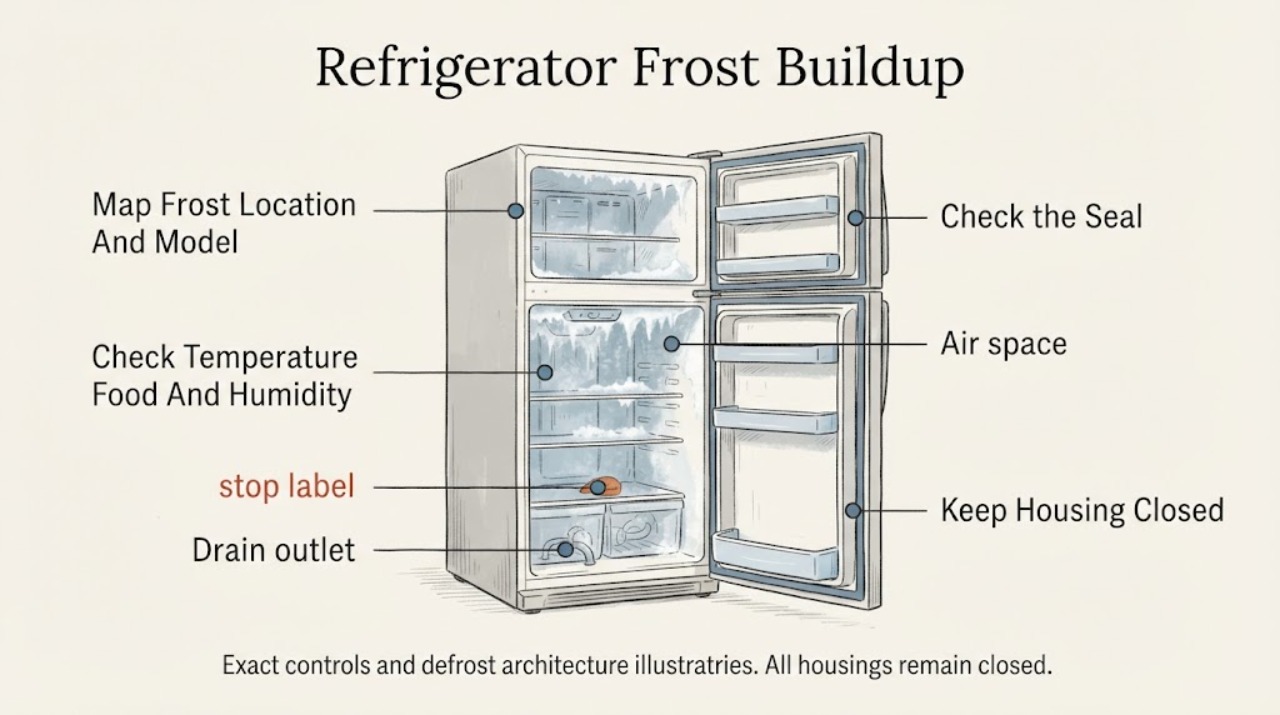
Work through in order
Diagnostic checks
Use only checks that match the exact appliance or system and its official guide.
-
Check 1
Record the complete Haier model information and map the frost: refrigerator back wall, freezer drawer or ceiling, door edge, food surface, or a drain area. Check the exact manual for No Frost, automatic-defrost, or manual-defrost wording.
Expected result: The frost is a thin back-wall film that melts, thick recurring back-wall ice, freezer-surface frost, frost at the door edge, or frost that blocks a drawer or air path; the model is No Frost or manual defrost.
Next step: Use the matching branch below and the exact manual. Do not start a defrost procedure until the model's defrost type is confirmed.
Stop if: Stop for smoke, sparks, burning odor, exposed wiring or tubing, water near electrical parts, a damaged cord, or any need to open an internal panel.
Why this matters
Why: The location and design determine the next safe check. A light back-wall film can be normal, while recurring or obstructive frost and door-edge frost point to different moisture, closure, airflow, drainage, or service branches.
-
Check 2
Compare the temperature setting with the exact Haier manual. Keep food away from the rear wall and air passages, cover high-moisture food, cool hot food before storing it, and reduce unnecessary door opening.
Expected result: The setting is unusually cold for the model, moist or uncovered food is present, food touches the rear wall, the door is opened frequently, or storage and setting are already appropriate.
Next step: Make only a clearly identified, model-approved setting correction and reorganize food; then observe whether the buildup stops or melts during normal operation. If it returns, continue to the closure and drain checks.
Stop if: Do not repeatedly change an unknown setting, block air passages with food, or touch frozen food or cold surfaces with wet hands.
Why this matters
Why: Haier identifies low temperature, humid air, food against the back wall, and frequent opening as icing contributors. Correcting those conditions can distinguish environmental moisture from a persistent appliance fault.
-
Check 3
Inspect the visible door gasket, cabinet contact surface, shelves, drawers, and packages for an obstruction or gap. Close the door normally and check whether the gasket sits evenly without tearing, distortion, or a corner held open by contents.
Expected result: The door cannot close fully, a package or shelf interferes, the gasket is visibly torn or distorted, the door edge is frosting, or the visible seal and closure look even.
Next step: Remove only an obvious obstruction and recheck normal closure. If the gasket is damaged or frost persists with an even closure, document the model and arrange Haier service rather than stretching, gluing, cutting, or heating the seal.
Stop if: Do not use a heat source to reshape the gasket, remove door panels, adjust hinges under load, or continue if the door or cabinet is damaged.
Why this matters
Why: A closure gap admits humid room air and makes frost near the door or compartment more likely. A damaged gasket may require model-specific replacement, but frost location alone does not identify a part.
-
Check 4
If the exact manual identifies an exposed refrigerator drain or discharge outlet, inspect it only from the accessible opening after disconnecting power. Clear an obvious surface blockage only with the model-approved nonmetallic method; do not probe behind a liner.
Expected result: The outlet is visibly blocked, water pools below it, the outlet is open and dry, or the model does not expose a user-serviceable drain.
Next step: Follow only the exact manual's accessible cleaning direction. If water persists, the outlet is inaccessible, or frost returns, keep the appliance safe and call qualified service.
Stop if: Do not use a knife, wire, drill, compressed air, boiling water, or chemical cleaner, and do not remove an interior liner or drain pan.
Why this matters
Why: Haier lists a blocked water discharge outlet as a refrigerator-compartment icing condition. A clear or inaccessible outlet shifts the diagnosis toward door, moisture, airflow, or internal drainage/defrost service.
-
Check 5
For a model that explicitly permits manual defrost, disconnect power and follow the matching manual; use only the supplied or approved plastic scraper after ice has softened. For a No Frost model, do not chip ice from internal surfaces or evaporator areas.
Expected result: The manual identifies manual defrost, the freezer has approved user-accessible ice removal, the model is No Frost, or the ice is hard, hidden, or blocking an internal panel.
Next step: Let permitted ice thaw with power disconnected and use the model's procedure. If the model is No Frost, the ice is inaccessible, or the buildup returns, leave internal diagnosis to qualified service.
Stop if: Never use a knife, pick, metal tool, hair dryer, heat gun, flame, boiling water, or live electrical test; do not open panels.
Why this matters
Why: Haier permits plastic-tool removal only where the applicable model instructions support it and says No Frost models do not need routine ice removal. Hidden or hard ice can conceal damage and is not a safe scraping task.
-
Check 6
After documenting the model, frost location, setting, door closure, food and humidity conditions, and any accessible drain observation, note whether frost returns, blocks airflow, affects cooling, or leaves water.
Expected result: The frost stops, a light back-wall film melts normally, thick ice returns, a No Frost model keeps icing, drawers or air passages are blocked, cooling is poor, or water and alarms accompany the buildup.
Next step: Keep the appliance in service only when it operates normally without recurring or obstructive frost. Otherwise disconnect power when safe and arrange model-specific Haier service with the observations and model information.
Stop if: Do not keep cycling a unit with recurring frost, poor cooling, active water, smoke, odor, sparks, or damaged wiring, and do not replace internal parts by guesswork.
Why this matters
Why: Resolution after visible corrections supports a moisture, placement, closure, or accessible-drain condition. Recurrence or compound symptoms make an internal defrost heater, sensor, fan, control, drain, or sealed-system fault possible; frost alone cannot identify which part.
Use your observations
Decision map
Find the observation that best matches what you see, then follow the next safe action.
-
PATH 01Safety boundary
What you see
A thin frost film is limited to the refrigerator back wall and melts during an off cycle without blocking food, airflow, or cooling.
Do this next
Keep food off the rear wall, cover moist food, avoid unnecessary door opening, and monitor whether it melts normally. Use the recurring-frost branch if it becomes thick or persistent.
Why this path and its safety boundary
Why it matters: Haier describes this limited back-wall pattern as potentially normal moisture frost rather than proof of a failed refrigerator.
Safety stop: Call service for frequent recurrence, poor cooling, standing water, or any electrical or physical hazard.
-
PATH 02Safety boundary
What you see
Back-wall frost is thick or returns quickly, water remains after melting, the temperature setting is too cold, food touches the wall, or an accessible drain is blocked.
Do this next
Correct only the visible, model-approved condition and inspect an accessible drain as directed. If ice or water returns, arrange Haier service.
Why this path and its safety boundary
Why it matters: Moisture, setting, food placement, door opening, or drainage is more likely than a normal brief cycle, although persistent frost after correction needs service.
Safety stop: Do not probe a hidden drain, remove a liner, or use sharp tools, heat, or chemicals.
-
PATH 03Safety boundary
What you see
Frost is on freezer surfaces or a drawer after frequent opening or humid loading, and the exact model permits manual defrost or identifies a No Frost design.
Do this next
Reduce humid-air entry and follow only the matching manual. Where manual scraping is explicitly permitted, disconnect power and use an approved plastic tool; for No Frost or hidden ice, call service.
Why this path and its safety boundary
Why it matters: Moisture entering during door opening can create freezer frost. Manual-defrost and No Frost architectures have different user procedures.
Safety stop: Never chip an internal No Frost evaporator or use a knife, metal pick, hair dryer, heat gun, flame, or boiling water.
-
PATH 04Safety boundary
What you see
Frost remains in a No Frost system, or it concentrates around the door edge while the door is obstructed, unevenly closed, or the visible gasket is damaged.
Do this next
Remove an obvious obstruction and document the gasket and model. If the seal is damaged or the No Frost buildup persists, keep the appliance safe and arrange Haier service.
Why this path and its safety boundary
Why it matters: A persistent No Frost buildup needs internal diagnosis; a door-edge pattern makes humid-air entry from closure or gasket problems more likely.
Safety stop: Do not heat, stretch, glue, cut, or remove the gasket or door panel yourself.
-
PATH 05Safety boundary
What you see
Frost returns after the exact setting, food, closure, humidity, and accessible-drain checks, or it blocks airflow, affects cooling, or is accompanied by water, alarms, noise, odor, or visible damage.
Do this next
Arrange qualified Haier refrigerator service and provide the model, frost location, timing, settings, door and drain observations, cooling symptoms, and any visible hazard.
Why this path and its safety boundary
Why it matters: An internal defrost, fan, control, sensor, drain, or sealed-system problem is possible and cannot be selected safely from frost appearance alone.
Safety stop: Stop use for smoke, sparks, burning odor, exposed wiring or tubing, water near electrical parts, a damaged cord, or any need to access internal panels.
Helpful context
Understand the symptom
Frost location is the first decision
A thin film on the rear wall of the refrigerator compartment may form during cooling and melt during an off cycle. Haier also links freezer frost to moisture and temperature. Thick frost that keeps returning, spreads over a compartment, blocks a drawer, or leaves water after melting is a different pattern from an occasional light film.
No Frost and manual-defrost models are not interchangeable
Haier says some refrigerators and freezers defrost automatically while others require manual defrost. Its freezer guidance says No Frost models do not need routine ice removal. Use the manual for the exact model before deciding whether any defrost procedure is permitted; do not scrape an internal No Frost evaporator or remove a panel.
Recurring frost can come from air, moisture, or an internal fault
Haier lists a cold setting, humid air, frequent door opening, food against the rear wall, an incompletely closed door, and a blocked discharge outlet among refrigerator-compartment icing conditions. Cover moisture-rich food, cool hot food before storage, keep food from the rear wall and air passages, and confirm the door closes. If buildup returns after these visible checks, an internal defrost, fan, control, or sealed-system diagnosis belongs to service.
Safety boundary
Stop conditions
- Disconnect power and stop use for smoke, sparks, a burning or electrical odor, a damaged cord, exposed wiring or tubing, or water near electrical parts.
- Do not use a knife, pick, wire, drill, metal scraper, hair dryer, heat gun, flame, boiling water, or chemical cleaner to remove frost.
- Do not chip ice from a No Frost system, remove interior liners or panels, probe hidden drains, or perform live electrical tests.
- Do not keep operating the refrigerator when frost blocks airflow, cooling is poor, water is pooling, or a recurring alarm or abnormal noise is present.
- Do not order or replace a gasket, heater, fan, sensor, control, drain, or sealed-system part from frost location alone; use qualified model-specific diagnosis.
Only after diagnosis
Potential parts
- refrigerator or freezer door gasket
Consider this category only if a qualified or model-specific inspection confirms a torn, distorted, or nonsealing gasket after visible closure and obstruction checks.
Gasket shape and installation vary by complete Haier model; do not order from frost location alone.
When checks do not resolve it
Need a professional?
Arrange qualified Haier refrigerator service when frost returns after the model-appropriate setting, food, door-closure, humidity, and accessible-drain checks; when a No Frost model keeps icing; or when frost blocks airflow, drawers, or cooling. Stop immediately for smoke, sparks, burning odor, exposed wiring or tubing, a damaged cord, water near electrical parts, active leaking, or any need to open an internal panel.
Safety scope: The owner may record the model, observe frost and closure, reorganize food, make a clearly documented model setting check, and inspect an explicitly accessible drain after disconnecting power. Qualified personnel must handle internal panels, evaporator, defrost heater, fan, sensor, control, wiring, drain assembly, and sealed-system work.
Common questions
FAQ
Is frost on the back wall of a Haier refrigerator always a failure?
No. Haier says a limited back-wall frost pattern can melt during an off cycle. Thick or recurring ice, water, poor cooling, or blocked airflow needs the temperature, moisture, closure, drain, and model-defrost checks described above.
How can I reduce frost in the freezer?
Reduce humid-air entry by limiting unnecessary door opening and covering moisture-rich food, and keep the door fully closed. Then follow the exact model's defrost instructions; No Frost models do not need routine ice removal.
Can I use a knife or hair dryer to remove refrigerator ice?
No. Haier warns against sharp tools and limits plastic-scraper use to applicable manual-defrost instructions. Disconnect power and follow the exact manual, or let qualified service handle hidden or persistent ice; do not apply direct heat.
Why is frost forming around the refrigerator door?
A gap from a package, shelf, incomplete closure, or a damaged gasket can admit humid room air. Correct only an obvious obstruction and recheck closure; a damaged seal or persistent edge frost needs model-specific service rather than heat or an improvised repair.
Why does frost come back after it melts?
If setting, food moisture, door closure, and an accessible drain are correct, recurrence can indicate an internal defrost, fan, sensor, control, drain, or sealed-system issue. Record the pattern and arrange qualified Haier service instead of choosing a part from the frost location.
Read the exact guide
Official sources
- Icing up in the refrigerator compartmentHaier India · Haier refrigerator guidance for the regional models covered by this support article; exact thermostat, liner, and drain design varies by model.
- Refrigerator defrostHaier India · Haier refrigerator and freezer defrost guidance; exact model defrost method must be confirmed in the matching manual.
- Back wall of refrigerator compartment frost or icing up.Haier Malaysia · Haier back-wall frost guidance for the regional models covered by this support article; image-based examples and model behavior vary.
- Icing in the freezer compartmentHaier India · Haier freezer guidance for the regional models covered by this support article; exact freezer and evaporator construction varies.
Community feedback
Share a repair observation
Share a plain-text repair observation. Accepted observations are published automatically; this page may take a moment to update.