
On this page
Start here
Quick answer
Do not choose a 2k, 10k, or other defrost-sensor value from the symptom alone. The supplied Electrolux case has no model or PNC, and Electrolux's product-search documentation shows that the exact product record is what connects a model/PNC to its manual, technical notes and parts list. First record the rating-plate identity and document where frost forms. For a visible frost problem, check door closure, gasket, temperature setting and blocked vents; if heavy ice is present, unplug the refrigerator and let it melt naturally without knives, heaters or a hairdryer. If the appliance is No Frost or the ice returns after safe defrosting, stop replacing guessed parts and arrange service for the exact model.
Before you begin
Safety first
- Do not choose a defrost sensor by a cross-model kΩ value, splice or bypass a sensor/fuse, remove sealed-system panels, use sharp tools or unapproved heat to remove ice, or test live refrigerator wiring. Give service the full rating-plate identity, installed-part number, frost location and temperature history.
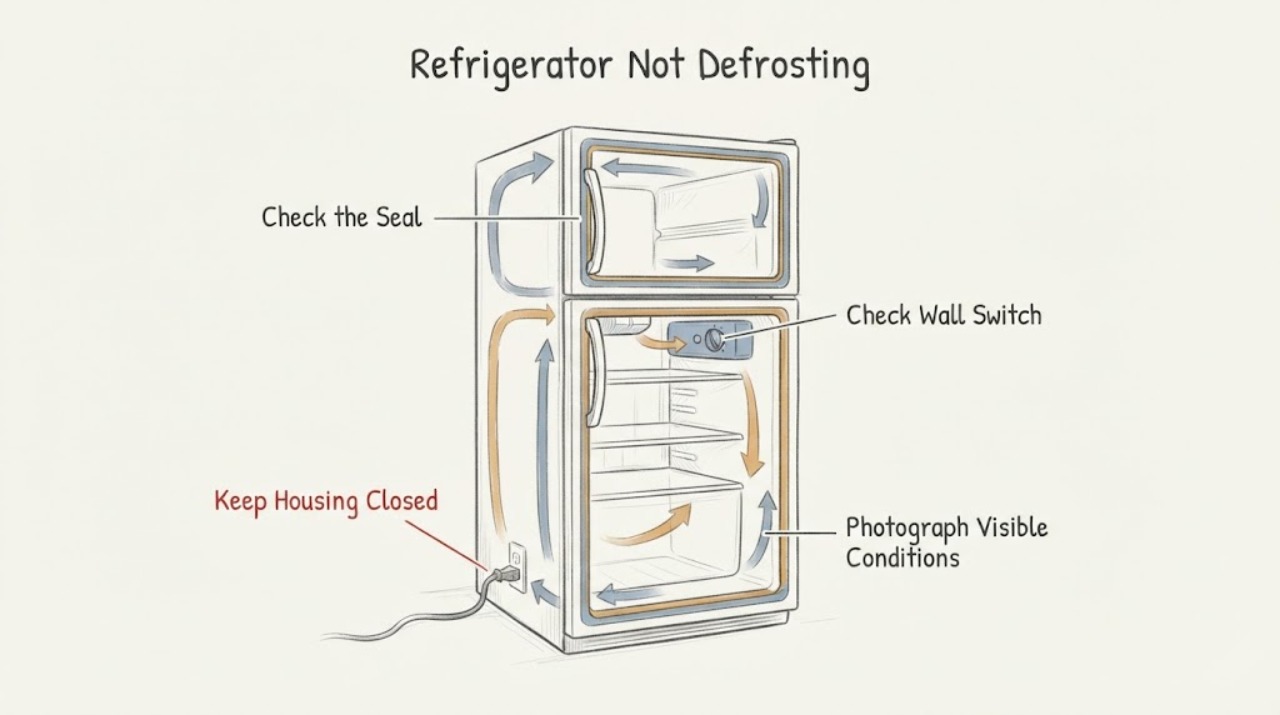
Work through in order
Diagnostic checks
Use only checks that match the exact appliance or system and its official guide.
-
Check 1
Before ordering or testing a defrost sensor, photograph the refrigerator rating plate and record the complete model, product number/PNC, revision or engineering suffix, and the part number printed on the installed sensor. Keep the refrigerator unplugged if a technician is working on exposed wiring.
Expected result: The complete model/PNC and installed-part identification are available, or only the Electrolux brand and a general refrigerator description are known.
Next step: Use the exact model/PNC record to ask Electrolux or the service provider to confirm the sensor and defrost-system specification. If identity is still missing, do not buy a sensor by resistance value or visual similarity.
Why this matters
Why: A complete product identity is needed to select the matching manual, technical note and parts list. The symptom does not establish whether the installed sensor is a 2k, 10k or another design.
-
Check 2
With the refrigerator operating normally and without removing panels, note where frost is forming, whether the door closes completely, and whether the gasket is dirty, warped or torn. Check that food is not blocking internal vents and that the temperature setting has not been moved below the recommended range for the appliance.
Expected result: Frost is concentrated near a door edge or vent, the gasket/door does not seal, or the vents are blocked; alternatively the door seals and visible airflow paths are clear.
Next step: Correct only visible loading, cleaning or closure issues using the exact manual. If the seal is damaged or frost continues with a good seal and clear vents, arrange service rather than opening the evaporator compartment.
Why this matters
Why: Electrolux identifies gasket/door sealing, temperature setting, door opening, ice-chute closure and blocked airflow as frost contributors. These observations can explain frost but cannot identify a defrost sensor or heater.
-
Check 3
If thick ice is already obstructing the freezer or vents, move food to safe temporary storage, switch the refrigerator off and unplug it, remove only the shelves and drawers the exact manual allows, leave the door open, and let the ice melt naturally. Wipe the interior and clean the drain opening once the ice is gone.
Expected result: The ice clears without tools, or it remains bonded/returns before normal cooling is restored.
Next step: Reconnect only after the interior is dry and reassembled, then allow the appliance to reach its selected temperature before returning food. If the ice cannot be safely removed or cooling does not recover, request service.
Why this matters
Why: A safe manual defrost can restore airflow temporarily, but it does not prove that a sensor, heater, fuse, timer or board is defective. Sharp tools and unapproved heat can damage the liner or cooling system.
-
Check 4
After safe defrosting, record freezer and refrigerator temperatures, the time until frost reappears, and whether doors were opened normally. Do not use a diagnostic mode, resistance table or part number from a different model as a substitute for the exact product documentation.
Expected result: Temperatures stabilize and frost does not return, or frost/poor cooling returns despite a sealed door and clear vents.
Next step: Give the technician the exact model/PNC, installed sensor part number, frost location, temperature log and defrost history. Leave the refrigerator off if wiring, insulation or the cooling circuit has been disturbed.
Why this matters
Why: A recurring pattern after external checks points to an unresolved defrost or airflow fault, but the opened public Electrolux guidance does not identify which internal component failed.
-
Check 5
Check that the refrigerator has power, the interior/control indicators operate, the vents are clear and the unit has enough surrounding airflow; do not pull it out or touch wiring if the floor is wet or the cord is damaged.
Expected result: The refrigerator lacks stable power, has a damaged cord or repeated protection trip, or it has stable power and the external conditions are normal.
Next step: If power is unsafe or unstable, leave the appliance disconnected and obtain qualified electrical/appliance service. If power is stable but frost returns, use the exact model service path.
Why this matters
Why: Electrolux routes power, installation and blocked-vent checks before internal cooling diagnosis. An electrical result does not confirm a sensor fault.
Use your observations
Decision map
Find the observation that best matches what you see, then follow the next safe action.
-
PATH 01Next step
What you see
The model/PNC and installed sensor number are not available, so the proposed “wrong sensor” is based only on a general Electrolux label or a resistance value from another appliance.
Do this next
Stop part selection, obtain the rating-plate data and have the exact Electrolux manual/parts record checked. Use only external frost and safety checks until then.
Why this path and its safety boundary
Why it matters: The identity is insufficient to confirm a compatible defrost sensor, and a guessed replacement could leave the defrost system unsafe or nonfunctional.
-
PATH 02Next step
What you see
Frost is associated with a door that does not seal, a dirty or damaged gasket, blocked vents, an obstructed ice chute, frequent long openings or an altered temperature setting.
Do this next
Correct the visible condition using the exact appliance instructions, monitor temperature and frost, and arrange service if the seal is damaged or the frost persists.
Why this path and its safety boundary
Why it matters: Electrolux identifies these as external frost contributors; the observation does not prove a defrost-sensor fault.
-
PATH 03Next step
What you see
Heavy ice clears after a safe unplugged natural defrost, but frost and poor cooling return after the refrigerator resumes operation.
Do this next
Stop replacing sensors by guesswork and request an authorised or qualified technician with the full model/PNC, part number, frost pattern and temperature log.
Why this path and its safety boundary
Why it matters: The defrost restored airflow temporarily but did not establish which internal part is responsible; a recurring No Frost problem needs model-specific diagnosis.
-
PATH 04Next step
What you see
The refrigerator has no stable power, a damaged cord, water near electrical parts or repeated breaker/GFCI trips.
Do this next
Leave the appliance disconnected if it can be done safely and arrange qualified electrical/appliance service; do not remove panels or test live circuits.
Why this path and its safety boundary
Why it matters: This is an electrical or water-safety boundary, not a sensor-selection problem.
-
PATH 05Next step
What you see
The refrigerator is a No Frost appliance and the door, gasket, vents and temperature setting are normal, but frost or poor cooling continues.
Do this next
Use the exact model manual and service route for internal diagnosis. Do not infer the sensor resistance, heater, fuse or control-board failure from the frost alone.
Why this path and its safety boundary
Why it matters: Electrolux says No Frost appliances do not normally require manual defrosting; recurrence after a safe melt is therefore not a normal maintenance answer.
Helpful context
Understand the symptom
The missing model is the first repair clue
The reported repair used a replacement defrost sensor, but no refrigerator model, PNC or revision is supplied. Electrolux's product-search documentation says a complete model or product number selects the product overview, manual, technical notes and parts list. That is why a resistance value seen for another Electrolux or Frigidaire appliance cannot confirm that the installed sensor is wrong. Photograph the rating plate and the installed part before discussing compatibility.
Confirm that the symptom is frost-related
Electrolux distinguishes normal condensation and frost from a persistent problem. For frost, its guidance calls out an incorrect thermostat setting, frequent or prolonged door opening, a damaged or dirty gasket, warm or large loads, blocked vents, a door that cannot close, and in some models a partly open ice-chute flap. These checks can explain excess ice without proving a defrost-sensor failure.
Use a safe full defrost only as an observation step
When ice is already blocking airflow, Electrolux's safe procedure is to switch off and unplug, remove food and removable shelves, leave the door open for natural melting, wipe the interior, clean the drain opening, and restart after reassembly. Do not chip ice with a knife or screwdriver and do not use a hairdryer, heater or steam cleaner unless the exact manufacturer instructions approve it. A refrigerator that refreezes after this observation needs model-specific diagnosis.
When checks do not resolve it
Need a professional?
Arrange authorised or qualified Electrolux appliance service when frost returns after a safe defrost and external seal/airflow checks, when the door gasket is damaged, when cooling does not recover, or when the exact sensor cannot be confirmed from the model/PNC documentation.
Safety scope: Do not choose a defrost sensor by a cross-model kΩ value, splice or bypass a sensor/fuse, remove sealed-system panels, use sharp tools or unapproved heat to remove ice, or test live refrigerator wiring. Give service the full rating-plate identity, installed-part number, frost location and temperature history.
Common questions
FAQ
Can the sensor be confirmed as wrong from “2k” versus “10k”?
No. The task has no model or PNC, and Electrolux's product-search documentation ties manuals, technical notes and parts lists to the selected product. A resistance value from another model is not a compatibility specification for this refrigerator.
Should I manually defrost the refrigerator?
If ice is blocking the freezer or vents, Electrolux describes an unplugged natural-defrost procedure: remove food and removable parts, leave the door open, let the ice melt, wipe the interior and clean the drain. Never use a knife, screwdriver, hairdryer, heater or steam cleaner unless the exact manufacturer instructions approve it.
Does frost around the back wall prove the defrost sensor failed?
No. Electrolux lists normal condensation, thermostat setting, door opening, gasket condition, warm food, ice-chute closure and blocked airflow as other frost causes. Check those visible conditions before asking service to diagnose the internal defrost circuit.
What should I give the repair technician?
Provide the complete model and PNC/product number, revision if shown, the sensor part number that was installed, where frost forms, temperature readings, and what changed after a safe defrost. Electrolux's product search uses the exact product identity to locate the relevant manual and technical material.
Read the exact guide
Official sources
- Refrigerators - Not CoolingElectrolux · The opened Electrolux owner-support article applies to all refrigerators. It supports checking stable power, installation, ambient location, temperature settings, blocked vents, door closure and gasket sealing before service. It is used for external decision branches and not to diagnose a sensor or sealed-system part.
- Why is my fridge frosting up?Electrolux · The opened Electrolux UK support article applies to freestanding and built-in fridges/fridge-freezers. It supports visible checks for thermostat setting, prolonged door opening, door closure, gasket condition, warm food and a dirty gasket, and directs service if these do not resolve the issue. It does not identify a sensor resistance or part fit.
- Refrigerators / Freezer - Frost Build UpElectrolux · The opened Electrolux Canada support article applies to refrigerators and lists gasket/door sealing, ice-chute closure, temperature setting and blocked vents as frost contributors. It is used for external observation only and does not prove an internal defrost component.
- How to Defrost a Fridge, Freezer or Chest FreezerElectrolux · The opened Electrolux UK support article applies to fridge/freezers and provides a safe manual-defrost path: switch off/unplug, remove food and removable parts, let ice melt naturally, wipe and clean the drain, then restart. It warns against knives/screwdrivers and unapproved heaters, hairdryers or steam cleaners; it also states No Frost units do not normally require manual defrosting.
- Product SearchElectrolux · The opened Electrolux Pro Corner documentation explains that a complete product number (PNC) or model selects a product overview and that the selected product exposes its user manual, sections, diagrams/technical notes and parts list. It is used to establish the identity gate for sensor compatibility, not as a refrigerator troubleshooting procedure.
Community feedback
Share a repair observation
Share a plain-text repair observation. Accepted observations are published automatically; this page may take a moment to update.