
On this page
Start here
Quick answer
There is no reliable universal number of hours or days for refrigerator coils to freeze when defrosting is not working. Frost accumulation depends on the refrigerator design, compressor run time, door openings, room humidity, door sealing, temperature settings and airflow. GE says automatic defrost schedules are model-dependent: some systems are timed and others adapt to usage, and the defrost cycle itself varies by model. A heavy frost pattern that returns after the model-approved defrost and external checks is more useful evidence of a problem than the elapsed time alone. Check the exact model's defrost type, keep doors closed during observation, inspect the gasket and vents, protect food if temperatures rise, and arrange service if heavy frost returns or access would require panels or a defrost-system diagnosis.
Work through in order
Diagnostic checks
Use only checks that match the exact appliance or system and its official guide.
-
Check 1
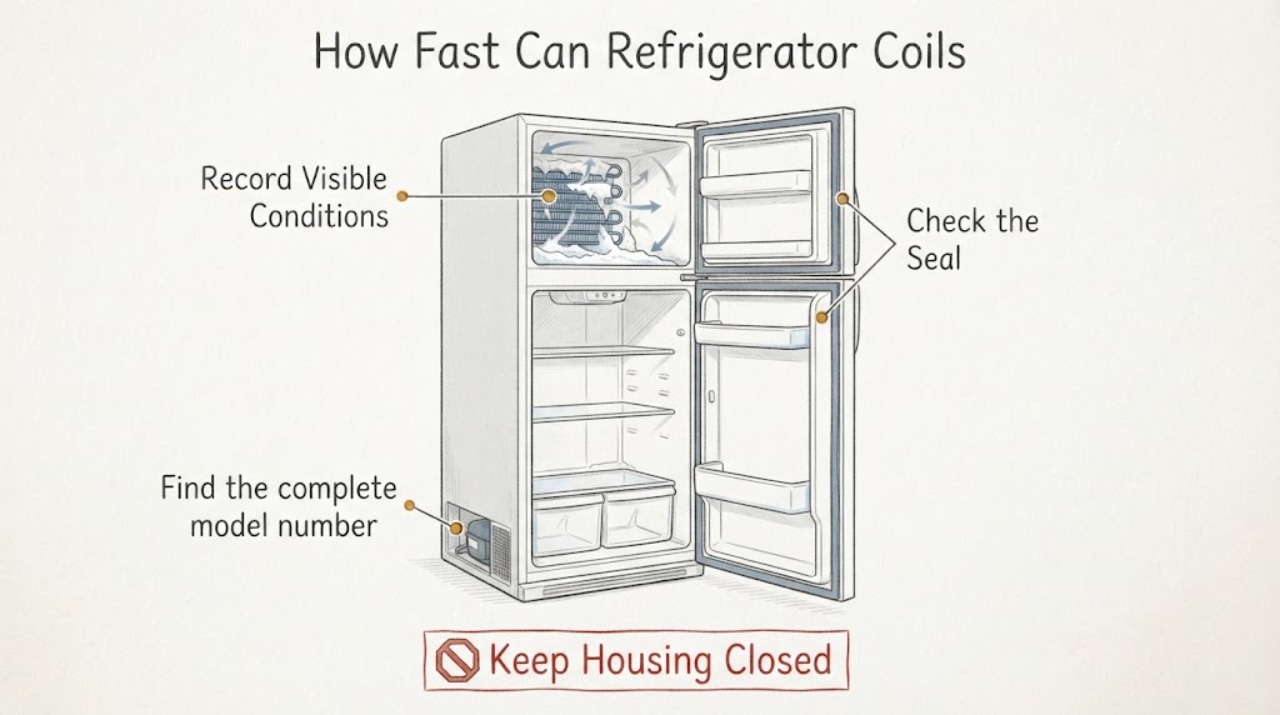
Find the complete model number and determine from the owner's manual or product description whether the refrigerator is frost-free/automatic defrost or a manual-defrost design. Note whether the freezer is the only compartment showing ice.
Expected result: The documentation identifies an automatic or adaptive defrost system, or it identifies a manual-defrost/partial-defrost design; the frost may be on the walls, packages, vents or a rear panel.
Next step: Use the exact manual's defrost and temperature instructions. Do not apply a different brand's timer, forced-defrost sequence or component test to an unidentified refrigerator.
Why this matters
Why: Automatic-defrost models are designed to melt evaporator frost during a cycle, while model design controls when and how that cycle runs. A manual-defrost section can accumulate frost as part of normal operation, so its timing cannot be used to judge an automatic system.
-
Check 2
Make a short observation log without repeatedly opening the doors: record room humidity if available, freezer temperature, the frost location, door-opening pattern and whether the door was left ajar or warm food was recently loaded.
Expected result: Frost appears after frequent or prolonged openings, in a humid room, near an apparent door gap, or after warm food was added; alternatively the doors stay closed and frost still returns while the freezer warms.
Next step: Reduce unnecessary openings, let hot food cool before loading, and keep perishable food in a safe cold location if the freezer temperature is rising. Continue with the seal and vent checks before requesting a defrost diagnosis.
Why this matters
Why: Warm humid air entering the cabinet can freeze on cold surfaces and can explain frost without a defrost-system failure. Frost that returns with closed doors and worsening temperature after the external causes are corrected is more concerning.
-
Check 3
Check the door and gasket from the outside: remove packages that prevent closure, confirm the door closes fully, inspect the gasket for cuts or gaps, and verify the cabinet is level enough for the doors to close as the model instructions specify.
Expected result: The door remains slightly open, the gasket has a visible gap or damage, the door is misaligned, or the door closes and seals evenly.
Next step: Correct only a safe obstruction or clean the accessible gasket as the manual permits. If the gasket is torn, the door cannot align, or heavy frost continues, arrange service rather than disassembling the door or freezer liner.
Why this matters
Why: A poor seal or misalignment admits warm humid air and can create recurring frost. A sound seal does not prove the heater, sensor or control is working, but it removes a common external cause.
-
Check 4
Check that food is not blocking the freezer and refrigerator air vents, and note whether the frost is concentrated around a vent or covers a broad visible area. Do not remove the rear cover to inspect the evaporator coil.
Expected result: Packages obstruct vents or airflow is visibly restricted, or the vents are clear but heavy frost and warming remain.
Next step: Rearrange food to restore the manual-specified clearance and observe the temperature. If heavy frost returns with clear vents, request model-specific service.
Why this matters
Why: Blocked vents can reduce air circulation and create temperature and moisture problems; frost can then block airflow further. Clear external obstructions only as directed by the manual, but a clear vent does not identify a failed defrost part.
-
Check 5
If the manual permits user defrosting, follow only that procedure and preserve the refrigerator's model instructions. Disconnect power when the manual requires it, protect food and flooring, and never use a hair dryer, sharp or metallic tool, hot water poured into the cabinet, or an improvised forced-defrost control sequence.
Expected result: The frost clears and normal temperatures return, or heavy frost returns after the permitted defrost while the doors, gasket and vents are normal.
Next step: If frost returns or temperature remains high, stop repeating manual defrosts and arrange qualified service. Do not access the heater, sensor, evaporator or control board without model-specific service documentation and appropriate training.
Why this matters
Why: A temporary return to normal after a complete, model-approved defrost shows that ice was obstructing operation, but it does not identify whether the cause was moisture entry, airflow or an internal defrost fault. Recurrence is a stronger service signal than the time it took frost to form.
Use your observations
Decision map
Find the observation that best matches what you see, then follow the next safe action.
-
PATH 01Next step
What you see
Frost appears after frequent or prolonged door openings, a humid period, warm food loading, or a visible door-seal gap, while the freezer remains at its normal temperature.
Do this next
Close the door fully, correct the accessible seal or obstruction, reduce unnecessary openings and monitor temperature and frost recurrence with the exact manual's settings.
Why this path and its safety boundary
Why it matters: Warm humid air entering the cabinet is a sufficient explanation for the observed frost; the pattern does not establish a failed defrost heater or timer.
-
PATH 02Next step
What you see
The model is frost-free/automatic defrost, doors and vents are normal, but heavy frost returns after a model-approved defrost and the freezer warms or airflow is reduced.
Do this next
Keep the cabinet closed, protect perishable food, and arrange qualified service with the model number, temperature log, frost location and recurrence history. Do not remove the liner or perform live tests.
Why this path and its safety boundary
Why it matters: The recurrence pattern needs a model-specific defrost or airflow diagnosis. It cannot be narrowed to a heater, sensor, timer, control or sealed-system fault from elapsed time alone.
-
PATH 03Next step
What you see
The refrigerator is a manual-defrost or partial-defrost design, and frost is present without abnormal warming or a failed door seal.
Do this next
Use the model's manual-defrost instructions and its stated frost limit or service guidance. Do not borrow an automatic-defrost schedule from another model.
Why this path and its safety boundary
Why it matters: Frost accumulation can be expected in a manual-defrost section, so the automatic-defrost failure question does not apply to that section.
-
PATH 04Next step
What you see
Ice or water is appearing on the freezer floor or in front of a bottom-freezer refrigerator, especially after a defrost cycle, while the drain path is inaccessible.
Do this next
Do not insert tools or wire into the drain. Keep the area safe and arrange service if the floor ice or water returns.
Why this path and its safety boundary
Why it matters: GE says an automatic-defrost drain tube can produce this pattern, but access may require disassembly; the visible water does not prove a heater failure.
Helpful context
Understand the symptom
Elapsed time is not a defrost test
A frost timer cannot be inferred from the thickness of ice or from how long the refrigerator has been running. GE explains that full-size frost-free refrigerators use automatic defrost, but the schedule may be timed or adaptive; an adaptive system considers compressor run time and door openings. Its guidance also says the length of the defrost cycle varies by model. That means a refrigerator can collect visible frost at different rates under different usage conditions, and a short observation cannot establish that a heater, sensor or control has failed. Record the model number and follow its manual for the actual defrost design.
Humidity and door use can make normal frost look like a defrost failure
Whirlpool says humid room air, frequent door openings, a door left open and blocked vents can increase condensation and frost. Frigidaire likewise identifies a poor gasket seal, very cold settings and blocked airflow as frost contributors. A busy household or humid room can therefore produce frost faster than a lightly used refrigerator even when both defrost systems are operating. Correct the accessible air-entry and airflow causes before using frost recurrence as evidence of an internal fault.
Use frost recurrence and temperature impact to choose the next step
Inspect the visible frost location and whether the freezer temperature is rising, but do not remove covers to reach an evaporator or heater. GE recommends service when heavy frost continues after checking doors, gaskets, alignment and leveling. Samsung says heavy frost may require defrosting according to the appliance's safe procedure, warns against using a hair dryer, and recommends service if frost returns. These are model- and condition-based decisions; the return of heavy frost, airflow loss or warming is more meaningful than a guessed number of hours.
Common questions
FAQ
How many hours does it take for refrigerator coils to freeze if defrost is not working?
There is no universal answer. Frost accumulation changes with model, compressor run time, door openings, humidity, door sealing, temperature settings and airflow. Manufacturer guidance describes different timed and adaptive defrost systems, so a guessed freeze-time threshold is not a reliable diagnosis.
Can frequent refrigerator openings make frost form even when defrost works?
Yes. Frequent or prolonged openings let humid room air enter and can create frost on cold surfaces. Correct the door seal and airflow conditions and monitor temperature before concluding that automatic defrost has failed.
If a full defrost temporarily fixes the refrigerator, does that prove the heater is bad?
No. It proves that ice was affecting operation, but it does not distinguish moisture entry, blocked airflow, drain issues and an internal defrost fault. If heavy frost returns after the model-approved procedure, service is the appropriate next step.
Read the exact guide
Official sources
- Refrigerator - Automatic Defrost SystemGE Appliances · Official GE guidance used for the general distinction between automatic defrost, timed/adaptive scheduling, model-dependent cycle length and heavy-frost service escalation; it does not identify this unspecified refrigerator's parts.
- How to Help Eliminate Condensation and FrostWhirlpool · Official Whirlpool general refrigerator guidance used for humidity and frequent-opening effects, door sealing and airflow; controls vary by model.
- Refrigerator - Frost Guard / Adaptive DefrostGE Appliances · Official GE explanation that adaptive defrost accounts for door openings and compressor run time; used to reject a universal frost-time threshold for an unidentified model.
- Frost forms in the Samsung freezer, refrigerator, or ice bucketSamsung Support · Official Samsung general frost guidance used for warm-air causes, vent clearance, the no-hair-dryer warning, model-safe defrost boundary and service if frost returns; it is not used for Samsung-specific controls on this unidentified refrigerator.
- Refrigerators / Freezer - Frost Build UpFrigidaire · Official Frigidaire general refrigerator guidance used for gasket, ice-chute, temperature and airflow causes and service escalation; no Frigidaire model is assigned here.
- Bottom Freezer Refrigerator - Clogged Drain Tube, Ice on Freezer FloorGE Appliances · Official GE guidance used only for the observable ice/water-on-freezer-floor pattern and its warning that drain access requires disassembly.
- Refrigerator - Frost in FreezerGE Appliances · Official GE external checks for frequent/open doors, temperature setting, gasket, alignment and leveling; used without transferring any model-specific repair procedure.
Community feedback
Share a repair observation
Share a plain-text repair observation. Accepted observations are published automatically; this page may take a moment to update.