
On this page
Start here
Quick answer
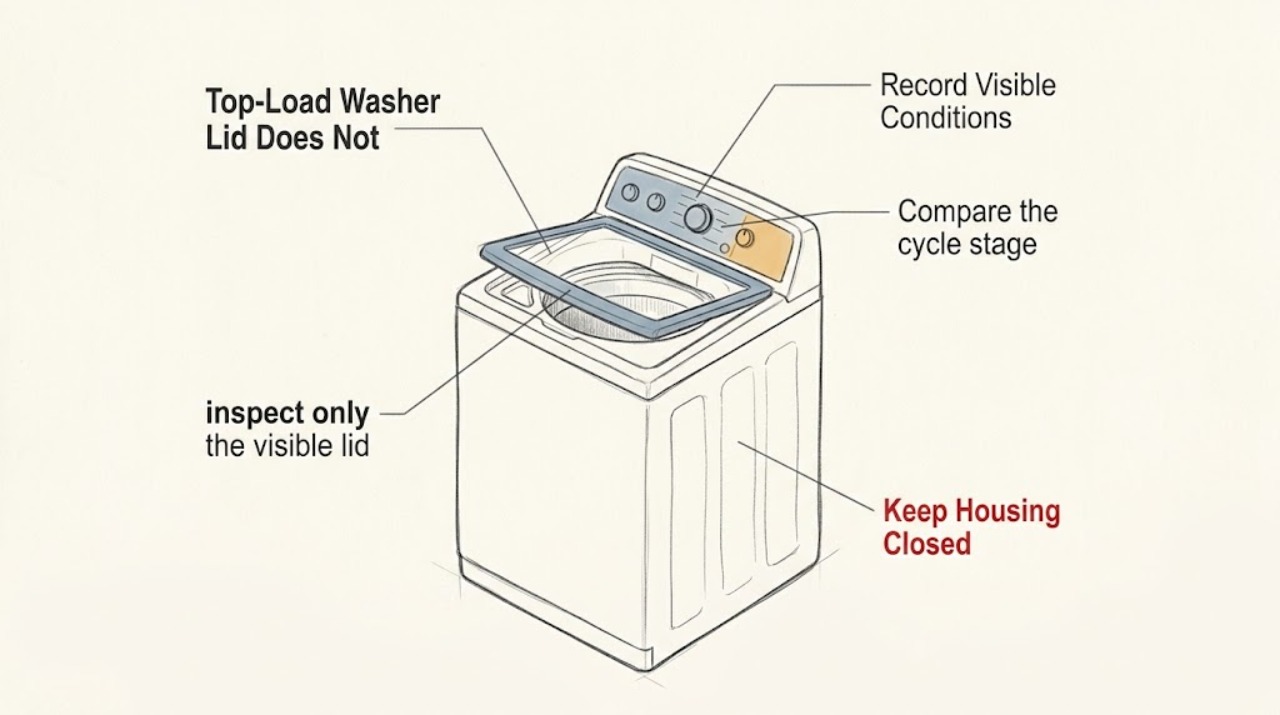
Do not assume an Amana top-load washer should lock at every stage. Amana's top-load guidance says that on some models the lid can remain unlocked during sensing and the entire agitation or wash phase, then lock before the first spin; another Amana page says features and lock timing vary by model. A lid that locks during rinse may therefore be normal if that phase is preparing for spin, but the exact model manual is required to confirm it. First record the phase, Lid Lock light, exact F3E3 display, and whether the washer fills, washes, drains, and spins. Check only visible clothing, packaging, lint, or detergent around the lid striker and lock. Amana's F3E3 page provides one low-risk five-minute power disconnect/reset, not a component diagnosis. If F3E3 returns, the lid never locks before spin, the cycle stops, or the washer leaks or behaves unsafely, keep it out of service and arrange qualified appliance service. Never bypass the lid lock, use service mode, or open the cabinet.
Before you begin
Safety first
- Owner checks are limited to recording the exact model, code, stage, and Lid Lock light; comparing the sequence with the model manual; clearing visible lid-striker interference; and performing Amana's documented five-minute power reset once. Do not restrain or bypass the lid, enter service mode, open the cabinet, reach into the lock, disconnect internal wiring, or perform live electrical tests.
Work through in order
Diagnostic checks
Use only checks that match the exact appliance or system and its official guide.
-
Check 1
Write down the complete model from the rating label, the exact display as F3E3 or another code, the Lid Lock light state, and the cycle stage when the lid is unlocked: sensing, fill, wash/agitation, drain, rinse, initial spin, or final spin. Note whether the washer is actually filling, moving the load, draining, and completing the cycle; do not interrupt a moving basket to test the lid.
Expected result: The lid is unlocked only during sensing or agitation, locks before spin or during rinse, remains unlocked when spin should begin, or F3E3 appears at a repeatable stage.
Next step: Use the complete model manual to compare the observed sequence. If the washer does not lock before spin, stops with F3E3, or the model cannot be identified, stop normal use and arrange qualified service rather than guessing from another Amana model.
Stop if: Do not pull the lid open while the basket is moving, tape or hold the lid closed, or use a service or diagnostic mode to force a lock.
Why this matters
Why: Amana states that lock timing varies by model and that some top-load platforms leave the lid unlocked during sensing and the agitation portion, then lock before spin. A code or failure that recurs at a defined stage is more useful than the general statement that the lid is not locked.
-
Check 2
Compare the cycle stage with Amana's documented top-load behavior without opening or restraining the lid. In the published sensing sequence, an unlocked lid can pause sensing and wash, and on some models the lid remains unlocked during agitation but locks before the initial spinout; a rinse lock may coincide with the transition toward spin.
Expected result: The washer pauses when the unlocked lid is opened and resumes when it is closed, the lid locks before spin, or it never locks before spin and the cycle cannot advance.
Next step: Follow the exact manual for this model's normal stage behavior. If the observed stage differs from the manual or the lock failure blocks spin, preserve the code and arrange service; do not force the machine to continue.
Stop if: Do not defeat the safety interlock, press the striker into the lock by hand, or reach into the lid-lock assembly.
Why this matters
Why: A pause/resume sequence and a lock before spin can fit the documented model-dependent operation. Failure to lock before high-speed movement, or a cycle that will not advance, is not safely explained by the rinse timing alone.
-
Check 3
With the washer stopped and the lid open, inspect only the visible lid striker and lock opening for clothing, packaging or shipping material, lint, detergent residue, a visibly cracked piece, or a lid that is misaligned. Wipe a reachable external spill with a soft damp cloth and mild soap only as Amana describes; do not remove the lock or lid hardware.
Expected result: A visible obstruction or residue is present and clears, the striker does not align with the opening, visible damage is present, or the area looks clean and undamaged.
Next step: Clear only the visible obstruction with power disconnected if the area is wet or unsafe. If the lid still fails to lock, the striker is damaged, or the geometry does not match the manual, keep the washer off and request qualified service.
Stop if: Do not pry the striker, bend the lid, remove screws, insert tools into the lock, or apply lubricant or adhesive.
Why this matters
Why: Amana identifies clothing, packaging, lint, and detergent build-up as possible interference with the lid striker or lock. A clean exterior does not rule out an internal lock, wiring, or control issue, and visible misalignment needs service rather than force.
-
Check 4
If F3E3 is displayed and there is no leak, burning smell, damaged cord, or moving-basket hazard, perform Amana's documented control reset once: disconnect the washer from its power source for five minutes, then restore power from a dry, safe position. Record whether the code clears and whether the lid follows the model manual's normal stage sequence; do not repeatedly reset it.
Expected result: F3E3 clears and the washer completes the expected sequence, F3E3 returns, or the washer remains unable to lock before spin or advance the cycle.
Next step: Use the washer only if the exact manual's sequence completes without the code, abnormal movement, or leakage. For a returning F3E3 or unresolved lid timing, stop use and provide the full model and stage record to qualified service.
Stop if: Do not cycle power repeatedly, access the cabinet, perform electrical measurements, or use a reset as a substitute for a lid-lock diagnosis.
Why this matters
Why: Amana's F3E3 page supports a five-minute control reset but does not identify a failed lid-lock part. A returning code or continued stage failure means the reset did not resolve the underlying condition.
-
Check 5
After a single documented reset and any visible correction, make no more than one normal, supervised cycle observation if the washer is dry, stable, and the exact manual permits it. Record whether the lid locks before spin, whether F3E3 returns at the same stage, and whether there is retained water, a leak, abnormal noise, or violent movement.
Expected result: The cycle completes with the expected lock transition, the code returns at the same stage, the washer cannot begin spin, or a leak, abnormal movement, or electrical symptom appears.
Next step: Keep the washer out of service for any repeat code, failure to lock before spin, leak, or unsafe behavior. Give service the model, code, stage, Lid Lock light, visible-check result, and reset result.
Stop if: Do not repeat severe tests, run with the lid restrained, bypass the lock, open the cabinet, or continue a cycle with water leaking or violent motion.
Why this matters
Why: A completed cycle supports a cleared operating condition but does not prove an intermittent lock fault is gone. A repeat at the same stage or a safety/performance symptom needs professional diagnosis, not a guessed lock or control replacement.
-
Check 6
Before contacting service, preserve the exact model and serial information, market, cycle name, load, water level setting, F3E3 display, stage-by-stage lid-light behavior, and any visible obstruction or reset result. Do not identify a lid-lock switch, wiring, actuator, or control board from the code alone.
Expected result: The model and code table are available and the behavior is documented, or the model is missing and F3E3/lid timing cannot be matched to an Amana manual.
Next step: Use the model-matched manual and arrange qualified appliance service for a recurring code or lock failure. Keep the washer off if it cannot lock before spin or shows a leak or electrical warning.
Stop if: Do not enter service mode, bypass an interlock, remove the console, disconnect internal wiring, or order a lock assembly without a model-specific diagnosis.
Why this matters
Why: Amana directs owners to model-specific instructions for lock timing and code guidance. With no model, F3E3 can be documented as a recurring code but cannot be assigned a universal meaning or part.
Use your observations
Decision map
Find the observation that best matches what you see, then follow the next safe action.
-
PATH 01Next step
What you see
The complete model manual allows the lid to remain unlocked during sensing and agitation, the washer pauses when the lid is opened, and the lid locks before initial or final spin without F3E3 returning.
Do this next
Use the washer according to the exact manual and monitor. Request service if the timing changes, F3E3 appears, the lid fails to lock before spin, or the cycle stops.
Why this path and its safety boundary
Why it matters: This can be normal model-specific safety timing; a lid that locks later during rinse does not by itself prove a failure.
-
PATH 02Next step
What you see
The washer never locks before spin, F3E3 returns after the single five-minute reset, or the cycle cannot advance even though the lid appears closed and the visible striker area is clear.
Do this next
Keep the washer off and arrange qualified Amana appliance service with the full model, code, stage, and reset result. Do not continue spin tests or choose a replacement lock from the symptom.
Why this path and its safety boundary
Why it matters: The documented stage behavior or reset has not resolved the condition. A lid-lock, control, wiring, or related fault is possible, but F3E3 does not identify which internal part failed.
-
PATH 03Next step
What you see
Clothing, packaging, lint, detergent residue, or another visible obstruction prevents the striker from entering the lock, and the timing returns to normal after it is cleared without force.
Do this next
Keep the lid and lock area clean and follow the exact manual. Stop and request service if the obstruction returns, the striker or lid is damaged, or the lid still does not lock at the required stage.
Why this path and its safety boundary
Why it matters: Visible interference is the stronger explanation for that occurrence; it does not establish a failed lock assembly.
-
PATH 04Next step
What you see
The model is missing, the code is shown as F3E3 but the exact code table or lid sequence cannot be matched, or the reported rinse-lock behavior conflicts with the available manual.
Do this next
Recover the model and serial label, use the matching manual, and arrange service if the code or lock concern persists. Do not borrow a code meaning or lock procedure from another Amana platform.
Why this path and its safety boundary
Why it matters: Amana's public guidance is model-dependent and does not support a universal F3E3 interpretation or a universal lock schedule without the model identity.
-
PATH 05Next step
What you see
The lid concern is accompanied by retained water, a leak, violent movement, smoke, burning odor, sparks, a hot or damaged cord, or an attempt to open the lid while the basket is moving.
Do this next
Stop the washer, isolate power and water only from a safe dry position where possible, keep clear of the moving or damaged appliance, and obtain qualified appliance or electrical help. Do not restart it to confirm F3E3.
Why this path and its safety boundary
Why it matters: This is a water, mechanical, or electrical safety path, not a routine lock-timing question.
Helpful context
Understand the symptom
The reported sequence matters: sensing, fill, and wash are not necessarily lock points on every Amana top-load washer. Amana's public guidance describes models that leave the lid unlocked during sensing and agitation, then lock before the first spin, while also warning that operations vary by model. A lid locking later during rinse can be a normal safety transition, but F3E3 cannot be interpreted safely without the model's code table.
Use the exact model manual to decide whether this cycle is behaving as designed. The user-level boundary is limited to recording the stage and display, clearing visible interference, and performing Amana's documented five-minute power reset once. Do not hold the lid down, bypass the striker or lock, enter a service mode, or remove the cabinet to test a lock or control.
When checks do not resolve it
Need a professional?
Use qualified Amana appliance service for recurring F3E3, failure to lock before spin, cycle interruption, a clean but misaligned or damaged striker, or any unresolved model-specific timing conflict. Use qualified electrical or emergency help for smoke, sparks, burning odor, hot or damaged power connections, or an active water/electrical hazard.
Safety scope: Owner checks are limited to recording the exact model, code, stage, and Lid Lock light; comparing the sequence with the model manual; clearing visible lid-striker interference; and performing Amana's documented five-minute power reset once. Do not restrain or bypass the lid, enter service mode, open the cabinet, reach into the lock, disconnect internal wiring, or perform live electrical tests.
Have this ready
- Provide the complete model and serial, market, cycle and load, water-level setting, exact F3E3 display, Lid Lock light state, stage at which it appears, whether the washer fills/washes/drains/spins, visible obstruction findings, the five-minute reset result, and any leak, movement, or electrical symptom.
Common questions
FAQ
Should an Amana top-load washer lock during sensing and wash?
Not always. Amana says some top-load models leave the lid unlocked during sensing and the entire agitation portion, then lock before spin; features and timing vary by model. Use the exact manual to determine whether your sequence is expected.
Is it normal for the lid to lock during rinse instead?
It can be consistent with a model that locks before the first spin or during the transition toward spin, but no model was supplied, so it cannot be declared normal universally. Record the Lid Lock light and whether the washer locks before spin, then check the model manual.
What does F3E3 mean on an Amana washer?
Amana's public F3E3 page provides a five-minute control power reset but does not assign the code to one confirmed part. If F3E3 returns or the lid will not lock before spin, arrange qualified service instead of selecting a lock or control by guesswork.
What can I safely check before calling service?
Record the exact model, code, stage, and Lid Lock light; inspect for visible clothing, packaging, lint, or detergent near the striker; and perform Amana's five-minute reset once when there is no hazard. Do not bypass the lock, enter service mode, open the cabinet, or repeatedly run the washer.
Read the exact guide
Official sources
- Fill or Sensing Light On - Product HelpAmana Product Help · Supports the stage-specific distinction that an unlocked lid can pause sensing and wash, while the lid locks after wash before initial spinout on the covered platform. Use the exact manual when the model is unknown.
- What’s Under the LidAmana · Supports the general top-load stage and safety explanation only; the opened manual is not claimed as the unknown washer's exact model manual. The complete model and market must be matched before treating its sequence as exact.
- Lid Light FlashingAmana Product Help · Supports the safe visual check for clothing, packaging, lint, or detergent around the striker and explains that sensing may restart if the lid is opened. It does not authorize lock bypass or disassembly.
- Lid Locking on a Top Load High Efficiency WasherAmana Product Help · Supports model-dependent lid timing, visible obstruction checks, one five-minute reset, and professional boundary. Amana explicitly says features and operations vary by model, so this is not a universal F3E3 interpretation.
- F3E3 - Error CodeAmana Product Help · Directly supports the F3E3 five-minute control reset and service boundary, but does not define F3E3 as a universal failed lid-lock part across Amana models.
Community feedback
Share a repair observation
Share a plain-text repair observation. Accepted observations are published automatically; this page may take a moment to update.