
On this page
Start here
Quick answer
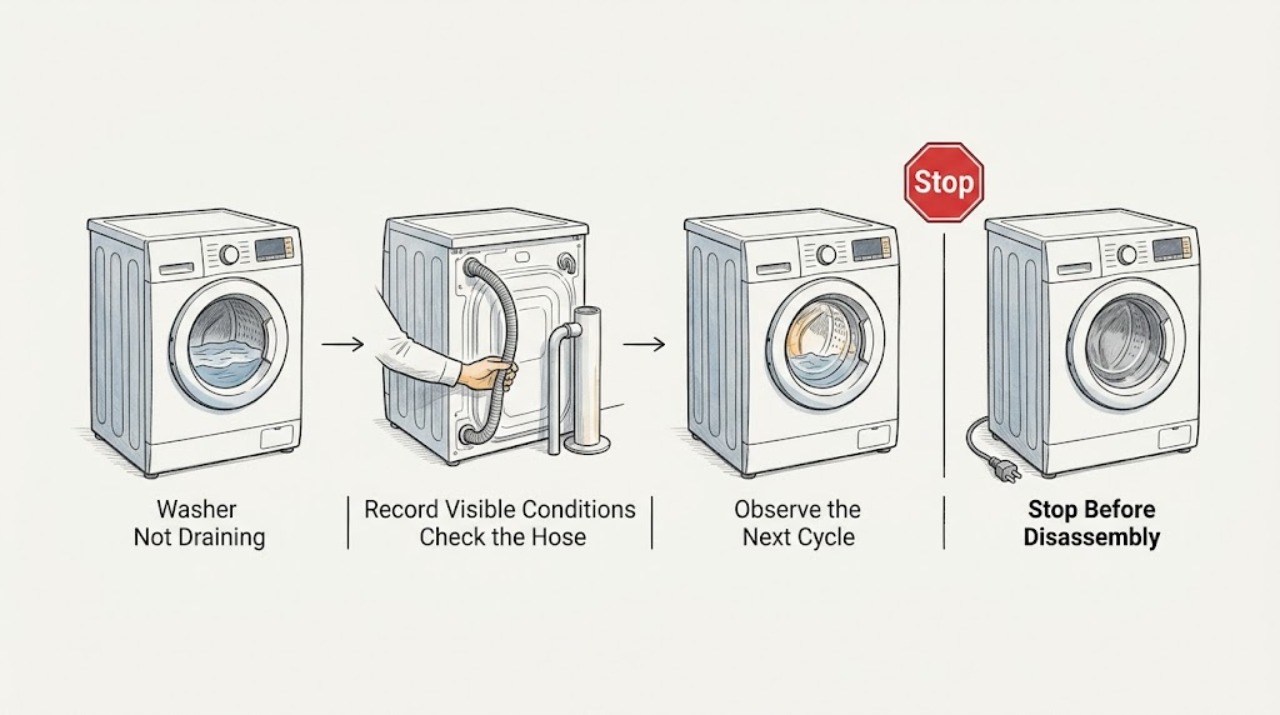
Start by noting whether the tub contains standing water, the clothes are merely very wet, or water drains slowly. With the washer stopped, check the visible drain hose for kinks, a clog, incorrect insertion, or an overly high route, and check the standpipe or utility sink for a visible blockage. Amana also links tightly packed or unbalanced loads and excess detergent suds with wet loads or poor draining. On some front-load models, a model-specific pump filter is accessible, but do not open panels or reach into a pump unless the exact manual identifies a user-accessible procedure. Stop for a leak, damaged cord, burning odor, unusual noise, or a hose or filter you cannot safely access; arrange qualified appliance service if a correctly installed, clear drain path still leaves water in the washer.
Work through in order
Diagnostic checks
Use only checks that match the exact appliance or system and its official guide.
-
Check 1
Stop the cycle with the normal control and wait until the basket has stopped before looking inside. Record whether water is standing in the basket, whether the washer is empty but the load is very wet, whether the drain was slow, which phase stopped, and whether a display light or code appeared. Do not reach into a moving basket or standing water.
Expected result: The tub is full or partly full, the tub is empty but clothes are wet, water drains slowly, the washer stopped during drain, or the cycle completed without a drain fault.
Next step: Follow the matching drain-path, load, or detergent check. Keep the washer off for a leak, electrical odor, damaged cord, unusual noise, or water near electrical components.
Why this matters
Why: Standing water or a drain-phase stop makes a blocked hose, drainpipe, pump filter, or pump problem more likely. An empty tub with a wet load makes loading, spin selection, or detergent suds more likely than a total drain blockage.
-
Check 2
With the washer stopped, inspect only the visible drain hose and its outlet. Look for a kink, crushing behind the cabinet, a loose connection, an end inserted too far, a route that is too high for the model, tape sealing the hose to the standpipe, or a visible blockage at the standpipe or utility-sink opening. Do not pull the washer out against a full tub or detach a hose that could release water unexpectedly.
Expected result: The hose is kinked or crushed, its end is sealed or inserted too far, its route does not match the model instructions, the drain opening is visibly blocked, or the visible installation appears correct.
Next step: Correct only an obvious external hose position using the exact Amana installation instructions, clear a visible blockage at the household drain opening, and monitor one drain attempt. If water remains or the hose requires disconnection, stop and arrange service rather than forcing it.
Why this matters
Why: A restricted hose or drain opening can limit flow; excessive insertion or sealing can cause siphoning on applicable front-load installations. A correct visible route does not rule out a hidden clog, filter, pump, or internal problem.
-
Check 3
Check the model's installation instructions or owner manual for the drain outlet arrangement before judging its height or insertion. Compare the visible hose with the supplied U-shaped form and the manual's limits; for the Amana guidance reviewed here, top-load instructions address insertion and routing, while front-load instructions also address siphoning and an air gap.
Expected result: The setup matches the exact manual, the hose extends beyond the model's stated insertion or height limit, the hose is taped or sealed, or the washer was recently moved or installed.
Next step: Restore the model-approved hose form and air gap only from outside the machine. If the installation cannot be matched without moving a water-filled washer or disconnecting plumbing, leave it in place and call an appliance technician.
Why this matters
Why: A recently changed or nonconforming installation can cause poor draining even when the pump is operating. Amana's published limits differ by washer configuration, so a dimension from another model is not a safe substitute.
-
Check 4
If the tub is empty but the clothes are unusually wet, check the load and cycle instead of assuming the drain pump failed. With the washer stopped, redistribute a bunched load, remove some items from a tightly packed load, and confirm the selected cycle and spin setting in the manual. Use the model's Drain/Spin or Rinse/Spin option only as instructed, and do not add detergent to the test cycle.
Expected result: The load was tightly packed or unbalanced, a bulky or single item was washed, a low-spin cycle was selected, the load is balanced with a normal spin setting, or water remains in the tub.
Next step: Run one correctly loaded, model-approved drain or spin cycle. If the tub still holds water, the pump runs without discharge, or the washer stops again, stop using it and request service.
Why this matters
Why: Amana says an unbalanced or tightly packed load may not spin correctly, leaving clothes wetter than usual; a lower spin speed also removes less water. Water remaining in the tub points back to a drain-path or pump branch.
-
Check 5
Review the detergent used for the affected load. Use only the detergent type and measured amount specified for the exact Amana model and water conditions; do not add detergent while checking drainage. If heavy suds are visible and the tub can safely run the model-approved Rinse/Spin cycle, use that cycle once to remove excess suds.
Expected result: The washer used non-HE detergent where HE is required, more detergent than the label or manual calls for, visible persistent suds, or the correct measured detergent with no suds.
Next step: Correct the detergent amount on future loads and monitor one appropriate cycle. If suds persist, water remains, or the washer stops during drain, leave it off and arrange service.
Why this matters
Why: Amana explains that excess suds can reduce spin speed and slow or stop draining and spinning. Correct detergent use may improve a wet-load symptom, but it will not clear a blocked hose or failed pump.
-
Check 6
For a front-load Amana washer, check the exact manual for a user-accessible drain-pump filter before attempting any cleaning. Only if the manual explicitly identifies that filter and the washer is safe to work around, disconnect power through the normal accessible means, prepare for residual water, and follow that model's procedure; do not improvise a filter location, remove panels, or reach into a pump.
Expected result: The manual identifies an accessible filter, no filter is provided for that model, the filter contains lint or a small item, water cannot be contained safely, or the filter is behind a panel or otherwise inaccessible.
Next step: Clean only the explicitly accessible filter as the manual directs, then perform one monitored drain attempt. If the filter is not user-accessible, water still will not drain, or the pump is noisy or silent, stop and call qualified appliance service.
Why this matters
Why: Amana says a drain-pump filter is accessible on some front-load models and can collect dirt, lint, or other items. A model without that access, a hidden obstruction, or an unsafe water spill requires a different service path.
-
Check 7
After the external checks, observe one model-approved Drain/Spin attempt from a safe position. Note whether the pump makes a normal-sounding hum, whether water exits the hose, whether the tub level falls, and whether the washer displays a drain or spin fault. Do not repeat a failed attempt several times and do not open the cabinet to listen closer.
Expected result: Water exits and the level falls, the pump hums but no water exits, the pump is silent, the washer stops with water remaining, or the cycle drains but the load remains wet.
Next step: If drainage remains abnormal after the safe checks, leave the washer off and arrange qualified appliance repair. Provide the model, phase, water level, hose observations, detergent, filter status if applicable, and the pump's observed behavior.
Why this matters
Why: Discharge with a falling water level supports a corrected load or external-path issue. A hum without flow, silence during a commanded drain, or repeated stopping with water remaining makes a blocked filter or hose, pump, control, or wiring issue more likely; the sound alone cannot identify the part.
Use your observations
Decision map
Find the observation that best matches what you see, then follow the next safe action.
-
PATH 01Next step
What you see
The tub is empty but clothes are very wet, especially after a low-spin, bulky, single-item, or tightly packed load.
Do this next
Loading, cycle selection, or spin speed is more likely than a complete drain blockage.
-
PATH 02Next step
What you see
The visible hose is kinked, crushed, improperly routed, sealed to the standpipe, inserted too far, or the standpipe or utility sink has a visible blockage.
Do this next
An external drain installation or household plumbing restriction is more likely than an internal pump failure.
-
PATH 03Next step
What you see
There are persistent suds, excess detergent was used, and the tub is empty or drains while the load remains unusually wet.
Do this next
Excess suds may be reducing spin performance and slowing the drain/spin portion of the cycle.
-
PATH 04Next step
What you see
The washer is front-load and the exact manual explicitly identifies an accessible drain-pump filter, or the manual provides no owner filter access.
Do this next
A filter check is a model-dependent path, not a universal Amana washer step.
-
PATH 05Next step
What you see
A monitored drain attempt produces a pump hum without water flow, no pump sound with water remaining, or a repeated drain/spin stop after the hose and load checks.
Do this next
A hidden blockage, pump, control, or wiring fault is more likely, but the symptom cannot establish which part has failed.
-
PATH 06Next step
What you see
There is a leak, damaged cord or plug, burning or hot-rubber odor, smoke, sparking, unusual grinding, water near electrical parts, or an unsafe filter or hose condition.
Do this next
This has left routine owner troubleshooting and may present an electrical, mechanical, or water-damage hazard.
Helpful context
Understand the symptom
Separate standing water from a wet-load problem
“Not draining” can mean the tub is still full, the washer drains slowly, or the tub is empty but the final load is wetter than expected. A tightly packed or unbalanced load can leave clothes wet even when the drain path works, and excess detergent can create suds that slow draining. Record the water level and the cycle phase before changing anything; that observation determines whether to start with plumbing, loading, detergent, or a model-specific pump check.
Drain-hose details are model and configuration dependent
Amana's top-load guidance says the hose should not be kinked or clogged, should use the supplied U-shaped form, and should not be inserted too far or routed too high. Its front-load guidance also warns that an incorrectly positioned hose can siphon water back into the washer and that the hose should not be sealed to the drainpipe. Use the exact installation instructions for the washer in front of you rather than copying a dimension from a different Amana design.
Keep pump and electrical work behind the service boundary
Some Amana front-load models provide a user-accessible drain-pump filter, but the location and procedure are not universal. A filter or pump hidden behind a panel, a trapped object between the basket and tub, a pump that hums without moving water, and any wiring diagnosis require the exact manual and appropriate repair skill. Do not reach into standing water, remove panels, or run repeated cycles to force a blockage through.
Safety boundary
Stop conditions
- Stop immediately for a leak near electrical parts, a damaged cord or plug, burning or hot-rubber odor, smoke, sparks, grinding, or an unsafe water spill.
- Do not reach into a moving basket or standing water, remove cabinet panels, improvise a pump-filter location, disconnect a full drain hose, or run repeated failed drain cycles.
- Stop owner troubleshooting when the correctly installed visible drain path is clear but water remains, the pump is silent or hums without flow, the washer repeatedly stops, or the exact manual does not provide a safe accessible check.
Only after diagnosis
Potential parts
- drain-pump filter
Only relevant when the exact front-load model has a user-accessible filter and the manual or technician confirms that lint or a small item is restricting the drain path.
Filter access and fit vary by model; confirm the complete model number and the manufacturer's documentation before considering any replacement. - drain pump
Consider only after a qualified technician confirms pump failure rather than a hose, household drain, filter, load, suds, control, or wiring issue.
Do not infer pump fit or compatibility from the Amana brand alone; verify the exact model and service documentation. - drain hose
Relevant only when the existing hose is damaged, collapsed, or otherwise confirmed to be the restriction and cannot be correctly positioned.
Hose length, form, routing, and attachment depend on the washer model and installation; match the exact manual.
When checks do not resolve it
Need a professional?
Arrange qualified appliance service when the visible hose and household drain are clear but the Amana washer still will not drain, when a model-specific filter is inaccessible or does not resolve the issue, when the pump is silent or hums without moving water, or when a leak, electrical damage, unusual odor, smoke, sparks, or abnormal mechanical noise is present.
Common questions
FAQ
Why is my Amana washer not draining but the tub is empty?
An empty tub with a very wet load can result from an unbalanced or tightly packed load, a low-spin setting, or excess detergent suds rather than a total drain blockage. Redistribute the load, use the model-recommended cycle, and monitor one approved Drain/Spin or Rinse/Spin attempt. If water remains or the symptom repeats with a balanced load, arrange service.
What should I check on the Amana washer drain hose?
With the washer stopped, check for a kink, crush point, clog, incorrect insertion, an overly high route, or a hose sealed to the drainpipe. Requirements differ by top-load and front-load setup, so use the exact Amana installation instructions. Do not disconnect a full hose or move a water-filled washer to reach a hidden connection.
Does every Amana front-load washer have a drain-pump filter I can clean?
No. Amana says the filter is accessible on some front-load models. Check the exact model manual first; if it does not identify owner access, do not remove panels or improvise a filter procedure. A hidden filter, pump, or blockage belongs with qualified appliance service.
Why does my Amana washer hum but not drain?
A pump hum without water movement can indicate a restricted hose, filter, pump, or another drain-system fault, but the sound alone cannot identify the failed part. Check only the visible hose and model-approved filter path; if water remains, stop repeating cycles and arrange service.
When should I stop troubleshooting an Amana washer that will not drain?
Stop for a leak, water near electrical parts, damaged cord, burning odor, smoke, sparks, grinding, or an unsafe hose or filter condition. Also stop when the clear, correctly installed drain path does not restore drainage, the pump is silent or hums without flow, or the washer repeatedly stops. Keep it off and arrange qualified appliance service.
Read the exact guide
Official sources
- Owner's ManualAmana · Amana top-loading washer manual example; use the exact manual for the washer model
- Not Draining - Washer - Product Help | AmanaAmana · Top-load Amana washers; drain hose, detergent, load balance, and service guidance
- Not Draining - Front Load Washer - Product Help | AmanaAmana · Front-load Amana washers; model-dependent pump filter and drain-hose installation
Community feedback
Share a repair observation
Share a plain-text repair observation. Accepted observations are published automatically; this page may take a moment to update.