
On this page
Start here
Quick answer
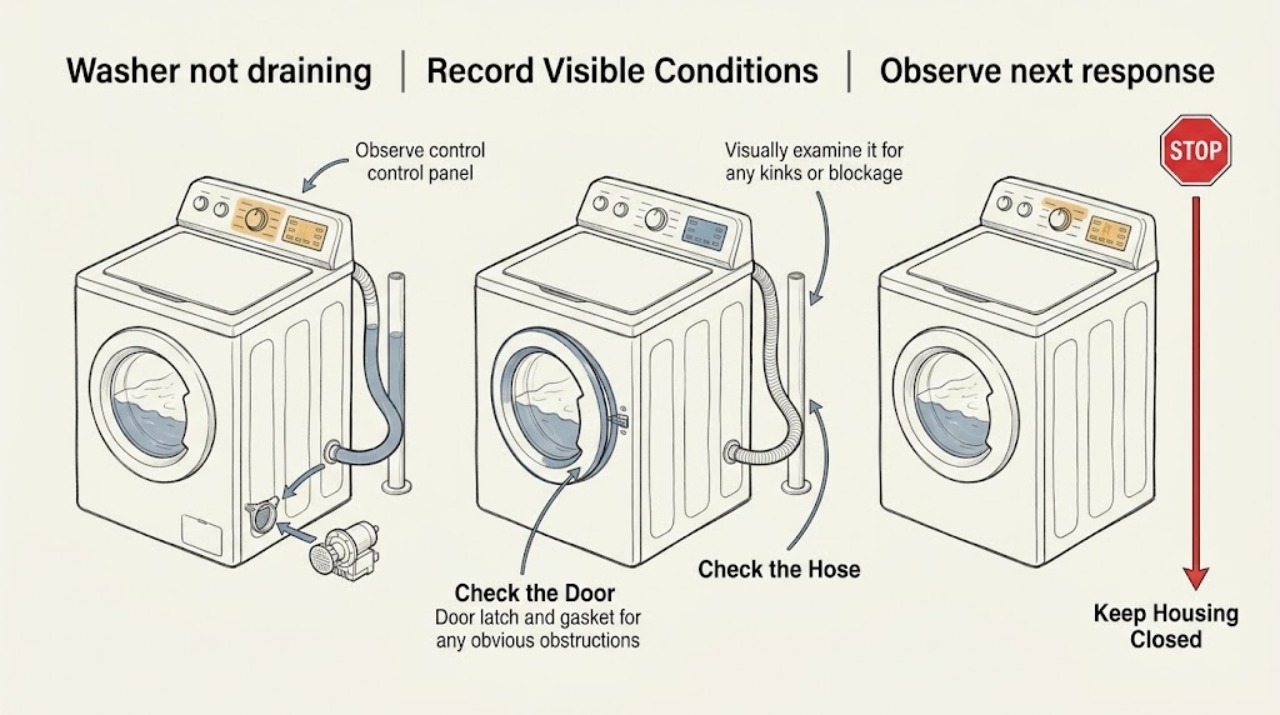
Record the exact Maytag model, any displayed code, whether water remains in the tub, and whether the problem occurred during drain or spin. Start with the visible drain hose and standpipe: look for a kink, clog, loose routing, a hose pushed too far down, or a sealed drain connection. Maytag says some front-load models have an accessible drain-pump filter, but its cleaning procedure is model-specific and requires the washer to be off; do not open panels or reach into a pump as a generic fix. A wet load can also result from an unbalanced load, a gentle spin selection, or excess suds rather than a failed pump. Do not force a locked door, run repeated cycles with standing water, or touch water near electricity. Arrange service when the pump filter or hose is inaccessible, the code returns, water remains after the approved checks, the washer leaks, or diagnosis requires pump, control, wiring, or cabinet access.
Before you begin
Safety first
- This article supports model identification, visible drain-hose and standpipe checks, load and detergent observations, and an accessible pump-filter procedure only when the exact Maytag manual permits it. It does not authorize door-lock bypass, pump or panel access, live electrical testing, pressurized plumbing work, appliance movement, or operation after a water or electrical hazard.
Work through in order
Diagnostic checks
Use only checks that match the exact appliance or system and its official guide.
-
Check 1
With the washer stopped and safe to approach, record the full Maytag model, exact display or code, remaining water level, load condition, and whether the failure occurred during drain, spin, or at the end of the cycle.
Expected result: Classify the result as a full tub, shallow residual water, a wet load with an otherwise empty tub, a humming pump with no water movement, no pump sound, or a code such as drn, Sud, or another model-specific indication.
Next step: Photograph the display and model label, preserve the load and water observations, and follow the corresponding hose, filter, load, or service path without repeatedly restarting the cycle.
Stop if: Stop for water near the outlet, plug, controls, or wiring; smoke, sparking, burning smell, a damaged cord, an active leak, or a door that will not safely contain water.
Why this matters
Why: A full tub or no water movement points toward the drain path, pump filter, pump, or control; a wet load with little water may instead reflect balance, spin selection, or suds. Codes must be matched to the exact model, not a generic Maytag list.
-
Check 2
If water remains in the tub or a front-load door stays locked, leave the washer off and use only the exact Maytag manual's safe cancel, drain, or residual-water procedure; do not pull the door open or reach into a locked drum.
Expected result: Record whether the door unlocks after the documented drain or cancel step, whether water remains, and whether a lock or drain code returns.
Next step: Use a model-approved drain or residual-water method with towels and a shallow container, or request service if the manual does not provide an accessible procedure or the water cannot be removed safely.
Stop if: Do not force the door, bypass the lock, tip or move a water-filled washer, open panels, or handle water near electrical parts.
Why this matters
Why: Maytag explains that a front-load door can remain locked when water cannot drain to help prevent flooding. A locked door with standing water is a containment condition, not evidence that the lock should be bypassed.
-
Check 3
From a dry, accessible position, inspect the visible drain hose and standpipe or laundry tub for kinks, crushing, clogs, loose routing, excessive insertion, or a connection sealed with tape; do not disconnect plumbing to probe a blockage.
Expected result: Record a kinked or blocked hose, hose end that is too far into the standpipe, missing U-shaped form or securing, a standpipe blockage or backup, a hose sealed too tightly, or a clear correctly routed drain.
Next step: Correct only an obvious visible routing issue using the exact installation instructions; use plumbing service for a blocked standpipe and appliance service for an internal hose, pump, or cabinet issue.
Stop if: Do not tape or seal the hose, pour drain opener into the washer or standpipe, disconnect a pressurized line, pull the appliance out alone, or reach into the pump.
Why this matters
Why: Maytag links poor drainage to hose kinks or clogs, incorrect insertion, sealed connections that prevent an air path, standpipe height or routing, and household drain blockage. A clear visible path with standing water shifts concern toward the pump or an internal restriction.
-
Check 4
Only if the exact Maytag front-load manual identifies an accessible drain-pump filter, turn the washer off and follow that manual's residual-water and filter procedure with a shallow container and cloth; do not remove a cabinet panel or use a generic filter location.
Expected result: Record whether the filter is present, clogged with lint or foreign objects, damaged, missing, or clean, and whether water drains through the model-approved access without leaking onto electrical parts.
Next step: Reinstall the filter exactly as the manual specifies, restore any drain hose or plug, clean spilled water, and stop if the washer still will not drain or the filter access is not explicitly user-serviceable.
Stop if: Do not use a screwdriver to reach inside, remove panels, operate the pump with the filter open, touch wet wiring, or continue if the filter will not seat or the housing leaks.
Why this matters
Why: Maytag says an accessible pump filter on some front-load models can collect dirt, lint, or other items and should be cleaned occasionally. A clean filter, damaged housing, pump that hums without moving water, or water that cannot be safely drained needs service diagnosis.
-
Check 5
If the tub is mostly empty but clothes remain wet, inspect the load distribution, overload condition, selected spin speed, and detergent amount from the control panel and basket opening without adding water or reaching into motion.
Expected result: Record a single heavy or tightly packed load, an unbalanced load, a gentle or low-spin selection, excessive suds, a Sud indication, or normal load and detergent conditions.
Next step: Follow the clothing-care label and model cycle guide, redistribute or reduce the load, and use only the measured HE detergent amount; request service if a normal load still leaves water or the drain code returns.
Stop if: Do not add extra detergent, add water to force a drain, run a high-speed cycle with violent imbalance, or continue if the washer leaks, overheats, or makes a new mechanical sound.
Why this matters
Why: Maytag says unbalanced or overloaded loads, slow-spin cycles, and excessive detergent suds can leave clothes wet or interfere with pumping and spinning. These findings do not prove that the drain pump has failed.
-
Check 6
If a display code is present, match the exact characters and model to the Maytag owner's manual or model-specific support page before clearing or restarting it; use a published code example only when the washer type and code are the same.
Expected result: Record whether the code is the top-load drn indication, Sud, a front-load long-drain code, a door or lid code, or an unfamiliar code that does not match the model documentation.
Next step: Follow the exact model's documented user check once; if the code does not clear, returns, or requires diagnostics, preserve it for qualified service rather than repeatedly resetting the control.
Stop if: Do not enter undocumented diagnostic modes, clear a code while a safety symptom remains, bypass a lid or door lock, or use a technician-only wiring procedure.
Why this matters
Why: Maytag's top-load code page says drn indicates the washer is not draining properly and may involve installation, while its broader guide lists drain hose, pump filter, suds, balance, and door causes. A different code or platform requires its own instructions.
-
Check 7
After one safe visible hose, load, detergent, or model-approved filter correction, document whether the washer drains fully and whether the problem returns on the same stage or code; do not run repeated cycles to force a result.
Expected result: Classify the result as normal drain, partial improvement, no water movement, recurring code, water under the cabinet, or unsafe to retry; note pump sound, leak location, and whether the door remains locked.
Next step: Keep the washer off and arrange qualified Maytag service with the model, code, stage, water level, filter or hose findings, load and detergent details, photos, and recording; use a plumber for a household standpipe blockage.
Stop if: Stop for an active leak, water near electrical parts, damaged cord, smoke, burning smell, sparking, abnormal heat, violent movement, or any need to remove panels or move the washer.
Why this matters
Why: Persistent standing water or a returning code after the correct checks makes a pump, internal hose, filter housing, pressure system, door or lid interlock, control, or wiring fault more likely than a simple hose kink.
Use your observations
Decision map
Find the observation that best matches what you see, then follow the next safe action.
-
PATH 01Safety boundary
What you see
Water remains in the tub and the visible drain hose or standpipe shows a kink, clog, loose routing, excessive insertion, a sealed connection, or backup.
Do this next
Correct only visible routing per the exact installation guide; use plumbing service for the standpipe and appliance service for persistent water or an internal restriction.
Why this path and its safety boundary
Why it matters: Installation or household drain restriction is more likely than an immediately failed pump, although an internal blockage remains possible if the visible path is corrected and water still does not move.
Safety stop: Do not seal the hose, pour chemicals into the drain, disconnect pressurized plumbing, or move a water-filled washer.
-
PATH 02Safety boundary
What you see
The washer is a front-load model with a manual-identified accessible pump filter, standing water remains, and the filter contains lint or foreign material without electrical or leak danger.
Do this next
Use the exact manual's off-state residual-water and filter-cleaning procedure once, reinstall everything correctly, and service the washer if drainage remains poor or the housing leaks.
Why this path and its safety boundary
Why it matters: A restricted pump filter is plausible. Maytag limits this check to some front-load models, so a top-load washer or a concealed filter must not receive the same procedure.
Safety stop: Do not remove cabinet panels, run the pump with the filter open, reach into the impeller, or work through water near electricity.
-
PATH 03Safety boundary
What you see
The tub is empty or nearly empty but clothes are wet, and the load was unbalanced, overloaded, on a gentle or low-spin cycle, or surrounded by excessive suds.
Do this next
Redistribute or reduce the load, follow the clothing-care and model cycle guide, use measured HE detergent, and reassess only once the washer is stable and leak-free.
Why this path and its safety boundary
Why it matters: Load distribution, selected spin, or detergent-related suds can explain poor extraction without a complete drain failure.
Safety stop: Do not force a high-speed spin through violent imbalance, add extra detergent or water, or continue if a drain code, leak, abnormal heat, or mechanical noise appears.
-
PATH 04Safety boundary
What you see
A front-load door stays locked with water present, or the display shows drn, Sud, a long-drain code, or an unfamiliar code.
Do this next
Follow the exact model's documented cancel, residual-water, hose, filter, or suds step once; service the washer if the door remains locked, the code returns, or water remains.
Why this path and its safety boundary
Why it matters: The lock may be preventing flooding, and the code must be interpreted by the exact model. A lock or code does not authorize a bypass or generic reset.
Safety stop: Do not force the door, enter an undocumented diagnostic mode, bypass a lock, or clear a code while a leak or electrical hazard is present.
-
PATH 05Safety boundary
What you see
The visible drain path is clear and correctly routed, the applicable filter is clean or inaccessible, but water remains, the pump hums without movement, no pump sound occurs, or the code returns.
Do this next
Keep the washer off and arrange qualified Maytag diagnosis with the exact model, code, drain-stage recording, water level, and checks already completed.
Why this path and its safety boundary
Why it matters: A pump, internal hose, filter housing, pressure system, interlock, control, or wiring fault becomes more likely and cannot be confirmed safely from outside.
Safety stop: Do not open panels, test live voltage, reach into the pump, replace the pump or control by guesswork, or restart after a leak, smoke, sparking, or burning odor.
Helpful context
Understand the symptom
Not draining is not the same as a slow spin
A tub full of water, a pump that runs without moving water, and clothes that are merely wetter than expected are different symptoms. Maytag notes that a gentle cycle, an unbalanced or overloaded load, or excessive suds can reduce extraction even when the drain path is not completely blocked. Record the water level and the point in the cycle before selecting a replacement pump.
Use front-load and top-load instructions separately
Some Maytag front-load models provide an accessible drain-pump filter; many top-load models instead rely on the visible drain hose, standpipe, load, and detergent checks in their guidance. A front-load door can remain locked when water cannot drain to help prevent flooding. Do not force a door or apply a front-load filter procedure to a top-load washer without the exact owner's manual.
Protect the floor, water, and electrical system
Keep the washer off while inspecting a filter or hose. Use a shallow container and towels only where the model manual permits residual-water draining, and keep water away from the plug, outlet, controls, and wiring. A leak, damaged cord, repeated breaker operation, smoke, burning smell, or water at electrical parts changes the task from a drain check to stop-use service.
Safety boundary
Stop conditions
- Do not force a locked door or lid, bypass an interlock, reach into a moving basket or pump, or move a water-filled washer alone.
- Do not open panels, test live voltage, handle wet wiring, replace a breaker or control, or use a technician-only diagnostic procedure.
- Do not tape or seal the drain hose, pour drain-opening chemicals into the washer or standpipe, disconnect pressurized plumbing, or repeatedly run cycles with standing water.
- Stop for water near the plug, outlet, controls, or wiring; a damaged cord; smoke, sparking, burning smell, abnormal heat, an active leak, or violent movement.
- Do not apply a front-load pump-filter procedure to a top-load Maytag washer, or interpret drn, Sud, or a long-drain code without matching the exact model manual.
Only after diagnosis
Potential parts
- drain pump filter or filter housing
Consider this category only when the exact front-load model has an accessible filter and service confirms a damaged housing, missing seal, or restriction that remains after the approved cleaning procedure.
Confirm the full Maytag model and filter housing design; top-load and front-load drain arrangements are not interchangeable by symptom alone. - drain pump
Consider this category only when the visible drain path and applicable filter are clear but qualified diagnosis finds no pumping, a worn impeller, or a failed pump.
Confirm the full Maytag model, pump configuration, wiring, and service diagnosis before ordering; do not infer pump failure from a wet load alone. - drain hose or hose clamp
Consider this category only when inspection confirms a kinked, split, crushed, or leaking hose or damaged securing hardware after the installation routing is checked.
Match exact model, hose length, end geometry, clamp, and installation routing; do not seal the hose into the standpipe or substitute an unverified fitting. - lid or door lock assembly
Consider this category only when model-specific diagnosis confirms a lock or latch failure that prevents a safe drain or spin, rather than a normal locked-door state with standing water.
Confirm exact Maytag model and lock design; never bypass the interlock or order a lock from a drain symptom alone.
When checks do not resolve it
Need a professional?
Arrange qualified Maytag appliance service when the visible drain hose and standpipe are clear, the model-approved accessible filter is clean or unavailable, but water remains, the pump does not move water, the code returns, the door remains locked, or diagnosis requires a pump, internal hose, filter housing, pressure system, control, wiring, cabinet, or live electrical access. Contact a plumber when the household standpipe or utility drain is blocked. Treat water near electrical parts, an active leak, smoke, sparking, burning smell, abnormal heat, a damaged cord, or violent movement as immediate stop-use conditions.
Safety scope: This article supports model identification, visible drain-hose and standpipe checks, load and detergent observations, and an accessible pump-filter procedure only when the exact Maytag manual permits it. It does not authorize door-lock bypass, pump or panel access, live electrical testing, pressurized plumbing work, appliance movement, or operation after a water or electrical hazard.
Common questions
FAQ
Why is my Maytag washer not draining?
Common paths include a kinked or blocked drain hose, standpipe or household drain restriction, an accessible pump filter on some front-load models, excessive suds, an unbalanced or overloaded load, a slow-spin selection, or a pump or control fault. Record whether water remains and follow the exact model guide before ordering a part.
What does drn mean on a Maytag washer?
Maytag's top-load HE code page says drn indicates the washer is not draining properly and can sometimes involve installation. Use that interpretation only when the code and washer type match; check the visible drain path and exact manual, then service the washer if the code returns.
Can I clean the drain-pump filter on a Maytag washer?
Only some Maytag front-load models have an accessible drain-pump filter. If the exact manual identifies it, turn the washer off and follow its residual-water and filter procedure with a container and cloth. Do not apply a generic filter location to a top-load model or remove panels.
Why is my Maytag washer leaving clothes wet if the tub is empty?
An unbalanced or overloaded load, a gentle or low-spin cycle, or excessive suds can leave clothes wet without a complete drain failure. Redistribute or reduce the load and use measured HE detergent according to the model guide; persistent wet loads or a code need service.
What should I do if the Maytag front-load door will not open after draining fails?
Do not force or bypass the lock. Maytag says the door can remain locked when water cannot drain to help prevent flooding. Leave the washer off, use only the exact manual's safe drain or residual-water procedure, and arrange service if water remains or the door stays locked.
When should I call for Maytag washer drain service?
Call when the visible hose and standpipe are clear, the applicable filter is clean or inaccessible, and water still remains; when a code returns; or when diagnosis requires pump, hose, control, wiring, cabinet, or door-lock access. Stop immediately for leaks, smoke, sparking, burning odor, damaged cord, or water near electrical parts.
Read the exact guide
Official sources
- Owner's ManualMaytag · Official Maytag owner's manual for a specific washer; use it as an example of model-specific access and follow the manual for the appliance being serviced.
- Not Draining - Front Load Washer - Product Help | MaytagMaytag · Official Maytag Product Help article for front-load washers; filter availability and all procedures are model-specific.
- Washer Not Draining or Spinning? Troubleshooting Guide - Product Help | MaytagMaytag · Official Maytag troubleshooting guide for washer drain and spin concerns; exact model owner documentation controls the procedure.
- Not Draining - Washer - Product Help | MaytagMaytag · Official Maytag Product Help article for top-load washers; apply its checks only to the matching configuration and manual.
- Error Codes in Top Load HE Washers - Product Help | MaytagMaytag · Official Maytag code table for top-load HE washers; codes and remedies must be matched to the exact model and are not a universal Maytag list.
- Latching a Front Load Washer Door - Product Help | MaytagMaytag · Official Maytag front-load washer door-latching support; it does not authorize bypassing the lock or apply unchanged to top-load lids.
Community feedback
Share a repair observation
Share a plain-text repair observation. Accepted observations are published automatically; this page may take a moment to update.