
On this page
Start here
Quick answer
A GE washer that is not draining may be paused between cycle stages, blocked at the drain hose or household standpipe, siphoning because of incorrect hose installation, restricted by a pump filter on models that have one, or unable to run the pump. Wait through the model's normal pause before changing a dial, then check the visible drain hose and household drain without moving a wet machine. Front-load models may have a user-accessible pump filter only when the model is designed with an access door; other models require service. A full tub that only hums, water near electricity, a leak or overflow, smoke, a burning smell, a damaged cord, or an inaccessible blockage is a stop-use condition. Use the exact GE manual for any filter procedure, collect residual water safely, and do not open panels, test energized parts, or repeatedly run a washer that remains full of water.
Before you begin
Safety first
- This article supports waiting through a model-normal pause, dry ordinary-access hose and plumbing observation, model-directed load review, and a pump-filter procedure only when the exact model provides access and residual water can be controlled safely. Do not handle wet electrical areas, force a lid or door, move or tilt the washer, disconnect wet plumbing, open panels, test live parts, bypass interlocks, or repeat cycles against a full tub or overflow.
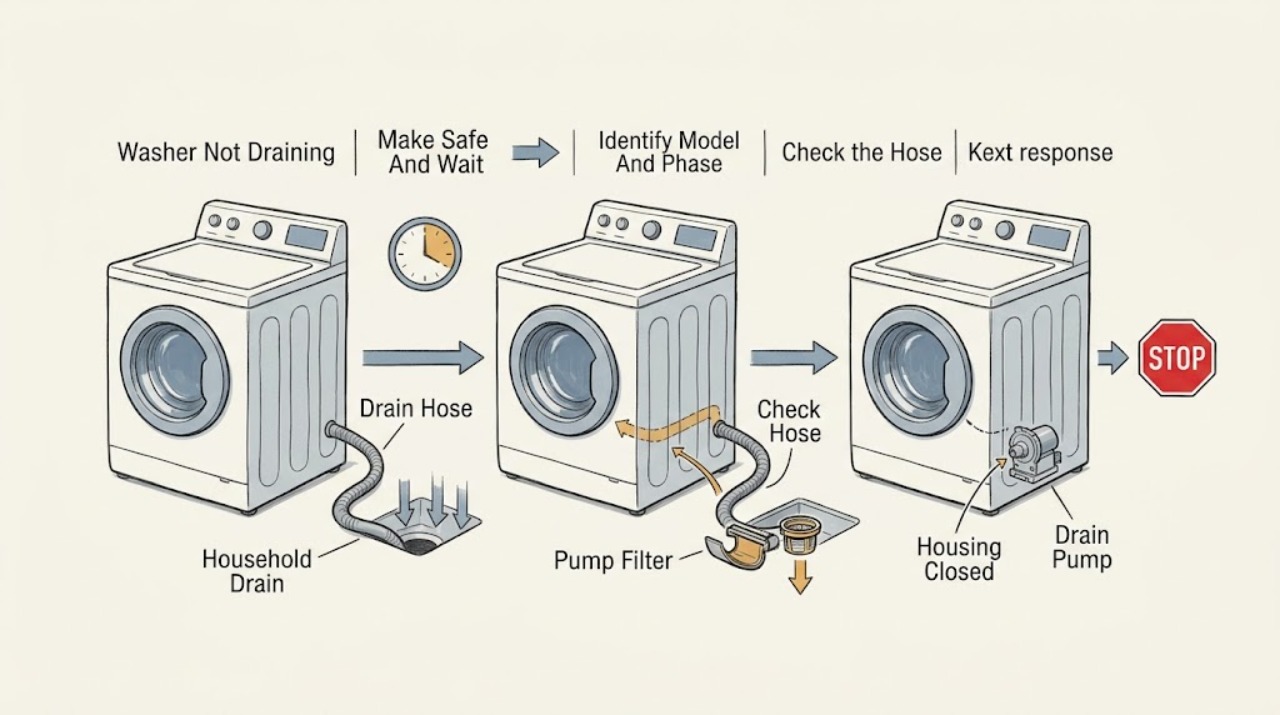
Work through in order
Diagnostic checks
Use only checks that match the exact appliance or system and its official guide.
-
Check 1
Stop using the washer's normal control if it responds, keep people and pets away from water, and observe from a dry position for a wet outlet or cord, smoke, sparks, a burning smell, active overflow, severe movement, or an unstable machine. If the machine may simply be between stages, wait through the pause described by the exact manual instead of advancing a dial.
Expected result: Record whether water is standing in the tub, whether it is spreading, whether the power area is wet or damaged, whether a circuit tripped, and whether the control display or timer is paused, showing a code, or unresponsive.
Next step: Leave the washer off and obtain qualified appliance, electrical, or plumbing help for a hazard, full tub that only hums, repeated circuit trips, or an unresponsive control. Continue only with dry ordinary-access checks when no stop condition is present.
Stop if: Do not touch a wet plug, outlet, cord, or cabinet, pull a plug through pooled water, reset a breaker repeatedly, open a locked lid or door, or keep cycling a full washer to make it drain.
Why this matters
Why: Water near electricity, smoke, sparks, heat, active flooding, or instability is a stop-use condition. A short model-normal pause is not proof of a blockage; manually advancing a dial can bypass a pump-out stage on some models.
-
Check 2
From the front or side, identify whether the GE washer is front-load, top-load, unitized, or portable and note the exact model if safely visible. Record the cycle phase when draining stopped and any display message or indicator without opening the cabinet.
Expected result: Record whether the tub is full or partly full, whether the pump is silent, humming, or rattling, whether water drains slowly, and whether the issue appears at the end of wash, during rinse, or during Drain and Spin.
Next step: Use the matching front-load, top-load, unitized, or portable path below and retrieve the exact GE manual before opening any filter or residual-water access.
Stop if: Do not infer a pump failure from a code alone, force a lid or door, reach into a moving basket, or remove a cover when the model and procedure are unknown.
Why this matters
Why: The washer style determines whether a pump filter may be owner-accessible. A phase-specific stop helps separate normal pause, drain-path restriction, pump blockage, control sequence, and service-level pump failure; a full tub with only a hum is specifically a service lead in GE's guidance.
-
Check 3
With the washer off and the floor dry, inspect the visible drain hose from the side or front for a kink, crush, pinch, crack, displacement, or hose pushed unusually far into the standpipe. Do not drag the washer or disconnect a wet hose to see behind it.
Expected result: Record whether the hose is visibly restricted or loose, whether water is leaking at the hose, and whether the hose enters a standpipe, utility sink, or other drain in the model-approved arrangement.
Next step: Correct only an obvious, loose, visible hose placement issue allowed by the exact installation instructions; leave the washer off for a crack, crush, inaccessible path, residual-water leak, or persistent no-drain condition.
Stop if: Do not disconnect the drain hose while water or electricity is present nearby, push it deeper into the standpipe, tape it in place, use a sharp object to clear it, or move the appliance across a wet floor.
Why this matters
Why: GE identifies a kinked or clogged hose and incorrect standpipe installation as causes of slow or failed draining; excessive insertion can cause siphoning or an installation-related symptom. A hidden blockage or damaged hose remains a service question.
-
Check 4
Observe the standpipe, utility sink, or floor drain from a safe dry position while the washer is idle. Look for standing water, wastewater residue, overflow, slow acceptance of water, or backflow around the drain; do not create a water test when the drain is already restricted or overflowing.
Expected result: Record whether the household drain accepts water normally, backs up during the washer's drain phase, or remains blocked independently of the washer.
Next step: Request plumbing service for a blocked or overflowing standpipe, floor drain, or utility sink. If the household drain is clear but the washer remains full, continue only with the exact model's pump-filter or service path.
Stop if: Do not pour drain cleaner into the washer or household drain, handle wastewater without appropriate protection, disassemble plumbing, or continue drain cycles against an overflow.
Why this matters
Why: If the household drain is blocked or backs up, the plumbing can stop the washer from draining or make an external restriction look like a washer fault. A clear drain with water still trapped shifts attention to the washer hose, filter, pump, or control path.
-
Check 5
For a front-load GE washer or other model that has a pump-filter access door, follow the exact owner's manual before opening it; only when the washer is safely isolated, cool, and the floor can contain residual water, place a shallow container and towels at the documented access point and inspect or clean the filter as instructed. If there is no model-designed access door, stop and request service.
Expected result: Record whether the filter contains lint, coins, fabric, or another obstruction, whether the filter and cap reseat as the manual describes, and whether water drains into the container; do not probe beyond the documented filter housing.
Next step: Replace and secure the filter or cap only as the exact manual directs, clean residual water, and make at most one safe drain observation. Request service for a model without access, a damaged or missing seal, persistent water, a seized filter, or a full tub that only hums.
Stop if: Do not open a filter with water near electricity, force a cap, reach into the pump, tilt or lift the washer, lose a seal, or use a tool to dislodge an inaccessible object.
Why this matters
Why: GE explains that small items can reach a front-load pump filter and restrict drainage, but access and cleaning are model-specific. A clear filter with a full tub, damaged cap, leak, or pump hum does not establish that the pump is serviceable.
-
Check 6
After the tub is safely stopped, review the load and controls against the exact GE manual. Note an overloaded or badly unbalanced load, a lid or door not safely closed, a pause, a flashing indicator, or a drain-related code; do not bypass a lock or manually advance a timer during a pause.
Expected result: Record whether redistributing or reducing the load is permitted, whether the washer can select its documented Drain and Spin function, and whether a code or indicator returns with water still present.
Next step: Make only a manual-approved load correction and choose the documented drain function once if the washer and area are safe. Leave it off and request service when the code returns, the tub remains full, or the lock or control is abnormal.
Stop if: Do not override a lid or door lock, advance the dial through a pause, repeatedly reset a code, or start a drain cycle with a leak, wet power area, or unstable washer.
Why this matters
Why: GE links out-of-balance loads with interrupted operation on some models and identifies model-specific indicators for a long drain. A load correction may help only when the drain path itself is clear; a returning code or full tub points toward restriction or service.
-
Check 7
Only when no stop condition is present, the floor and power area are dry, the washer is stable, the visible drain path is clear, and the exact model permits it, run one documented Drain and Spin or empty drain observation from a safe stationary position; stop immediately if water does not move or a leak appears.
Expected result: Record whether water drains fully, slowly, or not at all; whether the pump is silent, humming, or rattling; and whether a code, leak, unusual heat, or circuit trip appears.
Next step: Do not repeat the observation. Leave the washer off and arrange appliance service for a full, slow, or recurring no-drain result; request plumbing service if the household drain backs up.
Stop if: Do not run this test with standing water near electricity, an active leak or overflow, a damaged hose or cord, severe movement, a full tub that only hums, or an unknown internal source.
Why this matters
Why: A full tub with only a hum after the visible path is clear is a GE service lead. A complete drain supports a cleared restriction but does not prove an intermittent pump or control issue is repaired; a slow or partial drain keeps the blockage or pump path active.
-
Check 8
Gather the exact GE model and serial information if safely visible, washer style, water level, cycle phase, drain-hose and standpipe observations, filter result if the manual allowed access, display message, and any safe photos before requesting service.
Expected result: Confirm whether the issue is complete or slow no-drain, whether the tub hums, whether water backs up outside the washer, whether the problem follows a load, and whether any circuit, leak, lock, noise, or vibration symptom is present.
Next step: Use GE's product support and qualified repair route for a persistent or internal no-drain condition; use a plumber for household-drain overflow and electrical help for a wet, hot, damaged, or tripping power connection.
Stop if: Do not order a pump, filter, hose, control, or motor from a symptom alone, open the cabinet, test live parts, or bypass a lock or safety control.
Why this matters
Why: A model-and-phase record helps separate a normal pause, hose or plumbing restriction, pump-filter blockage, load or control condition, and pump or internal fault without repeating risky tests.
Use your observations
Decision map
Find the observation that best matches what you see, then follow the next safe action.
-
PATH 01Next step
What you see
The washer has only paused briefly between stages, no water is spreading, no electrical or leak hazard is present, and the exact GE guidance permits waiting; a manual dial has not been advanced.
Do this next
Wait through the model's documented pause and let the normal pump-out stage occur. If draining does not begin, water remains, or a code returns, move to the hose, plumbing, filter, and service paths instead of advancing the dial repeatedly.
-
PATH 02Next step
What you see
The visible hose is kinked, crushed, cracked, loose, or incorrectly routed, or the standpipe, utility sink, or floor drain backs up or cannot accept water independently of the washer.
Do this next
Keep the washer off; correct only an obvious manual-approved hose placement issue from dry access, and request appliance service for hose damage or plumbing service for a restricted household drain. Do not disconnect wet plumbing or use drain chemicals.
-
PATH 03Next step
What you see
A model-designed, accessible pump filter contains lint or a small item, the drain path is otherwise clear, and no water or electrical hazard is present; or the washer is front-load with a filter access door and draining slowed progressively.
Do this next
Use only the exact owner's manual's residual-water and filter procedure, then secure every cap or filter as specified and make one safe observation. A missing access door, seized or damaged filter, continued no-drain, or full tub that hums requires service.
-
PATH 04Next step
What you see
The washer drains after a permitted load correction or its model-specific control sequence, with no recurring code, leak, standing water, or abnormal pump sound; or the tub contains no visible water but a sloshing sound is described by the model as normal.
Do this next
Follow the exact GE manual and monitor the next normal load without bypassing controls. If no-drain returns, the tub remains full, or a code or pump symptom appears, leave the washer off and request service.
-
PATH 05Next step
What you see
The tub remains full and only hums, the washer stays slow or completely blocked after the visible hose, plumbing, load, and model-permitted filter checks, or the source is inaccessible or accompanied by a leak, heat, severe movement, code, or circuit trip.
Do this next
Leave the washer off and arrange qualified GE appliance service. A technician must determine whether the pump, filter housing, control, wiring, tub, hose, or another model-specific component is responsible; do not open the cabinet or guess a part.
Helpful context
Understand the symptom
Wait, then identify the washer style
A no-drain complaint can mean the machine is still in a normal pause, the pump-out path is restricted, or the controls stopped the cycle. GE notes that many models can pause between stages and that manually advancing a dial can skip the pump-out portion. Identify whether the machine is front-load, top-load, unitized, or portable before touching a filter or residual-water access point; procedures differ by design.
The drain hose and household plumbing come before an internal diagnosis
A kinked or crushed hose, hose pushed too far into a standpipe, an installation that siphons, or a blocked household drain can all leave water in the washer. If the standpipe or floor drain cannot accept water, the washer may be blamed for a plumbing restriction. Keep any check to dry, visible access and do not disconnect a hose containing residual water unless the exact manual and safe conditions clearly allow it.
Pump filters are model-specific and hold residual water
GE states that many front-load washers have a pump filter that catches small items, but only models with the designed access door should be cleaned by an owner; models without front access require service. A filter opening can release residual water, so the manual, a suitable container, towels, and safe power isolation matter. A full tub that only hums is a service signal rather than an invitation to force the filter or pump.
Use one safe observation, not repeated drain cycles
When the floor and electrical area are dry, the washer is stable, and no stop condition is present, one model-permitted Drain and Spin or empty observation can show whether the restriction has cleared. Stop immediately if the tub remains full, water leaks, the pump only hums, or the washer becomes hot or unstable. Document the phase, code, hose position, and water level for service.
Safety boundary
Stop conditions
- Water is near an outlet, plug, cord, wiring, or other electrical connection; the cord or outlet is hot or damaged; or a breaker or GFCI trips.
- Active flooding, wastewater overflow, a rapidly spreading leak, or a washer that is unstable, walking, or moving severely.
- The tub remains full and the pump only hums, the drain is completely silent after safe checks, or the pump area is hot, grinding, or leaking.
- The drain hose or standpipe is cracked, crushed, displaced, blocked, or inaccessible without moving the washer or disconnecting wet plumbing.
- The model has no owner-accessible pump-filter door, the filter or cap is seized or damaged, or residual water cannot be contained safely.
- A door or lid will not safely release, the basket is moving, or a lock or safety interlock would need to be bypassed.
- A code or no-drain condition returns after one model-permitted correction or observation, or the washer also has a leak, heat, smoke, odor, severe vibration, or abnormal noise.
- Any proposed step requires opening the cabinet, testing energized parts, tilting or lifting the appliance, or using a tool to reach an inaccessible blockage.
Only after diagnosis
Potential parts
- drain hose or hose connector
Consider only when the hose is confirmed cracked, crushed, kinked, displaced, or unable to remain correctly routed after household plumbing is separated from the washer fault.
Verify the full GE model, hose routing, connector design, and installation instructions before ordering or disconnecting plumbing. - pump filter, filter cap, or filter seal
Consider only for a model with an owner-accessible filter when the exact diagnosis finds a damaged cap, seal, or housing rather than a clean filter or household drain restriction.
Confirm the exact model and residual-water procedure; not every GE washer has an owner-cleanable pump filter. - drain pump
Consider only when a technician confirms the visible drain path and model-permitted filter are clear but the pump remains silent, hums with a full tub, or fails to move water.
Verify the complete model and diagnostic result before ordering; pump access exposes residual water and electrical components. - lid or door lock component
Consider only when the exact model's control sequence prevents drain or spin because the lock is confirmed faulty, not merely because the tub remains full.
Do not bypass the lock; confirm model-specific diagnosis and compatible fit before any repair. - washer control or wiring component
Consider only after hose, household drain, load, filter, and pump causes are evaluated and a technician identifies a model-specific control or wiring fault.
Never test energized parts or order a control from an indicator alone; verify the complete model and service diagnosis.
When checks do not resolve it
Need a professional?
Arrange qualified GE appliance service when the tub remains full and only hums, draining stays slow or fails after the model's safe hose, plumbing, load, and accessible-filter checks, the model has no user-accessible filter, or the condition recurs with a code, leak, heat, severe vibration, or abnormal sound. Request plumbing service for a backed-up standpipe or household drain and electrical help for a wet, hot, damaged, or repeatedly tripping power connection. Treat active flooding, smoke, sparks, or dangerous movement as urgent stop-use conditions.
Safety scope: This article supports waiting through a model-normal pause, dry ordinary-access hose and plumbing observation, model-directed load review, and a pump-filter procedure only when the exact model provides access and residual water can be controlled safely. Do not handle wet electrical areas, force a lid or door, move or tilt the washer, disconnect wet plumbing, open panels, test live parts, bypass interlocks, or repeat cycles against a full tub or overflow.
Common questions
FAQ
Why is my GE washer not draining but humming?
GE treats a tub full of water that only hums as a service lead. After the washer is safely off, check the visible hose and household drain and use a model-permitted pump-filter procedure only when the model has that access; do not open the cabinet or keep cycling it.
How long should I wait if my GE washer pauses before draining?
Some GE models pause between cycle stages. Wait through the pause described by the exact manual and do not manually advance a dial, because that can skip pump-out on some models. If water remains after the expected stage, continue with the hose and plumbing checks.
Can a clogged standpipe make a GE washer look like it is not draining?
Yes. GE says a restricted household drain can prevent discharge or cause water to overflow, while a loose or incorrectly installed hose can also cause a no-drain symptom. Keep the washer off and request plumbing service for a backed-up standpipe or floor drain.
Does every GE washer have a pump filter I can clean?
No. GE says pump-filter cleaning applies to front-load models with a designed access cover; models without that access require their own manual or service. Do not open panels or tilt the washer to find a filter.
What should I check when a GE washer leaves water in the tub?
First wait through any model-normal pause, then check the visible drain hose and household standpipe from dry access. If the model has an accessible pump filter, use only its exact manual procedure; standing water with a humming pump, an unknown source, or a recurring failure needs service.
When should I stop using a GE washer that will not drain?
Stop for a full tub that only hums, water near electricity, active overflow, wastewater, a damaged hose or cord, smoke, heat, severe movement, repeated codes, or any need to move the appliance or open its cabinet. Arrange qualified appliance, plumbing, or electrical help as appropriate.
Read the exact guide
Official sources
- Unitized Washer - Will Not DrainGE Appliances · Applies to GE unitized and Spacemaker families; portable or older designs may have different filter access, so the exact manual controls.
- Support for GE Washers and DryersGE Appliances · Use for GE product support and repair routing; it is not a substitute for model-specific diagnosis.
- Front Load Washer - Will Not Drain or Drains SlowlyGE Appliances · Applies to GE front-load families as a model-family guide; the exact owner's manual controls pump-filter access, drain installation, and service procedure.
- Front Load Washer - TroubleshootingGE Appliances · General GE front-load guidance; exact model installation instructions and owner's manual control hose routing and pump-filter access.
- Top Load Washer - Will Not DrainGE Appliances · Applies to GE top-load families as a model-family guide; model year, controls, drain arrangement, and owner's manual control the applicable path.
- Front Load Washer - Cleaning a Pump FilterGE Appliances · Only for GE front-load washers with a bottom-front access cover; other models require their own manual or service.
- Frequently Asked Questions About GE WashersGE Appliances · General GE washer FAQ; exact model manual and support article control any code, pause, hose, or installation details.
Community feedback
Share a repair observation
Share a plain-text repair observation. Accepted observations are published automatically; this page may take a moment to update.