
On this page
Start here
Quick answer
First note whether the washer is paused normally, leaves water in the basket, hums without moving water, or drains slowly and then stops. Keep the lid or door closed until the basket is still, and keep the washer off if water is near the cord, outlet, controls, or other electrical equipment. Check the visible drain hose for kinks, crushing, a blockage, incorrect height, or siphoning; check the household standpipe or sink drain for a backup; and use the exact Hotpoint model instructions for a front-load pump filter or a Drain and Spin cycle. Do not manually advance an older mechanical timer during a normal pause, open the cabinet, force a pump, or disconnect a wet hose. A tub that remains full and only hums, a damaged hose, a returning code, a leak, or a drain path that remains blocked needs qualified service or plumbing help.
Before you begin
Safety first
- Keep the washer off for a significant leak, water near electrics, hot or uncontrolled water, smoke, burning odor, a hot plug or outlet, a basket that will not stop, or a washer that will not turn off. Do not open the cabinet, bypass safety devices, or repeat drain tests.
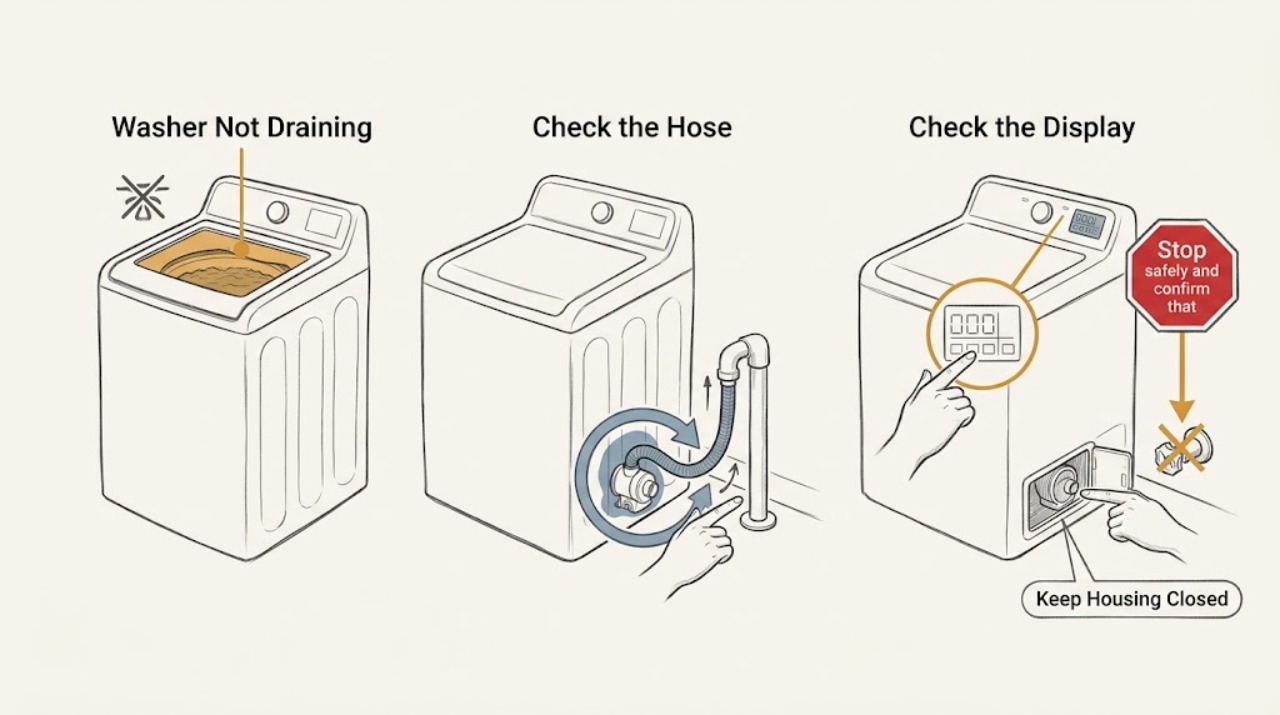
Work through in order
Diagnostic checks
Use only checks that match the exact appliance or system and its official guide.
-
Stop safely and confirm that water is actually retained
Press Pause or Stop and wait for the basket or drum to become completely still. Record the model number, top-load or front-load style, selected cycle, whether water is visible, and whether the washer is paused, humming, repeatedly trying to pump, or showing a light or code. From a dry, safe position, look for water near the cord, outlet, controls, smoke, a hot connection, or a rapidly spreading leak.
Expected result: The basket does not stop, water reaches electrical equipment, smoke or a burning odor appears, the washer will not stop, or the leak is large or rapidly worsening.
Next step: Keep clear and isolate power only from a safe, dry location. Do not touch wet electrical equipment or pull a wet plug. Close the water supply only if it is safely reachable, then arrange qualified appliance or electrical service; use emergency help for smoke or fire.
Stop if: Do not open the lid or door during movement, run another cycle, or move the washer through pooled water.
Why this matters
Why: This is an injury, fire, electrical, or water-damage event rather than a routine drain check.
-
Allow for a documented pause before changing the control
If no water is visible and the washer is quiet or paused after agitation, wait for the interval allowed by the exact model instructions instead of manually advancing a mechanical timer. Do not turn a dial past the pump-out section just to make the cycle appear to continue.
Expected result: The washer resumes and drains after the normal pause, water remains after the pause, or the control is manually advanced and the pump-out phase may have been skipped.
Next step: Let the documented cycle complete if it resumes normally. If water remains, return the control to the model-approved position and continue with the visible drain checks; do not force the timer or repeatedly restart it.
Stop if: Do not manually advance a mechanical timer through a possible pump-out phase.
Why this matters
Why: A normal pause or timer position can mimic a no-drain complaint. Water that remains after the model's normal pause points to the drain hose, household plumbing, pump or filter, lid, or a control fault.
-
Inspect the visible drain hose and its routing
With the washer off and the floor dry, inspect the full visible drain hose for kinks, flattened sections, crushing, damage, a loose end, or a hose pushed too far down into the standpipe. Compare the discharge height and support with the exact model installation instructions. Hotpoint-branded washers covered by the official guidance have model-dependent height limits; do not treat a compact or unitized model like a full-size washer.
Expected result: The hose is kinked, crushed, damaged, unsupported, too high or too low for the model, pushed too far into the drain, taped into an airtight connection, or visibly clear and correctly routed.
Next step: Correct only a safe visible routing issue documented for the model and secure the hose without forcing it. If the hose is damaged, the holder is missing, or water remains after the correction, request service.
Stop if: Do not disconnect a wet hose, remove a retaining clip or fastener not covered by the manual, or use a makeshift extension.
Why this matters
Why: A restricted or incorrectly installed hose can stop or slow drainage, while a correct visible hose shifts suspicion toward the household drain, pump or filter, or control system.
-
Separate a blocked household drain from a washer restriction
Observe the standpipe, wall drain, or utility sink only from a safe, accessible position. Look for water rising or backing up when the washer pumps out, slow drainage in other fixtures, or a drain opening that is visibly obstructed. Do not pour chemical cleaner into the washer or pull the appliance away from the wall to reach a concealed connection.
Expected result: The household drain backs up or drains slowly for other fixtures, the standpipe is clear but the washer retains water, or the drain path cannot be inspected safely.
Next step: Use qualified plumbing help for a blocked household drain. If the household drain is clear but the washer still will not drain, continue only with the exact model's pump or filter instructions or arrange appliance service.
Stop if: Do not use drain chemicals in the washer and do not work on a wet or inaccessible plumbing connection.
Why this matters
Why: A shared plumbing restriction is more likely when the household drain backs up. A clear household drain with retained washer water points more toward the hose, pump, filter, or washer control.
-
Clean a front-load pump filter only when the model has documented access
For a front-load washer with an access cover at the lower front, follow the exact Hotpoint or GE Appliances model instructions to prepare a shallow pan and towels, drain residual water slowly, and clean and refit the filter. The washer must be off and safely isolated; if a hot cycle recently ran, wait for the model's cooling guidance. Do not assume a top-load, compact, or model without a front access cover has the same filter.
Expected result: The filter contains lint or a small object, the filter is stuck or damaged, water is hot or uncontrolled, or there is no documented front access cover.
Next step: Clean and refit the filter only as the exact model instructions allow, then secure the access door and wipe the area dry. Request appliance service for a stuck or damaged filter, uncontrolled water, or a model without user-accessible filter instructions.
Stop if: Do not force the filter, reach into the pump, remove cabinet panels, or perform this check with hot water or a wet electrical area.
Why this matters
Why: A clogged front-load pump filter can restrict drainage, while a stuck, damaged, hot, or undocumented access path requires service rather than force.
-
Check lid or door and load conditions without reaching into motion
After the tub is still, confirm that the lid or door is fully closed and that no clothing is caught at the opening. Check whether the washer is overloaded or severely out of balance, because some models will not complete spin or drain behavior normally when the load cannot balance. Do not bypass the lid or door switch and do not reach into a moving basket.
Expected result: The lid or door was open, laundry blocks closure, the load is overloaded or bunched, the washer is a much older model with lid-dependent operation, or the lid or door is closed and the tub remains full.
Next step: Close the lid or door correctly, remove only excess laundry after motion stops, and use the exact model's drain or spin function once if safe. If the switch or latch is damaged or the tub remains full, arrange service.
Stop if: Do not defeat the lid or door interlock or run a cycle with damaged closure hardware.
Why this matters
Why: A lid or door condition can prevent the washer from completing a drain or spin sequence on applicable models. A full tub with a correctly closed lid or door makes a drain-path or pump problem more likely.
-
Use a model-documented Drain and Spin attempt once
After the hose, household drain, lid or door, and applicable filter checks are complete, select Drain and Spin or the model's equivalent only as the owner instructions describe. Stay nearby and watch the first pump-out. Do not run this test if water is near electrical parts, the washer is leaking, water may be hot, or a safety symptom is present.
Expected result: Water begins leaving promptly, the pump hums with a full tub but no water moves, the washer drains only after a hose correction, or the same no-drain condition or code returns.
Next step: If it drains normally, monitor one ordinary cycle. If it hums without moving water, a code returns, or the tub remains full, leave the washer off and request appliance service.
Stop if: Do not repeat Drain and Spin attempts to force a stuck pump or empty a leaking washer.
Why this matters
Why: A successful pump-out after a routing or filter correction supports a restriction. A full tub with only humming or a recurring failure suggests a pump, obstruction, wiring, control, or other fault requiring diagnosis.
-
Record the exact symptom for service
If the washer still will not drain, record the model, top-load or front-load style, cycle stage, water level, error or flashing light, pump sound, drain-hose routing, household drain result, filter result if applicable, and whether the washer was recently moved or serviced. Keep the washer off instead of opening the cabinet or replacing a pump by guesswork.
Expected result: The tub is full and the pump only hums, the hose and household drain are clear, the filter is clear or not accessible, a code returns, or the washer drains slowly on every cycle.
Next step: Arrange qualified appliance service and provide the recorded sequence. Use plumbing service as well when the household drain backs up or the restriction is outside the washer.
Stop if: Do not dismantle the cabinet, bypass safety controls, or keep operating with a full tub and repeated no-drain condition.
Why this matters
Why: A pump, motor, obstruction beyond the user-accessible path, wiring, control, or model-specific fault is possible and cannot be confirmed safely from external checks.
Use your observations
Decision map
Find the observation that best matches what you see, then follow the next safe action.
-
PATH 01Next step
What you see
The washer is only paused, no water is visible, and it resumes within the normal model pause; or an older mechanical dial was advanced during the pause.
Do this next
Let the documented sequence complete and do not manually advance the timer. If water remains after the normal pause, use the model's drain guidance and check the hose and household drain.
Why this path and its safety boundary
Why it matters: The apparent no-drain symptom may be a normal phase pause or a timer position that skipped the pump-out stage.
-
PATH 02Next step
What you see
Water remains in the tub, the drain hose is kinked, crushed, too high, inserted incorrectly, or the household standpipe backs up during pump-out.
Do this next
Correct only the visible model-documented hose issue. Use qualified plumbing help for a backed-up household drain, and request appliance service if the hose is damaged or the washer still retains water.
Why this path and its safety boundary
Why it matters: An external drain routing or household plumbing restriction is more likely than a failed pump.
-
PATH 03Next step
What you see
A front-load model has a documented lower-front pump-filter access, drainage is poor, and the filter contains lint or a small object without hot or uncontrolled water.
Do this next
Clean and refit the filter only as the exact model instructions allow, then observe one safe drain attempt. Stop for a stuck or damaged filter, uncontrolled water, or a returning fault.
Why this path and its safety boundary
Why it matters: A clogged pump filter is a plausible restriction in the drain path.
-
PATH 04Next step
What you see
The tub is full and the pump only hums, the hose and household drain are clear, or the washer drains slowly on every cycle despite a clear filter or no filter access.
Do this next
Leave the washer off and arrange qualified appliance service. Do not open the cabinet or continue repeated drain attempts.
Why this path and its safety boundary
Why it matters: A pump, internal obstruction, wiring, control, or other washer fault is more likely than a simple external kink.
-
PATH 05Next step
What you see
The lid or door was open, laundry blocked closure, or an applicable lid switch or door latch does not register closed.
Do this next
Close the lid or door correctly after motion stops and follow the exact model instructions. Do not bypass a switch or latch; request service if it is damaged or the tub remains full.
Why this path and its safety boundary
Why it matters: The washer may be preventing the drain or spin sequence for an interlock reason, especially on model-specific or older designs.
-
PATH 06Next step
What you see
A Drain and Spin attempt works after the hose or filter correction, with no leak, code, or electrical warning.
Do this next
Monitor one ordinary cycle and keep the hose secured. If the symptom returns, record the pattern and request service rather than repeating resets or tests.
Why this path and its safety boundary
Why it matters: A temporary or corrected drain-path restriction is more likely than a confirmed failed pump.
-
PATH 07Next step
What you see
Water is near electrical equipment, the leak is significant, water may be hot, smoke or burning odor appears, the basket does not stop, or the washer will not turn off.
Do this next
Keep clear, isolate power only from a safe dry location, and arrange qualified appliance or electrical service. Do not touch wet equipment or restart the washer.
Why this path and its safety boundary
Why it matters: The immediate risk is shock, burn, fire, or water damage, and ordinary drain troubleshooting must stop.
Helpful context
Understand the symptom
A pause is not always a failed drain
Some Hotpoint and related GE Appliances washer designs pause between phases, and a top-load washer can make a sloshing sound from its balance ring even when no water is visible. Do not advance a mechanical timer just because the washer pauses after agitation. Instead, note whether the water level is actually falling and whether the drain pump is audible.
Washer style changes the safe check
Top-load, front-load, compact, and unitized Hotpoint washers do not share the same pump access or drain limits. A front-load model may have a user-accessible pump filter; models without the documented access require service. Use the exact model installation and owner instructions before disconnecting a hose, opening a filter door, or selecting a drain cycle.
Separate the appliance drain from household plumbing
A kinked washer hose and a blocked household standpipe can look alike from the front. If the washer hose is visibly clear but the home's standpipe or sink drain backs up, the plumbing is the likely restriction. Do not use chemical drain cleaner in the washer and do not pull a heavy appliance away from the wall while its hoses and cord are connected.
Safety boundary
Stop conditions
- Stop immediately for water near an outlet, plug, cord, controls, or other electrical equipment; smoke, burning odor, a hot connection, a washer that will not turn off, or a rapidly spreading leak. Isolate power only from a safe, dry location and arrange qualified help.
- If water may be hot after a hot or sanitizing cycle, follow the exact model cooling guidance before any drain or filter access. Do not reach into a moving tub or through pooled water.
- Do not open the cabinet, bypass a lid or door interlock, force a pump or filter, disconnect a wet hose, or remove a drain-hose retainer as an experiment.
- Do not pour chemical drain cleaner into the washer or keep repeating Drain and Spin when the tub remains full, the pump only hums, a code returns, or an external restriction is not resolved.
Only after diagnosis
Potential parts
- drain hose or hose support
Consider this only when the exact model diagnosis identifies a visibly damaged drain hose or missing or damaged support after the external routing is confirmed.
Drain hose shape, retainer, and routing differ by Hotpoint top-load, front-load, compact, and unitized models. Confirm the exact model and diagnosis before selecting a replacement. - front-load pump filter
Consider this only when the exact front-load model has a documented filter, the filter is damaged or cannot seal, and service diagnosis links it to the no-drain condition.
Top-load and some other Hotpoint models do not have the same user-accessible filter. Confirm the model and filter design before selecting a part. - drain pump
Consider this only when the hose, household drain, lid or door condition, and applicable filter are clear and a qualified diagnosis confirms a failed or obstructed pump.
Pump fit and access are model-specific. Do not order or install a pump based on a humming sound alone.
When checks do not resolve it
Need a professional?
Request appliance service for a full tub with a humming pump, persistent or recurring no-drain condition, a damaged or inaccessible hose or filter, a failed lid or door interlock, a returning code, or any leak or electrical symptom. Request plumbing help when the household standpipe or sink drain backs up.
Safety scope: Keep the washer off for a significant leak, water near electrics, hot or uncontrolled water, smoke, burning odor, a hot plug or outlet, a basket that will not stop, or a washer that will not turn off. Do not open the cabinet, bypass safety devices, or repeat drain tests.
Common questions
FAQ
Why is my Hotpoint washer not draining but not showing an obvious clog?
Check whether it is in a normal pause, then inspect the visible drain hose and household standpipe, and use the exact model's front-load pump-filter instructions if applicable. A full tub with only a humming pump or a recurring failure needs appliance service.
Can a Hotpoint washer drain hose stop the washer from draining?
Yes. A kinked, crushed, damaged, unsupported, incorrectly inserted, too-high, or airtight drain hose can restrict flow or cause siphoning. Compare the visible installation with the exact model instructions and do not remove a retaining clip or disconnect a wet hose as an experiment.
Does every Hotpoint washer have a pump filter I can clean?
No. The official pump-filter procedure is limited to front-load washers with a documented lower-front access cover. Top-load, compact, unitized, and other models may have different access or require service. Use the exact model manual and stop if water is hot or uncontrolled.
Should I advance the timer when my older Hotpoint washer pauses before draining?
Not automatically. Official guidance says some models pause between phases and warns that advancing a mechanical timer can skip the pump-out portion. Wait for the model's normal sequence and use the owner instructions if water remains.
What does it mean if my Hotpoint washer only hums with a full tub?
A full tub with only a hum after the hose, household drain, lid or door, and applicable filter checks points toward a pump, obstruction, wiring, or control fault. Leave the washer off and arrange qualified appliance service rather than repeating Drain and Spin.
When should I stop troubleshooting a Hotpoint washer that will not drain?
Stop for water near electrical equipment, hot or uncontrolled water, smoke, burning odor, a basket that will not stop, a washer that will not turn off, a significant leak, or a full tub that remains after the model-specific visible checks. Isolate power only from a safe dry location and arrange qualified service; use plumbing help for a household drain backup.
Read the exact guide
Official sources
- Washer - Spins and Stops RepeatedlyGE Appliances · Official general guidance; production year and model design affect cycle behavior.
- Front Load Washer - Cleaning a Pump FilterGE Appliances · Only for front-load washers with the documented lower-front access cover; other models require their own manual or service.
- Washer - Drain Hose InformationGE Appliances · Official guidance explicitly including Hotpoint top-load, front-load, combo, and unitized washers; consult the exact installation instructions.
- Washer - Drain HeightGE Appliances · Official guidance explicitly covering Hotpoint top-load and front-load washers; compact and model-specific requirements differ.
- Front Load Washer - TroubleshootingGE Appliances · Official GE Appliances guidance for front-load washer behavior; access and parts vary by Hotpoint model.
- Top Load Washer - Will Not DrainGE Appliances · Official GE Appliances support guidance that explicitly covers related washer behavior; exact Hotpoint model instructions control.
- Hotpoint Washer Use and Care BookHotpoint · Older Hotpoint W3000R-family manual; use only for general safety warnings and do not generalize its controls to newer models.
- Washer – Drain and Spin CycleGE Appliances · Official general washer guidance; available cycle names and options vary by Hotpoint model.
Community feedback
Share a repair observation
Share a plain-text repair observation. Accepted observations are published automatically; this page may take a moment to update.