
On this page
Start here
Quick answer
If an LG washer is not draining, stop the cycle and first note whether water is still in the tub, whether the tub water may be hot, and whether an OE code is shown. From safe access, check the external drain hose for a kink, crush point, high loop, submersion, blockage, or freezing. Front-load and combination LG units may have a user-accessible drain-pump filter; top-load models may not, so use the exact model instructions before opening a panel. If that model has a filter, cool the water, empty residual water into a shallow container, clean the filter, and reinstall its cap and cover fully. If a safe drain test sends strong water through the hose but the household standpipe or sink backs up, the house drain needs attention. No flow, unusual pump noise, recurring OE, a leak, water near electrical parts, or water too hot to handle is a stop-and-service condition.
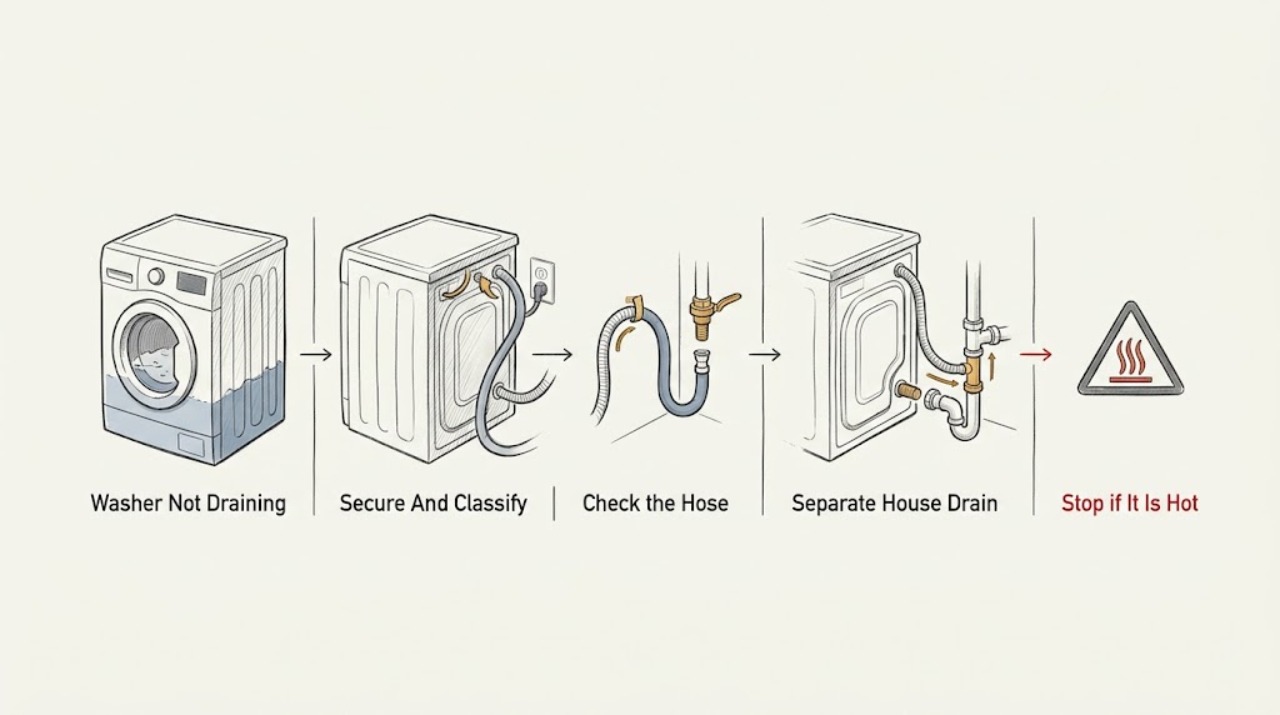
Work through in order
Diagnostic checks
Use only checks that match the exact appliance or system and its official guide.
-
Check 1
Stop the cycle using the normal control, keep hands and feet away from standing water, and record the LG model number, washer type, cycle stage, door or lid state, water level, water temperature if safely apparent, and any display code.
Expected result: Water is absent, shallow, or standing in the tub; the water may be hot; an OE code is displayed; or the lid or door remains locked.
Next step: Keep the washer stopped, use the exact model manual for the lid or door and drain procedure, and continue only if the water and access are safe. Do not force a locked door or lid.
Stop if: Stop and arrange service for hot water that cannot be safely contained, a leak toward electrical parts, a damaged cord or outlet, smoke, a burning smell, or a door or lid that will not release under the model instructions.
Why this matters
Why: Standing or potentially hot water changes the spill and burn risk. An OE code supports a water-outlet problem, but it does not identify whether the hose, pump filter, household drain, pump, or control is responsible. Model type determines which checks are available.
-
Check 2
From a dry, stable position, inspect the visible drain hose and its connection without moving or tipping the washer. Look for a kink, crush point against the wall, hose trapped under the unit, excessive height, submersion, visible blockage, or freezing.
Expected result: The hose is straight and supported, or it is kinked, compressed, submerged, blocked, frozen, or positioned so the pump must push against an abnormal restriction.
Next step: If safe and permitted by the exact model instructions, correct only an obvious external bend or support problem without disconnecting a wet hose. Let a frozen hose thaw naturally as directed by LG; do not use boiling water or heat. If the hose is damaged, inaccessible, or still restricted, arrange service.
Stop if: Do not pull the washer out, disconnect the hose, reach under the appliance, or apply heat when water is present, the unit is unstable, the hose is damaged, or electrical contact is possible.
Why this matters
Why: A restricted or frozen hose can cause slow or absent discharge and an OE symptom. A hose that looks clear and correctly positioned makes the pump filter, pump, or downstream drain more likely, but visual inspection cannot prove the pump is healthy.
-
Check 3
Only when the water is cool, the hose connection is safely reachable, and the exact LG instructions permit it, place the drain hose securely into a suitable container or open drain and run one short Drain or Spin test while watching continuously.
Expected result: Water leaves the hose with a strong stream, leaves weakly or not at all, the container or open drain backs up, or the pump makes an abnormal sound.
Next step: Stop after that observation. Keep the hose secured and have the household drain cleared if it backs up; arrange appliance service if flow is weak or absent, the pump sounds abnormal, or the test cannot be done without a spill.
Stop if: Do not perform this test with hot water, a loose hose, a full container, a slippery floor, a locked door or lid, a leak, or water near electrical parts. Do not repeat cycles to force drainage.
Why this matters
Why: A strong stream with backup at the standpipe, sink, or branch drain makes a household drain obstruction more likely. Weak or absent flow with a clear hose points more toward the washer-side filter, pump, control, or an internal restriction. Abnormal sound is a service clue, not a reason to run more cycles.
-
Check 4
If the exact LG model is a front-load or combination unit with a documented pump-filter access panel, let the tub cool, prepare a shallow pan and towels, drain residual water through the model's residual-water hose if provided, and remove and clean the filter only as the LG procedure directs.
Expected result: The model has no documented user filter, the filter contains lint or small objects, the filter is clear, water keeps flowing unexpectedly, or the filter or cap is damaged.
Next step: Remove only visible debris allowed by the manual, inspect the seal and threads, and reinstall the filter, cap, stopper, and access cover fully. If there is no model-specific filter procedure, skip this action and use the service path.
Stop if: Do not open a panel on an unknown model, reach into a hot or deep tub, force the filter, use tools to pry it, leave the cap or cover loose, or continue when water cannot be contained.
Why this matters
Why: A blocked filter can restrict the pump path. A clear filter shifts suspicion toward the hose, pump, control, or house drain. Top-load units may not have this filter, and a damaged or poorly seated cap can create a leak after reassembly.
-
Check 5
After any permitted hose or filter check, verify from the outside that the hose is supported, the filter cap and access cover are fully restored, and the floor is dry before one supervised test.
Expected result: The washer drains normally, drains but leaks at the filter or hose, still shows OE, leaves water behind, or the pump remains silent or unusually loud.
Next step: Stop after one supervised result and document the leak location, remaining water, sound, and code for service. Do not continue cycling a leaking or non-draining unit.
Stop if: Stop immediately for any leak, electrical contact, smoke, burning smell, repeated OE, grinding, humming without flow, or water that remains after the permitted check.
Why this matters
Why: Normal drainage after a corrected restriction supports that restriction as the cause. A leak after reassembly indicates a seal, cap, hose, or cover problem. Persistent no-flow or abnormal pump behavior points to a washer-side fault that external checks cannot safely identify.
-
Check 6
Decide whether the observed pattern is safe for a scheduled appliance visit or requires prompt service, and send the technician the model number, code, washer type, water level, hose position, filter result if applicable, drain-test result, and any leak or sound recording.
Expected result: The unit is dry, stable, and drains after an allowed external correction, or it remains blocked, leaks, makes an abnormal sound, repeats OE, or cannot be tested safely.
Next step: Use the exact LG support or service route for the model and report the decision-changing observations. Keep the washer off if it leaks, repeatedly fails to drain, or creates an electrical or burn hazard.
Stop if: Do not open the pump, bypass a lid or door lock, jumper controls, test live wiring, or order a pump or control until the exact model and diagnosis support it.
Why this matters
Why: A single corrected hose or filter restriction can be documented for monitoring. Persistent blockage, recurrence, pump symptoms, a hidden obstruction, or an unsafe spill condition needs appliance diagnosis rather than a guessed replacement part.
Use your observations
Decision map
Find the observation that best matches what you see, then follow the next safe action.
-
PATH 01Next step
What you see
The washer is a top-load model or any LG model with a hose that is visibly kinked, crushed, trapped, submerged, frozen, or incorrectly positioned, and there is no leak or electrical hazard.
Do this next
Correct only the visible support or bend allowed by the model instructions, thaw naturally if frozen, then perform at most one supervised drain observation. If it remains blocked or the hose is damaged, request service.
Why this path and its safety boundary
Why it matters: The drain path outside the washer is more likely than a failed pump, but visual correction cannot prove the internal path is clear.
-
PATH 02Next step
What you see
The drain hose produces a strong discharge during a safe, supervised test, while the standpipe, sink, or branch drain backs up or drains slowly.
Do this next
Stop the appliance test, keep the hose secured, contain the spill, and arrange qualified plumbing service for the household drain. Do not use repeated washer cycles to clear it.
Why this path and its safety boundary
Why it matters: The washer pump can move water, so a downstream household drain obstruction is more likely than a washer filter or pump fault.
-
PATH 03Next step
What you see
A front-load or combination model has a documented pump-filter procedure, the tub water is cool enough to handle, and the filter contains debris or the drain improves after the permitted cleaning.
Do this next
Restore the filter, stopper, cap, and cover completely and run only one supervised check. Stop and arrange service for persistent OE, no flow, abnormal sound, or a leak.
Why this path and its safety boundary
Why it matters: A restricted pump-filter path is plausible. A clear filter or a leak at the cap shifts the issue toward the pump, seal, hose, or another model-specific fault.
-
PATH 04Next step
What you see
The external hose appears clear, the household drain does not back up, and the washer has weak or no discharge, a silent pump, abnormal pump sound, repeated OE, or water left behind.
Do this next
Keep the washer off and provide the model, code, timing, water level, and sound description to qualified appliance service. Do not open the pump or test live components.
Why this path and its safety boundary
Why it matters: A washer-side restriction, pump, control, or wiring issue is more likely, and the exact cause cannot be selected safely from the symptom alone.
-
PATH 05Next step
What you see
Water is hot or uncontrolled, the floor is slippery, the hose cannot be secured, the door or lid is locked, water is near electrical parts, or a leak, smoke, burning smell, or damaged cord is present.
Do this next
Keep people away, avoid touching electrical parts or forcing the appliance, and use appropriate emergency or qualified appliance help. If there is a suspected electrical or burning hazard, leave the unit de-energized only when that can be done without contact with water.
Why this path and its safety boundary
Why it matters: The immediate risk is greater than the value of another drain test; a normal troubleshooting sequence should not continue.
Helpful context
Understand the symptom
Start with the washer type and the water left behind
Do not assume every LG washer has the same drain filter or access panel. Front-load and combination units commonly provide a pump-filter procedure, while LG's filter guidance says top-load units do not have that same filter. Record the full model number, whether the unit is top-load or front-load, the cycle stage, and any displayed OE code. If the door is locked by water level or the water is hot, do not force the door or reach into the tub.
A hose problem and a house-drain problem can look alike
A crushed, kinked, frozen, submerged, or incorrectly positioned hose can keep the pump from moving water. A washer can also discharge normally while the standpipe, sink, or branch drain backs up. LG's drain guidance uses a controlled hose-to-container or open-drain comparison to separate those possibilities; it is a diagnostic observation, not permission to leave a hose unsecured or to run a large amount of water onto a floor.
Clean a pump filter only when the exact model provides one
On a compatible front-load or combination model, residual water can spill when the service panel, residual-water hose, or pump filter is opened. Let the tub cool, use a shallow pan and towels, and follow the exact LG sequence for draining and replacing the cap and cover. Do not copy that procedure to a top-load model, remove an inaccessible panel, or keep testing after a leak, electrical contact, or abnormal pump sound.
Safety boundary
Stop conditions
- Stop immediately for smoke, a burning smell, arcing, a damaged cord or outlet, or water near electrical parts.
- Stop for hot water that cannot be safely contained, a slippery floor, an uncontrolled leak, or a door or lid that remains locked under the exact model procedure.
- Stop after one supervised drain observation if there is no flow, abnormal pump noise, repeated OE, or water remains in the tub.
- Do not open a pump, bypass a lock, test live wiring, force a filter, or choose a replacement part without model-specific diagnosis.
When checks do not resolve it
Need a professional?
Arrange qualified appliance service when the LG washer still will not drain after a safe hose check and any model-approved filter cleaning, when the pump is silent or unusually loud, the OE code returns, water remains, a filter cap or hose leaks, or the model does not provide a safe user-accessible drain path. Seek prompt help for smoke, burning odor, electrical contact, or uncontrolled water.
Common questions
FAQ
Why is my LG washer not draining but not showing an OE code?
An OE code is one LG water-outlet symptom, not a requirement for a drain fault. Check the model-specific hose path, downstream drain behavior, and—only on models that provide it—the pump filter. Persistent no flow, standing water, or abnormal pump sound needs service.
Does every LG washer have a drain-pump filter?
No. LG's filter guidance distinguishes front-load and combination units from top-load models. Confirm the exact model before opening a filter panel or copying a residual-water procedure.
How can I tell whether the washer or the house drain is blocked?
When it is safe and the model instructions permit it, a single supervised test can direct the hose into a suitable container or open drain. Strong discharge with backup at the standpipe or sink points toward the household drain; weak or absent discharge points more toward the washer side.
Can I keep running an LG washer that leaves water in the tub?
Do not keep repeating cycles to force drainage. Stop for a leak, hot or uncontrolled water, electrical contact, a locked door or lid, abnormal pump noise, repeated OE, or water that remains after a permitted check, and arrange qualified appliance service.
Read the exact guide
Official sources
- LG Washer – How to Clean the Drain Pump FilterLG Electronics · LG says this filter guidance applies to front-load and combination units; top-load models may not have the filter.
- LG washing machine - Whys is water not draining from my washer?LG Electronics · LG washing-machine guidance for separating an appliance drain issue from a household drain issue; exact model instructions control.
- [LG Washing Machine] Water Not Draining (OE Error)LG Electronics · LG support guidance for washing machines; exact model instructions control access and procedure.
- [LG top load washing machine drain] Water is not drained during washing and the washing machine stops.LG Electronics · LG top-load washer support guidance; model-specific hose installation instructions control.
- LG Washer - Why Isn't My Washer DrainingLG Electronics · LG washer troubleshooting guidance; water temperature and filter access vary by model.
Community feedback
Share a repair observation
Share a plain-text repair observation. Accepted observations are published automatically; this page may take a moment to update.