
On this page
Start here
Quick answer
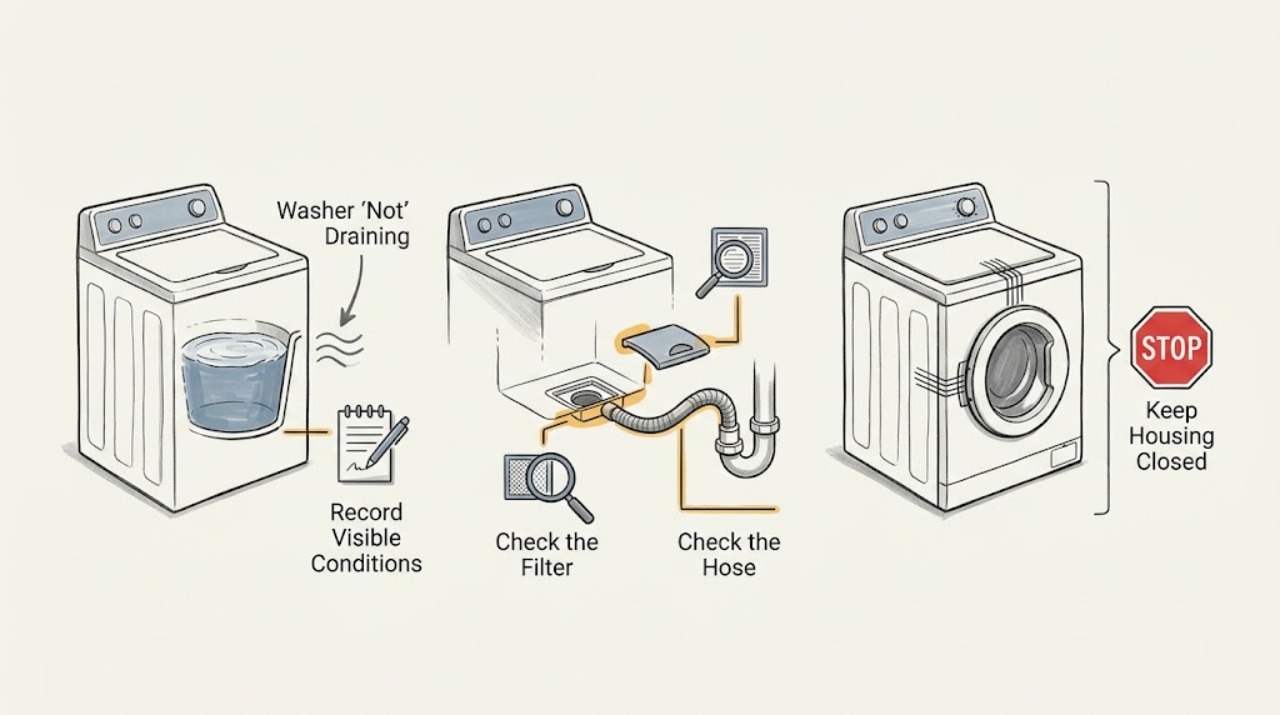
If a Kenmore washer leaves water in the tub, first record whether it stopped before draining, drains slowly, or drains but will not spin. Then stop the cycle and keep clear of water near electrical parts. From a dry, safe position, check the exact model manual, visible drain-hose routing, the standpipe or laundry drain for backup, and—only if the manual identifies an accessible filter—the filter for debris. Kenmore washer designs vary, so do not apply a drain-filter location, error-code meaning, button sequence, or part fit from another model. A humming pump with no water movement, a silent pump, a returning code, a full tub after the visible checks, or any leak near electrics needs qualified appliance or plumbing service.
Before you begin
Safety first
- Keep the washer off for wet electrical areas, flooding, hot residual water, damaged hoses, smoke, burning or electrical odor, arcing, shock, hot connections, or repeated breaker trips. Do not open the cabinet, bypass an interlock, move the washer, or repeat drain tests.
Work through in order
Diagnostic checks
Use only checks that match the exact appliance or system and its official guide.
-
Check 1
Stop the cycle and wait until the tub or drum is completely still. Record the exact model, washer style, selected cycle, displayed code, water level, and whether the washer stopped before drain, drains slowly, or drains but skips spin. Do not reach into moving water or operate a wet plugged-in appliance.
Expected result: The tub remains full, water is only partly gone, the pump is silent or humming, the door/lid remains locked, the code returns, or water is near the cord, outlet, or controls.
Next step: Keep the washer off. From a dry, safe location, isolate power only by a safe normal method and close the water supply if safely reachable; arrange qualified appliance service, or plumbing service when a house drain is implicated.
Why this matters
Why: The stop stage separates a drain-path problem from a pump, interlock, control, or safety condition. Water near electrical parts or a locked full tub makes continued testing unsafe.
-
Check 2
Use the Kenmore manual finder with the full model number and identify whether the washer is front-load or top-load, whether it has a drain/filter access point, and what the manual calls the drain or spin-only function. Do not copy a sequence or filter location from another Kenmore model.
Expected result: The manual identifies a model-specific drain function or accessible filter, identifies no user filter, or the model cannot be confirmed.
Next step: Follow only the matching manual. If the model remains unknown or the manual does not authorize the next check, stop user-level troubleshooting and give the model information to service.
Why this matters
Why: Kenmore washer layouts and controls differ. An unknown model makes a button sequence, door-release method, filter location, and part choice uncertain.
-
Check 3
From a dry position without pulling the washer, inspect the visible drain hose for a kink, crush point, obstruction, submerged end, or an unusually tight fit in the standpipe. Look for wastewater backing up at the standpipe, laundry sink, or floor drain; do not disconnect a wet hose or move a connected washer.
Expected result: The hose is visibly restricted, the household drain backs up, the hose route looks normal, or the source of restriction is hidden behind the washer.
Next step: Correct only a clearly visible routing issue permitted by the exact manual. Use plumbing service for a backing-up household drain; use appliance service when the route is normal, hidden, damaged, or unsafe to reach.
Why this matters
Why: A hose or household-drain restriction can prevent a working pump from evacuating the tub. A normal visible route makes a hidden obstruction, pump/filter issue, interlock, or control fault more likely.
-
Check 4
If and only if the exact Kenmore manual identifies a user-accessible drain filter or residual-water hose, check the manual's safety conditions first: tub temperature, safe floor, container or towels, power state, and cover location. Inspect the filter for lint, coins, or other foreign material without forcing the cap or reaching into a moving tub.
Expected result: The manual has no user filter, the filter is obstructed, residual water is hot or excessive, the cap will not turn normally, or the filter is clear.
Next step: Reassemble only exactly as the manual directs after a safe, model-authorized inspection. If the filter is inaccessible, damaged, hot, leaking, or clear while the washer still will not drain, stop and arrange service.
Why this matters
Why: An obstructed filter can restrict drainage, but filter access and residual-water handling are model-specific. Heat, force, or an inaccessible filter is a service boundary.
-
Check 5
With the washer still safe and the model manual authorizing it, perform at most one supervised drain or spin-only attempt after the visible hose check or filter check. Listen from outside the cabinet and observe whether water moves, moves slowly, or does not move; do not open panels or use energized electrical tests.
Expected result: Water drains normally, drains slowly, the pump hums with no water movement, the pump is silent, the washer drains but will not spin, or the fault returns.
Next step: Stop after one supervised attempt if the symptom remains, the code returns, or abnormal sound, heat, smell, leak, or electrical behavior appears. Provide service with the model, code, stage, pump sound, and water movement.
Why this matters
Why: Normal drain after an external correction points to a restriction or temporary condition. Slow/no flow with humming suggests a blockage or pump path; silence can involve the pump, interlock, control, or power; drain-without-spin points to a separate balance, lid/door, or control condition.
-
Check 6
Check the load and lid/door only after all motion stops. Note whether a bulky or single item caused an imbalance, whether the lid/door closes and latches as the manual requires, and whether the washer rocks or has moved enough to pinch the hose; do not bypass the interlock or reach into a moving tub.
Expected result: The washer drains but will not spin, the lid/door message remains, the load was badly unbalanced, the washer has shifted, or the load and installation look normal.
Next step: Use one suitable balanced load only if the washer is stable and the exact manual permits a retry. Stop and arrange service for a damaged latch, repeated imbalance, a moved or unstable washer, or a returning no-drain condition.
Why this matters
Why: Some no-drain complaints are actually a cycle or interlock stopping before spin; imbalance or movement can also affect hose routing. Persistent failure with a closed interlock, suitable load, and clear hose points toward service.
Use your observations
Decision map
Find the observation that best matches what you see, then follow the next safe action.
-
PATH 01Next step
What you see
The washer is full of water, the visible drain hose is kinked/crushed, or the household standpipe backs up.
Do this next
Keep the washer off and correct only an obvious model-authorized hose-routing issue. Use plumbing service for a backed-up household drain; use appliance service if the hose is damaged, inaccessible, or the tub remains full after the route is clear.
Why this path and its safety boundary
Why it matters: The external drain route is more likely than a confirmed pump failure.
-
PATH 02Next step
What you see
The exact manual identifies an accessible filter and it contains foreign material, but water is not hot and the floor can be protected safely.
Do this next
Clean and reinstall only as the exact Kenmore manual directs, then make one supervised model-authorized drain attempt. Stop for heat, force, leaks, or a returning fault.
Why this path and its safety boundary
Why it matters: A filter restriction is plausible, but the finding does not prove the pump or the rest of the drain path is healthy.
-
PATH 03Next step
What you see
The pump hums during the authorized drain attempt but little or no water moves, and the hose and household drain are clear.
Do this next
Stop user troubleshooting and arrange appliance service for internal inspection. Do not remove the pump, cabinet, wiring, or foreign objects hidden in the tub-to-pump path.
Why this path and its safety boundary
Why it matters: A blockage in the pump/filter path or a failing pump is more likely than a control-only problem.
-
PATH 04Next step
What you see
The washer is silent during drain, the lid/door does not latch, a code returns, or it drains but will not progress to spin despite a suitable load.
Do this next
Keep the washer off and provide service the full code, model, cycle stage, lid/door state, pump sound, and water level. Do not bypass the latch or test live wiring.
Why this path and its safety boundary
Why it matters: An interlock, control, power, or separate spin/balance condition is possible; a drain pump cannot be confirmed from the symptom alone.
-
PATH 05Next step
What you see
Water is near electrical parts, the appliance or cord is wet, the floor is flooding, residual water is hot, or there is smoke, burning odor, arcing, shock, or repeated breaker operation.
Do this next
Keep clear, do not touch the wet plugged-in appliance, and isolate power or water only from a dry, safe location. Arrange qualified appliance/plumbing or emergency help as appropriate.
Why this path and its safety boundary
Why it matters: The immediate risk is shock, fire, scalding, or water damage; diagnosis must stop.
Helpful context
Understand the symptom
Start with the exact stop stage
Not draining can mean the tub remains full, water leaves slowly, the cycle stops before drain, or the washer drains but does not proceed to spin. Note the selected cycle, whether the pump can be heard, whether the tub is full or partly empty, and any displayed code. Kenmore sells both front-load and top-load washers, and its manual finder directs owners to use the model number for the matching manual, so a generic drain procedure is not reliable across the brand.
Separate the external drain path from the washer
A visible hose kink, crushed section, incorrect placement, or backed-up standpipe can restrict discharge even when the washer pump is working. If water flows from the washer's hose into a suitable container during a model-authorized test, the household drain is more suspect; do not perform that test if the model manual does not permit it, the floor is wet, or the hose connection cannot be handled safely.
Filter access is model-specific
Some washers have a user-accessible drain-pump filter or residual-water hose, while others do not. The exact Kenmore manual decides whether a filter exists and how it may be accessed. Residual water can be hot or spill quickly; do not open a cover, loosen a cap, or drain a tub unless the model instructions, temperature, floor, and containment are all safe.
Know when the pump diagnosis becomes professional work
A pump that hums without moving water, stays silent during a model-authorized drain attempt, leaks, or repeatedly trips a protection device can require internal testing. Do not use a meter, remove the cabinet, bypass a lid or door interlock, or order a pump from a symptom alone. Give service the exact model and the drain-stage observations.
Safety boundary
Stop conditions
- Stop immediately for water near the cord, plug, outlet, controls, or other electrical parts; never touch a wet appliance that remains plugged in.
- Stop for flooding, hot residual water, a damaged hose, smoke, burning or electrical odor, arcing, shock, a hot connection, or repeated breaker trips. Do not restart to test.
- Do not move or tilt the washer, open the cabinet, remove the pump, bypass a lid/door interlock, reach into a moving tub, or perform energized electrical tests.
- Do not open a filter or residual-water cap unless the exact Kenmore manual authorizes it and the water temperature, floor, containment, and power state are safe. Do not apply another model's code, filter location, or drain sequence.
Only after diagnosis
Potential parts
- drain hose or hose clamp
Consider this category only when the visible hose or clamp is damaged, kinked beyond safe correction, or confirmed by the exact model installation to be the restriction.
Drain hose routing and clamps vary across Kenmore washer styles and models. Confirm the exact model and diagnosis before selecting a part. - drain pump or pump filter
Consider this category only after the external drain route is clear and model-authorized filter inspection or qualified diagnosis identifies a blocked or failed pump path.
Kenmore pump and filter arrangements differ by model and platform. Confirm exact model fitment and use qualified service for internal access. - lid or door interlock
Consider this category only when the lid or door closes correctly but the exact model still prevents drain/spin or returns an interlock indication.
Interlocks vary by Kenmore washer style and model. Confirm the exact model and service diagnosis before any part decision. - control or drain-related wiring
Consider this professional-repair category only when hose, household drain, filter, and pump checks are clear and qualified diagnosis finds that the pump is not being controlled or powered.
Electrical diagnosis and component fit are model-specific and require the matching service documentation; do not test live wiring as an owner check.
When checks do not resolve it
Need a professional?
Arrange qualified Kenmore or appliance service when the washer remains full after the model-authorized hose and filter checks, a pump hums without flow, the pump is silent, a filter or hose is damaged or inaccessible, a code returns, the lid/door interlock fails, or the washer drains but still cannot proceed. Use plumbing service when the standpipe or household drain backs up. Treat wet electrical parts, flooding, hot water, smoke, arcing, shock, or repeated breaker trips as immediate safety issues.
Safety scope: Keep the washer off for wet electrical areas, flooding, hot residual water, damaged hoses, smoke, burning or electrical odor, arcing, shock, hot connections, or repeated breaker trips. Do not open the cabinet, bypass an interlock, move the washer, or repeat drain tests.
Common questions
FAQ
Why is my Kenmore washer not draining?
The most useful first split is a kinked or blocked drain path, a model-specific filter or pump issue, a lid/door interlock stopping the cycle, or a control problem. Record the cycle stage and pump sound, inspect only visible hose routing, and use the exact Kenmore manual before accessing any filter.
Should I clean the drain-pump filter on a Kenmore washer?
Only if the exact Kenmore manual identifies an accessible filter and the residual water, temperature, floor, containment, and power conditions are safe. Some Kenmore designs do not use the same filter arrangement; never force a cap or open an unknown panel.
What does a humming sound mean when the washer will not drain?
A hum shows that a drain-related motor may be attempting to run, but it does not prove that water can pass. With the hose and household drain clear, a blockage or failing pump becomes more likely and needs qualified diagnosis rather than a pump purchase based on sound alone.
Can too much detergent make a Kenmore washer seem unable to drain?
Excess suds can slow or disrupt draining and leave clothes wet on some washer designs. Use only the detergent type and amount specified by the exact Kenmore manual; if the tub remains full or the condition repeats, stop testing and arrange service.
Read the exact guide
Official sources
- LG Washer - Troubleshooting Washer Does Not Drain or Spin (Clothes Too Wet)LG Electronics USA · LG guidance used only for general washer mechanics and safety clues; Kenmore's exact model manual controls Kenmore procedures and dimensions.
- Washer Drain Pump Genuine Original Equipment Manufacturer (OEM) partKenmore · Kenmore product page for one drain-pump part; it supports the pump's role but does not establish fitment for this topic without a model.
- Washers | Laundry | KenmoreKenmore · Kenmore product catalog; it establishes that multiple washer styles exist, not a universal troubleshooting procedure.
- LG Washer - Why Isn't My Washer DrainingLG Electronics USA · LG support example used for general filter and residual-water hazards; do not infer that a Kenmore washer has the same filter or access panel.
- Find Your Manual | Kenmore Appliance Manuals & GuidesKenmore · Kenmore's official manual finder; exact model manual controls buttons, filter access, error codes, and safe procedures.
Community feedback
Share a repair observation
Share a plain-text repair observation. Accepted observations are published automatically; this page may take a moment to update.