
On this page
Start here
Quick answer
An Amana washer can appear stuck during a normal pause or sensing period, but the stage where it stops is the fastest way to narrow the cause. Record whether it is filling, washing or sensing, draining, spinning, or waiting for the lid or door to lock. Keep the lid or door closed while the basket moves, check the matching water-supply or drain path, correct an accessible load imbalance, and use only the model-specific reset or a five-minute power cycle when the machine is safely inactive. If water will not drain, the lid or door will not lock, the washer repeatedly stops at the same stage, an error returns, a leak or burning smell appears, or the controls cannot leave the machine safely inactive, stop and arrange qualified appliance service.
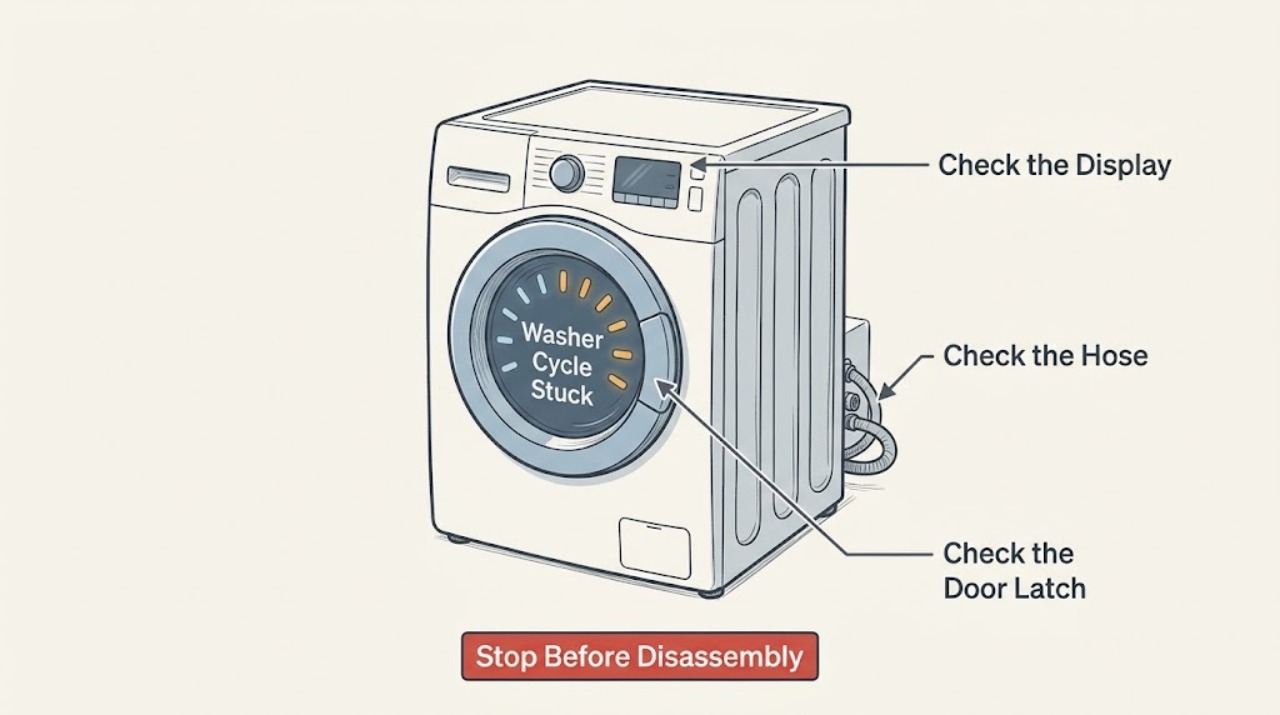
Work through in order
Diagnostic checks
Use only checks that match the exact appliance or system and its official guide.
-
Check 1
Leave the washer in place and identify the stopped phase from the display or indicators: filling, sensing or washing, draining, spinning, or waiting for the lid or door. Note whether the tub is moving, whether water is entering or standing in the tub, whether the lid or door is locked, and any displayed code or flashing light. Keep the lid or door closed while the basket moves.
Expected result: The washer is in a normal pause or sensing period, is filling slowly, is washing but not advancing, is holding water, is attempting to spin, or is waiting for a lid or door lock.
Next step: Write down the phase and any code, then follow the matching supply, lid/door, drain, or load check below. Do not cancel or open the lid solely because a normal sensing or pause period looks inactive.
Why this matters
Why: A phase-specific symptom narrows the next safe check. Amana documents pauses and staged fills on some cycles, while water remaining at the drain phase, an unbalanced load at spin, or a lock that cannot engage points to different causes.
-
Check 2
If the washer is stuck while filling or the wash light remains on, check that both hot and cold household faucets are fully open, the inlet hoses are not kinked, and the visible hose connections are not leaking. Do not remove a hose or clean an inlet screen while the supply is pressurized; use the model manual for any shutoff and screen procedure.
Expected result: One faucet is closed, a hose is kinked, a connection leaks, both supplies are open with good hose routing, or the washer has water but does not detect a level change.
Next step: Correct only the accessible faucet or hose-routing issue, then use the model's Start/Pause control to resume. If fill still does not begin or the indicator returns, stop repeating resets and arrange service.
Why this matters
Why: Restricted or missing supply can hold the washer at fill; Amana also notes that the wash indicator can remain on when water level does not change as expected. Open supply and clear routing make a simple fill restriction less likely, not proof of a failed valve or sensor.
-
Check 3
If the washer is waiting for a lid or door lock, close it firmly and inspect the visible latch area for clothing, lint, detergent buildup, or another obstruction. Clean only the accessible contact area with a damp cloth when the machine is stopped; never press, tape, or bypass the lock or reach inside while the basket is moving.
Expected result: The lid or door closes and locks, a visible obstruction prevents latching, the lock clicks but the cycle does not advance, or the lock never engages or will not release after the basket stops.
Next step: Remove only the visible obstruction and resume using the model control. If the lock remains unreliable, do not bypass it; keep the washer out of service and arrange qualified repair.
Why this matters
Why: Amana says the lid/door lock is a safety condition for operation and that debris can prevent locking. A clean, closed lid that still will not lock or a lock that behaves abnormally points toward a lock, control, or wiring diagnosis rather than a load setting.
-
Check 4
If water remains when the washer should drain or spin, observe the accessible drain hose for a kink, crushing, clog, or incorrect insertion depth, and check the household standpipe or utility sink for a blockage. Do not reach into the pump, remove hoses from a water-filled machine, or open panels; protect the floor from any water that may escape.
Expected result: The hose is kinked or blocked, the household drain is backed up, the hose routing matches the installation instructions, the tub is empty, or the washer hums without lowering the water level.
Next step: Correct only an obvious external routing issue and use the model's drain function if the tub is safe and the lid/door remains closed. If water does not leave, stop the cycle and arrange service; do not repeatedly run a full cycle with standing water.
Why this matters
Why: Amana links incorrect drain routing, a kink or clog, and household drain blockage with failure to pump out. If the accessible path is clear but water remains or the pump only hums, an internal pump, obstruction, control, or sensor issue may need service.
-
Check 5
If the washer stops at wash-to-spin or repeatedly tumbles without reaching full spin, pause only through the model's control and wait for the basket to stop. Redistribute a tightly packed load, remove a few items if appropriate, check that the washer is level from the outside, and select the model's recommended drain/spin option without opening a locked lid.
Expected result: The load is tightly packed or shifted, the washer is visibly out of level, the load is wet but water is gone, the cycle uses low or no spin, or the washer repeatedly self-corrects and never spins.
Next step: Correct the accessible load or setting once and monitor. If the washer still stops at spin, displays an error, bangs excessively, or cannot level, keep it out of service and request qualified diagnosis.
Why this matters
Why: Amana says an off-balance load can reduce or stop spin and may trigger a self-correction cycle; low-spin settings also leave more water. A balanced load on a level machine that still cannot spin makes a mechanical, lock, drain, or control problem more likely.
-
Check 6
After recording the phase and code, use the model-specific Start/Pause or Cancel control once. If the washer is safely inactive and there is no standing water, leak, burning odor, unusual heat, or abnormal noise, perform the Amana power cycle described in its support guidance: disconnect power for five minutes, then restore it and select the model-approved cycle. Do not use a factory-reset sequence unless the owner's manual explicitly describes it.
Expected result: The washer resumes once and completes, the same phase or code returns, the controls remain locked or unresponsive, or the washer cannot be made safely inactive.
Next step: If it repeats, stop resetting and arrange qualified service with the model number, phase, code, water state, and checks already performed. If a leak, burning smell, smoke, sparking, or unsafe electrical condition appears, leave the appliance disconnected only if that can be done without contact with danger and seek appropriate help.
Why this matters
Why: A power cycle can clear a temporary control interruption but cannot repair a blocked drain, failed lock, supply fault, imbalance, or damaged component. A repeat at the same phase is useful service evidence.
-
Check 7
Check the model manual for the exact cycle guide and error-code meaning, using the washer's model number from its normal accessible label. Compare the recorded phase, indicator, water level, load condition, and whether the lid or door locked with that guide; do not substitute instructions from a different Amana washer family.
Expected result: The code or indicator has a model-specific remedy, the manual identifies a normal pause, the symptom is not listed, or the model cannot be confirmed.
Next step: Follow only the matching low-risk instruction in the manual. For an unlisted, recurring, or model-uncertain failure, provide the record to qualified appliance service rather than opening the cabinet.
Why this matters
Why: Amana features and operations vary by model. An unlisted or recurring phase stop cannot safely be assigned to a particular valve, pump, motor, lock, or control from the symptom alone.
Use your observations
Decision map
Find the observation that best matches what you see, then follow the next safe action.
-
PATH 01Next step
What you see
The washer is quietly sensing, pausing briefly, or performing a staged fill on a cycle that permits it, with no error, leak, or abnormal noise.
Do this next
This can be normal operation rather than a stuck control. Opening the lid or canceling during sensing can restart the process on some models.
-
PATH 02Next step
What you see
The washer remains at fill or wash-light status and water is absent, weak, or not changing level.
Do this next
Closed faucets, kinked hoses, a supply restriction, or a water-level sensing problem are more likely than a drain or spin imbalance.
-
PATH 03Next step
What you see
The lid or door is closed but the lock indicator does not engage, flashes, or remains locked after the basket has stopped.
Do this next
A visible obstruction may be preventing the safety lock, but a clean latch that still fails is more consistent with a lock or control fault.
-
PATH 04Next step
What you see
The washer stops before spin with visible standing water or a pump that runs without lowering the water level.
Do this next
External drain routing, a blocked household drain, excessive suds, or an internal drain-path problem can prevent the cycle from advancing; spin settings cannot solve retained water.
-
PATH 05Next step
What you see
The washer reaches spin, tumbles or refills to rebalance, bangs, or leaves clothes wet while the tub is otherwise drained.
Do this next
An uneven or tightly packed load, an unsuitable low/no-spin selection, or an out-of-level cabinet is more likely than a fill fault.
-
PATH 06Next step
What you see
A five-minute power cycle or one normal correction only temporarily helps and the washer stops at the same phase, returns the same code, leaks, smells hot, sparks, or leaves controls unresponsive.
Do this next
A persistent control, lock, supply, drain, motor, or sensor fault is more likely than a temporary glitch; the phase history is valuable for diagnosis but is not enough to select a part safely.
Helpful context
Understand the symptom
Identify the phase before restarting
A washer that pauses while sensing, tumbles during a long fill, waits for a lid lock, tries to rebalance a load, or pumps out water is not showing the same fault. Note the indicator light or display, whether water is entering or leaving, whether the basket is moving, and whether the tub contains standing water. Amana notes that some cycles pause as part of normal operation and that bulky cycles may fill in stages, so a short pause by itself is not proof of a failed part.
Use the model manual for control and lock behavior
Amana top-load and front-load washers do not all use the same controls, indicator names, lid or door locks, or reset sequence. Use the model number to find the owner's manual and read the cycle and error-code section before changing a setting. Do not bypass a lid or door lock, reach into a moving basket, remove panels, or work on wiring to force a cycle to advance.
Safety boundary
Stop conditions
- Stop the cycle and arrange qualified service if the washer repeatedly stops at the same phase, a code returns after the model-approved check, or the lid or door lock is unreliable.
- Do not continue running a washer with standing water, an active leak, burning odor, smoke, sparking, unusual heat, severe banging, or a cord or outlet that appears damaged.
- Never bypass or tape a lid/door lock, reach into a moving basket, remove panels, or test live wiring to make a cycle advance.
- Do not repeatedly reset the washer to mask a fill, drain, lock, imbalance, or electrical fault; record the phase and code for the technician.
Only after diagnosis
Potential parts
- water inlet valve or inlet screen
Consider only if both household supplies and hose routing are confirmed and a qualified diagnosis finds inadequate washer fill or a valve fault.
Confirm the complete Amana model and the technician's fitment identification; inlet parts vary across washer families. - lid or door lock assembly
Consider only when the visible latch is clear and the model-specific test confirms the lock does not reliably engage or report closed.
Top-load lid locks and front-load door locks are not interchangeable; verify the exact model before ordering. - drain pump or drain-path component
Consider only after accessible hose and household-drain checks are clear and water still does not leave or the pump is diagnosed as faulty.
A qualified technician should identify the failed component and exact model fit; do not infer a pump replacement from a wet load alone. - control or water-level sensing component
Consider only if the washer repeatedly stops at fill or another phase after supply, lock, drain, load, and reset checks are resolved.
Use the model-specific service documentation and diagnosis; controls and sensors are not universal across Amana washers.
When checks do not resolve it
Need a professional?
Arrange qualified appliance repair when an Amana washer remains stuck after one matching low-risk check and a model-approved reset, when it stops at the same stage, cannot drain or lock, shows a recurring error, or has a leak, abnormal noise, burning odor, smoke, sparking, or unsafe electrical behavior. Give the provider the full model number, top-load or front-load type, stopped phase, indicator or code, water level, load condition, and checks already performed.
Common questions
FAQ
Is a short pause proof that my Amana washer is stuck?
No. Amana documents pauses during certain phases and staged filling on some cycles, especially bulky-load programs. Note whether water is entering, the basket is moving, and what the display shows; let the model's documented phase continue unless there is a leak, abnormal noise, or another stop condition.
Why does my washer stay on the wash or sensing light?
The washer may be in a normal sensing or fill pause, or it may not be receiving or detecting enough water. Check both hot and cold faucets and accessible hose routing, then use the model manual for the indicator meaning. If supplies are open but the light and stopped phase return, arrange service.
What if my Amana washer is stuck with water inside?
Do not reach into the tub or remove hoses from a water-filled machine. Check only the accessible drain hose and household drain for an obvious kink, clog, or incorrect routing, and keep the washer out of repeated cycles if the water remains. A qualified technician should diagnose an internal pump or drain-path fault.
Can I reset an Amana washer that is stuck?
If the washer is safely inactive and there is no standing water, leak, burning smell, unusual heat, or abnormal noise, Amana describes disconnecting power for five minutes as a possible control reset. Use only the owner's-manual reset for your model, and do not keep resetting if the same phase or code returns.
Why does the washer stop before spin even though it is running?
A shifted or tightly packed load, low/no-spin selection, drain restriction, or leveling problem can keep a washer from completing spin. Redistribute the load and check accessible drain routing once; if it repeatedly rebalances, bangs, leaves water, or stops at the same phase, request qualified service.
Read the exact guide
Official sources
- Not Filling or Long Fill - WasherAmana · Amana top-load washer water supply, fill timing, drain hose routing, and cycle-specific fill behavior
- Not Spinning - WasherAmana · Amana washer spin-stage imbalance, low-spin selection, drain, leveling, and power-failure guidance
- Lid Locking on a Top Load High Efficiency WasherAmana · Amana washer lid-lock safety, closed-lid phase behavior, visible obstructions, and qualified service
- How to Reset a WasherAmana · Amana washer power-cycle recovery, control lock, manuals, and service routing
- Not Draining - WasherAmana · Amana top-load washer drain hose, suds, load-balance, wet-load, and drain service guidance
- TroubleshootingAmana · Amana washer cycle pauses, fill, lid, drain, spin, error, and safety troubleshooting in a model owner's manual
Community feedback
Share a repair observation
Share a plain-text repair observation. Accepted observations are published automatically; this page may take a moment to update.