
On this page
Start here
Quick answer
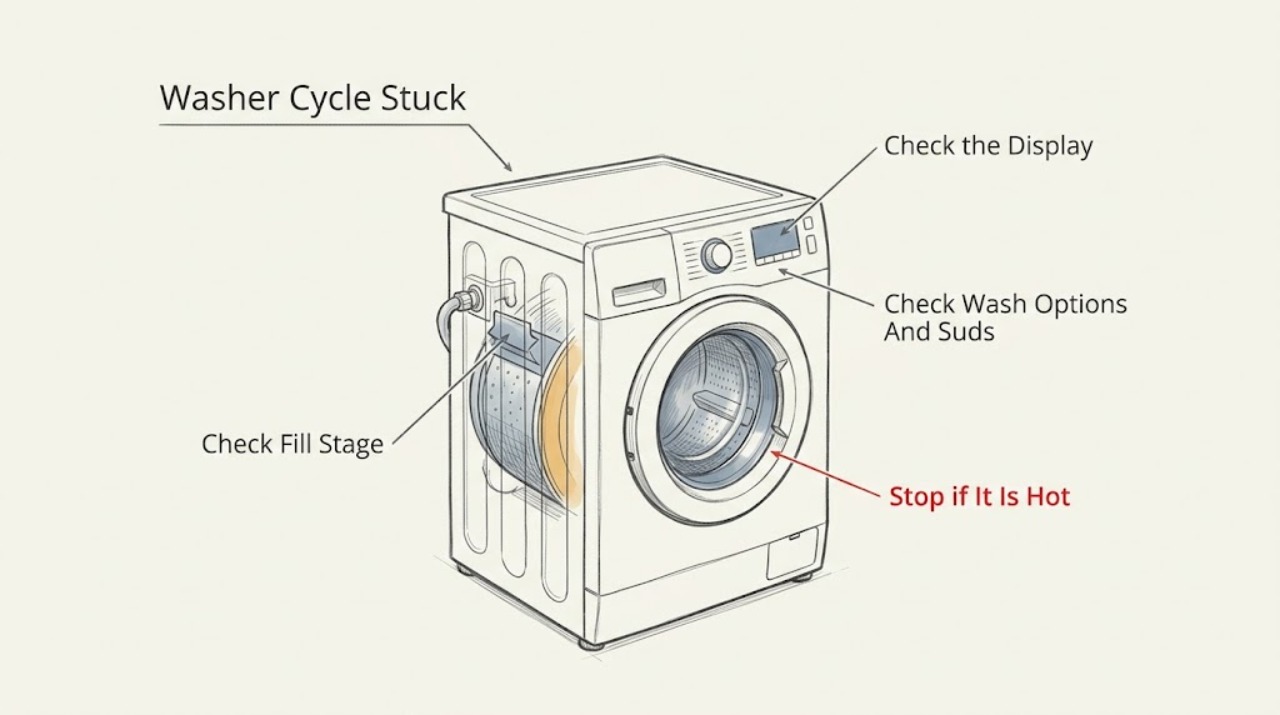
An LG washer may look stuck because its timer is extending for a selected option, heavy load, excess suds, slow filling, slow draining, or an unbalanced spin; it may also be stopped by a real code or a door/lid condition. First record the exact display or blinking pattern, model, selected cycle, and stage: fill, wash, rinse, drain, or spin. Do not force the door, reach into a moving drum, or repeatedly restart it. Check the matching external cause: open water valves and unkinked inlet hoses during fill, the selected options and suds during wash, the drain hose and filter only when the tub is safe to empty, and load balance during spin. If the drum never moves, water leaks, the door remains locked, the code returns, or the check needs panels or live electrical work, stop and request LG or qualified appliance service.
Work through in order
Diagnostic checks
Use only checks that match the exact appliance or system and its official guide.
-
Check 1
Before pressing Start, Pause, or Power repeatedly, photograph the display or blinking-light pattern and write the full LG model; note the selected course, options, load, and point where the cycle stopped.
Expected result: Classify the state as fill, wash/agitation, rinse, drain, spin, end-of-cycle, a door/lid lock state, or an exact error code; record whether water remains and whether the drum has moved.
Next step: Use the matching LG model guide and stage branch below. Keep the photo and sequence for service; do not copy a code meaning from a different LG model.
Stop if: Stop immediately for smoke, burning odor, sparking, water on electrical parts, a damaged cord, a violent movement, or a door that will not release safely.
Why this matters
Why: The same complaint can be a normal extended phase, a blocked transition, or a code-driven stop. LG's cycle guide asks which phase is prolonged and whether water enters or the drum moves, while LG says code meanings vary by model.
-
Check 2
If the timer is stuck during fill or rinse, check from behind the washer that both water valves are open, the hot and cold hoses are routed to the correct inlets, and neither hose is kinked or crushed; only inspect inlet filters when the model guide permits hose removal and water can be contained safely.
Expected result: Record whether water enters at all, enters slowly, enters one temperature only, or stops while the code appears; note a closed valve, kink, visible filter buildup, or no external cause.
Next step: Correct only an obvious open-valve or kink condition, then follow the exact model retry. Keep water off and request service for a leaking hose, damaged connection, no fill after the external check, or a returning code.
Stop if: Do not pull the washer out forcefully, open a pressurized connection, remove a filter without a bucket and model instructions, or work in a wet area near power.
Why this matters
Why: LG links a prolonged fill to inlet-filter deposits, kinked hoses, low supply flow, selected options, or a water valve condition. No fill with a matching code points toward the water path; normal fill with no drum progress points to a different branch.
-
Check 3
If the washer is in the wash phase, read the selected options and observe whether the drum intermittently tumbles, water is being added or removed, or thick suds are present; do not cancel a hot or active phase by forcing the door.
Expected result: Record whether a stain or soak option, extra-water choice, optimizer, or similar extended course is selected; note repeated water changes, visible suds, a quiet but powered panel, or no drum movement at all.
Next step: Allow an intentional option or suds response to finish when the appliance is otherwise safe. For a future load, use only the detergent type and amount specified for the model. Request service when the drum never moves, the panel is unresponsive, or the cycle stays stopped after the allowed option check.
Stop if: Do not add more detergent, force the door, reach into the drum, or open the cabinet to inspect a motor or control.
Why this matters
Why: LG says selected stain/soak options and automatic suds removal can extend the wash time. Intermittent tumbles and water changes can be progress; a drum that never moves, a code, or a persistent stop after options are removed is not explained by a normal timer extension.
-
Check 4
If the timer is stuck during drain or before spin, first look for water remaining in the tub and a kinked or displaced drain hose; clean the drain filter only with the exact model procedure, a safe water-capture setup, and a cooled tub.
Expected result: Record whether the pump sounds, water exits, the drain hose is kinked or too low/high for the model, the drain filter is visibly obstructed, or water remains with no pump response.
Next step: Correct only an obvious hose-position issue and use the model's filter procedure if safe. Close the filter and cover fully to prevent a leak; request service when water will not drain, the pump is silent or abnormal, the filter will not open, or the code returns.
Stop if: Do not open a filter with hot water in the tub, run a cycle over a leak, tip the washer, force a locked door, or handle standing water near an electrical connection.
Why this matters
Why: LG associates slow draining with a blocked filter, kinked or incorrectly installed hose, or an external drain issue. A full tub can also keep the door locked. Hot water or a large spill makes filter access unsafe until the tub is cool and water can be controlled.
-
Check 5
If the washer is stuck at spin, observe whether it slowly tumbles and redistributes the load, then check that the load is not a single heavy item and that the washer sits level; do not reach in while the drum can move.
Expected result: Record repeated balance attempts, a UE or other exact code, a tub that never moves, severe vibration, a small mixed load, or a stable washer that still will not spin.
Next step: Pause only as the model allows, redistribute or add similar items when the guide recommends it, and retry once. Request service for severe movement, a returning code, a level/floor problem that cannot be corrected safely, or a drum that never moves.
Stop if: Do not hold the drum, defeat a lid/door lock, place hands under the washer, or keep restarting a machine that walks, bangs, or exposes a loose part.
Why this matters
Why: LG says an unbalanced load can make the drum slow, tumble, and retry until a UE code appears. A drain restriction can also delay spin. No drum movement after the external checks points toward a repair condition rather than a balance correction.
-
Check 6
If the display is frozen, the door or lid remains locked, or the code returns after the correct stage check, stop the cycle using the normal control and isolate water or electrical power only from a safe, dry location; do not disassemble the washer.
Expected result: Record whether the panel responds, whether water or heat remains, whether the lock releases only after the tub is safe, and whether the original code returns after one model-approved restart.
Next step: Keep the washer out of service and request LG or qualified appliance service with the original display photo, model, stage, water level, and all checks performed.
Stop if: Do not force the door, bypass the lock, measure live voltage, remove panels, or repeatedly reset until the code history is lost.
Why this matters
Why: A locked door can be a safety response to water, heat, or an unfinished phase. A frozen panel, repeated code, or lock that does not release after the model procedure can involve control, sensor, latch, pump, or wiring faults.
Use your observations
Decision map
Find the observation that best matches what you see, then follow the next safe action.
-
PATH 01Safety boundary
What you see
The timer is stopped during fill or rinse, water is absent or slow, and a valve, hose, or inlet-filter condition matches the exact LG model guidance.
Do this next
Open the supply valves and remove only visible hose kinks; inspect inlet filters only under the model procedure. Request service for no fill, a leak, damaged hoses, or a returning code.
Why this path and its safety boundary
Why it matters: A water-entry restriction is more likely than a spin or motor fault; selected water options can also add time. If water enters normally, do not keep working on the inlet path.
Safety stop: Stop for a wet power area, a pressurized leak, a hose that will not disconnect safely, or any need to open the cabinet.
-
PATH 02Safety boundary
What you see
The wash timer extends while the drum tumbles or water changes, and a stain/soak option, excess suds, or a heavy/thick load is present.
Do this next
Allow the phase to finish when there is no leak, odor, or unsafe motion; reduce detergent and review options on a later load according to the model guide. Escalate if the cycle remains stopped or a code returns.
Why this path and its safety boundary
Why it matters: The washer may be carrying out the selected treatment or automatic suds response rather than being stuck. A quiet powered machine or a drum that never moves is a different condition.
Safety stop: Do not force the door, add detergent during the cycle, or open the washer to inspect moving parts.
-
PATH 03Safety boundary
What you see
Water remains at the end of wash or before spin, the drain sound is abnormal or absent, or the code matches a drain/outlet condition.
Do this next
Use the exact LG filter and residual-water procedure only when safe; check external hose position and the drain path. Request service if drainage does not resume, a leak appears, or the filter cannot be accessed safely.
Why this path and its safety boundary
Why it matters: A drain filter, hose, pump, or external drain restriction is more likely, and remaining water can keep the door locked. It is not safe to open the filter until the tub is cool and water can be contained.
Safety stop: Stop for hot water, a large uncontrolled spill, water at power connections, or a pump/filter that requires force or cabinet access.
-
PATH 04Safety boundary
What you see
The washer tumbles and retries during spin, shows a model-matching unbalance code, or never moves after filling.
Do this next
Redistribute the load or correct an obvious level issue only as the model permits, then retry once. Request service for no motion, severe vibration, repeated unbalance, or a returning code.
Why this path and its safety boundary
Why it matters: Repeated tumbling can be LG's balance routine, while a drum that never moves is a service condition in LG's cycle guide. Drain restrictions can also prevent a normal spin transition.
Safety stop: Do not defeat the lock, hold the drum, place hands under the unit, or keep restarting a machine that moves violently.
-
PATH 05Safety boundary
What you see
The door or lid stays locked after the safe stage ends, the panel is frozen, or the same code returns after the matching external check.
Do this next
Leave the washer off, keep the door closed if water or heat remains, and request LG or qualified service with the model, code, stage, water level, and photo sequence.
Why this path and its safety boundary
Why it matters: Water level, heat, latch, pump, sensor, motor, or control behavior may still be preventing a safe restart. Clearing the display does not establish that the washer is repaired.
Safety stop: Do not force or bypass the lock, drain through an improvised opening, remove panels, or test live electrical components.
Helpful context
Understand the symptom
A long timer is not always a failed cycle
LG says cycle time can change with the selected course, load size and weight, fabric thickness, water temperature, detergent suds, and added options. A pause or repeated movement during spin can also be the washer trying to rebalance the load. The useful distinction is whether the machine is making progress in the current stage: water enters, the drum moves, water drains, or the final spin completes. If the display shows a code or the drum never moves, use the model-specific error path rather than assuming the timer alone is wrong.
The stage determines the safe check
A fill delay points toward water valves, inlet hoses, filters, or supply conditions. A wash delay can be an intentional option, excess suds, or slow draining. A spin delay can involve a drain restriction or an unbalanced load. A locked door may be holding water or heat for safety. LG's guides note that pictures and steps can differ by model, so record the complete model and use its manual before removing a hose, opening a filter, or changing a cycle.
Protect against water, heat, and moving-part hazards
Do not open a drain filter while the tub may contain hot water; LG warns that hot water can cause burns and that a large amount of water can reach the floor. Do not force a door or reach into a drum that can start moving. If there is a leak onto electrical parts, smoke, a burning odor, a damaged cord, or an unusual electrical sound, turn off water and power only from a safe location and arrange service.
Safety boundary
Stop conditions
- Stop immediately for smoke, burning or electrical odor, sparking, a damaged cord, active leaking onto electrical parts, violent movement, or a door/lid that cannot release safely.
- Do not open a drain filter while the tub may contain hot water, and do not run a cycle over an active leak or uncontrolled spill.
- Do not force or bypass a door/lid lock, reach into a moving drum, tip the washer, open panels, or test live electrical parts.
- Do not repeatedly restart a cycle that never advances, never moves the drum, or returns the same code; preserve the first code and stage for service.
When checks do not resolve it
Need a professional?
Request LG or qualified appliance service when the drum never moves, the cycle remains stopped after the stage-specific external check, the exact code is not listed for the model, the code returns, the door or lid stays locked, water will not drain, or a leak, abnormal heat, odor, noise, or electrical symptom is present.
Common questions
FAQ
Why is my LG washer timer stuck but the drum still moves sometimes?
LG says cycle time can extend for selected options, heavy or thick loads, excess suds, slow filling or draining, and spin rebalancing. Identify the current phase and whether the machine is making progress. Request service if the drum never moves, a code returns, or the cycle remains stopped after the matching external check.
Can I open the drain filter when my LG washer is stuck?
Only follow the exact model procedure after confirming the tub is cool and water can be contained safely. LG warns that hot water can burn and that a large amount of water may spill. Keep the washer off and request service when the filter cannot be opened safely, the pump is abnormal, or water is near electrical parts.
Why did my LG washer stop after filling and not spin?
Check the exact selected course and whether Pause/Add Item is active. LG notes that a Soak or wash-only operation can stop without draining after that phase. If the drum never moves after the permitted course check, request professional service rather than opening the washer.
Does an LG error code have the same meaning on every washer?
No. LG states that notification codes vary by model. Record the complete code, full model, cycle stage, and observed behavior, then use that model's guide; do not apply a water, drain, balance, or door meaning from another model without checking.
Read the exact guide
Official sources
- LG Washer - Why Isn't My Washer DrainingLG · LG washer drain filter, residual-water, hose, hot-water, spill, and reassembly cautions
- [LG washing machine washing] The tub does not spin after water is supplied.LG · LG washer post-fill no-spin behavior, selected soak course, and service boundary
- [LG Front Load Washing Machine] Troubleshooting LeaksLG · LG washer leak, drain, gasket, hose, residual-water, and inspection boundaries
- LG Washer - Cycle Time Does Not ChangeLG · LG washer cycle delays by fill, wash, rinse, and spin phase, with model-safe next steps
- LG Washer - Troubleshooting Fills Too Slow / Does Not FillLG · LG washer fill-stage code-first troubleshooting and inlet-hose boundaries
Community feedback
Share a repair observation
Share a plain-text repair observation. Accepted observations are published automatically; this page may take a moment to update.