
On this page
Start here
Quick answer
A Maytag washer can look stuck when its displayed time is only an estimate, it is balancing a load, heating water, reducing suds, or waiting for a lid or door lock. First record the exact model, cycle stage, display, water level, and whether the basket is moving. Keep the lid or door closed while the basket moves, and do not force a lock. Check only the model-listed external cause: a closed lid or door, a visible latch obstruction, load distribution, water supply, drain hose, or excess suds. If the washer will not drain, keeps filling, cannot unlock, makes abnormal movement or noise, leaks, smells hot or electrical, or the same error returns after one documented reset, stop using it and arrange qualified service.
Before you begin
Safety first
- This article supports recording the stage and performing only exact model-listed ordinary-access checks. Do not bypass the lock, reach into a moving basket, disconnect pressurized hoses, open the cabinet, enter diagnostics, or test energized parts.
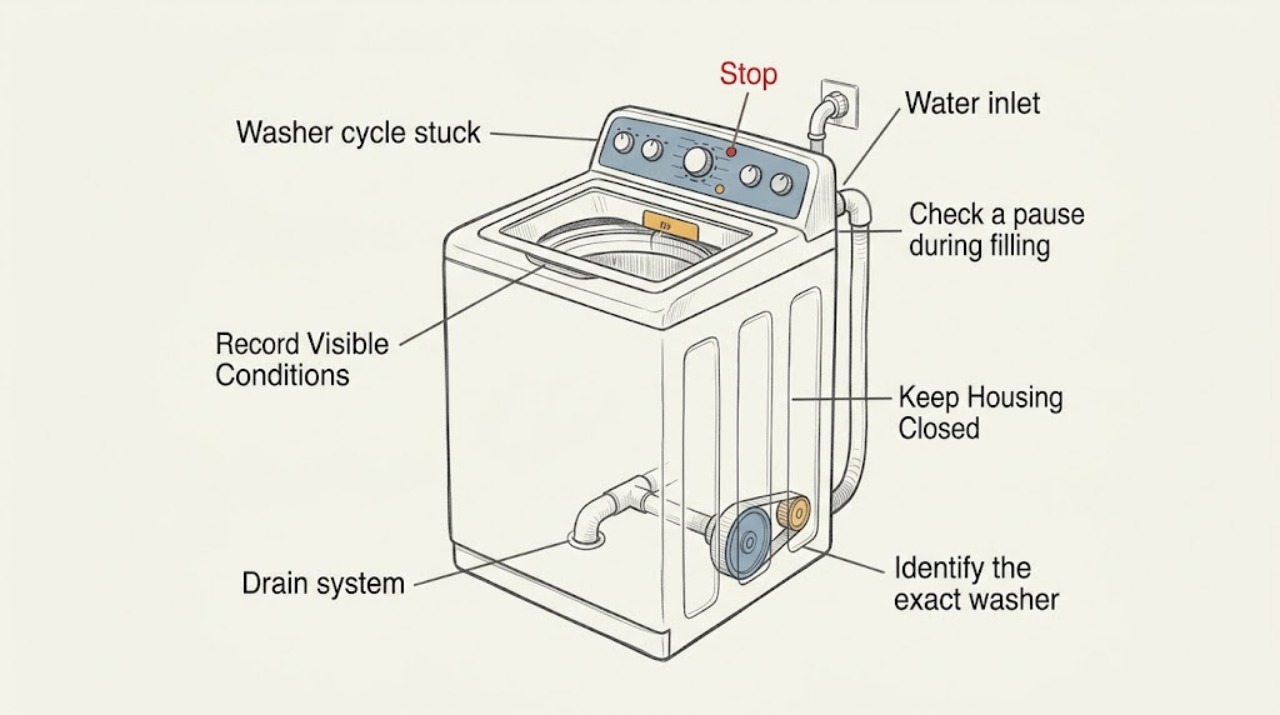
Work through in order
Diagnostic checks
Use only checks that match the exact appliance or system and its official guide.
-
Record the stuck stage and stop for hazards
Pause or cancel the cycle using the normal control if it responds, keep the lid or door closed, and record the display, cycle name, stage, water level, basket movement, and any flashing lights before changing settings.
Expected result: The washer is quiet and safe with no smoke, burning smell, sparking, leak, overflowing water, violent movement, or damaged cord; or one of those conditions is present.
Next step: For smoke, fire, sparking, burning smell, uncontrolled water, or a damaged or hot cord, stop using the washer, leave the area when appropriate, and seek emergency, electrical, plumbing, or appliance help from a safe location. Otherwise keep the washer paused while identifying the exact stage.
Stop if: Do not reach into a moving basket, force the lid or door, or continue a cycle that is leaking, overheating, or electrically abnormal.
Why this matters
Why: A time display can pause during normal balancing, heating, or suds reduction, but smoke, electrical symptoms, uncontrolled water, violent movement, or a hot smell is an immediate stop-use condition.
-
Identify the exact Maytag washer
Record the complete Maytag model number and identify whether the machine is front-load or top-load from the label and manual; do not remove panels or lift the cabinet to find the information.
Expected result: The model and washer family are clear, or the model is unreadable or the control layout does not identify the family.
Next step: Use the exact model manual and Maytag Product Help category. If the model or family is uncertain, keep the washer stopped and provide a label photo and display photo to Maytag support or a qualified technician.
Stop if: Do not guess the model, open the cabinet to locate a label, or apply a front-load procedure to a top-load machine or vice versa.
Why this matters
Why: Maytag's lid, door, drain, balance, and cycle-time instructions vary by model and washer family. A front-load door procedure cannot be assumed for a top-load lid, and a code list from another family may misdirect the check.
-
Check a pause during filling or washing
If the washer stopped while filling or just before washing, inspect only the visible water faucets, inlet hoses, and external hose condition; confirm the lid or door is closed and latched as the model requires, without disconnecting a hose or bypassing a lock.
Expected result: Both required faucets are open, hoses are not visibly kinked, the lid or door is latched, and the washer still does not advance; or an external supply, hose, closure, or latch problem is visible.
Next step: Correct only a visible external condition allowed by the manual, then use the model's normal resume control once. If the washer still does not fill or wash, keep it stopped and arrange service.
Stop if: Do not disconnect pressurized hoses, reach into the tub, bypass the lid or door lock, or open an internal water or control part.
Why this matters
Why: A missing water supply, kink, unlatched lid or door, or visible obstruction can hold a fill or wash stage. If those conditions are normal and the cycle remains stuck, the inlet, lock, control, or another internal condition becomes more likely.
-
Interpret a wash-time pause before calling it a fault
For a front-load washer, observe whether the displayed time is holding while the washer slowly balances, heats water, or shows visible excessive suds; do not add more detergent or interrupt a moving basket just to make the number change.
Expected result: The washer is gently balancing, a selected cycle heats water, excessive suds are visible, or the washer is silent with no water, motion, heat, or progress.
Next step: Allow the model-described balancing, heating, or suds routine to finish while monitoring safely. If the cycle does not recover, a code returns, or the washer cannot drain or spin, stop it and arrange service.
Stop if: Do not open the door during a moving or hot stage, add detergent to a suds condition, or keep restarting a cycle that is not recovering.
Why this matters
Why: Maytag says the remaining time is an estimate and can stay constant during balancing or heating; excessive detergent can trigger a suds-reduction routine that adds time. Silence without an expected condition or a recurring error is less consistent with a normal timer delay.
-
Check the drain and spin path from safe access
If the washer is stuck during draining or spinning, observe whether water remains and inspect the visible drain hose for a kink or obvious external blockage; for a front-load model, clean an accessible pump filter only if the exact manual describes that procedure and the washer is safely disconnected and drained as instructed.
Expected result: Water remains, the hose is visibly kinked or blocked, the load is noisy or violently unbalanced, the model exposes a pump filter, or the external path appears normal but the washer still will not drain or spin.
Next step: Correct only a visible hose or load issue permitted by the manual. If water remains, the door or lid stays locked, the filter procedure is unavailable, or drain and spin do not recover, keep the washer out of service and arrange qualified service.
Stop if: Do not force the door or lid, remove a pump cover without the manual's safe procedure, handle standing water around energized equipment, or reach into a moving basket.
Why this matters
Why: Maytag identifies door or lid closure, unbalanced loads, excess suds, drain routing, and on some models a pump filter as possible contributors. Persistent water or no spin despite an allowed external check can indicate a pump, lock, control, or drive fault.
-
Check the lid or door lock without bypassing it
With the basket stopped, inspect the visible lid or door latch area for clothing, packaging, lint, detergent buildup, or a visibly damaged striker; close it normally and use only the model's documented pause or cancel control.
Expected result: The closure is blocked or dirty, the lock engages after the obstruction is cleared, the washer is still moving, water remains, or the lock will not engage or release.
Next step: Remove only visible external debris with a soft damp cloth when the manual permits, then follow the exact model resume or reset instruction once. If the lock remains abnormal or water remains inside, arrange service.
Stop if: Do not bypass, defeat, pry, or manually release the lock, and do not reach inside while the basket moves.
Why this matters
Why: Maytag says a top-load washer may not advance until the lid is closed and that a front-load door can remain locked when water has not drained. A persistent lock fault is a safety-system issue, not a reason to pry the door or lid.
-
Use one documented reset only after safe checks
When the washer is stopped, dry, safe, and free of smoke, leaks, standing water hazards, abnormal heat, and lock problems, use the exact model's documented control or power reset once; do not repeat resets to force a stuck cycle forward.
Expected result: The display clears and the washer completes a normal stage, or the stuck behavior, code, water, lock, noise, or motion problem returns.
Next step: If the problem returns or the washer cannot complete a safe cycle, keep it out of service and arrange qualified Maytag appliance service with the model, stage, display, and checks already performed.
Stop if: Do not repeatedly cycle power, run a new load to reproduce a hazardous symptom, or enter technician diagnostics.
Why this matters
Why: A temporary control interruption can clear an incomplete cycle, but a returning fault points to an unresolved water, lock, balance, drain, drive, sensor, or control condition.
Use your observations
Decision map
Find the observation that best matches what you see, then follow the next safe action.
-
PATH 01Safety boundary
What you see
The displayed time is holding during a front-load heated cycle, balancing routine, or visible suds reduction, while the washer remains otherwise safe and continues its expected actions.
Do this next
Allow the expected routine to finish while monitoring from a safe position. If the washer becomes silent, repeats the same stage indefinitely, shows a code, or fails to drain or spin, move to service guidance.
Why this path and its safety boundary
Why it matters: A time estimate delay is more likely than a stuck control; Maytag says heating, balancing, and suds reduction can extend the displayed time.
Safety stop: Do not add detergent, open a moving or hot door, or restart repeatedly to change the time display.
-
PATH 02Safety boundary
What you see
The washer is stuck before or during filling or washing, the lid or door is open or not latched, or the exact model guide points to water supply or closure.
Do this next
Close the lid or door and inspect only visible water supply and latch obstructions as the manual allows. If the unit still will not fill or advance, keep it stopped and arrange service.
Why this path and its safety boundary
Why it matters: A visible faucet, hose, latch, or lid or door condition is more likely than a drain or spin fault, but the family-specific manual controls the sequence.
Safety stop: Do not bypass the lock, disconnect pressurized hoses, or reach into the tub.
-
PATH 03Safety boundary
What you see
The tub contains water or the washer stalls during drain or spin, with a kinked hose, unbalanced load, excess suds, visible filter access, or unusually loud movement.
Do this next
Perform only the exact model's safe external hose, load, or accessible filter check. If water remains, the lock stays engaged, the washer shakes violently, or the issue returns, request qualified service.
Why this path and its safety boundary
Why it matters: Drain routing, load balance, suds, lock protection, or a pump and drive issue is more likely than a simple timer display problem.
Safety stop: Do not force the door or lid, handle standing water around energized equipment, or reach into a moving basket.
-
PATH 04Safety boundary
What you see
The lid or door remains locked while the basket is moving or water remains, or the lock will not engage because of a visible obstruction or persistent fault.
Do this next
Wait for the basket to stop, use only the model's pause or cancel and reset procedure, and request service if water remains or the lock will not release normally.
Why this path and its safety boundary
Why it matters: Maytag treats the lock as a safety device; a locked door can also prevent flooding when a front-load washer has not drained.
Safety stop: Do not pry, bypass, defeat, or manually release the lock.
-
PATH 05Safety boundary
What you see
The exact model-matched check and one documented reset do not restore progress, or the same error or flashing light returns at the same stage.
Do this next
Keep the washer out of service and give qualified service the model, exact display, stage, water and lock state, and the checks already completed.
Why this path and its safety boundary
Why it matters: An internal water, drain, lock, drive, sensor, or control fault is more likely than an ordinary cycle delay, but the symptom does not identify a replacement part.
Safety stop: Do not select random cycles, repeat resets, enter service diagnostics, or replace a part from an unverified code interpretation.
-
PATH 06Safety boundary
What you see
The stuck cycle involves smoke, fire, burning smell, sparking, a hot or damaged cord, uncontrolled water, violent movement, overheating, or a door or lid locked with a dangerous condition inside.
Do this next
Stop using the washer, leave the area when appropriate, avoid wet or damaged electrical equipment, and contact emergency, electrical, plumbing, or qualified appliance help from a safe location.
Why this path and its safety boundary
Why it matters: This is an immediate stop-use condition, not a timing or reset problem.
Safety stop: Do not continue the cycle, restore power to reproduce the symptom, force the lock, or reach into the appliance.
Helpful context
Understand the symptom
A timer that pauses is not always a failed cycle
Maytag's front-load guidance says the displayed remaining time is an estimate. The washer may hold the value while balancing a bulky load, heating water, or reducing excessive suds. That expected delay is different from a washer that stays at one stage with no water, drain, motion, or control response. Record the stage and physical behavior before cancelling or resetting.
Fill, wash, drain, spin, and lock stages point to different checks
A fill pause makes the external water supply and inlet path more relevant; a drain or spin pause makes the drain hose, pump filter if the model exposes one, suds, load balance, and door or lid lock more relevant. Top-load models may not advance while the lid remains open, while front-load doors can remain locked when water has not drained. Use the exact model manual instead of transferring a procedure between families.
Protect the lock and the person first
The door or lid may stay locked while the basket is moving or water remains inside. Do not reach into the drum, bypass the lock, pull the door open, or enter service diagnostics. If a single documented reset does not restore a normal cycle, or if water, motion, heat, noise, or a lock remains abnormal, keep the washer out of service and call a qualified technician.
Safety boundary
Stop conditions
- Stop using the washer immediately for smoke, fire, burning smell, sparking, a hot or damaged cord, uncontrolled water, violent movement, overheating, or a dangerous locked-door or lid condition; leave the area when appropriate and seek emergency, electrical, plumbing, or appliance help from a safe location.
- Do not force, pry, defeat, bypass, or manually release a washer door or lid lock, especially when the basket is moving or water remains inside.
- Do not reach into a moving basket, handle standing water around energized equipment, disconnect pressurized hoses, open the cabinet, or enter technician diagnostics as a user check.
- Do not add detergent or restart repeatedly when the washer is balancing, reducing suds, heating, or displaying a recurring error.
- Do not transfer a cycle, lock, fill, drain, or error-code procedure between Maytag models or between front-load and top-load families without the exact manual.
When checks do not resolve it
Need a professional?
Arrange qualified Maytag appliance service when the cycle remains at one stage after the exact model-listed check and one documented reset, an error or flashing light returns, filling or draining does not complete, the washer will not spin, the door or lid will not lock or unlock normally, the washer shakes violently, or the model and display cannot be matched. Seek immediate help for smoke, fire, burning smell, sparking, damaged cord, uncontrolled water, overheating, or a dangerous lock condition.
Safety scope: This article supports recording the stage and performing only exact model-listed ordinary-access checks. Do not bypass the lock, reach into a moving basket, disconnect pressurized hoses, open the cabinet, enter diagnostics, or test energized parts.
Common questions
FAQ
Why is my Maytag washer timer stuck on one number?
The remaining time is an estimate and can hold while a front-load washer balances a load, heats water, or reduces excess suds. If there is no expected motion or heating, the same stage repeats, an error returns, or the washer will not drain or spin, stop using it and arrange service.
What should I check if the washer is stuck while filling?
Use the exact model manual, then inspect only visible water faucets, inlet hoses, and lid or door closure as the guide allows. Do not disconnect pressurized hoses or bypass the lock. If supply and closure are normal but the washer still does not advance, request qualified service.
Why does a Maytag washer stop during spin?
Maytag identifies an unbalanced load, excess suds, drain problems, and lock conditions as possible contributors. A washer may try to correct an imbalance, but violent shaking, standing water, a locked door or lid, or a repeated stop needs service rather than repeated cycle restarts.
Can I force open a Maytag washer door or lid when the cycle is stuck?
No. The lock protects against a moving basket and can remain engaged when water has not drained. Wait for motion to stop and use only the model's documented pause, cancel, or reset procedure; do not pry, bypass, or manually release the lock.
Should I reset my Maytag washer if the cycle is stuck?
Only after the washer is safely stopped, dry, and free of leaks, smoke, overheating, and lock hazards, and only when the exact model guide documents the reset. Use it once. A returning code or stuck stage means the washer should remain out of service for qualified diagnosis.
When is a stuck Maytag washer an emergency?
Stop immediately for smoke, fire, burning smell, sparking, a hot or damaged cord, uncontrolled water, violent movement, overheating, or a dangerous locked-door or lid condition. Leave the area when appropriate and contact emergency, electrical, plumbing, or appliance help from a safe location.
Read the exact guide
Official sources
- Error Codes in Top Load HE Washers - Product Help | MaytagMaytag Product Help · Top-load washer source showing family-specific code meanings and the need to use the exact model manual.
- Appliance Manuals and Literature | MaytagMaytag · Primary source for locating the exact Maytag washer manual before interpreting a stuck cycle or display.
- Contact Us | MaytagMaytag · Brand support source for finding model information and preparing a service request with the exact stage and symptom.
- Cycle Time is Not Advancing - Front Load Washer - Product Help | MaytagMaytag Product Help · Front-load source for distinguishing an expected timer pause from a cycle that is not progressing; not a universal procedure for top-load models.
- Lid Locking on a Top Load High Efficiency Washer - Product Help | MaytagMaytag Product Help · Top-load source for the lid-lock boundary and model-specific operating differences; not a front-load door procedure.
- Error Codes in Front Load Washers - Product Help | MaytagMaytag Product Help · Front-load washer source showing that the available code list is model-dependent and that unresolved codes should be serviced.
- Washer Not Draining or Spinning? Troubleshooting Guide - Product Help | MaytagMaytag Product Help · Cross-model Product Help reference for external drain, balance, suds, and spin symptoms; only some models expose a pump filter.
- Stops Mid Cycle- Washer - Product Help | MaytagMaytag Product Help · Top-load source for spin-stage imbalance and mid-cycle stop patterns; the exact model manual controls the procedure.
- Latching a Front Load Washer Door - Product Help | MaytagMaytag Product Help · Front-load source for door and water-lock behavior; do not transfer it to top-load lids without the exact manual.
- Lid Not Latching - Washer - Product Help | MaytagMaytag Product Help · Top-load source for visible lid and latch checks; exact model operation varies.
- How to Reset a WasherMaytag Product Help · Brand reset reference used only conditionally after a safe stop; exact model instructions control and repeated resets are not a repair.
Community feedback
Share a repair observation
Share a plain-text repair observation. Accepted observations are published automatically; this page may take a moment to update.