
On this page
Start here
Quick answer
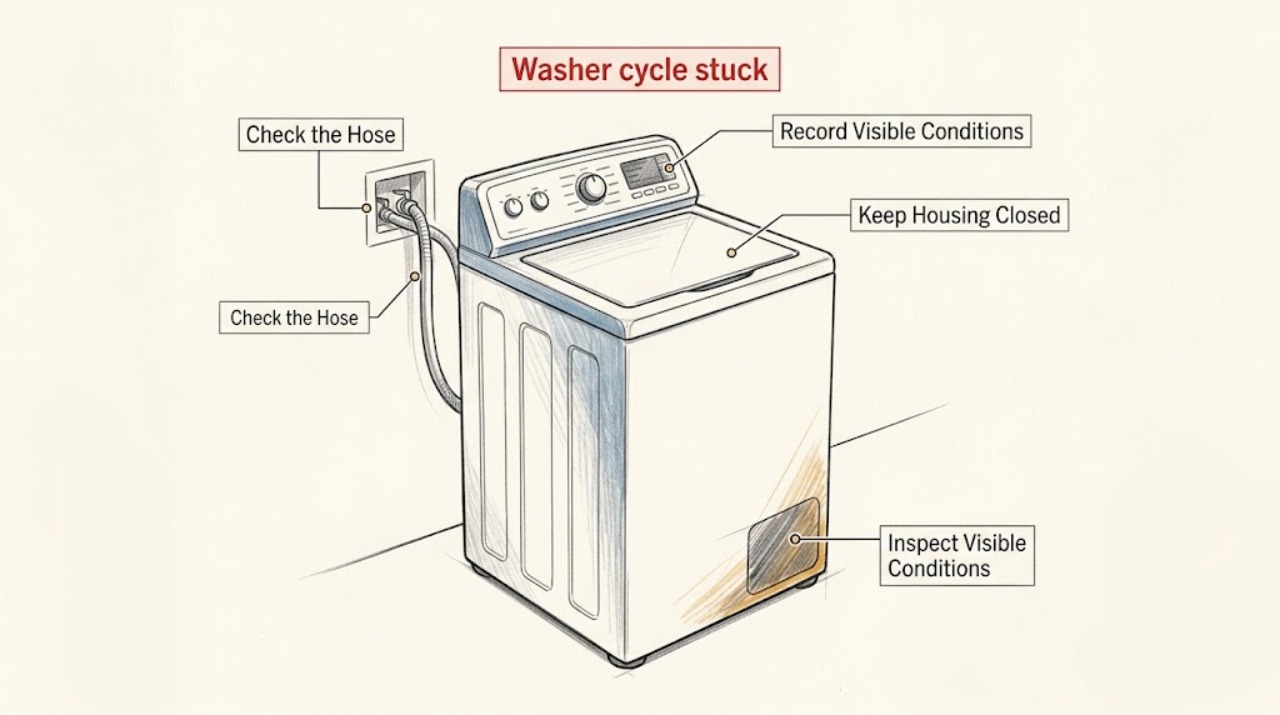
A GE washer that appears stuck may be in a normal pause, sensing or soak period, waiting for a closed lid or door, unable to fill or drain, correcting an unbalanced load, or locked up after an interrupted cycle. First stop and record the exact stage—fill, wash or agitate, rinse, drain, spin, or door-lock state—along with any display text and whether water remains. Do not reach into a moving tub, force a lid or door, manually advance a timer during a normal drain pause, or open the cabinet. Check only visible model-appropriate items: water supply and hoses at fill, lid or door status, drain hose and household drain, load balance, and the exact control state. GE says full-size top-load models may pause up to three minutes between stages, and its reset guidance allows a single model-appropriate power reset after a safe interruption; if the same stage, code, leak, noise, or control failure returns, leave the washer off and arrange qualified service.
Before you begin
Safety first
- Keep the washer off for smoke, burning odor, arcing, overheating, leaks near electrical parts, violent movement, repeated breaker trips, a tub that will not stop, or a damaged lid, door, hose, cord, plug, or outlet. Do not open the cabinet or bypass an interlock.
Work through in order
Diagnostic checks
Use only checks that match the exact appliance or system and its official guide.
-
Check 1
Press Pause or Stop only as the model permits, keep the lid or door closed while the tub is moving, and record the exact stage: filling, sensing, wash or agitate, soak, rinse, drain, spin, or end-of-cycle lock. Record all display text or light patterns, whether water remains, and any smoke, odor, leak, heat, or violent movement.
Expected result: The washer is briefly paused, the tub is still moving, water remains, the lid or door is locked, the display shows an error or canceled state, or a safety symptom is present.
Next step: Keep clear and stop immediately for smoke, burning odor, a hot electrical connection, a leak near electrics, violent movement, or a tub that will not stop. Otherwise continue only with the stage-specific visible check below; never force a lock or reach into motion.
Why this matters
Why: Stage and safety observations separate a normal model pause from a fill, interlock, drain, balance, drive, or control problem. A hazard is not an ordinary cycle check.
-
Check 2
If the washer is stuck at fill or sensing, confirm from a dry, safe position that both household supply valves are open, the inlet hoses are connected to the intended ports without visible kinks, and the selected cycle has not been paused or delayed. Do not disconnect a pressurized hose or open the cabinet.
Expected result: A valve is closed, a hose is kinked, the cycle is paused or in a documented soak or sensing period, or the visible supply path is correct but the washer still does not fill or advance.
Next step: Correct only a visible valve or hose-position issue and allow the model's normal sensing or soak period. If the washer still will not fill or advances no further, stop and arrange service rather than opening the inlet assembly or applying an unverified cycle sequence.
Why this matters
Why: A closed supply, restricted hose, or intentional model state can prevent the next stage. Correct visible setup with no fill points to an inlet, sensor, control, or water-pressure issue that cannot be confirmed safely from inside the washer.
-
Check 3
If the washer is stuck during wash or agitation, observe only after the tub has stopped whether the lid or door is fully closed, a lid-lock or door-lock indicator is active, and the machine was accidentally paused. For a top-load model, note whether the washer is sensing after fill or whether an overload is pressing beyond the balance ring; do not bypass the interlock.
Expected result: The lid or door is open or not locking, the machine is in a normal sensing or soak period, the load is excessive or gathered to one side, or the interlock and load appear normal but agitation does not begin.
Next step: Close the lid or door and clear only the model-documented pause or lock state. If safe and the tub is stationary, remove excess items or redistribute the load once. Do not bypass a lock or continue testing when the interlock is damaged; arrange service if the cycle still does not agitate.
Why this matters
Why: GE links lid state and load or balance conditions to a washer that will not agitate or spin, while some models intentionally pause while sensing or soaking. A correct lid and suitable load with repeated failure makes a drive, sensor, or control fault more likely.
-
Check 4
If the washer is stuck at drain or rinse, note whether water remains and inspect the visible drain hose for a kink, flattening, clog, incorrect standpipe placement, or a household drain that backs up. On an applicable front-load model, use the exact manual before accessing a user-serviceable pump filter; do not open a filter with a full tub unless the model procedure controls the water safely.
Expected result: Water drains after a visible hose or plumbing correction, the hose or household drain is blocked, a pump hums without removing water, a front-load pump filter is accessible and clogged per the manual, or the path appears correct but water remains.
Next step: Correct only model-approved visible routing and run one supervised drain attempt if the floor and connections are dry. Stop for a leak, wastewater backup, trapped water, or a returning drain indication; do not dismantle the pump or force a full filter open, and arrange service.
Why this matters
Why: A restricted drain path can keep a washer from reaching rinse completion or spin. A hum with trapped water or a clear path with no pumping points to a pump, sensor, or internal fault and may create a flood risk.
-
Check 5
If the washer reaches spin but pauses, repeats, or leaves water in the clothes, wait through the model's normal pause and observe the basket, load distribution, level, and displayed SPIN, balancing, dE, E2, or canceled indication. Do not manually advance a timer during pump-out and do not reach into a moving basket.
Expected result: The pause lasts within the model's documented interval, the load is unbalanced or too large, the washer is not level, the lid was opened, a code or light pattern returns, or the motor runs without spinning the tub.
Next step: Wait rather than advance a timer. When motion has fully stopped, correct only an obvious load or leveling issue using the manual and try once if no hazard exists. If the code or failure returns, leave the washer off and arrange qualified service.
Why this matters
Why: GE identifies short pauses, lid status, leveling, load balance, and control states as distinct spin paths. A stable, correctly closed washer that pumps but cannot spin may need service for the drive or related system.
-
Check 6
After the safe stage checks, perform at most one model-appropriate control reset. GE's general electronic-control guidance uses a two-minute power interruption, but the model manual controls whether a reset is suitable; disconnect only from a dry, safe location and do not reset with a leak, moving tub, burning odor, or other hazard.
Expected result: The washer resumes once, the same stage or code returns, the display remains blank or locked, or the washer stops again after the reset.
Next step: If the symptom returns or the controls remain unresponsive, leave the washer off and give service the exact model, stage, code, water state, and reset result. Do not repeat resets or open the control panel.
Why this matters
Why: A reset may clear a temporary control lock after an interruption, but it cannot repair a restricted drain, failed interlock, supply fault, unbalanced installation, pump, motor, or control failure.
Use your observations
Decision map
Find the observation that best matches what you see, then follow the next safe action.
-
PATH 01Next step
What you see
A full-size top-load washer has paused for only a few minutes between agitation, pump-out, rinse, or spin and shows no hazard.
Do this next
Wait through the model's documented pause and do not manually advance a timer. If the pause exceeds that behavior or returns at the same stage, use the matching stage branch and arrange service if needed.
Why this path and its safety boundary
Why it matters: GE describes short pauses between stages as normal on many models; the washer may still be advancing or pumping out.
-
PATH 02Next step
What you see
The washer is stuck before or during fill, and a supply valve is closed or an inlet hose is visibly kinked.
Do this next
Correct the visible setup only if dry and safe, then allow one normal model cycle attempt. If it still does not fill or advances no further, stop and arrange service.
Why this path and its safety boundary
Why it matters: The visible water-supply path can prevent the washer from reaching wash or rinse; this does not prove an internal valve fault.
-
PATH 03Next step
What you see
The washer fills but does not agitate, or the cycle remains at sensing, while the lid or door is not correctly closed or the machine is in a documented soak or sensing period.
Do this next
Close the lid or door and wait only through the documented sensing or soak period. Do not bypass the interlock. If the lock is damaged or the cycle still will not agitate, arrange service.
Why this path and its safety boundary
Why it matters: A lid or door interlock or an intentional model state can look like a stalled wash; newer top-load designs may briefly sense before engaging the drive.
-
PATH 04Next step
What you see
Water remains at drain or rinse, the hose or household drain is restricted, or a drain indication returns.
Do this next
Inspect only visible routing and model-approved access, keeping water away from electrical parts. Stop for a leak, backup, trapped water, or a pump that only hums and request service.
Why this path and its safety boundary
Why it matters: A blocked or incorrectly routed drain path can hold the washer at the current stage and prevent spin; a clear path with no pumping is more consistent with an internal fault.
-
PATH 05Next step
What you see
The washer stops at spin with SPIN or balancing indication, shaking, an overloaded basket, or an unlevel cabinet.
Do this next
Wait for all motion to stop, redistribute or reduce the load once, and correct only visible leveling issues using the manual. If movement or the stop returns, leave the washer off and arrange service.
Why this path and its safety boundary
Why it matters: GE identifies load distribution and leveling as reasons a washer may pause or stop spin rather than complete the cycle.
-
PATH 06Next step
What you see
The cycle is stuck after a power interruption or pause, the controls are locked or unresponsive, and no leak or electrical hazard is present.
Do this next
Use the exact model reset guidance once, including the required post-reset cycle selection. If the controls remain stuck or the issue returns, stop and request service rather than repeating resets.
Why this path and its safety boundary
Why it matters: GE says an interrupted cycle can lock electronic controls, and a model-appropriate power reset may restore them once.
-
PATH 07Next step
What you see
Smoke, burning odor, a hot plug or outlet, arcing, a leak near electrics, repeated breaker trips, violent walking, or a tub that will not stop occurs.
Do this next
Stop immediately, keep clear, close water valves only if safely reachable, and isolate power only from a dry safe location. Do not restart or open the cabinet; obtain qualified or emergency help as appropriate.
Why this path and its safety boundary
Why it matters: This is a fire, electrical, water, or injury hazard, not a normal cycle pause.
Helpful context
Understand the symptom
Name the stage before changing anything
Cycle stuck is a symptom, not one diagnosis. A washer may pause while sensing a load, soak before washing, wait between pump-out and spin, or stop because it cannot satisfy a fill, lid, drain, balance, or control condition. Write down the selected cycle, displayed lights or text, elapsed behavior, water level, and whether the tub is moving. The same symptom means different things on a front-load, top-load, compact, or older timer-controlled model.
A short pause can be normal
GE notes that many full-size top-load washers can pause for up to three minutes between cycles, including before pump-out and spin. A Hydrowave model can also briefly sense the load after filling before agitation. Wait through the model's documented pause rather than turning a timer dial forward or repeatedly pressing controls. A pause that exceeds the documented behavior or returns at the same stage needs a different branch.
Front-load and top-load checks are not interchangeable
Front-load models may have a model-accessible pump filter and a locked door; some require service for filter access. Top-load models use a lid state, balance ring, and model-specific drive or sensing behavior. GE's support pages also distinguish older lid-dependent designs, Hydrowave models, and newer displays. Use the exact model manual for a control sequence, error meaning, pump access, and any reset procedure.
Do not turn a stalled cycle into a flood or injury
Keep hands out of a moving tub and do not force a door or defeat a lid interlock. If water is trapped, inspect only safe visible hose and plumbing conditions and follow the model's drain instructions. Stop for a leak near electrical parts, smoke, burning odor, a hot plug, repeated breaker trips, violent movement, or a tub that does not stop. Qualified service is the right next step for a recurring stuck stage or an inaccessible internal component.
Safety boundary
Stop conditions
- Stop immediately for smoke, burning odor, arcing, a hot plug or outlet, repeated breaker trips, a leak near electrical parts, violent walking, or a tub that does not stop. Keep clear, isolate power only from a dry safe location, and do not restart.
- Do not reach into a moving tub, force a lid or door, defeat an interlock, remove a full pump filter without the exact model procedure, or open the cabinet for an internal check.
- Do not manually advance a timer during a normal pump-out pause, repeatedly reset the controls, or apply a reset sequence from another GE washer style or model.
- Stop for trapped water, wastewater backup, a pump that only hums, a drain leak, or a supply connection that cannot be handled dry and safely. Arrange appliance or plumbing service as appropriate.
- Keep the washer out of use when the same cycle stage, code, door or lid fault, drain failure, spin failure, or unresponsive control returns after its single documented check or reset.
Only after diagnosis
Potential parts
- drain pump or pump filter assembly
Consider this category only after qualified diagnosis confirms a drain restriction or failed pump after visible hose and household plumbing checks.
Pump access and fit vary by GE washer style, model, and revision. Confirm the exact model and service diagnosis before selecting a part. - lid or door-lock assembly
Consider this category only when the lid or door is correctly closed but the interlock prevents the next stage or produces a returning model-specific indication.
Top-load lid switches and front-load door locks are different systems. Confirm the exact model and diagnosis; never bypass the interlock. - water inlet valve or control component
Consider this category only after qualified diagnosis links a verified fill failure or recurring control lock to the model-specific valve or control path.
Do not infer compatibility from appearance or a generic cycle symptom. Confirm the model, electrical configuration, and service findings.
When checks do not resolve it
Need a professional?
Arrange qualified GE or appliance service when the washer remains stuck after the model-appropriate visible fill, lid or door, drain, load, leveling, and single-reset checks; a code returns; the pump only hums; the controls stay locked; the lid or door interlock fails; or the motor runs without spinning the tub. Use plumbing service for a backed-up household drain. Treat smoke, burning odor, arcing, electrical overheating, a leak near electrics, violent movement, repeated breaker trips, or a tub that will not stop as immediate safety issues.
Safety scope: Keep the washer off for smoke, burning odor, arcing, overheating, leaks near electrical parts, violent movement, repeated breaker trips, a tub that will not stop, or a damaged lid, door, hose, cord, plug, or outlet. Do not open the cabinet or bypass an interlock.
Common questions
FAQ
Is a short pause in a GE washer cycle normal?
It can be. GE says many full-size top-load models may pause up to three minutes between stages, including before pump-out and spin, and some models briefly sense a load after filling. Do not manually advance a timer; investigate if the pause exceeds the model's documented behavior or repeats at the same stage.
What should I record when my GE washer is stuck?
Record the exact model, front-load or top-load style, selected cycle, stage where it stopped, display text or light pattern, whether water remains, lid or door state, hose and drain observations, load balance, and any noise, leak, odor, heat, or breaker symptom. This prevents applying a check from a different model family.
Can I reset a GE washer that is stuck?
Only when there is no leak, moving-tub hazard, burning odor, overheating, or other safety sign and the exact model guidance allows it. GE describes a two-minute power interruption for some electronic-control lockups. Use one documented reset at most; if the control or cycle remains stuck, arrange service.
Why is my GE washer stuck with water still inside?
Check only safe visible conditions first: a kinked or blocked drain hose, a backed-up household drain, or a model-accessible pump-filter path described in the manual. A pump that only hums, a full tub that will not drain, a leak, or a returning drain indication needs service; do not open a full filter or dismantle the pump without the exact procedure.
Why does my GE washer stop before spin?
The washer may still be pumping out, waiting after a normal pause, responding to a lid or door state, correcting an unbalanced or unlevel load, or unable to complete drainage. Wait through the model pause, let motion stop, check the visible load and level, and stop for a returning code, trapped water, violent movement, or a motor that runs without spinning the tub.
When should I stop troubleshooting a stuck GE washer?
Stop for smoke, burning odor, arcing, a hot plug or outlet, repeated breaker trips, a leak near electrical parts, violent walking, a tub that will not stop, a damaged interlock, or trapped water that cannot be handled safely. Keep the washer off and obtain qualified or emergency help as appropriate.
Read the exact guide
Official sources
- Top Load Washer - Does Not SpinGE Appliances · GE top-load spin guidance; display codes, options, and Hydrowave features vary by model and production period.
- Top Load Washer - Will Not DrainGE Appliances · GE top-load drain guidance; hose height and display behavior vary by model and washer size.
- Washer - Resetting the Electronic ControlsGE Appliances · GE control-reset guidance; exact reset behavior and control type vary by model.
- Top Load Washer - Fills But Will Not AgitateGE Appliances · GE top-load support article; Hydrowave, lid hardware, and control behavior are model-specific.
- Frequently Asked Questions About GE WashersGE Appliances · GE Appliances washer FAQ covering multiple model families; exact model instructions control where designs differ.
- Front Load Washer - TroubleshootingGE Appliances · GE front-load guidance; pump-filter access and controls vary by exact model, and some models require service for access.
Community feedback
Share a repair observation
Share a plain-text repair observation. Accepted observations are published automatically; this page may take a moment to update.