
On this page
Start here
Quick answer
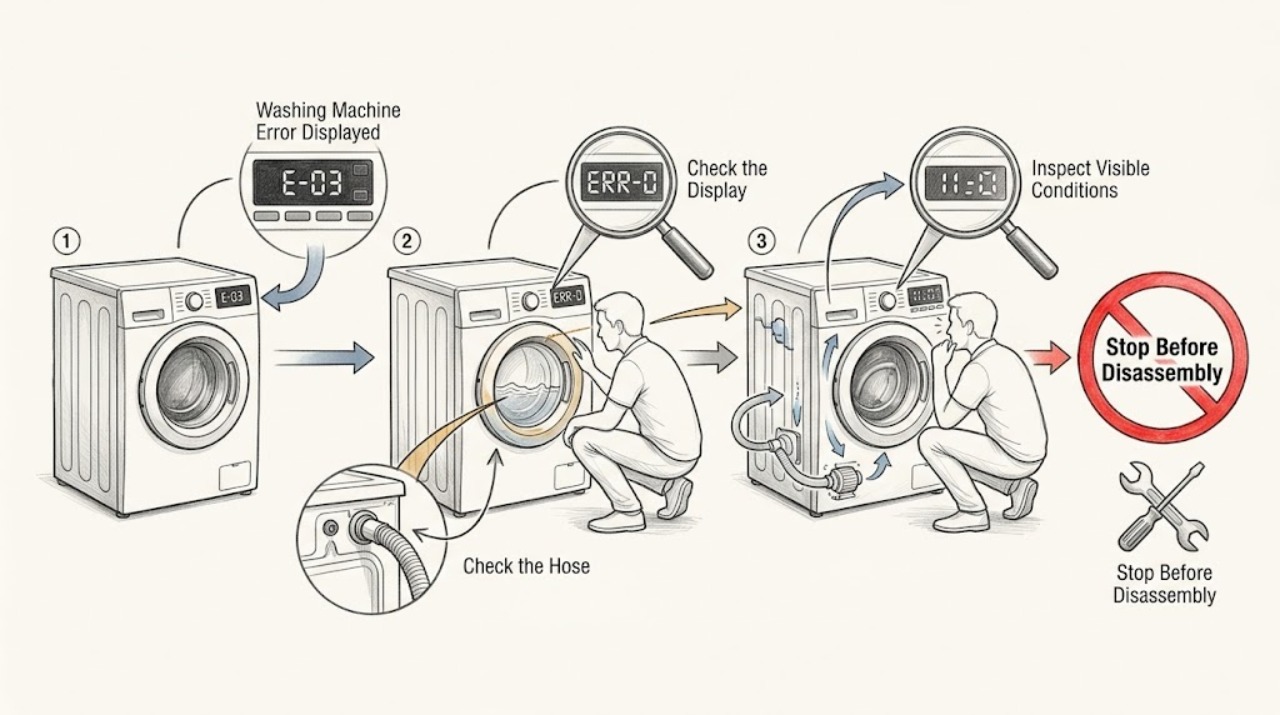
When an Amana washing machine displays an error, record the exact characters, whether it is a front-load or top-load model, and what the washer was doing when the code appeared. Amana's code tables are model-family specific, so use the owner's manual and the matching Amana Product Help page rather than guessing from a similar-looking code. Low-fill codes such as F8 E1 or LO FL point first to open hot and cold valves, kinked or clogged inlet hoses, inlet screens, or drain-hose installation; drain codes such as F9 E1 or drn point to the drain hose and standpipe. Other displays can indicate control lock, excess suds, an open lid or door, an unbalanced load, a dispenser issue, or a system fault. Do only external, model-directed checks; stop for smoke, burning odor, water near electrical parts, a damaged cord, repeated power faults, a locked drum with water inside, or a code that persists after the manual's safe reset and arrange qualified appliance service.
Work through in order
Diagnostic checks
Use only checks that match the exact appliance or system and its official guide.
-
Check 1
Copy the complete display exactly and note the washer type, cycle, load condition, whether water is in the tub, and whether the code appeared during filling, washing, spinning, draining, or at startup.
Expected result: The display is a recognizable code such as F8 E1 or LO FL, F9 E1 or drn, Sud or Sd, F8 E2, LOC or LC, Int, or another F-code; the cycle stage is known or unknown.
Next step: Use the owner's manual and the matching Amana front-load or top-load error table. Keep the recorded code available if service is needed; do not repeatedly clear it before recording the symptom.
Why this matters
Why: The code family narrows the check, but the same-looking characters can have different meaning by model and load type. Unknown characters or a code not listed for the model cannot be safely diagnosed from the display alone.
-
Check 2
For a fill or low-flow display, observe the hot and cold supply valves, inlet hoses, and accessible hose routing. Confirm both valves are open and look for a kink, crushing, anti-flood device, or obvious restriction without disconnecting a pressurized hose.
Expected result: A valve is closed, a hose is kinked or visibly damaged, or the external supply looks normal but the washer still reports low flow.
Next step: Correct only an obvious valve position or hose routing issue when the area is dry and safe, then follow the model's code-clearing instruction once. If the code returns, stop and arrange service rather than opening the inlet valve or cabinet.
Why this matters
Why: Amana links F8 E1 or LO FL to insufficient detected incoming water and lists the household valves, hose condition, and connected flow-control devices as checks. A normal exterior does not rule out a blocked inlet screen or internal inlet-valve fault.
-
Check 3
For a drain display such as F9 E1 or drn, observe the drain hose from outside the washer through its visible run to the standpipe or laundry tub. Look for a kink, crushing, a blocked end, an incorrectly sealed opening, or an obviously incorrect hose position; do not reach into the pump or remove a wet hose while the washer is powered.
Expected result: The hose is kinked or obstructed, the standpipe connection is sealed or positioned incorrectly, or the hose appears clear but the washer still drains slowly or leaves water inside.
Next step: Make only the model-approved external routing correction, then run the specified drain or test cycle. If water remains, the pump cannot drain, or the display returns, stop and arrange qualified appliance service; do not tilt the machine or disassemble the pump area.
Why this matters
Why: Amana identifies long drain time with a drain hose or installation problem among the first checks. If the external path is clear but water remains, the pump, filter, internal hose, or control may need service.
-
Check 4
Match the displayed code to the model's table and perform only its low-risk user action: close an open lid or door, remove objects from the lid or door area, redistribute an unbalanced load, wait through a documented suds-reduction or drain routine, or check that a dispenser drawer is fully closed and not visibly packed with detergent.
Expected result: The code clears after the matching condition is corrected, or it remains after the washer completes the documented routine or reset.
Next step: Resume only if the washer completes a short test without the code, abnormal noise, leaking, or unsafe behavior. If the code returns, preserve the exact code and stop troubleshooting beyond the model manual's user steps.
Why this matters
Why: A cleared lid, load-balance, suds, control-lock, interruption, or dispenser display supports a temporary operating condition. A repeat or persistent code indicates the underlying condition may remain or the washer may have a component fault.
-
Check 5
If the display is an unlisted or generic F-code, observe whether the washer is responsive, whether the tub is empty, and whether there is a visible leak, unusual noise, burning smell, damaged cord, or repeated interruption of power. Do not open the cabinet to identify the failed component.
Expected result: The code remains after the model's documented power cycle, the control is unresponsive, water remains, or a safety symptom accompanies the display.
Next step: Stop using the washer and arrange qualified appliance service. If there is smoke, active sparking, or a burning or electrical odor, keep clear of the appliance and use the appropriate emergency or electrical service response.
Why this matters
Why: Amana directs persistent other F-codes to qualified diagnosis. An unresponsive control, retained water, leak, or electrical or burning symptom raises the risk of continuing to run the washer or attempting an internal repair.
-
Check 6
Run one model-approved test cycle only after the display-specific external check, and record whether the washer fills, tumbles, drains, and spins without the code. Keep the model number, exact code, cycle, load, and any hose or dispenser observation with the result.
Expected result: The cycle completes normally, the code returns at the same stage, or a different code or symptom appears.
Next step: Use the machine only if it remains dry, stable, and code-free. For any repeat, new code, incomplete drain, abnormal sound, or unsafe symptom, stop and provide the complete record to qualified service.
Why this matters
Why: A completed cycle supports a cleared operating condition but does not establish that an intermittent fault is gone. A repeat at the same stage gives the technician a more useful path than a generic error description.
Use your observations
Decision map
Find the observation that best matches what you see, then follow the next safe action.
-
PATH 01Safety boundary
What you see
Does the display identify a low-fill or low-flow condition such as F8 E1 or LO FL?
Do this next
Check both water valves, visible inlet-hose routing, and the model's inlet-screen guidance without disconnecting a pressurized hose or opening the cabinet.
Why this path and its safety boundary
Safety stop: Use the exact code and cycle stage to select the drain, door or lid, suds, dispenser, balance, control, or system-error branch in the model table.
-
PATH 02Safety boundary
What you see
Does the display identify a long-drain condition such as F9 E1 or drn, and is water left in the washer?
Do this next
Inspect only the visible drain-hose route and standpipe setup, then use the model's drain test; persistent retained water or a clear hose requires appliance service.
Why this path and its safety boundary
Safety stop: Do not assume the washer is clogged. Follow the matching code table for the displayed condition and cycle stage.
-
PATH 03Safety boundary
What you see
Is the display a lid, door, control-lock, suds, dispenser, balance, or cycle-interruption message with no leak or electrical warning?
Do this next
Perform only the corresponding user action in the manual, such as closing the lid or door, redistributing the load, waiting for the routine, or checking the dispenser drawer.
Why this path and its safety boundary
Safety stop: Treat an unlisted, recurring, or system F-code as unresolved and preserve the exact display for qualified diagnosis.
-
PATH 04Safety boundary
What you see
Does the code persist after the model's documented reset or return during the same cycle stage?
Do this next
Stop using the washer and arrange qualified appliance service, especially if water remains, the control is unresponsive, or the washer leaks or makes an abnormal sound.
Why this path and its safety boundary
Safety stop: Run one short model-approved test cycle while observing for leaks, abnormal noise, incomplete drain, or another displayed code.
Helpful context
Understand the symptom
The exact display matters
Error displayed is a symptom category, not one diagnosis. Amana's front-load and top-load tables list different codes and explicitly direct the owner to the model manual because the published lists may not include every code for every washer. Photograph or write down the exact characters before clearing anything, including spaces, dashes, and whether a letter could be a number.
Keep checks outside the cabinet
Do not remove an access panel, reach into a moving drum, bypass a lid or door lock, probe wiring, or test live electrical parts to clear a display. Close the water valves and disconnect power only as the model manual directs. A reset can clear a temporary control state, but it cannot prove that an underlying fill, drain, motor, or control fault is repaired.
Only after diagnosis
Potential parts
- water inlet hose
Consider this only if inspection finds a kinked, damaged, or internally restricted hose and the model manual or technician confirms replacement is appropriate for the displayed low-flow condition.
Confirm the exact washer model, hose connection, temperature rating, and manufacturer guidance before selecting a replacement. - washer drain hose
Consider this only if the drain code persists and the visible hose is kinked, damaged, or otherwise confirmed to be the restriction rather than the pump or household standpipe.
Match the exact model and installation requirements; do not substitute a hose based only on a displayed code.
Common questions
FAQ
Why is my Amana washer showing an error code?
The display is a model-specific symptom, not one universal fault. Record the exact characters and cycle stage, then use the matching Amana table and owner's manual. The code may relate to filling, draining, a lid or door, suds, balance, dispenser, control, or another system.
What should I check for F8 E1 or LO FL?
Confirm both hot and cold supply valves are open and look for kinked or restricted inlet hoses and incorrect drain-hose installation. Amana also identifies inlet screens as a possible debris point; inspect or clean them only under the model's safe instructions and do not open the washer cabinet.
What does F9 E1 or drn mean on an Amana washer?
It indicates a drain-time or draining problem. Start with the visible drain hose and standpipe setup for a kink, clog, sealing, or routing issue. If the hose is clear but water remains or the code returns, stop and arrange qualified appliance service rather than opening the pump area.
When should I stop clearing an Amana washer error?
Stop for smoke, burning or electrical odor, sparking, a damaged cord, water near electrical parts, an active leak, a locked drum with water inside, repeated power interruption, or any code that persists after the model's safe user step. Keep the cabinet closed and arrange qualified service.
Read the exact guide
Official sources
- drn - Error CodeAmana Product Help · Long-drain meaning, visible drain-hose restrictions, standpipe routing, and service escalation.
- Error Codes in Top Load HE WashersAmana Product Help · Top-load error meanings and model-specific cautions for drain, fill, lid, load balance, power interruption, and suds displays.
- F8 E1 or LF or LO FL Error Code in DisplayAmana Product Help · Incoming-water checks, visible hose restrictions, inlet screens, and drain-hose installation for low-flow displays.
- Error Codes in Front Load WashersAmana Product Help · Front-load error meanings and model-specific cautions for low flow, long drain, suds, dispenser, lock, balance, and other codes.
Community feedback
Share a repair observation
Share a plain-text repair observation. Accepted observations are published automatically; this page may take a moment to update.