
On this page
Start here
Quick answer
A Bosch washer display can show a normal status, a user-correctable condition, or a fault that requires service, and the exact model determines the meaning. Photograph the complete symbol or code first. On Bosch's official US washer guidance, a flashing pause/play icon can be energy-saving mode, a soap-bubble icon can indicate excess detergent, CL is child lock, E16/F16 or E34/F34 indicates the door is not locked properly, E18/F18 points to a blocked or kinked drain path, E23/F23 indicates AquaStop leak protection, and E32/F32 or H:32 indicates an imbalance. Bosch also lists E19/F19 as heating time exceeded, E20/F20 as unexpected heating, and E80 as a drive-circuit fault. Use only the model-specific ordinary checks the display calls for: close the door, redistribute laundry, check a hose or pump only with power off and safe water handling, or reduce detergent. For a leak, hot residual water, cracked or damaged parts, repeated breaker trips, a recurring code, a drive or heating fault, or an unknown symbol, stop the washer and arrange qualified Bosch service. Do not bypass a door lock or AquaStop, open live electrical parts, or keep resetting a persistent message.
Before you begin
Safety first
- This article permits ordinary display, door, load, detergent, and model-approved hose or pump observations only. Live electrical testing, leak-source access, AquaStop, heating, drive, sensor, and control repair belong to qualified service.
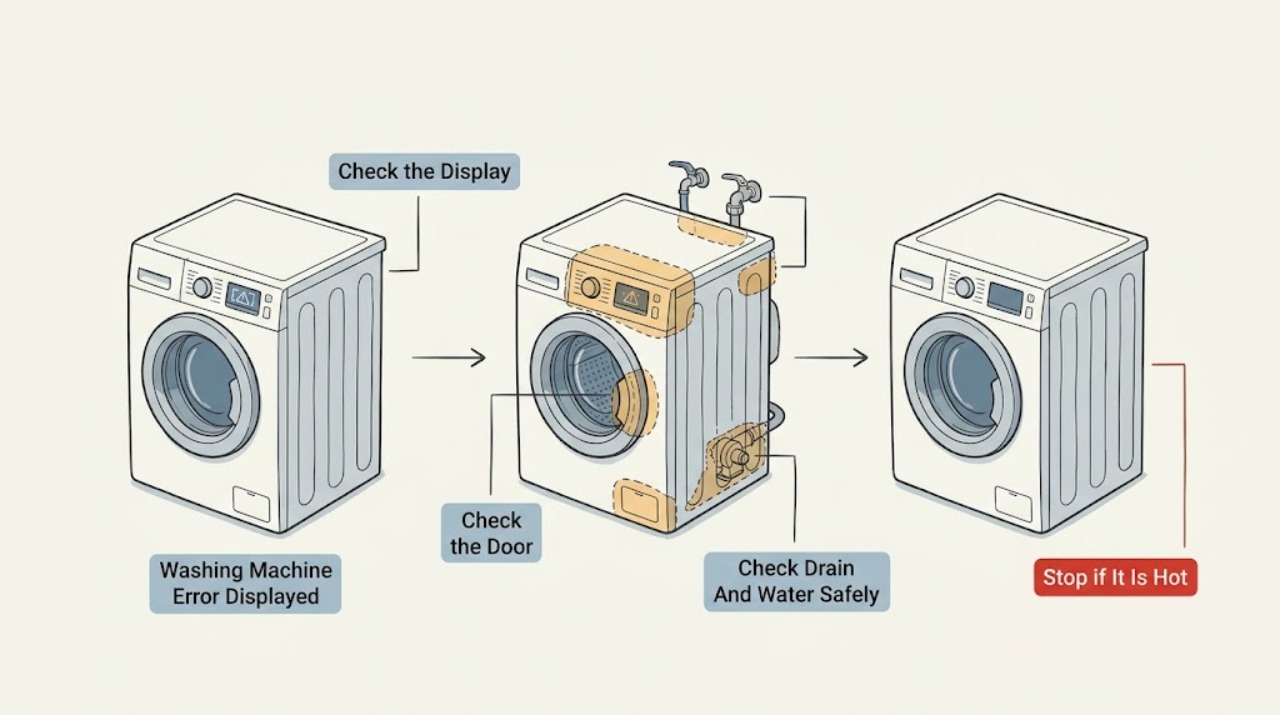
Work through in order
Diagnostic checks
Use only checks that match the exact appliance or system and its official guide.
-
Check 1
Stop the program if safe, photograph the full display and model label, and inspect from ordinary safe access for water on the floor, an open or locked door, abnormal heat, smoke, burning odor, damaged cord, or a breaker that trips again.
Expected result: Classify the message as a normal icon, door, drain, inlet, leak, imbalance, heating, sensor, drive, or unknown fault; record whether water or heat is present and whether one zone or the entire washer is affected.
Next step: Turn off water and disconnect power from a safe point for a leak or hazard; otherwise use the exact manual and continue only with the matching low-risk check.
Stop if: Do not force the door, touch wet electrical parts, open a live cabinet, reset a breaker repeatedly, or continue a cycle with smoke, burning odor, uncontrolled heat, or water damage.
Why this matters
Why: A status icon or imbalance may allow an ordinary control or load correction, while a leak, unexpected heating, electrical damage, or unknown recurring code is a stop condition. The exact model determines the meaning of an unfamiliar display.
-
Check 2
If the message is an energy-saving icon, child lock, or door code and there is no water leak or electrical hazard, wake the display or use the exact manual's normal control sequence; for E16/F16 or E34/F34, close the door until it latches and check for laundry caught between the door and housing.
Expected result: Record whether the icon clears, the door locks audibly, the program starts, or the same message returns with a full or empty drum.
Next step: Remove only visible trapped fabric, close the door normally, and try the model-approved restart once; arrange service if the lock does not engage or the code returns.
Stop if: Do not tape, bridge, pry, or bypass the door lock, and do not force a locked door while water or heat remains inside.
Why this matters
Why: Bosch documents energy-saving mode and child lock as operating states, and a door code can result from incomplete closure or trapped laundry. A persistent door message with a mechanically closed door may involve the latch or interlock.
-
Check 3
For an E18/F18 or drain-related display, set the program to off and unplug the washer; only if the model manual permits it and the water is cool enough to handle, inspect the visible drain hose for a kink and clean the accessible pump area using the manual's procedure.
Expected result: Record whether the hose is kinked, the pump filter or impeller area is blocked, water is present or unusually hot, the pump cover reseats without force, and whether the code returns after a safe drain check.
Next step: Restore the pump cover and hose only as the manual specifies, check for leaks, and arrange service if water cannot be safely removed or E18/F18 returns.
Stop if: Do not drain scalding water onto the floor, run the pump with the cover removed, force a cap, probe live wiring, or continue if a leak appears.
Why this matters
Why: Bosch associates E18/F18 with a blocked or kinked drain path and warns residual water can be hot. A clear path with a returning code suggests a pump, sensor, or control issue rather than permission to dismantle more of the washer.
-
Check 4
For E23/F23 or a water-in-base or leak-protection indication, turn off the water tap immediately if safe, keep the washer unused, and inspect only for an obvious external hose or floor leak without removing panels.
Expected result: Record whether the floor or base is wet, the inlet or drain hose is leaking, the display remains E23/F23, or no external source is visible.
Next step: Leave water off and arrange Bosch or qualified appliance service with the exact code and leak observations; do not run another cycle to locate the leak.
Stop if: Do not bypass AquaStop, open the base, tilt the washer, reconnect water for a test, or operate while leak protection is active.
Why this matters
Why: Bosch says E23/F23 means AquaStop has activated and that a leak may be present; the washer should not be used until fixed. An unseen base leak cannot be ruled out by a dry floor alone.
-
Check 5
If the display identifies imbalance or excess detergent and there is no leak, electrical hazard, or unexpected heating, redistribute a mixed load as the manual recommends or reduce detergent for the next comparable load; do not add water while the washer runs.
Expected result: Record whether the spin completes at normal speed, the imbalance message returns with a balanced load, the soap-bubble icon clears, or excessive foam remains.
Next step: Use the exact program and load guidance once; if the message returns, the drum bangs, or foam remains excessive, stop and request service rather than adding spin or detergent.
Stop if: Do not run with a visibly damaged drum, force high spin, add extra water, or keep retrying a load that causes severe vibration or a returning fault.
Why this matters
Why: Bosch says E32/F32 or H:32 can interrupt or reduce spin to protect the appliance and that large and small items together can help distribution. A soap-bubble icon indicates too much detergent; a persistent code with a balanced load may need service.
-
Check 6
For E19/F19, E20/F20, E80, a sensor or communication code, repeated cutoffs, an unknown display, or any code that returns after the model-approved single reset, switch the washer off and preserve the display record rather than running another diagnostic cycle.
Expected result: Record whether the code occurs during fill, heat, wash, drain, or spin; whether the machine is hot, humming, leaking, or unresponsive; and whether an authorized manual step changed it.
Next step: Leave the washer disconnected when required and arrange qualified Bosch service with the exact code, model, phase, and safety symptoms.
Stop if: Do not test heaters, motors, sensors, boards, or live wiring, bypass thermal or door protection, or continue operation to reproduce a dangerous fault.
Why this matters
Why: Bosch describes heating-time, unexpected-heating, and drive-circuit messages as faults that may exceed ordinary user repair; a recurring or unlisted code is not identified by a generic reset.
Use your observations
Decision map
Find the observation that best matches what you see, then follow the next safe action.
-
PATH 01Safety boundary
What you see
The display is a pause/play energy-saving icon, CL child lock, or a door indication with no leak, heat, or electrical hazard.
Do this next
Use the exact manual's wake, unlock, or normal door-closure sequence once; request service if the state cannot be cleared or the door will not lock.
Why this path and its safety boundary
Why it matters: Bosch documents these as operating or access states, while a door code can result from incomplete closure or trapped laundry.
Safety stop: Do not bypass the lock or force the door.
-
PATH 02Safety boundary
What you see
E18/F18 or a drain message appears and water remains, the hose is kinked, or the pump area is blocked, without an active electrical hazard.
Do this next
Unplug, wait for safe water temperature, and perform only the model-approved hose or pump check; service a returning code or unsafe drain.
Why this path and its safety boundary
Why it matters: Bosch associates E18/F18 with a blocked or kinked drain path and warns that residual water may be hot.
Safety stop: Do not handle scalding water, run without a pump cover, or force the drain assembly.
-
PATH 03Safety boundary
What you see
E23/F23 or water-in-base leak protection is displayed.
Do this next
Turn off the water tap, leave the washer unused, and arrange qualified service.
Why this path and its safety boundary
Why it matters: Bosch says AquaStop has activated and a leak may be present; the washer should not be used until fixed.
Safety stop: Do not bypass AquaStop, reconnect water for a test, or open the base.
-
PATH 04Safety boundary
What you see
E32/F32 or H:32 returns during spin, or the soap-bubble icon appears, with no leak or uncontrolled heating.
Do this next
Redistribute laundry or reduce detergent according to the exact manual and perform one normal cycle; service a returning fault or severe vibration.
Why this path and its safety boundary
Why it matters: Bosch associates imbalance with reduced or interrupted spin and the bubble icon with excess detergent.
Safety stop: Do not force high spin, add water while operating, or continue with damaging vibration.
-
PATH 05Safety boundary
What you see
E19/F19, E20/F20, E80, a sensor or communication code, a recurring unknown code, or unexpected heating is present.
Do this next
Stop using the washer and arrange qualified Bosch service with the exact display and event history.
Why this path and its safety boundary
Why it matters: The display points beyond a simple user-state correction and may involve heating, drive, sensing, or control electronics.
Safety stop: Do not run repeated resets, probe live parts, or replace internal components by code alone.
Helpful context
Understand the symptom
Record the exact display and the machine's physical state
Bosch uses both letter-number codes and icons. Write down punctuation, a leading E or F, a tap or key icon, flashing versus steady text, and the phase in which it appeared. Note whether the drum contains water, the door is locked, the floor is wet, the machine is unusually hot, or the breaker has tripped. The same-looking display can have different details by model, so use the owner's manual for the exact appliance rather than a generic code list.
Some messages describe an operating state
A pause/play icon can indicate energy-saving mode, CL can indicate child lock, and an imbalance code can mean the washer is protecting itself by reducing or interrupting the spin. Bosch also describes a soap-bubble icon as excessive detergent. These states still need the normal model-specific control response, but they are different from water in the base, unexpected heating, or a drive fault. Do not defeat a lock or safety response just to make the message disappear.
Water and heating codes change the safety decision
For E18/F18, Bosch describes a blocked or kinked drain path and warns that residual water may be very hot during pump work. E23/F23 indicates AquaStop leak protection and calls for the water tap to be turned off and the washer to remain unused until repaired. Heating-time or unexpected-heating codes, a recurring fault after a permitted reset, or a machine that heats when it should not should be escalated rather than tested repeatedly.
Safety boundary
Stop conditions
- Stop and disconnect from a safe point for water leakage, smoke, burning odor, sparks, a hot or damaged cord, unexpected heating, or a breaker that trips again; turn off the water for a leak code.
- Do not use a washer displaying E23/F23 or water-in-base leak protection until the leak protection issue is fixed.
- Do not force or bypass the door lock, AquaStop, thermal protection, pump cover, child lock, or other safety device.
- Do not handle potentially scalding residual water, probe live circuits, open panels, test heaters or motors, or tilt the washer to find a leak.
- Do not keep resetting an E19/F19, E20/F20, E80, sensor, communication, or unknown code, or continue a cycle after the message returns.
Only after diagnosis
Potential parts
- model-specific door lock or latch assembly
Consider only after qualified diagnosis confirms that the door closes correctly but a documented door code persists.
Match exact Bosch model and safety interlock design; never bypass or substitute the lock based on the code alone. - model-specific drain pump or pump cover assembly
Consider only after safe hose and pump-area checks and qualified diagnosis confirm a failed pump or damaged cover.
Confirm exact model, pump rating, seal, cover fit, and leak test procedure; residual water may be hot. - model-specific heater, sensor, drive, or control assembly
Consider only after qualified testing identifies the internal component; heating, sensor, drive, and communication codes do not identify a part by themselves.
Match exact model and revision and restore all thermal, electrical, leak, and interlock protections through qualified service.
When checks do not resolve it
Need a professional?
Arrange Bosch authorized or qualified appliance service when a code is persistent, undocumented for the exact model, returns after the model-approved single reset or ordinary check, or indicates AquaStop, leaking, unexpected heating, heating time, drive, sensor, communication, or repeated power faults. Service is also needed for a door that will not lock, a drain that cannot be safely cleared, severe vibration, or a code accompanied by smoke, odor, sparks, hot electrical parts, or water damage.
Safety scope: This article permits ordinary display, door, load, detergent, and model-approved hose or pump observations only. Live electrical testing, leak-source access, AquaStop, heating, drive, sensor, and control repair belong to qualified service.
Common questions
FAQ
What should I do when my Bosch washer shows E23 or F23?
Turn off the water tap, stop using the washer, and arrange Bosch or qualified service. Bosch says AquaStop has activated and a leak may be present.
Is E18 or F18 always a failed drain pump?
No. Bosch associates E18/F18 with a blocked or kinked drain path as well as a pump that needs attention. Inspect only the model-approved accessible path with power off and safe water handling; service a returning code.
What does E32 or H:32 mean on a Bosch washing machine?
Bosch describes these as an imbalance that can reduce or interrupt spin. Redistribute large and small items as the manual recommends; arrange service if the message returns with a balanced load or vibration is severe.
Can I reset an unknown Bosch washer error?
Use only the exact model's documented single reset. Bosch says a recurring or unlisted message needs support; do not keep resetting a code that returns or appears with heat, leak, or electrical symptoms.
Read the exact guide
Official sources
- E18 Washing Machine Error CodeBosch · Official Bosch support article for E18; the exact accessible drain components and procedures depend on the model.
- Washing machine error code E23 or F23Bosch Home Appliances · Official Bosch support article for E23/F23; exact installation and leak-source details remain model-specific.
- Washer Error Codes | Laundry TroubleshootingBosch · Official Bosch US laundry error overview; individual code behavior and controls vary by model.
- Bosch Washer Error CodesBosch · Official Bosch US washer error-code resource; displayed codes and user steps depend on the exact appliance.
Community feedback
Share a repair observation
Share a plain-text repair observation. Accepted observations are published automatically; this page may take a moment to update.