
On this page
Start here
Quick answer
When an AEG washing machine displays an error, first record the exact code, flashing pattern or warning symbol and whether the machine is leaking, stopped filling, stopped draining, or will not start. Use the manual for that exact model; the same-looking family of codes can lead to different checks. With the machine safely stopped, perform only the external check or reset that AEG gives for the displayed code. E90–E94 codes are described by AEG as electronic configuration or communication problems and need authorised service if a reset does not clear them. EF0, EFo or EF3 can involve excess foam, an unbalanced load or a leak; stop for any visible leak and do not keep running the machine. If the code returns, is not covered by the manual, or points to an internal fault, disconnect the washer when safe and arrange authorised service rather than opening the cabinet.
Before you begin
Safety first
- The reader should not open the cabinet, perform live electrical tests, bridge connectors, bypass door or leak protection, tip the appliance, or continue using it after water leakage, smoke, burning odour, sparking or repeated power trips.
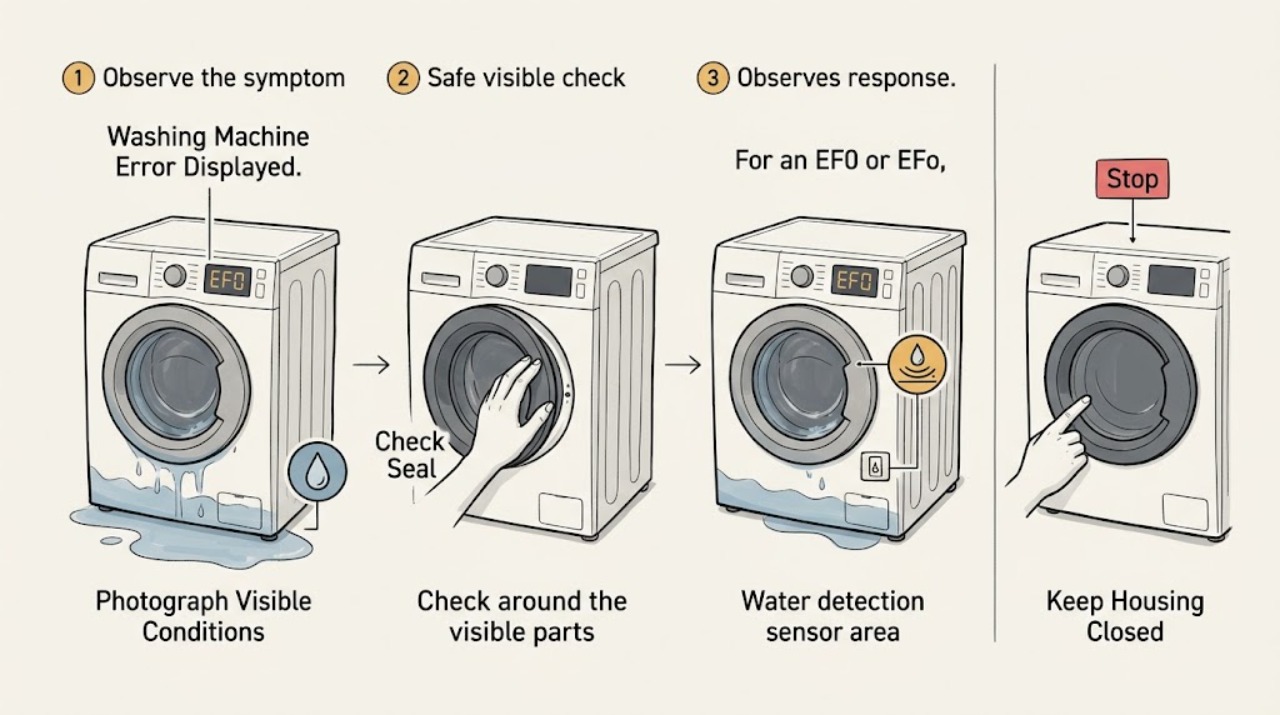
Work through in order
Diagnostic checks
Use only checks that match the exact appliance or system and its official guide.
-
Check 1
Before resetting anything, photograph or write down the full display, every letter or digit, the number of beeps or flashes, the selected programme, and what the drum and water are doing.
Expected result: You have a stable code or symbol, or the display only shows a vague light pattern that is not identified in the manual.
Next step: Search the AEG manual for that exact model and code, then follow only the checks listed for it. If the display is unreadable or the code is absent from the manual, use the service branch rather than guessing.
Stop if: Stop immediately for visible water, smoke, burning odour, sparking, a hot plug, a damaged cord, or repeated breaker/RCD operation; do not continue the diagnostic cycle.
Why this matters
Why: An exact code narrows the relevant AEG guidance; a vague pattern cannot safely identify a component. A code that disappears after power is removed may still be important if it returns.
-
Check 2
With the programme stopped, inspect only the visible door seal, inlet hose connections and accessible floor area for water. Do not pull the washer forward or remove panels to look behind it.
Expected result: There is no leak, or there is water at the door, hose, filter area or floor and the display shows EF0, EFo or EF3 or a similar warning.
Next step: For any visible leak, stop using the machine, close the water supply if safely accessible, disconnect power if safe, and arrange service. Do not restart merely to see whether the code clears.
Stop if: Do not tip or dismantle a heavy appliance, reach into a wet electrical area, remove a jammed internal filter by force, or bypass a leak or door safety device.
Why this matters
Why: AEG says EF0-family warnings can be associated with leakage, while laundry caught at the seal, a hose leak or a damaged filter can let water escape. A visible leak makes continued operation unsafe and does not prove which internal component is at fault.
-
Check 3
For an EF0 or EFo warning with no visible leak, check the detergent amount and visible dispenser condition, and consider whether the load is severely uneven. Use the model manual for cleaning instructions.
Expected result: There is excessive foam, a dirty dispenser, or a very uneven load; alternatively, these conditions are not present or an EF3 warning indicates leak detection.
Next step: If foam is present, switch off and let it subside as the AEG guidance and manual permit, then use less detergent on a later cycle. Correct only an obvious load or dispenser issue; if the warning returns, stop and arrange technician inspection.
Stop if: Do not run repeated cycles to flush away foam, use an unverified chemical treatment, or continue if water is leaking or the warning returns.
Why this matters
Why: AEG lists over-foaming and an unbalanced load as possible EF0 causes, and says a dirty dispenser can let water flow out. EF3 is associated with detected leakage and should be treated as a safety branch rather than a detergent-only problem.
-
Check 4
If the code is E90, E91, E92, E93 or E94, switch the washer off and perform the reset specified by AEG for that code and model; reconnect it only when the appliance and area are dry and safe.
Expected result: The code clears and a normal programme completes, or the same code returns after the reset.
Next step: If the code returns, keep the washer disconnected and contact an authorised service centre with the exact code; do not open the control area or attempt board-level repair.
Stop if: Do not perform live electrical tests, remove the control panel, bridge connectors, or keep restarting an appliance with a recurring electronic code.
Why this matters
Why: AEG describes this code group as configuration or communication problems with electronic parts. A reset can clear a transient control state, but it does not identify or repair an electronic failure.
-
Check 5
For any other code, compare the exact display with the AEG manual and check only the associated user-accessible condition, such as a fully closed door, water supply, drain path or accessible filter, when the manual instructs it.
Expected result: The specified user check resolves the code, or the code remains, returns, or points to a motor, heater, sensor, door lock or electronic fault.
Next step: If resolved, run only the model-approved verification cycle while watching for the same warning. If unresolved or recurring, leave the washer disconnected and arrange authorised service with the code and checks recorded.
Stop if: Do not substitute a part based only on a code, defeat the door lock, work inside the cabinet, or restart after a safety warning.
Why this matters
Why: AEG's no-start guidance says an error code indicates a specific issue and should be interpreted through the appliance troubleshooting guide. A persistent or internal-fault code needs professional diagnosis; the display alone is not proof that a particular part should be replaced.
Use your observations
Decision map
Find the observation that best matches what you see, then follow the next safe action.
-
PATH 01Next step
What you see
Water is present around the washer, the door seal or hose is leaking, or EF3 is shown.
Do this next
Stop the programme, close the water supply and disconnect power only if safe; do not run another cycle, and arrange technician inspection.
-
PATH 02Next step
What you see
There is foam, a dirty dispenser or a clearly uneven load, but no visible leak.
Do this next
Correct the user-accessible cause according to the manual, allow foam to subside if present, and stop for service if the warning returns.
-
PATH 03Next step
What you see
The display matches the E90, E91, E92, E93 or E94 family.
Do this next
Perform the AEG-specified reset once; if the code remains or returns, keep the washer disconnected and use authorised service for the electronic diagnosis.
-
PATH 04Next step
What you see
The model manual gives a safe external check for the displayed code and no safety symptom is present.
Do this next
Perform that check once, then verify the result only as the manual allows. A recurring code is a service case.
-
PATH 05Next step
What you see
The display is not covered by the exact manual, the code returns after its reset, or it points to an internal component.
Do this next
Stop at the user-accessible boundary, preserve the code and appliance details, and arrange authorised service.
Helpful context
Understand the symptom
An error code is a decision point, not a part diagnosis
The exact code, beeps or flashing lights matter more than the word ‘error’. AEG's support guidance uses the model manual and product-specific troubleshooting pages to interpret the display. Write down the code before switching the appliance off, because a reset can remove useful evidence.
Separate harmless reminders from fault warnings
Some messages may describe a setting or maintenance task, while others stop the cycle because the machine detects a water, door, motor, heating or electronic problem. Without the exact model and code, do not infer which component has failed or order a part from the display alone.
Protect against water and electrical hazards
If water is visible, a hose or door seal is leaking, the machine smells burnt, sparks, or repeatedly trips a protective device, stop the cycle and do not restart it. Disconnect power and water only if you can do so safely; do not open the cabinet or bypass a door, leak or electrical safety system.
Only after diagnosis
Potential parts
- washing machine door seal or latch
Consider this category only if the exact code guidance and visible inspection show a door-seal leak or the machine cannot prove the door is closed; a code alone does not establish that this part has failed.
Confirm the exact AEG model and manufacturer fit information before any replacement; do not bypass the door lock. - washing machine inlet or drain hose and filter component
Consider this category only when the manual-directed external check finds a damaged hose or accessible filter component associated with the displayed water or drain warning.
Use the exact model identification and manual to confirm the correct component and whether the task is user-serviceable; isolate water and power safely first. - washing machine electronic control or sensor component
This is a service-diagnosis category only for a recurring electronic or sensor-related code such as the E90-family after the documented reset; the display does not identify a specific part.
Do not order or install an internal electronic component from the error code alone; an authorised technician must confirm the fault and model fit.
When checks do not resolve it
Need a professional?
Call an authorised appliance service centre when an error returns after the model-directed user check or reset, the code is not covered by the exact manual, E90 through E94 persists, EF0 or EF3 returns, or the code indicates an internal component. Stop immediately for a visible leak, smoke, burning odour, sparking, abnormal heat, a damaged cord or repeated power trips; disconnect power and water only if safe and do not use the washer until it is checked.
Safety scope: The reader should not open the cabinet, perform live electrical tests, bridge connectors, bypass door or leak protection, tip the appliance, or continue using it after water leakage, smoke, burning odour, sparking or repeated power trips.
Common questions
FAQ
What should I do first when my AEG washing machine shows an error?
Record the complete code or flashing pattern and what the washer was doing, then use the manual for that exact model. Do not choose a replacement part from a generic code list.
What do AEG E90, E91, E92, E93 and E94 codes mean?
AEG describes this family as configuration or communication problems with electronic parts. Perform the specified reset once; if the code remains or returns, keep the washer disconnected and arrange authorised service.
What can cause an AEG EF0 or EFo warning?
AEG lists possible water leakage, excess foam and an unbalanced load. Check only the user-accessible causes named in the manual; any visible leak, EF3 warning or recurring message requires stopping the machine and arranging service.
Can I keep using the washer if the error disappears after a reset?
Only perform the model-approved verification described in the manual and watch for a repeat. A recurring code, water leak or safety symptom means stop using the washer and seek professional help.
Read the exact guide
Official sources
- Washing machine displays error message E90, E91, E92, E93 or E94AEG Support · AEG code-specific guidance for the E90 through E94 display family.
- Washing machine displays error message EF0, EFo, EF3 or emits 15 beeps / 15 flashesAEG Support · AEG code-specific guidance for EF0, EFo and EF3 warnings, including leak, foam and load-related checks.
- Washing Machine Not Working or Not Turning On – Troubleshooting GuideAEG Support · AEG guidance for a washing machine that does not respond, has a blank display, fails to start, or displays an error code.
Community feedback
Share a repair observation
Share a plain-text repair observation. Accepted observations are published automatically; this page may take a moment to update.