
On this page
Start here
Quick answer
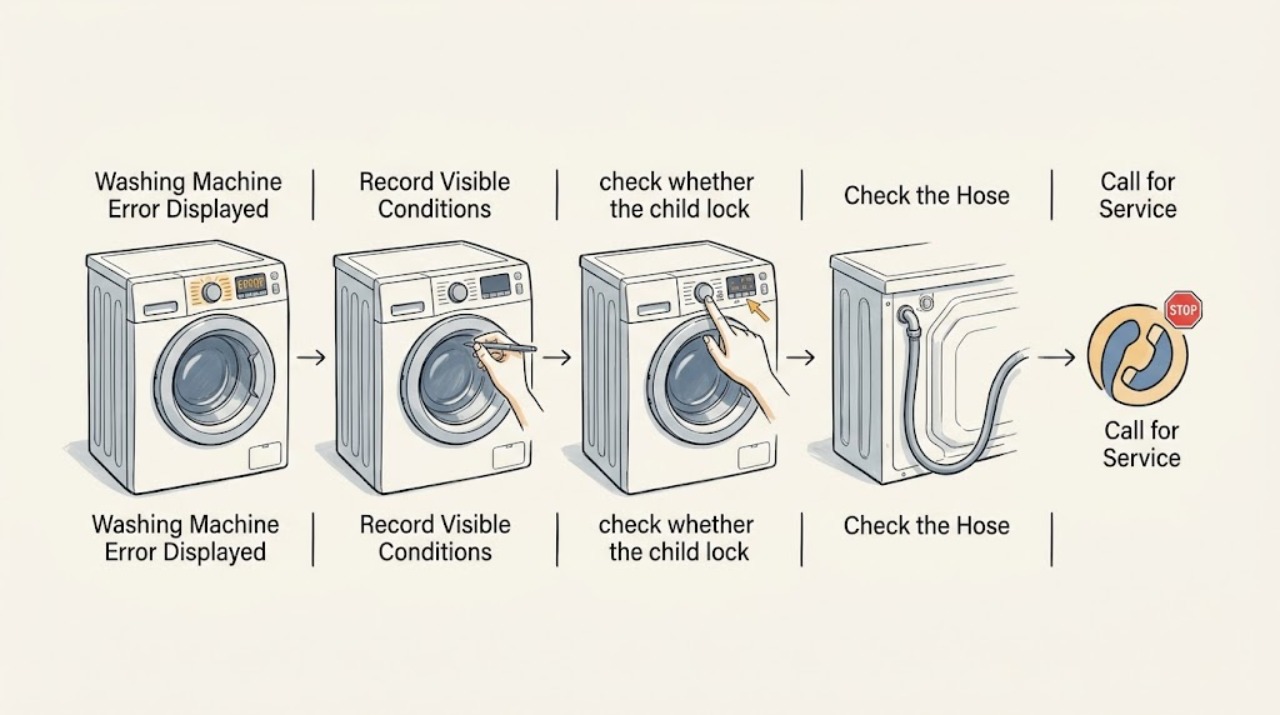
First write down the exact characters or symbol on the Beko washing machine display and check them against the manual for your model. A displayed padlock or no-water symbol may be a status or control-lock indication rather than a fault. On one Beko user-manual fault table, E5 points to a possible clogged pump filter, E8 to a water-intake problem, E17 to excess foam, E18 to an unbalanced load, E12 to water detected in or under the machine, E27 to the drain path, and E29 to a supply or pressure protection state. These meanings are model-specific, so stop at the exact code and follow the matching branch rather than replacing a part from the code alone.
Work through in order
Diagnostic checks
Use only checks that match the exact appliance or system and its official guide.
-
Check 1
With the machine stopped, record the exact display message or symbol and identify the appliance model from its rating label or manual.
Expected result: The display is either a status symbol such as a padlock, door lock, or no-water indicator, or a fault-style code such as E5, E8, E17, E18, E27, or E29.
Next step: If it is a symbol, follow the control/status branch below. If it is a code, open the manual for that model and continue with the matching drain, fill, foam, balance, leak, or supply check; do not order a part from the code alone.
Why this matters
Why: Beko uses different display symbols and model-specific fault tables; an exact code is more useful than a general report that an error is displayed.
-
Check 2
If a padlock or blinking-control indication is shown, check whether the child lock is active and use the model manual's child-lock release procedure; on models using the documented button combination, hold the first and second auxiliary-function buttons together for three seconds.
Expected result: The lock symbol or blinking control lights disappear and the program selector or buttons accept a change, or the controls remain locked.
Next step: If the controls unlock, run one short empty test cycle. If they remain locked or the same message returns, stop repeating button combinations and use the model manual or an authorized service agent.
Why this matters
Why: A lock indication can be a control setting rather than a failed component, and Beko notes that the button configuration can vary by model.
-
Check 3
For E5, E27, or a no-drain symptom, turn the machine off and unplug it, wait for hot water to cool, then inspect the accessible pump-filter area and drain hose for debris, a kink, or trapped water. Do not remove a pump filter while the appliance is running.
Expected result: Water drains through the intended drain point, the filter contains lint or a small foreign object, or the hose is restricted; alternatively, the path is clear but the machine still cannot drain.
Next step: If a blockage is found, clean and refit the filter and straighten the hose, then try one spin or short cycle. If the path is clear, water leaks, or the code returns, stop and call an authorized service agent rather than opening the pump or control area.
Why this matters
Why: The Beko fault table associates E5 with a possibly clogged pump filter and E27 with the drain path. Hot residual water and trapped water make this a check to perform only after power is disconnected and the water has cooled.
-
Check 4
For E8 or a no-water indication, verify that the household water taps are open, there is no known outage, and the inlet hose is connected without a fold; also check that the loading door or front cover is fully closed and locked.
Expected result: Water is available and the hose is open, the door-lock indication appears and the machine fills on a retry, or the machine still does not take in water.
Next step: If the machine fills after the external checks, monitor the complete short cycle. If water is available but E8 returns or the door cannot lock, stop the test and arrange authorized service.
Why this matters
Why: The Beko manual connects E8 with failure to take in water and directs checks of the taps, water supply, inlet-hose condition, filter, and door/cover lock.
-
Check 5
For E17 or E18, inspect the load and detergent result: redistribute a tangled or very small load, use only the detergent amount specified for the load, and run the appropriate short or spin program without adding more detergent.
Expected result: Excess suds are visible, the load is concentrated on one side, the drum spins after redistribution, or the same code returns with a balanced load and appropriate detergent.
Next step: If the code clears, use the recommended detergent quantity on future loads. If it returns with a balanced load or the machine cannot spin, stop and call service rather than forcing a higher-speed cycle.
Why this matters
Why: The Beko table associates E17 with excess foam and E18 with an imbalance that prevents the spin cycle from starting; these observations distinguish a load or detergent condition from a persistent machine fault.
-
Check 6
For E12, E29, an unexplained stop, or visible water under the machine, cancel the program using the model's normal selector procedure, unplug the appliance if it is safe to do so, look for water at the floor and hose connections, and close the water valves if a hose is leaking.
Expected result: There is no water and a short cycle completes, or water remains under the machine, a hose leaks, or the code returns after the restart.
Next step: If the area is dry and a single short test is normal, monitor the appliance. If water, a burning smell, electrical tripping, or a repeated E12/E29/SC condition is present, stop using the machine and contact an authorized service agent.
Why this matters
Why: The Beko manual describes E12 as possible water inside or under the product and E29 as a self-protection response to a supply problem such as line voltage or water pressure; a leak or repeated protection state is not a part-identification shortcut.
Use your observations
Decision map
Find the observation that best matches what you see, then follow the next safe action.
-
PATH 01Safety boundary
What you see
The display shows a padlock, door-lock, no-water, or blinking-control indication rather than an alphanumeric fault code.
Do this next
Use the display-symbol and model-manual instructions, check the door, water supply, or child-lock state, and run only one short test after the indication clears.
Why this path and its safety boundary
Safety stop: Continue with the exact-code branch.
-
PATH 02Safety boundary
What you see
The code is E5 or E27, or water remains in the drum and the machine cannot drain.
Do this next
Use the cooled, unplugged filter and drain-hose check. Retry once after clearing an accessible blockage; call service if the path is clear or the code returns.
Why this path and its safety boundary
Safety stop: Continue with the fill, foam, balance, or supply branch that matches the displayed code.
-
PATH 03Safety boundary
What you see
The code is E8, E17, or E18.
Do this next
Check the external water supply and inlet hose for E8, or the load and detergent for E17/E18. Retry one short cycle only after the relevant condition is corrected.
Why this path and its safety boundary
Safety stop: Continue with the water/protection or unknown-code branch.
-
PATH 04Safety boundary
What you see
The code is not listed in the model manual, the display shows SC, or the same code returns after the documented external check.
Do this next
Stop using the machine and contact an authorized Beko service agent with the exact code, model, and observations.
Why this path and its safety boundary
Safety stop: A single cleared status condition can be monitored through one short cycle.
Helpful context
Understand the symptom
Identify what the display is showing
A short code, a padlock, a no-water icon, a door-lock icon, and a remaining-time display do not mean the same thing. Record the characters exactly, including a leading letter, and take a photo if the message disappears. Do not substitute a code from a similar-looking Beko model: the official manual for your model is the authority for the meaning and reset procedure.
Use the result of each check to choose the next branch
A display is useful only when it changes the next decision. Clear a simple control-lock or supply condition and retest once; if the same code returns, or if the machine leaks, smells hot, or trips power, stop troubleshooting and arrange authorized service.
When checks do not resolve it
Need a professional?
Use an authorized Beko service agent for a persistent or unknown display code, a leak, electrical symptom, failed door lock, or any repair requiring internal access.
Common questions
FAQ
Should I replace a part when my Beko washing machine displays an error?
No. First match the exact code and model to the manual and complete the relevant safe external check. A code can identify a condition such as restricted draining, low water intake, foam, or imbalance without proving that a particular component has failed.
Why does my Beko display show a padlock instead of a fault code?
A padlock commonly indicates that the child lock or door-lock state is active. Check the model manual's release procedure and confirm that the door is closed; the button combination and icon behavior can vary by model.
What should I do if the error returns after a reset?
Do not keep repeating resets. Record the exact code and what the machine did, then arrange authorized service if the code returns after the matching external check, especially if there is a leak, electrical symptom, failed door lock, or water left in the drum.
Read the exact guide
Official sources
- How to fix a washing machine that won’t start a programBeko · General Beko support guidance; model-specific control-lock procedures can differ.
- Symbols on the DisplayBeko · Display-symbol reference for the documented Beko washing-machine interface; icons can vary by model.
- Washing Machine User ManualBeko · Use the code meanings as an example for the documented model and confirm the exact table in the user's own model manual.
Community feedback
Share a repair observation
Share a plain-text repair observation. Accepted observations are published automatically; this page may take a moment to update.