
On this page
Start here
Quick answer
If an Amana washer is not spinning, first check whether the lid or door is fully latched, the control is unlocked, and the Start/Pause command was entered; then redistribute an overloaded load, confirm the cycle allows spin, and check for standing water or a kinked drain hose. If it still will not spin, the lid lock remains in fault, the pump cannot drain, the breaker trips, or you hear grinding/burning symptoms, stop and arrange qualified appliance service instead of opening the washer.
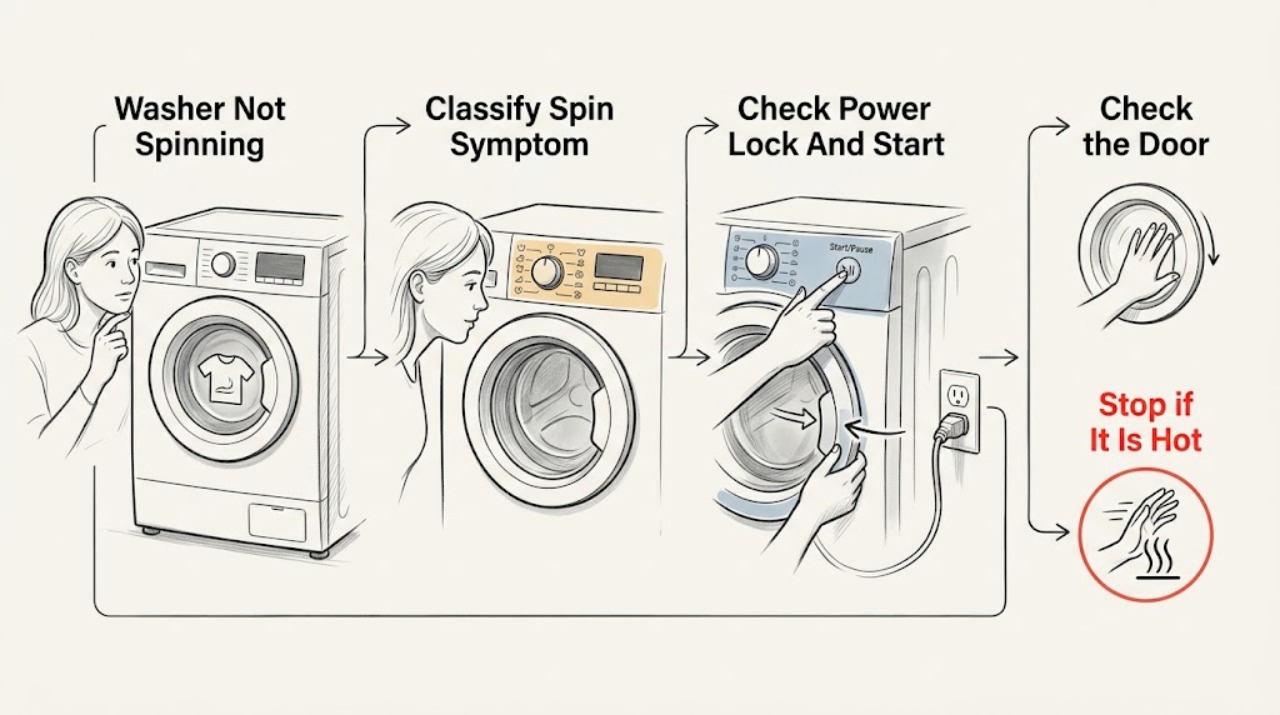
Work through in order
Diagnostic checks
Use only checks that match the exact appliance or system and its official guide.
-
Check 1
Note whether the basket never moves, spins briefly then stops, spins slowly, or completes with water/wet clothes. Read any flashing Spin, Lid Lock, Door, or error indicator before opening the lid/door.
Expected result: The washer is full of water, the lid/door-lock indicator flashes, the basket is unbalanced/noisy, or the basket is simply using a low-spin cycle.
Next step: Follow the matching branch below rather than repeatedly pressing Start. If no indicator or visible cause exists, continue with power, lock, load, and drain checks.
Stop if: Stop if the basket moves unexpectedly, the cabinet leaks, or there is smoke, burning odor, arcing, or exposed wiring.
Why this matters
Why: Standing water points toward drain or hose installation; a lock indicator points toward the interlock; noise/vibration points toward balance; a low-spin cycle may be operating as designed.
-
Check 2
Check that the washer has power, the control is not locked, the cycle selector is fully on a valid cycle, and the model's Start or Start/Pause control is pressed and held as instructed. If power was interrupted, use only the manual's reset sequence.
Expected result: The panel is blank, the Control Lock light is on, the cycle starts after the documented Start/Pause input, or the panel remains powered but will not accept the command.
Next step: Restore only an external switch/breaker condition when safe, unlock using the manual, and retry once. If the panel stays blank or the command remains unavailable, arrange service.
Stop if: Do not repeatedly reset a breaker, use an extension cord, remove covers, or test terminals.
Why this matters
Why: No power prevents spin; Control Lock blocks touch commands; some Amana models require a deliberate press-and-hold to engage a cycle. A powered but unresponsive panel may have a control fault.
-
Check 3
Close the top-load lid or front-load door firmly and inspect the accessible strike/edge for lint, detergent residue, or a garment caught in the seal. Do not press the lock mechanism by hand while the washer is powered.
Expected result: The lock indicator clears and the washer enters spin, or the lid/door appears closed but remains unlocked or shows a flashing lock indicator.
Next step: Remove only the visible obstruction and wipe the accessible strike/seal as directed, then close the lid/door and retry. If the lock still fails, arrange service for the interlock or control.
Stop if: Never bypass, tape, wedge, or manually defeat the lid/door lock.
Why this matters
Why: Amana states that the lid/door must be closed and latched for operation on relevant models; a visible obstruction or dirty strike can prevent the lock signal needed for spin.
-
Check 4
Pause only when the manual permits it, then redistribute tightly packed laundry evenly around the basket. Check whether Low Spin, No Spin, Delicate, Hand Wash, or a bulky-item cycle was selected; use the recommended cycle for the load.
Expected result: The load is tightly packed, a single bulky item is present, the washer is shaking/walking, or a low/no-spin setting is selected.
Next step: Remove or redistribute items, level the washer only as the manual describes, and select Drain & Spin or the correct high-spin cycle when appropriate. If the basket remains unstable or will not spin empty, arrange service.
Stop if: Stop if the washer walks violently, the tub strikes the cabinet, or leveling would require lifting or dismantling the appliance.
Why this matters
Why: Amana explains that unbalanced or oversized loads can reduce or stop spin, while low-spin settings intentionally leave more water in the load.
-
Check 5
If water remains in the tub, inspect the visible drain hose for a kink, clog, poor placement, or a taped/sealed standpipe connection. Consider whether excess non-HE detergent or too much detergent created suds; follow the manual before cleaning any pump filter.
Expected result: Water stands in the tub, the hose is visibly restricted, a drain/spin indicator is active, or the tub is empty but the basket still will not spin.
Next step: Correct only a visible hose placement problem, use the model's Drain & Spin procedure, and use the recommended detergent amount/type. If water will not drain or a pump filter must be opened, disconnect power and follow the exact manual or arrange service.
Stop if: Do not reach into standing water with power connected, open a pump filter without controlling the water, or pour more detergent into a sudsy load.
Why this matters
Why: The washer may inhibit high-speed spin until water leaves. Amana links standing water to drain-hose installation and links excess suds to slow or stopped draining/spinning.
-
Check 6
Record the complete Amana model number, top-load/front-load type, display and lock indicators, water level, selected cycle/spin setting, load behavior, drain-hose observations, recent power event, and whether the basket spins empty.
Expected result: The washer still will not spin after the visible checks, the lid/door lock or drain fault returns, the breaker trips, or abnormal noise/heat/smell is present.
Next step: Arrange Amana or qualified appliance service with the record and owner manual. Keep the washer off if it is leaking, electrically unsafe, or mechanically violent.
Stop if: Stop using the washer for smoke, burning odor, arcing, damaged cord, exposed wiring, major leak, or repeated electrical trips.
Why this matters
Why: The remaining possibilities include a lid/door interlock, drain pump, drive motor, belt/coupling, suspension, control, wiring, or other internal fault requiring model-specific diagnosis.
Use your observations
Decision map
Find the observation that best matches what you see, then follow the next safe action.
-
PATH 01Next step
What you see
The panel is blank, Control Lock is on, or Start/Pause does not engage the cycle.
Do this next
Check external power once and unlock/start using the model manual. If the panel remains blank or unresponsive, arrange service.
Why this path and its safety boundary
Why it matters: The washer may lack supply power, have locked controls, or have a control/input fault.
-
PATH 02Next step
What you see
The lid/door appears closed but its lock indicator flashes or the washer will not enter spin.
Do this next
Clear only visible residue or clothing, close the lid/door, and retry once. Do not bypass the lock; arrange service if it remains in fault.
Why this path and its safety boundary
Why it matters: The interlock has not confirmed a safe closed condition, possibly because of an obstruction, residue, strike, latch, or control fault.
-
PATH 03Next step
What you see
The washer shakes, walks, has a single bulky item, is tightly packed, or uses a low/no-spin cycle.
Do this next
Redistribute the load, use the correct bulky-item cycle or documented Drain & Spin, and verify stable leveling without lifting the appliance.
Why this path and its safety boundary
Why it matters: The machine may reduce or stop spin to control imbalance, or the selected cycle may intentionally use a slower speed.
-
PATH 04Next step
What you see
Water remains in the tub, the drain/spin light is active, the hose is kinked/incorrectly placed, or the load is very sudsy.
Do this next
Correct a visible hose issue, use the model's Drain & Spin and detergent guidance, and arrange service for a persistent drain or pump fault.
Why this path and its safety boundary
Why it matters: The washer may be unable to reach spin because it has not drained or because suds are interfering with the drain/spin process.
-
PATH 05Next step
What you see
A front-load washer pauses or tumbles without reaching final spin, while the door is closed and no water-level fault is visible.
Do this next
Allow the documented pause, check load balance and spin setting, and follow the front-load manual. Escalate if the basket never reaches spin or the error returns.
Why this path and its safety boundary
Why it matters: The load may be redistributing, the cycle may be using a slower spin, or an error may be preventing the final ramp-up.
-
PATH 06Next step
What you see
The washer will not spin empty after the visible checks, or there is grinding, burning smell, a major leak, repeated power trip, or severe vibration.
Do this next
Stop operating the washer and arrange qualified Amana/appliance service with the model number and symptom record.
Why this path and its safety boundary
Why it matters: An internal drive, suspension, pump, control, wiring, or safety fault is more likely than a load-setting issue.
Helpful context
Understand the symptom
First separate a washer that never enters spin from one that spins slowly or ends with wet clothes. A no-spin cycle can be a normal response to an open lid/door, a control lock, an unbalanced load, a low/no-spin setting, excess suds, or water that has not drained. Amana's guidance also differs between top-load and front-load models, so use the model manual when the visible checks do not identify the branch.
Keep the first checks user-accessible: display and lock indicators, lid/door closure, Start/Pause, load distribution, cycle spin setting, standing water, and the visible drain hose. Do not reach into a moving basket, bypass the lid or door lock, remove a pump cover while water is present, or open the cabinet to test the motor or wiring.
If the washer stopped during spin, correct only the visible cause and run the model's documented Drain & Spin or restart sequence once. A repeated lock fault, drain failure, severe vibration, electrical trip, burning smell, or grinding noise needs qualified service. Keep hands clear of the basket and disconnect power before any user-authorized cleaning described in the manual.
Safety boundary
Stop conditions
- Do not bypass the lid or door lock, reach into a moving basket, or remove covers to test the motor, pump, belt, or wiring.
- Do not open a pump filter or drain connection with water present unless the exact model manual provides a safe, power-isolated procedure.
- Do not repeatedly reset a breaker that trips again, and do not use an extension cord or altered fuse arrangement.
- Stop immediately for smoke, burning odor, arcing, damaged cord or wiring, major leaking, violent walking, or the tub striking the cabinet.
- Use the model manual for cycle, lock, drain, detergent, and reset instructions; do not generalize a sequence from another Amana washer.
When checks do not resolve it
Need a professional?
Arrange Amana or qualified appliance service when the washer will not spin empty after the visible checks, the lid/door lock or drain fault persists, water cannot be removed, the breaker trips again, or there is severe vibration, grinding, burning odor, leaking, or electrical damage.
Have this ready
- Complete Amana model number, top-load/front-load type, display and lock indicators, cycle and spin setting, load and balance observations, water level, drain-hose result, recent power event, and whether the basket spins empty.
Common questions
FAQ
Why is my Amana washer not spinning?
Check the lid/door lock, Control Lock, Start/Pause input, load balance, spin setting, standing water, drain hose, and detergent/suds. The correct branch depends on whether the basket is empty, wet, noisy, or locked.
Can an unbalanced load stop an Amana washer from spinning?
Yes. An oversized, tightly packed, or single bulky load can cause vibration and reduced or stopped spin. Redistribute the items and use the recommended cycle for bulky laundry.
Why is there water left in my Amana washer after the spin cycle?
Check the visible drain hose for kinks, clogging, or incorrect placement, and use the model's Drain & Spin guidance. If the pump cannot drain or a filter must be opened, disconnect power and follow the manual or arrange service.
Can the lid lock or Control Lock prevent an Amana washer from spinning?
Yes. Control Lock prevents touch commands, and the lid/door must be closed and latched on relevant models before the washer can operate or spin. Do not bypass the lock; arrange service if it remains in fault.
When should I call for Amana washer service?
Call when the washer will not spin empty after visible checks, the lock or drain fault returns, the breaker trips, water remains, or there is violent vibration, grinding, burning odor, smoke, leaking, or damaged wiring.
Read the exact guide
Official sources
- Not Spinning - WasherAmana Product Help · Amana's top-load guidance covers low/no-spin settings, bulky loads, Add a Garment behavior, drain-hose installation, and leveling.
- Amana Owner's ManualAmana · This official manual is model-specific, not a universal Amana procedure. Its troubleshooting covers door closure, control lock, load balance, HE detergent/suds, drain hose, spin settings, and persistent-fault escalation.
- Spin Light Flashing - Product HelpAmana Product Help · Amana describes how an uneven load can create noise, vibration, reduced spin, and a flashing spin indication, and that significant imbalance can stop spinning.
- Why Your Washer Won't SpinAmana · Amana's official article covers overloaded/unbalanced loads, drain-hose installation, low/no-spin settings, power interruptions, lid-lock indicators, detergent/suds, and professional repair escalation.
- Not Starting - WasherAmana Product Help · Amana explains that Control Lock prevents touch commands, the lid must be closed/latching for operation on relevant models, and some models require pressing and holding Start.
Community feedback
Share a repair observation
Share a plain-text repair observation. Accepted observations are published automatically; this page may take a moment to update.