
On this page
Start here
Quick answer
If a Bauknecht washing machine is not spinning, first check that the selected program includes a spin phase and that the spin speed has not been set to zero. Make sure the door is closed and acknowledged, the machine has drained, and the load is not a single bulky or heavily absorbent item; redistribute the laundry and try one suitable spin program. Check that the washer stands firmly and level, but do not open the cabinet or reach into the pump or drive. If the spin still will not run, the machine leaves water in the drum, vibrates heavily, shows a recurring warning, or trips power, stop using it and arrange qualified appliance service.
Before you begin
Safety first
- Do not open panels, test live pump or motor circuits, remove the door lock, alter suspension, bypass the interlock, or continue operating with leakage, smoke, sparking, or repeated power trips. Close the water tap and disconnect power only when safe and appropriate.
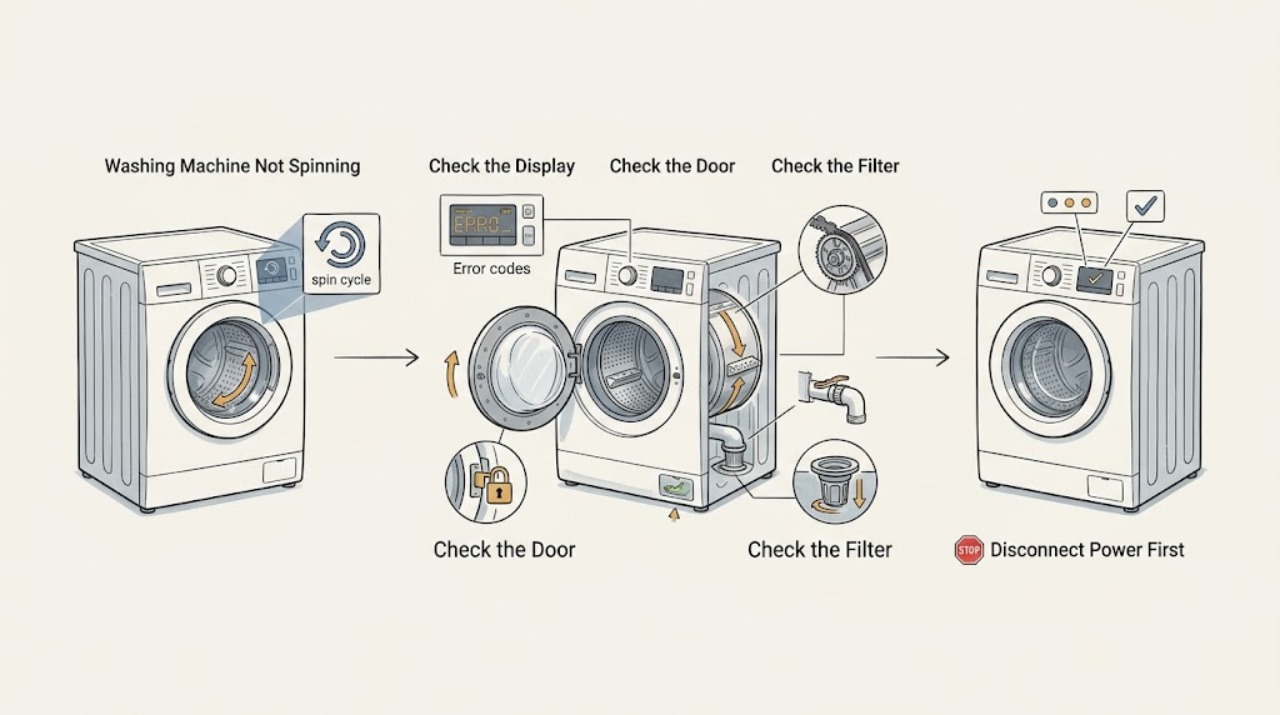
Work through in order
Diagnostic checks
Use only checks that match the exact appliance or system and its official guide.
-
Check 1
Read the selected program and spin-speed display. Confirm that the program includes spinning, the spin speed is not set to zero, and the washer is not in a rinse-hold or other mode that intentionally delays the final spin; use the exact model guide for the control sequence.
Expected result: A no-spin or zero-speed setting is selected, a hold or special program is active, or a normal spin-capable program and speed are already selected.
Next step: Select a suitable spin or rinse-and-spin program and make one supervised start attempt. If the controls will not change or the display shows a recurring fault, stop and arrange service.
Stop if: Stop if the control panel is damaged, wet, unresponsive, or would require opening the console or bypassing a safety control.
Why this matters
Why: A control setting can make a mechanically healthy washer appear not to spin; a valid spin setting shifts attention to load balance, drainage, door acknowledgment, and stability.
-
Check 2
With the washer stopped, inspect the load through the door and redistribute a single bulky item or a few heavy absorbent items so that the drum contains a mixed, evenly spread load. Do not exceed the model's stated capacity and do not reach into a moving drum.
Expected result: The load is a single heavy or absorbent item, tightly gathered on one side, very small, or already reasonably distributed.
Next step: Close the door and run one suitable spin or rinse-and-spin program. If the washer repeatedly tries to balance, reduces speed, or stops with a balanced load, continue to the drain and stability checks.
Stop if: Stop for a locked door, water that cannot be safely drained, a damaged seal or glass, or any need to force the door or drum.
Why this matters
Why: Bauknecht says an unbalanced load can prevent the final spin to avoid excessive vibration; redistribution can restore spinning without indicating a failed motor.
-
Check 3
Check whether water remains in the drum and whether a pump or water warning is displayed. If the exact model manual describes user cleaning, switch off and unplug the washer, close the tap, and follow that manual's filter procedure with a suitable container; otherwise do not open the filter or pump area.
Expected result: Water remains, a pump warning is lit, the accessible drain hose is visibly kinked, or the drum is empty and the drain path appears normal.
Next step: Correct only an obvious, documented hose or filter condition and check for leaks before one supervised spin attempt. If water remains or the pump warning returns, close the tap and arrange service.
Stop if: Stop for hot water, flooding, a leaking filter cover, an inaccessible pump, a blocked hose that needs disconnection, or any need to remove panels or test a pump electrically.
Why this matters
Why: The washer may inhibit spinning until water is pumped out; a blocked filter or hose can explain both standing water and a skipped spin, while a drained drum shifts attention to balance, door, and drive checks.
-
Check 4
Close the door gently and start one suitable spin program while observing whether the door is acknowledged and the Start/Pause indicator changes. Do not press, wedge, or bypass the door lock.
Expected result: The door latches and the program proceeds, or the door remains unacknowledged and the cycle refuses to start or spin.
Next step: If the door is acknowledged, continue observing the spin. If it is not acknowledged, switch the washer off and arrange service for the door, latch, interlock, or related wiring.
Stop if: Stop for cracked glass, a torn seal, a bent hinge or latch, exposed wiring, or any attempt to defeat the interlock.
Why this matters
Why: A door interlock or alignment problem can stop the washer from entering the spin phase even when the load and program are correct.
-
Check 5
With the washer empty and stopped, check that it stands firmly on a level floor, all accessible feet are seated, and it is not pressed tightly against furniture or a wall. Do not tilt or move a loaded appliance by yourself.
Expected result: The washer rocks, a foot is not seated, the cabinet has shifted, or the machine is stable and aligned.
Next step: If the model instructions describe safe foot adjustment, correct only the accessible empty-machine condition and make one supervised spin attempt. If the machine remains unstable or the door alignment is affected, arrange service.
Stop if: Stop if the appliance must be lifted, pulled from cabinetry, disconnected, or tilted, or if vibration is violent, the cabinet is damaged, or the drum rubs.
Why this matters
Why: An uneven machine can create excessive vibration and cause the washer to reduce or withhold the final spin; stability does not rule out an internal fault if the drum remains still.
-
Check 6
Arrange qualified appliance service when a valid spin program, balanced load, closed door, drained drum, and stable installation still do not produce spinning, or when a warning, leak, repeated vibration, or power trip returns. Provide the model identifier and the exact point at which the cycle stops.
Expected result: The drum remains still or repeatedly aborts despite the external checks, or the washer has abnormal noise, an error, standing water, leakage, or electrical symptoms.
Next step: Keep the washer switched off and close the water tap if leakage is present until it is assessed. Do not run repeated test cycles or open the cabinet.
Stop if: The professional boundary begins before removing panels, testing motor or pump wiring, opening the door lock, or bypassing any safety control.
Why this matters
Why: The remaining possibilities include the door interlock, pump or drain system, motor or drive, suspension, sensor, wiring, or control board; the no-spin symptom alone cannot identify a safe replacement.
Use your observations
Decision map
Find the observation that best matches what you see, then follow the next safe action.
-
PATH 01Next step
What you see
The selected program omits spinning, the spin speed is zero, or a hold setting is active.
Do this next
Arrange qualified service and follow the exact model guidance.
Why this path and its safety boundary
Why it matters: Select a suitable spin-capable program and speed using the model instructions, then make one supervised test. Escalate if the controls will not change.
-
PATH 02Next step
What you see
A single bulky or absorbent item, a very small load, or laundry gathered on one side is present.
Do this next
Arrange qualified service and follow the exact model guidance.
Why this path and its safety boundary
Why it matters: Redistribute the load and run one suitable spin program. Repeated aborts with a balanced load require diagnosis rather than more laundry.
-
PATH 03Next step
What you see
Water remains in the drum, a pump warning is shown, or the drain hose or filter path is blocked.
Do this next
Arrange qualified service and follow the exact model guidance.
Why this path and its safety boundary
Why it matters: Use only the model-documented unplugged filter or hose procedure if safe and accessible; otherwise close the tap and arrange service. Do not spin with a leak or unresolved standing water.
-
PATH 04Next step
What you see
The door does not latch or the machine continues to report it open.
Do this next
Arrange qualified service and follow the exact model guidance.
Why this path and its safety boundary
Why it matters: Keep the washer out of service and have the door, latch, interlock, and alignment checked. Never bypass the lock.
-
PATH 05Next step
What you see
The washer rocks, is uneven, or moves violently during an attempted spin.
Do this next
Arrange qualified service and follow the exact model guidance.
Why this path and its safety boundary
Why it matters: Stop the cycle. Correct only a safe, empty-machine leveling condition described by the manual; escalate for persistent movement, cabinet damage, or inaccessible feet.
-
PATH 06Next step
What you see
Program, load, drain, door, and stability checks pass but the drum still will not spin or the failure recurs.
Do this next
Arrange qualified service and follow the exact model guidance.
Why this path and its safety boundary
Why it matters: Keep the washer off and arrange qualified diagnosis of the drive, pump, interlock, sensors, wiring, suspension, and control system. Do not infer one part from the symptom alone.
Helpful context
Understand the symptom
A skipped spin is often a protection response
Bauknecht's troubleshooting guidance separates a disabled spin setting from a load that the washer cannot balance. One bulky towel, blanket, or very small absorbent load can keep the final spin from running or reduce its speed. Redistribute the load and use a suitable spin or rinse-and-spin program; do not force the drum or add water by hand.
Check drainage before blaming the motor
The machine may not spin while water remains because the drain path or pump condition has not been resolved. Look for a pump or water warning and follow the model manual's unplugged filter procedure only if it is intended for the user. If water remains, a hose is blocked, or the washer leaks, close the tap and arrange service rather than opening the cabinet.
Use vibration and door behavior as decision points
A door that is not acknowledged, a washer that rocks, or a heavy knock during attempted spinning points to a different path than a silent drum with a valid program. Check only the accessible door and floor conditions. Leave the interlock, wiring, motor, suspension, and control electronics to qualified service.
Safety boundary
Stop conditions
- Do not force, slam, wedge, or bypass the door or its interlock.
- Do not open the cabinet or test live pump, motor, sensor, or control wiring.
- Stop for standing water with a leak, flooding, a damaged hose or filter cover, smoke, sparking, burning odor, or repeated power trips.
- Do not tilt, lift, or pull a loaded or built-in washer to reach a hose, pump, or foot.
- Do not keep restarting a machine that repeatedly aborts spinning, vibrates violently, or shows a recurring warning.
Only after diagnosis
Potential parts
- washing-machine drain pump or water filter assembly
Only consider the drain assembly after water remains in the drum or a pump warning persists following the model's safe, user-accessible checks.
Confirm the exact model and have the blocked or failed component diagnosed before ordering; drain parts are not universal. - washing-machine door interlock or latch
Only consider the interlock or latch when the door closes naturally but the washer does not acknowledge it and therefore will not enter the spin phase.
This is a safety-critical, model-specific assembly and should be tested and fitted by a qualified technician. - washing-machine motor or drum drive component
Only consider the drive system after a valid program, balanced load, closed door, drained drum, and stable cabinet are confirmed but the drum remains still.
Do not select a motor or drive part from the symptom alone; exact model diagnosis and fitment confirmation are required. - washing-machine suspension or leveling hardware
Only consider suspension or related hardware when the washer remains unstable or vibrates excessively after a safe, empty-machine leveling check.
Have the cabinet, feet, suspension, and installation checked together before identifying a model-specific part. - washing-machine control board or speed-control component
Only consider control electronics after service testing confirms that the machine receives a valid spin command but does not drive the drum or repeatedly aborts without a balance or drain cause.
Control components require exact model matching and qualified electrical diagnosis; do not replace them as a first check.
When checks do not resolve it
Need a professional?
Arrange qualified appliance service when the spin setting, load balance, door, drain path, and stable installation are all checked but the washer still will not spin; when it leaves water in the drum, repeatedly aborts, vibrates violently, leaks, shows a recurring warning, or trips power. Keep the appliance off and close the water tap if a leak is present.
Safety scope: Do not open panels, test live pump or motor circuits, remove the door lock, alter suspension, bypass the interlock, or continue operating with leakage, smoke, sparking, or repeated power trips. Close the water tap and disconnect power only when safe and appropriate.
Common questions
FAQ
Why is my Bauknecht washing machine not spinning?
Check that the program includes spin and the speed is not zero, then redistribute a bulky or uneven load. Also check that the door is acknowledged, water has drained, and the washer is stable.
Can one heavy item stop the spin cycle?
Yes. Bauknecht says an unbalanced load can prevent or reduce the final spin. Redistribute the load and try one suitable spin program rather than repeatedly adding items.
Why is my washer not spinning when water is still inside?
The washer may not enter spin until water is pumped out. Check for a pump warning and follow the model manual's safe filter procedure only if it is intended for the user; escalate for leaks, blockages, or a recurring warning.
Could an unlevel Bauknecht washer prevent spinning?
An unstable or uneven washer can create excessive vibration and cause the spin to be reduced or withheld. Check firm floor contact with the machine empty, but do not lift or move a loaded appliance.
Should I replace the motor if the drum will not spin?
Not from this symptom alone. Program settings, load balance, drainage, the door interlock, stability, drive, sensors, wiring, and controls can produce similar behavior. Have the fault diagnosed before selecting a part.
Read the exact guide
Official sources
- TROUBLESHOOTINGBauknecht / Whirlpool group documentation · The opened manufacturer-hosted guide lists door closure, Start/Pause, drain and pump conditions, an uneven machine, unbalanced laundry, and low spin speed among relevant cycle and spin symptoms, and directs persistent errors to customer service.
- Finden Sie schnelle Lösungen und einfache zur Fehlerbehebung - BauknechtBauknecht · Bauknecht's troubleshooting hub provides product-group self-help and repair assistance when the fault is not resolved by safe checks.
- Warum schleudert die Waschmaschine nicht?Bauknecht · Bauknecht's official FAQ identifies a no-spin program, zero spin speed, load-capacity and load-balance conditions as reasons a washer may not spin, and recommends redistributing laundry and trying the spin program again.
Community feedback
Share a repair observation
Share a plain-text repair observation. Accepted observations are published automatically; this page may take a moment to update.