
On this page
Start here
Quick answer
An AEG washer that will not spin is commonly held back by a Rinse Hold or no-spin option, an uneven or unsuitable load, a blocked drain path, or installation problems such as transport bolts or an unstable floor. Check the selected program and load first, then safely check the drain filter and hose; if an empty-drum spin still fails, water remains, the machine leaks, or it repeatedly shows a fault, stop using it and arrange authorised service.
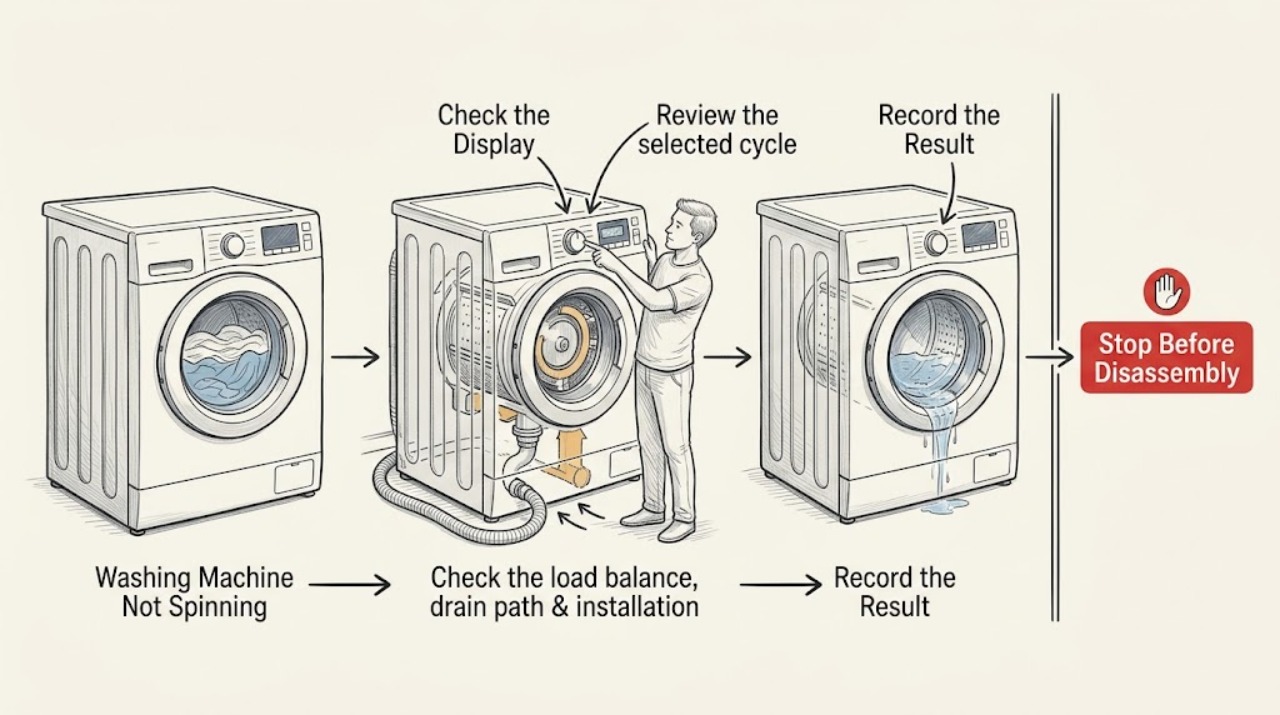
Work through in order
Diagnostic checks
Use only checks that match the exact appliance or system and its official guide.
-
Check 1
Note whether the drum never accelerates, whether the clothes are wet, whether water remains in the drum, whether the machine vibrates unusually, and whether a display fault such as EF5 appears.
Expected result: The washer has no spin, retained water, abnormal movement/noise, or a repeatable fault indication.
Next step: If there is a leak, burning smell, damaged cord, violent movement, or unsafe door condition, stop and use the service boundary. Otherwise continue with the program and load checks.
Why this matters
Why: Retained water makes the drain path the priority; a no-spin result with no water can be caused by a selected option, load condition, or installation issue; abnormal movement, noise, or a repeated code raises the need for service.
-
Check 2
Review the selected cycle and options for Rinse Hold, No Spin, or a cycle that intentionally omits the final spin. If the manual permits it for the current load, select the documented spin or drain-and-spin option.
Expected result: The Rinse Hold/no-spin option is active, or the chosen cycle is not intended to perform a final spin.
Next step: Run the documented final spin or drain-and-spin selection. If the option was not active or the washer still will not spin, continue to load and drain checks.
Why this matters
Why: The washer may be waiting for the user to choose the final drain/spin behavior rather than having a failed motor.
-
Check 3
Pause only through the normal controls, open the door when it unlocks safely, and redistribute the laundry evenly. Correct an overloaded drum, a very small load, or one bulky item by following the model's load guidance; do not force a locked door.
Expected result: The load is packed tightly, consists of one heavy/absorbent item, or is too small to balance; the washer spins after an even test load or empty drum.
Next step: Use an evenly distributed load within the model's limits. If an empty drum still will not spin, or the problem returns with ordinary balanced loads, stop troubleshooting and arrange service.
Why this matters
Why: The control may be withholding high-speed spin to prevent an imbalance. A successful empty or balanced-load test points away from an immediate drive failure.
-
Check 4
If the washer was recently installed or moved, verify from the model instructions that all transport bolts were removed. Check that the appliance stands level on all feet on a solid, stable floor and that it does not rock when idle.
Expected result: A transport bolt remains, the appliance rocks, or the floor/support is unstable; vibration improves after the installation issue is corrected by a qualified installer or according to the manual.
Next step: Correct only the installation issue described by the model instructions. If the washer is already correctly installed or still fails to spin afterward, continue to the drain check or service boundary.
Why this matters
Why: Transport restraints or an unstable/uneven installation can prevent a safe spin or trigger imbalance protection.
-
Check 5
If water remains or the washer cannot complete draining, switch it off and unplug it. Let hot water cool, use the model's drain procedure, then inspect the accessible drain filter for lint, coins, or buttons and check the drain hose for a kink or blockage. Refit the filter correctly before testing.
Expected result: The filter or hose is obstructed, or the washer drains after the obstruction is removed and the filter is correctly reinstalled.
Next step: Run the model-appropriate drain/spin test only after the filter is secure and there is no leak. If draining remains poor, water leaks, or the filter cannot be accessed safely, stop and request service.
Why this matters
Why: A restricted drain path can leave the washer unable to proceed to spin. A clean path that still leaves water suggests a pump, internal blockage, or electrical/control issue.
-
Check 6
After the option, load, installation, and safe drain checks, test the documented spin/drain-and-spin cycle with the drum empty, without bypassing a lock or safety control.
Expected result: The empty drum spins normally, or it still fails to spin, leaves water, makes abnormal noise, or repeats a fault.
Next step: For an empty failure or repeated fault, unplug the appliance and arrange authorised AEG service. Do not remove covers or test internal high-voltage parts.
Why this matters
Why: An empty successful test points to load distribution or installation; an empty failure indicates that further internal diagnosis is needed.
-
Check 7
Stop using the washer and disconnect it from power if it leaks, moves violently, emits an electrical or burning smell, has a damaged cord, keeps the door locked with water inside, or repeatedly fails after the safe checks.
Expected result: The unsafe condition or repeated no-spin failure persists.
Next step: Keep the appliance disconnected, protect the area from water, and contact an authorised AEG appliance service provider. Provide the model/PNC, display code, whether water remains, and what the empty test did.
Why this matters
Why: The issue may involve a pump, motor/drive, door interlock, control, internal leak protection, or another component that requires qualified diagnosis.
Use your observations
Decision map
Find the observation that best matches what you see, then follow the next safe action.
-
PATH 01Next step
What you see
Rinse Hold, No Spin, or an intentionally no-final-spin cycle is selected
Do this next
Use the documented final spin or drain-and-spin control for that cycle; if it still fails, check load and drain conditions.
-
PATH 02Next step
What you see
The drum contains one bulky item, a very small load, or an overloaded/uneven load
Do this next
Redistribute or adjust the load within the model instructions and compare with an empty-drum test.
-
PATH 03Next step
What you see
The appliance was recently installed/moved or rocks on its floor
Do this next
Check transport-bolt removal and level, stable support using the model installation guidance; persistent vibration needs service.
-
PATH 04Next step
What you see
Water remains in the drum or draining is slow
Do this next
Unplug, let hot water cool, and check the accessible filter and hose using the model drain procedure; a clear path with persistent poor draining needs service.
-
PATH 05Next step
What you see
The empty drum still will not spin, or a fault code repeats
Do this next
Stop testing, disconnect power, record the code and symptoms, and arrange authorised service for internal diagnosis.
-
PATH 06Next step
What you see
There is a leak, violent movement, electrical smell, damaged cable, or a locked door with water inside
Do this next
Do not continue or bypass the safety system; disconnect power if safe and use the service boundary.
Helpful context
Understand the symptom
Start with the symptom
A non-spinning AEG washer may leave clothes wet, leave water in the drum, stop after rinsing, or display a fault such as EF5. Those observations change the next check: a dry, unlocked drum points toward a program or load decision, while retained water points toward draining before any filter inspection. Do not force the door open or reach into a moving or powered machine.
Use the result of an empty-drum test
Once the safe checks below are complete and the door can be opened normally, run the applicable spin or drain-and-spin program with the drum empty, following the model manual. A successful empty test makes load balance, overload, or installation more likely; failure with an empty drum makes a control, drive, drain, or other technical fault more likely and is a service boundary.
Only after diagnosis
Potential parts
- drain filter or drain pump assembly
Consider only if the filter and hose are clear and a qualified technician confirms a drain-pump or internal drain fault.
AEG parts vary by exact model and PNC; confirm the appliance identification and technician diagnosis before selecting a part. - drive belt or motor assembly
Consider only when the empty drum still fails to spin and a qualified technician confirms a drive-system fault.
Do not infer belt or motor failure from a no-spin symptom alone; fit is model/PNC-specific. - suspension or damper components
Consider only if excessive vibration persists after load and level checks and a technician confirms worn suspension parts.
Use only parts matched to the exact AEG model/PNC and confirmed by service diagnosis. - door lock or interlock assembly
Consider only if the door-safety state prevents the cycle and a qualified technician confirms an interlock fault.
Never bypass the door lock; exact fit and safety rating are model-specific.
When checks do not resolve it
Need a professional?
Call authorised AEG service when an empty-drum spin still fails, draining remains poor after the accessible filter/hose check, a fault code repeats, the appliance leaks or moves violently, there is an electrical smell or damaged cord, the door remains locked with water inside, or the problem returns with ordinary balanced loads.
Common questions
FAQ
Why is my AEG washer leaving clothes wet?
Check whether Rinse Hold/no-spin is selected, whether the load is too large, too small, or uneven, and whether water remains because the drain path is restricted. If an empty-drum spin still fails, arrange authorised service.
Can a blocked filter stop an AEG washing machine from spinning?
Yes. AEG's drain guidance lists a blocked filter or hose as a reason water may not drain; the washer may not proceed to spin until the path is clear. Unplug first, let hot water cool, and follow the model drain procedure.
What should I do if the AEG machine shakes and will not spin?
Check load distribution and, especially after installation or moving, check transport-bolt removal, level, and stable support. Persistent violent movement or failure with an empty drum is a service issue.
Should I keep using the washer if the door stays locked with water inside?
No. Do not force the door or bypass the lock. Disconnect power if safe, follow the model's safe drain guidance, and use authorised service if water remains or the lock condition recurs.
Read the exact guide
Official sources
- AEG Washing Machine Does Not Spin – Causes and SolutionsAEG · Official AEG support guidance for washing machines; use the exact model manual where controls or access differ.
- How to Drain a Washing Machine or Washer Dryer (Step-by-Step Guide)AEG · Official AEG drain guidance; exact drain access and sequence depend on the model.
- Washing machine does not spinAEG · Official AEG support guidance for washing machines; cycle names and controls can vary by model.
- Washing machine displays error message EF0, EFo, EF3 or emits 15 beeps / 15 flashesAEG · Official AEG support guidance for the listed warning codes; do not generalize a code to models that do not use it.
Community feedback
Share a repair observation
Share a plain-text repair observation. Accepted observations are published automatically; this page may take a moment to update.