
On this page
Start here
Quick answer
A Baumatic washer may skip or delay spin because water has not drained, a no-spin or reduced-spin option is selected, or the imbalance-control system cannot safely distribute the load. Baumatic's official advice says the machine may make several balancing attempts, then abort spin and move to drain; its opened model-family manual also lists incomplete drainage, a no-spin option, excess detergent, and an uneven load as checks. First note whether water remains, inspect the selected spin option, and redistribute a mixed load only with the machine stopped. If the drum still will not spin after one normal drain and spin attempt, the machine vibrates severely, the door will not lock, water leaks, or an error returns, stop and arrange qualified service. Do not reach into a moving drum, remove panels, or replace a motor or belt based only on this symptom.
Before you begin
Safety first
- This article covers normal control selections, visible water and hose observation, safe load redistribution with the drum stopped, and one supervised cycle. Cabinet removal, lock or pump work, motor or belt diagnosis, wiring, live testing, and internal part replacement require qualified service.
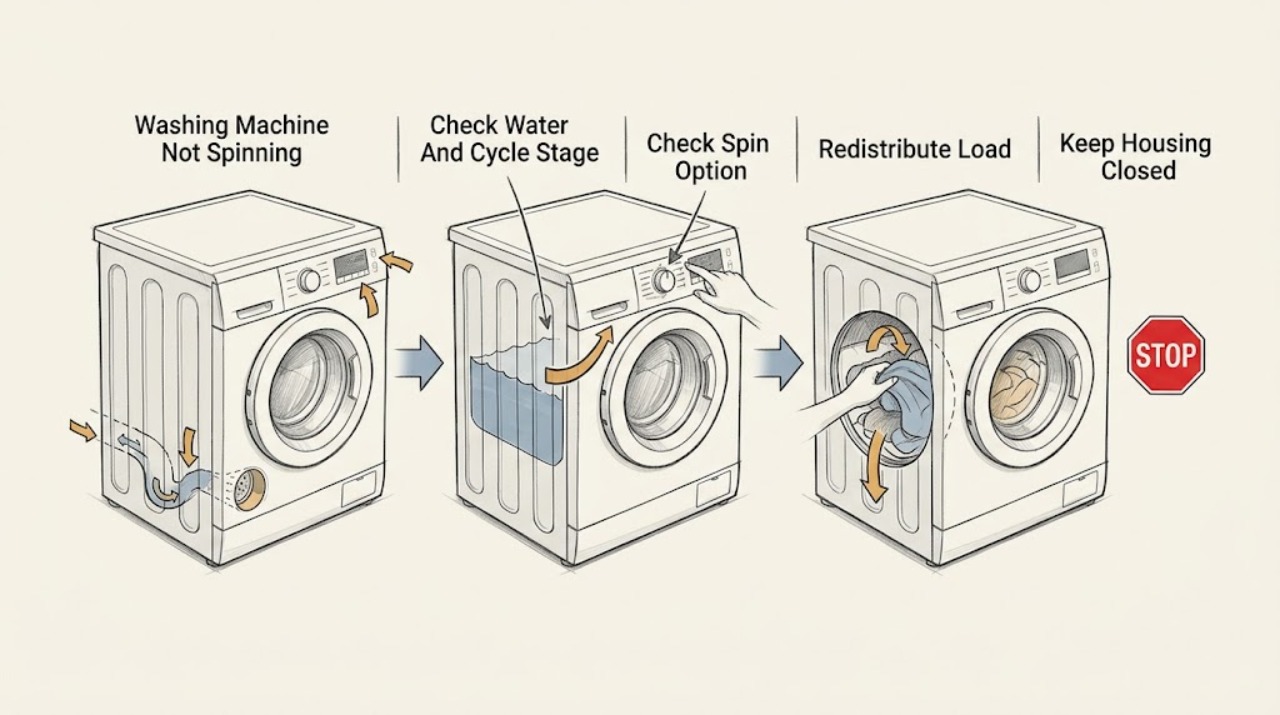
Work through in order
Diagnostic checks
Use only checks that match the exact appliance or system and its official guide.
-
Check 1
With the washer stopped, look through the door for standing water and note whether the programme ended, paused, or stopped before drain or spin. Do not open the door if water is visible or the lock indicator is on.
Expected result: The drum is empty, water remains, the pump is running or silent, or the cycle shows a drain-related error.
Next step: If the controls respond and the exact guide permits it, select the normal drain programme once. If water remains, the pump does not clear it, or a leak appears, leave the washer off and arrange service.
Stop if: Do not force the door, open a filter or hose without controlling discharge, or reach into a water-filled drum.
Why this matters
Why: Baumatic's manual says incomplete drainage can prevent spin, and a water-filled drum can keep the door interlock engaged. A drain fault is not cleared by selecting spin repeatedly.
-
Check 2
Read the selected programme and spin-speed controls. Check whether a no-spin, reduced-spin, rinse-hold, or similar option is active, using only normal front-panel controls and the exact model guide.
Expected result: A no-spin or reduced-spin option is active, the selected programme has a deliberate low spin, or a normal spin setting is already selected.
Next step: Clear the option or choose a normal spin programme only as the model guide permits, then make one supervised attempt. If the setting is normal and the drum still does not spin, continue to the load and service checks.
Stop if: Do not enter undocumented service modes or change wiring to force a spin.
Why this matters
Why: Baumatic's manual says some models include a no-spin function and that options can change spin behavior. A selected option can leave water in the drum or produce little visible rotation without an internal fault.
-
Check 3
If the drum is empty of standing water and the door can be opened normally, switch the washer off and inspect the load. Separate a single heavy item from tightly bunched clothes, then reload a balanced mixed load without overfilling the drum.
Expected result: The load is one bulky item, very small, tangled, bunched on one side, or reasonably mixed and balanced.
Next step: Close the door and run one normal spin or appropriate programme while observing from outside. If the washer repeatedly aborts, bangs, or remains still, stop and arrange service.
Stop if: Do not reach into the drum while it can move, overload it, or keep retrying after severe vibration.
Why this matters
Why: Baumatic says its imbalance-control system may abort spin when it cannot distribute a single item or very small load, to limit harmful vibration. Repositioning the load addresses balance only; it does not repair a drain or drive fault.
-
Check 4
Inspect only visible external conditions: confirm the washer is stable on the floor, no visible hose is crushed, and detergent use has not produced excessive foam. Do not pull out a built-in washer or adjust hidden fittings as a spin test.
Expected result: The washer rocks, a visible hose is kinked, there is excess foam, the machine is stable, or the external conditions look normal.
Next step: Correct only a plainly visible, safe obstruction or use the model's normal detergent guidance on a later cycle. If the washer still will not spin, leave it off and arrange service rather than moving or opening it.
Stop if: Do not remove transit hardware from an installed machine, dismantle the pump, use chemical foam suppressors, or adjust concealed feet while the appliance is unstable.
Why this matters
Why: Baumatic links severe movement to levelling, load distribution, or transit hardware, and its manual says excess detergent can impede spin. A crushed hose can contribute to drainage trouble, while normal external conditions do not rule out an internal fault.
-
Check 5
Confirm the door closes squarely and the door-lock indicator behaves normally, then select one suitable programme and press START/PAUSE as the exact model guide describes. Observe the transition from drain to spin without opening the door.
Expected result: The lock engages and the drum spins, the machine pauses while redistributing, the lock will not engage, or the programme returns to drain or stops.
Next step: If one supervised cycle completes normally, monitor the next use. If it pauses indefinitely, returns to drain, will not lock, or stops again, keep the washer off and arrange qualified service.
Stop if: Do not tape down the door switch, force the door, or reach into the drum while it is moving.
Why this matters
Why: Baumatic's manual requires correct door closure and describes the balance system making several attempts before aborting spin. A failed lock or repeated return to drain means the washer has not reached a safe spin state.
-
Check 6
Record the exact model or product code, programme and spin setting, water level, error code or flash pattern, load type, foam, hose and floor observations, door-lock response, and what happened during the one supervised attempt.
Expected result: The washer remains full of water, aborts spin repeatedly, shakes severely, the door will not lock, a fault returns, or a leak, odor, or electrical warning appears.
Next step: Turn the washer off, close the water tap if safely accessible, and arrange Baumatic-authorised or qualified appliance service. Provide the model and the observation record.
Stop if: Do not remove panels, test the motor, alter wiring, dismantle the pump, or continue a cycle with a failed lock, leak, or severe vibration.
Why this matters
Why: The record distinguishes drainage, option, balance, closure, installation, and internal drive faults without guessing at a motor, belt, pump, or control part.
Use your observations
Decision map
Find the observation that best matches what you see, then follow the next safe action.
-
PATH 01Safety boundary
What you see
Water remains in the drum when the washer should be spinning.
Do this next
Use a normal drain programme once only if the exact guide permits it. If water remains, the pump is silent, or a leak appears, leave the washer off and arrange service.
Why this path and its safety boundary
Why it matters: The washer may be preventing spin because drainage has not completed.
Safety stop: Do not force the door or open a filter or hose without a safe, model-specific water-control procedure.
-
PATH 02Safety boundary
What you see
The selected programme has no-spin, reduced-spin, or rinse-hold behavior.
Do this next
Clear the option or select the appropriate spin setting using the exact model guide, then make one supervised attempt. If it still will not spin, arrange service.
Why this path and its safety boundary
Why it matters: The control selection may intentionally prevent a fast spin or leave water in the drum.
Safety stop: Do not use undocumented control combinations or bypass a door lock.
-
PATH 03Safety boundary
What you see
The washer tumbles or tries several times, then drains without completing spin, especially with one bulky item or a very small load.
Do this next
Stop the washer, redistribute a balanced load with the drum still, and run one suitable programme. If the pattern repeats with a balanced load, arrange service.
Why this path and its safety boundary
Why it matters: Baumatic's imbalance-control system may be preventing harmful vibration because it cannot distribute the load.
Safety stop: Do not keep restarting after severe movement or enter the drum while it is moving.
-
PATH 04Safety boundary
What you see
The washer bangs, walks, rocks, or shakes strongly during the attempted spin.
Do this next
Stop the cycle and wait for the drum to stop. Check only whether the appliance visibly rocks or the load is bunched; arrange service if movement is severe or returns.
Why this path and its safety boundary
Why it matters: An uneven load, unstable installation, levelling issue, or transit hardware may be involved; continuing can damage the appliance or surroundings.
Safety stop: Do not hold the machine down, run repeated spin cycles, remove hidden transit hardware, or work under an unstable appliance.
-
PATH 05Safety boundary
What you see
A balanced load, normal spin setting, and permitted drain attempt do not restore spin, or the door will not lock, a fault returns, there is a leak, or an electrical warning appears.
Do this next
Leave the washer off, close the water tap if safe, and arrange qualified or authorised appliance service with the recorded sequence.
Why this path and its safety boundary
Why it matters: A drain, door-interlock, control, motor-drive, wiring, or other internal fault remains possible and cannot be identified safely from outside.
Safety stop: Do not open the cabinet, release the lock manually, test live parts, or replace a guessed component.
Helpful context
Understand the symptom
Not spinning does not always mean a motor fault
A washer can end a cycle without a fast spin when it detects an unbalanced load or has not drained. A single bulky item or a very small load may be difficult for the balance system to distribute. A drum that is full of water, a selected no-spin option, or a door that never locks points to a different next check than a balanced, empty drum that never turns.
Use only a controlled restart
After the visible checks, make one normal drain or spin selection with the door closed and stay nearby. A successful spin confirms only that the condition did not recur during that cycle. Repeated retries after violent movement, a leak, a failed drain, or an error can add risk and do not identify a repair part.
Confirm the exact model guide
Baumatic has several washing-machine families and model-specific controls. The opened manual applies to the BWMI147D/BWMI148D family, while the Baumatic advice centre directs owners to select a guide by product code. Record the model from an accessible rating plate or paperwork before applying any button sequence or timing instruction.
Safety boundary
Stop conditions
- Stop immediately for uncontrolled water, smoke, burning odor, hot electrical parts, exposed wiring, a failed door lock, or severe movement.
- Do not reach into a moving or water-filled drum, force the door, bypass the interlock, or hold the machine down during spin.
- Do not open the cabinet, test live wiring, dismantle the motor or pump, remove hidden transit hardware, or change control wiring.
- Stop after the water-state, spin-option, load-balance, visible-installation, and one supervised cycle checks if the washer remains unable to spin or the fault returns.
When checks do not resolve it
Need a professional?
Arrange Baumatic-authorised or qualified appliance service when water remains after a permitted drain attempt, a balanced load and normal spin setting still do not produce spin, the machine repeatedly aborts, the door will not lock, severe vibration returns, a fault code reappears, or there is a leak or electrical warning. Stop promptly for smoke, burning odor, hot electrical parts, exposed wiring, uncontrolled water, or a damaged door.
Safety scope: This article covers normal control selections, visible water and hose observation, safe load redistribution with the drum stopped, and one supervised cycle. Cabinet removal, lock or pump work, motor or belt diagnosis, wiring, live testing, and internal part replacement require qualified service.
Common questions
FAQ
Why is my Baumatic washing machine not spinning?
Check first whether water remains, a no-spin or reduced-spin option is selected, or the load is one bulky item or badly bunched. Baumatic says its balance system may abort spin to prevent harmful vibration. If a balanced load and normal drain or spin attempt do not help, arrange service.
What if my Baumatic washer has water left in the drum?
Keep the door closed and use a normal drain programme once only if the exact model guide permits it. If water remains, the pump does not clear it, or a leak appears, turn the washer off and arrange service rather than opening a filter or forcing the door.
Can an unbalanced load stop a Baumatic washer from spinning?
Yes. Baumatic says the machine may make several balancing attempts and then skip spin when it cannot distribute the load. With the drum stopped and empty of standing water, separate a single bulky item or bunched clothes, reload a balanced load, and make one supervised attempt.
Could a no-spin setting be selected on my Baumatic washer?
Some Baumatic models include a no-spin or reduced-spin option. Check the normal spin controls and programme settings in the exact model guide, clear the option if appropriate, and try one suitable cycle. If the setting is normal but spin still fails, arrange service.
When should I stop troubleshooting a Baumatic washer that will not spin?
Stop for severe shaking, a failed door lock, water leakage, smoke, burning odor, exposed wiring, uncontrolled water, or a fault that returns after the drain, setting, load, and one supervised-cycle checks. Keep the washer off and arrange qualified appliance service.
Read the exact guide
Official sources
- BWMI147D / BWMI148D Washing Machine Instruction ManualBaumatic · Official Baumatic manual for the BWMI147D/BWMI148D family only; verify the exact model before using its control sequence or error-code detail.
- Not spinning - Baumatic Advice CentreBaumatic · Official Baumatic advice-centre page for listed washing-machine and washer-dryer models; confirm the product code before applying its model list.
- Not draining the water out - Baumatic Advice CentreBaumatic · Official Baumatic advice-centre page; used only to establish that a drain problem needs a controlled water procedure and may require service, not as permission for an unqualified internal repair.
- Washing Machine Appliance Advice CentreBaumatic · Official Baumatic advice-centre index; it supports model verification and does not diagnose a particular no-spin fault.
Community feedback
Share a repair observation
Share a plain-text repair observation. Accepted observations are published automatically; this page may take a moment to update.