
On this page
Start here
Quick answer
If a Blomberg washing machine will not spin, check whether water is still in the drum first, then switch off and unplug it before inspecting the drain hose and pump filter. If the drum is empty, redistribute the laundry and remove excess items so the load can balance, then make sure the door is fully closed and latched before selecting a spin programme. If it still will not spin after the drain path is clear and the load is balanced, or if the motor, belt, door lock, wiring, or controls appear faulty, stop and arrange qualified Blomberg service rather than opening the cabinet.
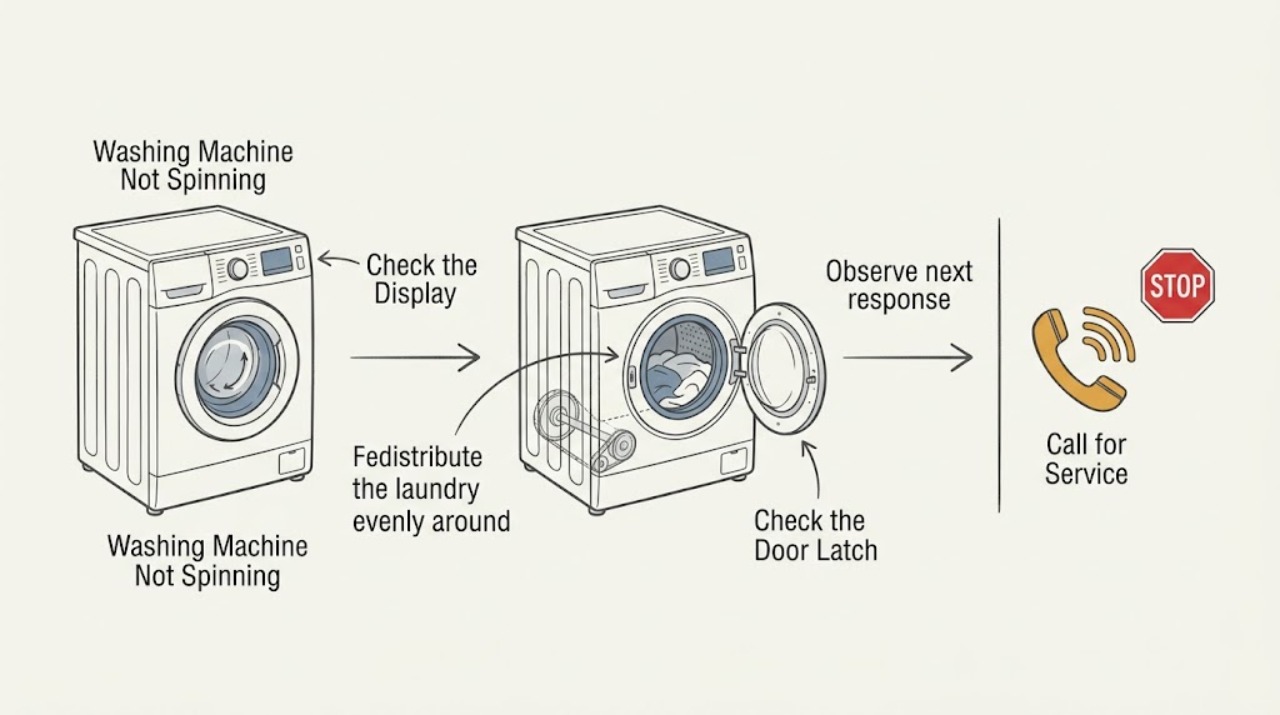
Work through in order
Diagnostic checks
Use only checks that match the exact appliance or system and its official guide.
-
Check 1
Note what remains at the end of the programme: check whether the drum still contains water, whether clothes are merely wet, whether the cycle stopped before spin, and whether any display message or unusual sound appeared.
Expected result: Water left in the drum keeps drainage in scope; an empty drum with wet, tangled clothes points more toward balance or programme selection; a click without starting can point toward the door latch; grinding, repeated clicking, or silence during a spin request needs caution.
Next step: If water remains, follow the drain-path checks before trying another spin. If the drum is empty, continue with load balance and door-latch checks. Stop for electrical or burning symptoms.
Why this matters
Why: These symptoms lead to different checks, so the water level and stopping point should guide the next step.
-
Check 2
With the washer off and unplugged, redistribute the laundry evenly around the drum. Remove some items if the load is heavy, and add suitable similar items only when the drum contains a single bulky item that cannot balance.
Expected result: A load that is spread evenly and within the model's stated capacity should allow the drum to distribute weight. A single heavy garment, a tangled bundle, or an overloaded drum can repeatedly stop the spin even when the motor is healthy.
Next step: Close the door and run the model's spin or drain-and-spin programme once with the rearranged load. If the machine still stops with a balanced load, inspect drainage and the door latch rather than adding more items.
Why this matters
Why: Blomberg describes automatic unbalanced-load detection that can hold the spin to protect the machine and its surroundings.
-
Check 3
Check that the loading door is fully closed and latched, with no clothing or debris caught around the seal or latch. Do not force the handle or defeat the interlock.
Expected result: A door that closes and latches normally allows the programme to proceed. A door that springs back, will not latch, or shows a door-related warning can prevent the spin cycle even when the load is balanced.
Next step: Remove only a visible obstruction and close the door normally. If the latch is damaged, loose, or still not recognised, leave the washer out of service and arrange qualified repair.
Why this matters
Why: The washer uses the door lock as an operating safety condition, so the drum will not spin when that condition is not confirmed.
-
Check 4
If water remains, inspect the visible drain hose for a kink, crushing, twist, blockage, or incorrect connection. Then prepare towels and a shallow container and clean the pump filter only after the washer is unplugged and the water has cooled.
Expected result: A restricted hose or filter can explain both standing water and a skipped spin. Debris such as coins, buttons, hairpins, or fibres in the filter confirms a drainage restriction; a clear path moves suspicion toward the pump or sensing system.
Next step: Drain the water in the model's documented way, rinse and refit the filter securely, and check for leaks. Do not reach into a powered pump or probe beyond loose, visible debris.
Why this matters
Why: Blomberg's troubleshooting guidance states that the machine will not spin if water has not drained completely and directs the user to check the filter and drain hose.
-
Check 5
Check the household standpipe or sink connection for an obvious blockage and confirm that the drain hose is routed at the height and insertion depth specified in the installation manual.
Expected result: A standpipe that backs up or cannot accept discharge points to a household plumbing problem. A clear standpipe with a correctly routed hose leaves the washer's pump, pressure sensing, or controls as the more likely cause.
Next step: Use a plumber for an inaccessible or repeatedly backing-up household drain. If the house drain is clear, refit the washer's filter and continue to one controlled spin test.
Why this matters
Why: The washer cannot complete a spin if its water cannot leave the appliance or the external drain path causes unreliable flow.
-
Check 6
After the load is balanced, the door is latched, and the drain path is secure, run one short spin or drain-and-spin programme while observing the drum, discharge hose, and sound of the machine.
Expected result: A smooth ramp to spin with no water left in the drum shows that balance or drainage was likely the cause. Repeated stopping with a balanced empty drum, a motor that only hums, a scraping sound, a persistent warning, or a belt-like smell indicates an unresolved mechanical or electrical fault.
Next step: Stop immediately for smoke, burning odor, leakage, abnormal noise, or electrical protection trips. Keep the washer unplugged and arrange qualified Blomberg service for a persistent no-spin condition.
Why this matters
Why: A single controlled test confirms the user-level correction without hiding a leak or stressing the machine with a full load.
Use your observations
Decision map
Find the observation that best matches what you see, then follow the next safe action.
-
PATH 01Next step
What you see
Water remains in the drum at the end of the programme.
Do this next
Do not force the door. Disconnect power, check the drain hose and pump filter safely, and use a drain or spin programme only after the water path is clear.
-
PATH 02Next step
What you see
The drum is empty but clothes are tangled, a single heavy item was washed, or the load is visibly uneven.
Do this next
Redistribute the laundry and adjust the load according to the model manual, then run one spin test.
-
PATH 03Next step
What you see
The door will not latch or a door warning remains.
Do this next
Remove only visible obstructions and close the door normally. If the latch is damaged or still unrecognised, stop and request service.
-
PATH 04Next step
What you see
The house drain backs up or the standpipe is blocked.
Do this next
Stop running cycles into the backed-up drain and arrange plumbing assistance.
-
PATH 05Next step
What you see
The hose and filter are clear, the load is balanced, and the washer still will not spin, or it makes abnormal noise or shows a persistent warning.
Do this next
Keep the appliance unplugged and contact qualified Blomberg service for pump, motor, belt, door-lock, wiring, or control diagnosis.
Helpful context
Understand the symptom
First separate a spin problem from a drain problem
Clothes that finish very wet do not always mean the motor has failed. Blomberg washers may hold back the high-speed spin when the load is uneven, when water has not drained, or when the door is not securely latched. Look at the final water level, whether the programme stopped before spin, and whether the drum tried to distribute the load before stopping. Do not force the door open while water remains inside.
Safety before checks
Turn the washer off and unplug it before reaching near the drain hose, pump filter, or any moving part. Water can be hot, and a filter opening can release water suddenly, so let the load cool and keep a container and towels ready. Never remove the cabinet, bypass the door lock, or work on the motor or belt as a household check. Stop for smoke, a burning smell, a damaged cord, leaking onto electrical parts, or repeated electrical trips.
Why a Blomberg washer may skip spin
An uneven load, an overloaded drum, or a single heavy item can trigger the washer's balancing protection. A blocked drain hose or pump filter can leave enough water in the drum to prevent spin. A door that is not fully latched prevents the cycle from starting, while a failed motor or drive belt needs professional diagnosis. Use the exact user manual for the model's load limits and programme names.
When checks do not resolve it
Need a professional?
Use qualified service for a persistent no-spin condition, a failed door lock, suspected motor or drive-belt fault, pump or pressure-sensing issue, wiring problem, or any safety warning.
Common questions
FAQ
Why are my clothes wet even though the Blomberg washer finished?
The washer may have withheld high-speed spin because the load was unbalanced, the drum still contained water, the door was not latched, or a fault was detected. Check the load, drain path, and latch in that order.
Can an unbalanced load stop a Blomberg washer from spinning?
Yes. Redistribute the laundry evenly and adjust an overloaded or single bulky load according to the model manual, then run one spin test.
Why should I check the drain filter for a spin problem?
Blomberg manuals state that the machine will not spin when water has not drained completely. A blocked drain hose or pump filter can therefore appear as a no-spin fault.
When should I stop troubleshooting a washer that will not spin?
Stop for smoke, burning odor, electrical trips, leaks near electrical parts, a damaged cord, a failed door latch, abnormal mechanical noise, or a persistent no-spin condition after the safe checks. Use qualified service rather than opening the cabinet.
Read the exact guide
Official sources
- Washing Machine / User’s ManualBlomberg · Blomberg LBF0502 washing machine manual; use the corresponding manual for another model
- Why is my washing machine not draining properly? | BlombergBlomberg · Blomberg washing machines; use model-specific filter and installation instructions
- Why is my Blomberg washing machine not spinning properly? | BlombergBlomberg · Blomberg washing machines; confirm capacity and programme details in the exact model manual
Community feedback
Share a repair observation
Share a plain-text repair observation. Accepted observations are published automatically; this page may take a moment to update.