
On this page
Start here
Quick answer
Stop the Amana washer if the cabinet, cord, outlet, water, or motor area is abnormally hot, or if you smell hot rubber, burning plastic, or see smoke. If the concern is an F0E4 or water that is too hot, verify the hot and cold inlet hoses are connected to the correct faucets; if the motor overload protector stops the washer again, leave it off and arrange service. Do not keep restarting an overheating washer to see whether it recovers.
Before you begin
Safety first
- Keep the washer off for smoke, sparking, scorching, hot electrical connections, repeated motor stoppage, persistent abnormal heat, or a fault that returns after the safe external checks. Do not open panels, bypass protection, or replace internal parts without model-specific instructions and the skills to do the work safely.
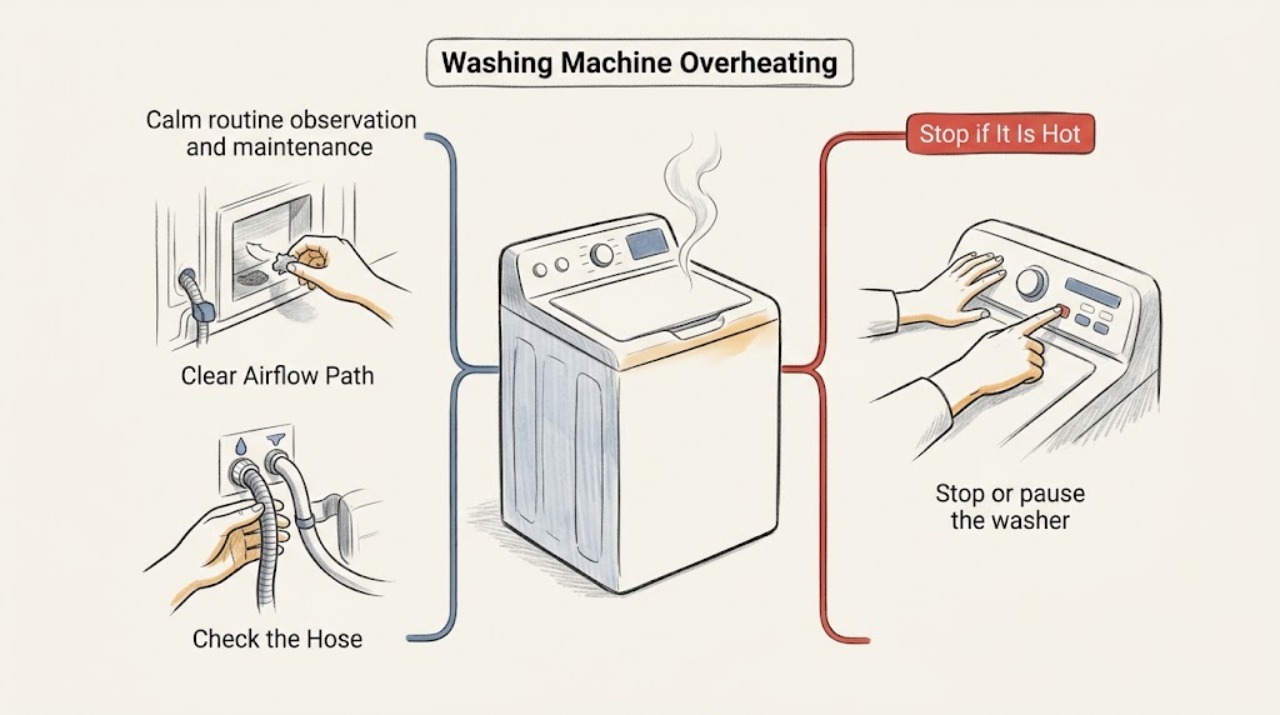
Work through in order
Diagnostic checks
Use only checks that match the exact appliance or system and its official guide.
-
Check 1
Stop or pause the washer at the first sign of abnormal heat and inspect only from outside once movement has stopped.
Expected result: There is smoke, sparking, melted plastic, a hot cord or outlet, a strong hot-rubber or burning odor, a cabinet too hot to touch, leaking hot water, or repeated motor stoppage.
Next step: Keep people away, stop using the washer, and isolate power only if it can be done safely without touching a hot or damaged connection. Arrange appliance service; use an electrician for a wall outlet or household wiring concern.
Stop if: Do not open the cabinet, touch the motor or wiring, or run another cycle when smoke, scorching, sparking, or a damaged cord is present.
Why this matters
Why: These findings can involve fire, shock, scalding, or an internal drive fault. They are not a normal cycle variation and cannot be cleared by another restart.
-
Check 2
Separate a water-temperature complaint from a motor or electrical heat complaint before choosing a repair path.
Expected result: The water or load is unusually hot and the display shows F0E4, or instead the smell, heat, noise, or stoppage is concentrated near the motor, belt or drive area during agitation or spin.
Next step: For F0E4 or hot incoming water, continue to the hose check. For motor-area heat, burning odor, or repeat stoppage, leave the washer off and give those symptoms to service.
Why this matters
Why: Amana's F0E4 path concerns water temperature and hose routing. Hot rubber, drive noise, or a motor that trips an overload protector points to load, drive, or internal electrical diagnosis rather than a hose swap alone.
-
Check 3
If the concern is F0E4 or water that is too hot, compare each inlet hose with the hot and cold labels at the washer and the faucets, without changing a connection while the area is unsafe.
Expected result: The hot hose is on the cold faucet, the cold hose is on the hot faucet, a hose is kinked or damaged, or the connections match the labels.
Next step: If the hoses are reversed and there is no active heat, leak, or electrical hazard, correct the routing according to the installation instructions and check for leaks. If the routing is correct or F0E4 returns, stop using the washer and request model-specific service.
Stop if: Do not disconnect a pressurized or hot hose, and do not continue if a hose bulges, leaks, or the surrounding connection is hot or damaged.
Why this matters
Why: Amana states that switched hot and cold hoses can make the rinse water warmer and that F0E4 means the washer senses water that is too hot. A damaged hose is a separate leak and safety concern.
-
Check 4
After the washer has cooled and only when there is no smoke, electrical damage, or leak, review the load size and whether the basket was tightly packed or badly unbalanced.
Expected result: The tub was overloaded, a single heavy absorbent item was spinning alone, clothing was packed tightly, or the washer stopped and then restarted after an overload-protector pause.
Next step: Remove some items and redistribute the load only if the washer is otherwise cool and safe. If the motor protector has stopped the washer more than once, or hot-rubber odor or abnormal noise remains, leave it off and call service.
Stop if: Do not keep resetting or restarting a motor that repeatedly stops, smells hot, or becomes abnormally warm.
Why this matters
Why: A heavy or unbalanced load can increase drive strain. The legacy Amana guide says an overload protector may stop the motor, but if it stops the motor again the washer should no longer be used.
-
Check 5
If there is no burning odor and the issue is a warm, stale, or musty smell from the tub, check detergent use, wet-load timing, and the model's Clean Washer procedure.
Expected result: Wet clothes were left in the basket, non-HE or excess detergent was used, or the odor is a residue or mildew smell without smoke, scorching, abnormal heat, or motor symptoms.
Next step: Use only the detergent type and amount specified for the washer, run the model's Clean Washer cycle with the permitted cleaner if the machine is otherwise safe, remove the load promptly, and leave the lid or door open between uses.
Stop if: Do not start a cleaning cycle to investigate a washer that is smoking, sparking, scorching, leaking hot water, or repeatedly stopping.
Why this matters
Why: Amana links these conditions with odor-causing residue and recommends a monthly Clean Washer cycle for applicable models. This path explains a cleanliness odor, not a hot-rubber or electrical overheating event.
-
Check 6
Record the model and the exact heat symptom before arranging service, rather than opening the washer to identify a component.
Expected result: The fault returns after the hose check, the water temperature is still wrong, the overload protector trips again, or there is any persistent hot-rubber, electrical, smoke, or scorching symptom.
Next step: Request appliance repair and provide the model number, washer style, cycle and stage when heat appeared, water temperature or F0E4 status, odor location, load size, hose routing, leaks, noises, and what stopped or reset.
Stop if: Do not bypass a safety device, substitute a thermostat or motor part, or run the washer unattended to reproduce the fault.
Why this matters
Why: A persistent symptom crosses the owner-maintenance boundary. The correct part and test sequence depend on the model, washer style, control, drive system, and the location of the heat.
Use your observations
Decision map
Find the observation that best matches what you see, then follow the next safe action.
-
PATH 01Safety boundary
What you see
Smoke, sparking, melted material, a hot cord or outlet, or a strong burning odor is present.
Do this next
Stop using the washer, keep clear of the damaged area, isolate power only if safe, and arrange appliance service; use an electrician for a household outlet or wiring concern.
Why this path and its safety boundary
Safety stop: Do not restart or open the washer while any smoke, scorching, sparking, or damaged connection remains.
-
PATH 02Safety boundary
What you see
The display shows F0E4 or the incoming wash/rinse water is clearly hotter than the selected setting.
Do this next
Check hot and cold hose routing against the labels and installation instructions if the area is cool, dry, and safe; if routing is correct or the fault returns, request service.
Why this path and its safety boundary
Safety stop: Do not handle a hot or leaking hose, and do not treat a control reset as a repair for a returning fault.
-
PATH 03Safety boundary
What you see
The hot and cold inlet hoses are connected to the opposite faucets or a hose is kinked, bulged, cut, or leaking.
Do this next
Correct only a safe, cool, accessible routing issue according to the model instructions; replace a damaged hose with a model-appropriate part through a qualified repair path.
Why this path and its safety boundary
Safety stop: Stop if the connection is hot, pressurized, leaking, or difficult to access.
-
PATH 04Safety boundary
What you see
The washer is tightly packed, contains a single heavy absorbent item, or its motor stops and later restarts.
Do this next
After cooling and only if no other hazard is present, reduce and redistribute the load once. If the protector stops the motor again, stop using the washer and call service.
Why this path and its safety boundary
Safety stop: Do not repeatedly reset a motor that trips, smells hot, or becomes abnormally warm.
-
PATH 05Safety boundary
What you see
The odor is stale or musty, with no smoke, scorching, abnormal heat, electrical sign, or motor stoppage.
Do this next
Follow the model's Clean Washer procedure, use the specified HE detergent amount, remove wet items promptly, and leave the lid or door open between uses.
Why this path and its safety boundary
Safety stop: Do not use a cleaning cycle as a test for active overheating.
-
PATH 06Safety boundary
What you see
The washer still overheats, gives F0E4 after correct hose routing, repeats motor stoppage, or has no clear external cause.
Do this next
Keep the washer out of service and request model-specific appliance repair with the recorded symptoms.
Why this path and its safety boundary
Safety stop: Any return of smoke, burning odor, scorching, sparking, leaking hot water, or abnormal heat overrides this branch and requires immediate stop and service.
Helpful context
Understand the symptom
Overheating can mean different things on a washer
The word overheating does not identify one component. Water that feels too hot, a hot-rubber odor during agitation or spin, a motor that stops, an electrical smell, and a warm or musty tub lead to different checks. The assigned topic does not include a model number or washer style, so use the model manual for controls and do not assume that every Amana washer has the same temperature sensor, motor drive, or fault codes.
Use the stop boundary first
Smoke, melted material, a hot cord or outlet, a strong burning odor, sparking, a cabinet that is too hot to touch, or repeated motor stoppage is a stop condition. Turn off the cycle and isolate power only by a normal, safe means when the area is dry and there is no immediate electrical danger. Do not remove panels, bypass the lid switch or overload protection, or reach into moving or hot parts.
Only after diagnosis
Potential parts
Only when the model instructions and a safe inspection show a damaged hose or incorrect routing; the replacement must match the exact washer and connection.
Requires model-specific diagnosis and testing by qualified service; do not infer a failed component from the code alone.
Professional diagnosis only; the exact drive arrangement varies by Amana model and safety devices must not be bypassed.
When checks do not resolve it
Need a professional?
Arrange appliance repair when the washer has smoke, sparking, scorching, a hot cord or outlet, a strong hot-rubber or burning odor, repeated motor overload stops, persistent F0E4 after the hose layout is correct, water that remains too hot, a damaged or leaking inlet hose, or any overheating symptom without a safe external explanation. Use a qualified electrician for a household wiring or outlet concern. Do not open the cabinet, bypass a safety device, or substitute internal components as a test.
Safety scope: Keep the washer off for smoke, sparking, scorching, hot electrical connections, repeated motor stoppage, persistent abnormal heat, or a fault that returns after the safe external checks. Do not open panels, bypass protection, or replace internal parts without model-specific instructions and the skills to do the work safely.
Common questions
FAQ
Does F0E4 mean the Amana washer itself is overheating?
F0E4 is Amana's water-temperature condition: the washer senses water that is too hot. First verify that the hot and cold inlet hoses are connected to the correct faucets. If the fault returns with correct routing, stop using the washer and arrange model-specific service.
What if the washer smells like hot rubber during spin?
Stop the cycle and let the machine cool without opening panels. Review whether the load was too heavy or unbalanced only if there is no smoke, scorching, or electrical damage. If the odor returns, the motor stops again, or the washer becomes abnormally hot, keep it off and request service.
Can a musty washer odor be mistaken for overheating?
Yes. A stale or musty tub odor without abnormal heat, smoke, scorching, or motor symptoms can relate to wet clothes left inside, detergent residue, or a missed Clean Washer cycle. Use the applicable model procedure, but do not run a cleaning cycle when active overheating signs are present.
Should I keep restarting the washer after it cools down?
No. A one-time safe load correction is different from a repeated overload stop, burning odor, or abnormal heat. Amana's manual says to stop using the washer and call a service technician if the overload protector stops the motor again.
Read the exact guide
Official sources
- Washer Safety and Use & Care GuideAmana · Amana top-load washer safety, inlet-hose inspection, load guidance, cleaning procedure, electrical-safety, and no-unauthorised-repair boundaries.
- Use & Care GuideAmana · Amana washer manual guidance for hot-rubber odor, overload protection, motor repeat-stop boundary, and water-hose troubleshooting; model-specific, so do not generalize its controls to every washer.
- Troubleshooting Washer OdorsAmana · Amana washer guidance for distinguishing residue odors and for checking water temperature, hose routing, detergent, and load size.
- F0E4 - Error CodeAmana Product Help · Amana top-load washer guidance for the F0E4 water-temperature condition, hose routing, and model-specific control reset.
- Removing Odor or Smell - WasherAmana Product Help · Amana top-load washer guidance for wet-load odor, HE detergent, and the Clean Washer cycle; used only for non-burning residue odor.
Community feedback
Share a repair observation
Share a plain-text repair observation. Accepted observations are published automatically; this page may take a moment to update.