
On this page
Start here
Quick answer
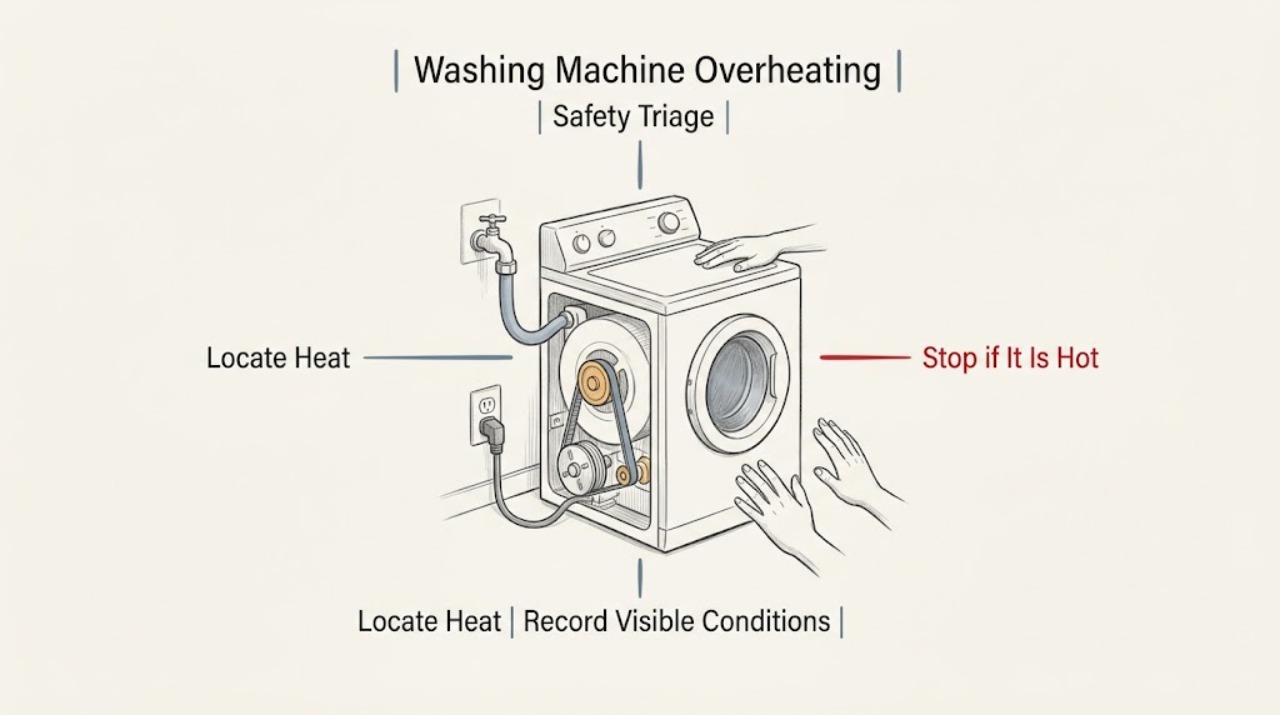
A Kenmore washer can feel warm because a hot or warm cycle is bringing in heated household water, because a motor or pump has been working under load, or because the cabinet, cord, plug, or laundry is becoming abnormally hot. Do not diagnose this by touch alone. Stop the cycle and isolate the washer if you notice smoke, a burning or melting smell, visible scorching, a hot or discolored plug or outlet, sparks, repeated breaker trips, a hot electrical cord, a leak near power, or heat that continues after the washer is stopped. When there is no fire or electrical warning, record which part is warm and at what cycle stage, confirm the model in Kenmore's manual system, reduce the load, check that the washer is level and can drain, and compare the selected water temperature with the incoming hot and cold connections. A washer with persistent cabinet, motor, wiring, or outlet heat needs model-specific professional service; do not open the cabinet or keep resetting it.
Before you begin
Safety first
- This article supports ordinary-access observation and model-manual checks only. Do not run the washer after an electrical or fire warning, touch wet or hot connections, use live electrical tests, open the cabinet, bypass safety devices, or replace internal parts based only on symptoms.
Work through in order
Diagnostic checks
Use only checks that match the exact appliance or system and its official guide.
-
Check 1
Stop the cycle using the normal control if it responds, keep hands and feet dry, and from a safe position identify whether there is smoke, flame, a burning or melting smell, visible scorching, sparks, a hot or discolored plug or outlet, a damaged cord, water at the electrical connection, or a breaker that has tripped.
Expected result: Classify the event as an active electrical or fire warning, water near power, a warm appliance without an odor or damage, or no abnormal heat that can be confirmed safely.
Next step: If safe to do so without touching wet equipment or a damaged connection, isolate power at the breaker or unplug by the intact plug while standing clear; leave the area and use local emergency procedures for smoke or fire. Otherwise keep clear and obtain qualified electrical or appliance help. For a merely warm cabinet with no warning signs, continue only with the non-invasive checks below.
Stop if: Do not touch a wet plug or outlet, pull a damaged cord, pour water on an electrical fire, repeatedly reset the breaker, or run the washer again after smoke, arcing, melting, burning odor, severe heat, or repeated trips.
Why this matters
Why: Smoke, flame, arcing, melting, burning odor, a hot or discolored connection, a damaged cord, a wet electrical area, or repeated tripping is not an ordinary washer-temperature complaint. The washer may have an electrical or mechanical fault and must not be operated for another test.
-
Check 2
After the washer is stopped and has cooled enough to approach safely, record the exact warm area without opening the cabinet: incoming hose or tub water, front door or lid, lower pump area, rear or lower motor area, top control area, side or rear cabinet, power cord, plug, or wall outlet.
Expected result: Note whether the heat is diffuse and related to a hot-water fill, limited to a moving or pumping phase, concentrated at one electrical connection, present while idle, or accompanied by odor, noise, leaking, or a fault display.
Next step: Photograph the safe exterior condition, note the cycle and elapsed time, and use the exact model manual for any model-specific interpretation. Keep the washer out of service when the heat is localized or unexplained.
Stop if: Do not remove panels, reach behind the basket, touch a hot connection, or use an infrared or electrical test as a substitute for qualified diagnosis when there is an odor, damage, water, or live-power concern.
Why this matters
Why: Diffuse warmth during a hot or warm fill is more consistent with selected water temperature. A localized hot spot at the plug, outlet, cord, control, motor, pump, or drive area—or heat that persists while idle—needs service rather than a temperature-setting adjustment.
-
Check 3
With the washer disconnected from any safety warning and the model identified, read the selected cycle and temperature setting in the Kenmore manual; compare it with the water actually entering the tub only through ordinary observation, without reaching into the machine.
Expected result: Record whether the heat appears only during hot or warm fill, during a steam or sanitize feature if the exact model has one, during rinse or spin, or when no water-heating option is selected.
Next step: Use only the documented cycle behavior for the exact model. If the observation does not match the manual or the washer heats in a cycle that should not call for hot water, stop use and provide the cycle, temperature, model, and timing to service.
Stop if: Do not deliberately select the hottest cycle to reproduce a suspected overheating condition, measure live voltage, bypass a temperature control, or defeat a thermal or lid/door safety device.
Why this matters
Why: Heat confined to the selected hot or warm fill can be normal household hot-water behavior. Heat that appears during spin, with cold-selected cycles, at the control or electrical connection, or after the fill has ended is not explained by the water setting alone and should be treated as an appliance or connection fault until assessed.
-
Check 4
With power isolated and the water supply accessible, look at the hot and cold supply valves, hoses, and the washer's labeled inlet connections; check for kinks, leakage, bulging, rubbing, or an obviously reversed connection without opening a valve body or removing an inlet valve.
Expected result: Record whether hot and cold hoses match the labels, both supply valves are open as required by the manual, water is leaking, a hose is damaged or pinched, or the inlet arrangement cannot be identified.
Next step: Correct only a clearly identified hose-label mismatch or kink when the manual permits it and the hoses and connections are cool and dry; otherwise close accessible water valves, contain the leak safely, and arrange appliance or plumbing service.
Stop if: Do not work around a leaking or wet electrical connection, loosen a pressurized hose, test a suspected inlet valve with live power, or continue operating when water reaches the outlet, cord, or control area.
Why this matters
Why: A wrong or restricted inlet arrangement can make the selected water temperature appear abnormal or prolong filling, but it does not explain a hot plug, cord, control, motor, or cabinet. A leak or damaged hose introduces a water-and-electricity hazard and takes priority over temperature diagnosis.
-
Check 5
With the washer stopped, unloaded, and safe to handle, inspect the load size and clothing for an excessive or tightly packed load, trapped object, unusual rubbing, or a basket or tub that cannot move normally by the gentle, model-appropriate check described in the manual.
Expected result: Record whether the washer was overloaded, whether a heavy item was concentrated on one side, whether a foreign object or rubbing mark is visible, and whether the basket movement or door/lid area is abnormal without force.
Next step: Remove excess items and redistribute a normal load only when there is no safety warning and the exact manual allows it. If the empty basket still rubs, binds, wobbles severely, or the washer overheats, keep it out of service and request repair.
Stop if: Do not reach under the basket, bypass the lid or door lock, rotate a hot or jammed mechanism with tools, or run an empty cycle to test a scraping or overheating fault.
Why this matters
Why: Overloading or an off-balance load can increase motor, pump, and drive effort and may create heat or repeated stopping. A scraping, seized, loose, or obstructed basket points to a mechanical problem; it is not a reason to keep running smaller loads until the heat disappears.
-
Check 6
Observe the washer's footing and cabinet after it is empty and powered off: check whether it rocks, walks, contacts a wall or adjacent appliance, or has visible damage around the feet, cabinet, hose, or drain path.
Expected result: Note stable footing, mild movement only during an unbalanced load, severe vibration, cabinet contact, a pinched hose, or damage and looseness at the feet or cabinet.
Next step: Use the model's installation instructions to make only ordinary external leveling adjustments when the washer is disconnected and dry. If the floor, cabinet, suspension, or mounting hardware is damaged or the washer cannot be stabilized, arrange service.
Stop if: Do not lift a full washer, reach beneath it while energized, keep operating when it walks or strikes nearby objects, or adjust internal suspension or counterweights.
Why this matters
Why: An unstable installation or external contact can add vibration and mechanical load, but it should not make an outlet, plug, cord, or control hot. Severe vibration, rubbing, or cabinet movement can damage hoses or wiring and needs correction before another cycle.
-
Check 7
Review the end of the last cycle and inspect only the accessible drain hose and floor area with power and water isolated: note whether water remained in the tub, draining was slow, the pump made a strained sound, or the hose was kinked or crushed.
Expected result: Classify the drain path as clear with a normal empty tub, slow or incomplete drain, a visible leak, a kinked or restricted hose, or an inaccessible pump/filter requiring the manual's specific procedure.
Next step: Follow only the exact model's safe filter or drain procedure after isolating power and water, if one is documented and the area is dry. If the tub remains full, water leaks toward power, the pump is seized, or the procedure requires cabinet access, obtain service.
Stop if: Do not reach into a wet pump area, run the washer with standing water near electricity, open a pressurized filter cap, or use live tests to locate a pump fault.
Why this matters
Why: A blocked or strained drain path can keep a pump working longer and add heat, but a hot electrical connection or burning smell remains an electrical stop condition. Standing water also raises shock and flood risk around an energized washer.
-
Check 8
With the washer off and approached only from a dry, safe position, inspect the visible plug, cord, outlet, and any extension cord or power strip for looseness, discoloration, melting, heat damage, pinching, or an unusual smell; do not test a live circuit yourself.
Expected result: Record a cool intact direct-wall connection, an extension cord or power strip, a loose or warm plug, a hot/discolored outlet, a damaged cord, or a breaker that trips when the washer runs.
Next step: Stop using the washer and have the outlet and appliance connection assessed by a qualified electrician or appliance technician. Preserve the plug and outlet condition for inspection; do not substitute an extension cord or power strip.
Stop if: Do not touch a hot or wet plug, pull a frayed cord, insert a plug into a damaged outlet, replace a breaker with a larger rating, or reset a tripping breaker repeatedly.
Why this matters
Why: A warm, loose, discolored, melted, damaged, or repeatedly tripping connection can overheat independently of the washer's water temperature. The direct-wall-outlet requirement and damaged-cord warnings are safety boundaries, not troubleshooting invitations.
-
Check 9
Only if there was no smoke, odor, abnormal heat, water near power, damage, or breaker trip, use the exact Kenmore manual's normal cancel/power procedure and allow the washer to cool; a single restart may be used only to document whether the symptom returns.
Expected result: Record whether the washer remains cool and completes a normal low-stress cycle, immediately becomes hot again, stops with a fault display, trips the breaker, or develops an odor or noise.
Next step: If the symptom returns, stop use and provide service with the model, cycle, load, heat location, timing, fault display, and power-connection observations. Do not repeat the reset or use increasingly hot cycles.
Stop if: Do not reset after smoke, burning smell, melting, arcing, water at power, a hot outlet, or a breaker trip, and do not bypass a thermal, lid, door, or control safety.
Why this matters
Why: A symptom that returns after cooling or a normal control reset suggests an unresolved control, motor, pump, drive, sensor, or connection issue; a reset does not repair overheating. Any safety warning during the observation ends testing immediately.
-
Check 10
Prepare the exact model number, cycle and temperature, load type and size, start-to-symptom timing, heat location, noise or vibration, water level and drain result, fault code, breaker behavior, and safe exterior photographs for Kenmore or a qualified technician.
Expected result: Confirm whether the evidence points to normal hot-water warmth, a fill or drain issue, load/friction stress, motor or pump heat, or a power/cabinet safety fault, while leaving the washer isolated if the cause is not clearly benign.
Next step: Use Kenmore's model-specific manual and customer-care/repair resources to request service; disclose every stop condition, including a hot plug or outlet, leak, smell, smoke, sparks, severe vibration, or repeated breaker operation.
Stop if: Do not remove the cabinet, test live components, bridge a thermal fuse or door/lid switch, replace a motor or control based only on symptoms, or resume use while a safety fault remains unexplained.
Why this matters
Why: A precise sequence and location lets the technician distinguish water temperature from electrical, drive, pump, or control overheating without the owner opening the cabinet or recreating a hazardous condition.
Use your observations
Decision map
Find the observation that best matches what you see, then follow the next safe action.
-
PATH 01Safety boundary
What you see
Warmth is limited to the water or nearby cabinet during a documented hot or warm fill, with no odor, smoke, unusual noise, leak, electrical heat, or abnormal stopping.
Do this next
Check the exact Kenmore manual for the cycle's temperature behavior, record the inlet connection and timing, and stop if heat spreads to the cord, plug, outlet, control, or cabinet or persists after the fill.
Why this path and its safety boundary
Why it matters: The selected water temperature or household hot-water supply may explain the observation; this is not the same as the washer or outlet overheating.
Safety stop: Do not choose a hotter cycle to test the limit, and stop for scalding water, smoke, odor, leaking, abnormal electrical heat, or unexpected heating in a cold-selected cycle.
-
PATH 02Safety boundary
What you see
Heat, discoloration, melting, odor, or looseness is concentrated at the plug, cord, outlet, power strip, or extension cord, or the breaker trips when the washer operates.
Do this next
Stop use and obtain qualified electrical and appliance assessment; isolate power only from a dry, safe position and preserve the connection condition for inspection.
Why this path and its safety boundary
Why it matters: Treat this as a possible electrical fault or overloaded/poor connection, not as a washer water-temperature issue.
Safety stop: Do not touch wet or hot connections, use an extension cord, force a plug, replace a breaker with a larger rating, or repeatedly reset power.
-
PATH 03Safety boundary
What you see
Heat appears in the motor, pump, lower/rear cabinet, or drive area during agitation, spin, or draining and is accompanied by strain, rubbing, hum, slow drain, or repeated stopping.
Do this next
Leave the washer isolated, record the cycle stage and sound, and arrange model-specific service without opening the cabinet or testing live parts.
Why this path and its safety boundary
Why it matters: Excess mechanical load, obstruction, drain restriction, or a failing motor/pump/drive is possible; an empty or smaller load is not a safe long-term workaround.
Safety stop: Stop immediately for burning odor, smoke, sparks, severe vibration, a hot connection, water near power, or heat that continues while idle.
-
PATH 04Safety boundary
What you see
The symptom follows an overloaded or unbalanced load, severe vibration, a rubbing basket, or slow/incomplete draining, while the electrical connection stays cool and intact.
Do this next
After power and water isolation, use the manual's ordinary load, leveling, and accessible drain guidance; do not run another cycle if rubbing, binding, severe movement, or heat remains.
Why this path and its safety boundary
Why it matters: Load distribution, installation, or drain effort may be increasing mechanical work, but the washer still requires a safe boundary if the heat is abnormal or repeats.
Safety stop: Do not reach into moving or wet mechanisms, bypass the lid/door lock, lift a full washer, or continue running to see whether the motor cools.
-
PATH 05Safety boundary
What you see
The washer becomes hot during a cold-selected cycle, after fill, during rinse/spin, while idle, or at the cabinet/control rather than only in the water.
Do this next
Keep the washer out of service, document timing and location, and request qualified diagnosis using the model number and manual.
Why this path and its safety boundary
Why it matters: The water setting does not account for the symptom; suspect a control, sensor, motor, pump, drive, ventilation, or electrical issue until the exact model is assessed.
Safety stop: Do not repeat cycles, bypass thermal protection, open the cabinet, or use live electrical measurements as an ordinary-user check.
-
PATH 06Safety boundary
What you see
Water is leaking toward the cord, plug, outlet, controls, or floor area where the washer is energized, or the tub remains full with a fault.
Do this next
Keep clear, isolate power and water only when safe, do not touch wet electrical parts, and obtain qualified appliance/electrical service.
Why this path and its safety boundary
Why it matters: Water and electricity create an immediate shock and damage risk; drain diagnosis is secondary to safe isolation.
Safety stop: Do not operate, unplug through standing water, open a wet pump or filter, or restart to test the leak.
Helpful context
Understand the symptom
First decide whether the heat is water, friction, or electricity
Water in a hot or warm wash can be expected, and the outside of a washer may feel different from the water inside it. That does not make a hot plug, cord, outlet, control area, or burning odor normal. A washer can also warm after a long wash or spin because the motor, pump, or drive has been loaded, but a concentrated hot spot, repeated thermal shutdown, smoke, melted plastic, or heat that increases while idle is a stop condition. Record the location and stage instead of repeatedly touching or rerunning the machine.
Kenmore model differences matter
Kenmore sells multiple washer designs and generations. The controls, temperature behavior, drain arrangement, motor protection, and service procedure can differ between a top-load washer and a front-load washer. Kenmore's manuals page asks for the full model number and provides the matching use-and-care material. Use that manual for the exact cycle names, inlet labels, reset instructions, and any model-specific temperature or diagnostic information; do not apply an undocumented heater, sensor, or error-code procedure from another washer.
Overheating is a safety issue, not a reason to bypass protection
If the washer trips a breaker, stops and later restarts, smells hot, or has a discolored connection, a protective device may be responding to an unresolved fault. A single safe power isolation can preserve evidence, but repeated breaker resets or running empty cycles to reproduce the heat can worsen damage. U.S. Fire Administration guidance calls for major appliances such as washers to be plugged directly into a wall outlet and for damaged or loose cords and outlets to be replaced or professionally assessed.
Safety boundary
Stop conditions
- Stop immediately for smoke, flame, burning or melting odor, visible scorching, sparks, a hot/discolored plug or outlet, damaged cord, repeated breaker trips, or heat that continues while the washer is idle.
- Do not operate or unplug a wet appliance or touch water near an energized cord, plug, outlet, or control; isolate power only from a dry, safe position and obtain qualified help.
- Do not use an extension cord or power strip for the washer, force a plug, replace a breaker with a larger rating, or repeatedly reset a tripping circuit.
- Do not open the cabinet, test live components, bypass a thermal fuse or lid/door lock, or run repeated hot, empty, or smaller-load cycles to reproduce overheating.
- Stop for severe vibration, rubbing, a jammed basket, a seized pump, a persistent hot motor/control area, a leak, or unexplained heat after the selected water fill has ended.
Only after diagnosis
Potential parts
- water inlet valve or inlet hose assembly
Consider this category only if the exact model's diagnosis confirms a hot/cold inlet, filling, hose, or valve fault rather than cabinet or electrical overheating.
Confirm the full model number, inlet labeling, hose routing, and manufacturer fit information; do not replace a valve or loosen a hose while wet, pressurized, or energized. - drain pump or drain hose assembly
Consider this category only when the exact model and service diagnosis identify a restricted or failed drain path associated with slow draining, pump strain, or residual water.
Confirm model-specific pump design and procedure; water must be isolated and the appliance disconnected before any approved access, and a wet electrical area requires professional service. - drive or motor component
Consider this category only after a qualified diagnosis links abnormal heat, rubbing, noise, or repeated stopping to the motor or drive system.
Confirm the exact model and the technician's failed component; do not infer fit or replace a motor, belt, coupling, control, or thermal device from heat alone.
When checks do not resolve it
Need a professional?
Arrange Kenmore or qualified appliance/electrical service when heat is localized to the cabinet, motor, pump, controls, cord, plug, or outlet; when the symptom appears outside a hot or warm fill; when it returns after cooling; or when there is smoke, odor, melting, sparking, a leak near power, severe vibration, a drain fault, or a breaker trip. Use the exact model number and manual because Kenmore washer designs and controls vary.
Safety scope: This article supports ordinary-access observation and model-manual checks only. Do not run the washer after an electrical or fire warning, touch wet or hot connections, use live electrical tests, open the cabinet, bypass safety devices, or replace internal parts based only on symptoms.
Common questions
FAQ
Is a warm Kenmore washer always overheating?
No. Water and nearby surfaces can feel warm during a selected warm or hot cycle. A hot plug, outlet, cord, control, motor area, concentrated cabinet hot spot, burning odor, smoke, melting, or heat that persists while idle is not normal warmth; stop using the washer and arrange qualified service.
Can hot water make a washing machine feel hot?
It can make the water and nearby surfaces warm during a hot or warm fill. Use the exact Kenmore model manual and record the stage. Heat during rinse or spin, in a cold-selected cycle, at the control or electrical connection, or after filling has ended needs assessment.
What should I do if the washer plug or outlet is hot?
Stop using the washer. Do not touch a wet or very hot connection, pull a damaged cord, or keep resetting the breaker. From a dry, safe position isolate power if possible and have a qualified electrician or appliance technician assess the outlet, cord, plug, and washer.
Can an overloaded load cause a washer to overheat?
An overloaded or badly unbalanced load can increase drive and motor effort and may cause vibration or repeated stopping, but it is not a safe explanation for smoke, burning odor, a hot connection, or persistent cabinet heat. Remove excess items only when the washer is safe and follow the model manual; service is needed if the symptom repeats.
Could a clogged drain make a washer hot?
A restricted drain can make a pump work longer or strain, especially if water remains, but standing water near electricity is an immediate safety concern. Isolate power and water only when safe, follow only the exact model's accessible drain guidance, and obtain service for a seized pump, residual water, leaks, or cabinet access.
Should I reset a Kenmore washer that overheats?
Do not reset after smoke, odor, melting, sparks, water near power, a hot outlet, or a breaker trip. If there was no safety warning, one normal manual-directed power/cancel procedure may document whether the symptom returns, but a repeat symptom means stop use and request diagnosis rather than repeating resets.
Where can I find the correct Kenmore washer instructions?
Use Kenmore's official manuals page with the full model number. The exact manual provides the applicable cycle, inlet, drain, installation, and safety instructions; do not substitute a procedure from another Kenmore generation or washer design.
Read the exact guide
Official sources
- Basement and Garage Fire SafetyU.S. Fire Administration · Government fire-prevention guidance for washers and dryers; it is general safety information rather than a Kenmore repair procedure.
- Appliance and Electrical Fire SafetyU.S. Fire Administration · Government fire-safety guidance for major household appliances including washers; it does not diagnose a particular Kenmore model.
- Kenmore ManualsKenmore · Kenmore's official manual lookup; the exact model manual controls cycle, installation, safety, and service instructions for a particular washer.
- Customer CareKenmore · Kenmore customer-care and repair-resource directory; it does not replace the model-specific manual or diagnosis.
Community feedback
Share a repair observation
Share a plain-text repair observation. Accepted observations are published automatically; this page may take a moment to update.