
On this page
Start here
Quick answer
Treat a Frigidaire washing machine that feels unusually hot, smells of burning, smokes, sparks, trips a breaker, or heats the cord or outlet as a stop-use condition. End the cycle and isolate power only from a safe, accessible control or disconnect; do not touch a hot or damaged cord, open the cabinet, or restart it to see whether it cools. If the only heat is normal selected wash water, separate that from an overheated cabinet or electrical part. After the machine is cool, document the location, cycle, load, noises, display, and power symptoms, then arrange Frigidaire or qualified appliance service.
Before you begin
Safety first
- The professional determines whether the cause is supply-side, wiring, control, motor, pump, load, water-temperature, or another model-specific condition, then tests and replaces parts only with the correct safety procedure and confirmed fit.
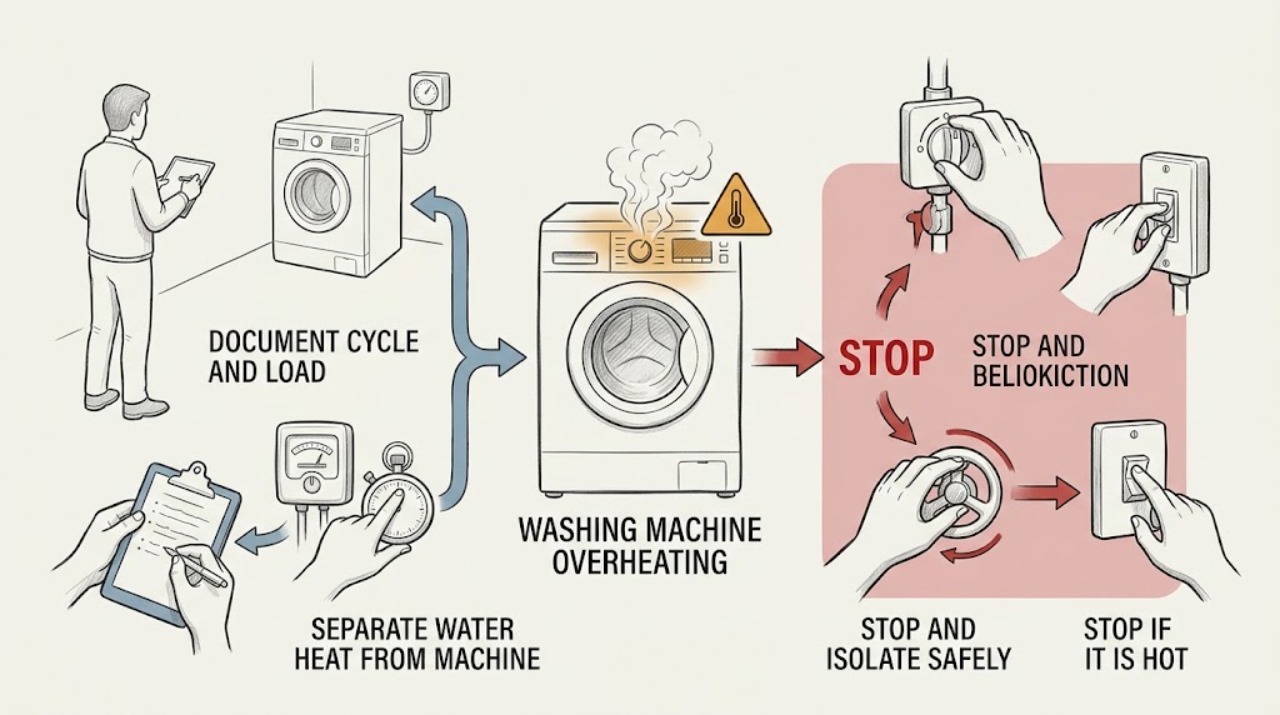
Work through in order
Diagnostic checks
Use only checks that match the exact appliance or system and its official guide.
-
Check 1
If the washer is currently hot, smoking, sparking, making a burning smell, or heating its cord or outlet, stop the cycle from a safe position and keep people away; isolate power only through an accessible, undamaged control or disconnect that can be operated without touching the hazard.
Expected result: Record which symptom occurred, where heat or odor was noticed, whether smoke or sparks were visible, whether water was present near the connection, and whether a breaker or fuse opened.
Next step: Leave the washer out of service and arrange qualified appliance or electrical service. If there is active smoke or fire, leave the area and contact emergency services according to local procedure.
Stop if: Do not touch a hot, melted, wet, or damaged cord or outlet; do not pull a plug through water, open the cabinet, or restore power to reproduce the event.
Why this matters
Why: These are safety symptoms rather than routine wash-performance symptoms. A damaged connection, energized fault, or overheated internal component cannot be cleared by a reset or another test cycle.
-
Check 2
After the washer is cool and safe, identify whether the reported heat was only the water or laundry from a selected hot cycle, or whether the cabinet, control area, drum-side opening, cord, outlet, or surrounding floor became unusually hot.
Expected result: Note the selected temperature, the point that felt hot without touching a hazardous surface, the cycle stage, and whether the heat was accompanied by an odor, noise, display event, leak, or power interruption.
Next step: Keep the washer off if any non-water heat, odor, damage, or power symptom occurred. If the concern was only temperature selection, use the exact model manual rather than assuming every Frigidaire washer has the same water-control behavior.
Stop if: Do not touch a suspect hot part, measure live electrical points, remove panels, or reach into a locked or moving tub.
Why this matters
Why: Heat limited to expected wash water is a different path from heat at an electrical connection or cabinet. A hot exterior, cord, outlet, or localized machine area needs service even if the display still works.
-
Check 3
With power isolated and the machine cool, document the cycle, load size and type, point at which it stopped, displayed code or lights, unusual hum or vibration, and whether the problem occurred during fill, wash, drain, or spin.
Expected result: Compare the event with Frigidaire's normal-operation descriptions: load sensing may delay filling, a lid lock may click, a pump may hum while draining, and an out-of-balance load may vibrate or prevent spinning.
Next step: Save photos of the display and the load arrangement, then report the sequence to service. Do not restart a cycle when the original event included heat, odor, smoke, sparks, or a repeated trip.
Stop if: Stop if documenting would require opening a panel, releasing a lock manually, reaching into the tub, or moving an unstable or leaking appliance.
Why this matters
Why: A normal pause or sound may explain a perceived stop but does not explain a burning smell or hot electrical surface. Vibration, a stuck tub, repeated humming, or a load-specific stop gives the technician a clue about the mechanical path without proving a failed part.
-
Check 4
From the front and without moving the washer, inspect the visible plug, cord, receptacle, and accessible water hoses for looseness, discoloration, melting, moisture, kinks, or signs of rubbing; verify only that the controls and display behave as already observed.
Expected result: Look for a loose connection, heat discoloration, damaged insulation, water at the floor or receptacle, an extension-cord arrangement, or a supply interruption. Do not remove the plug if it is hot or damaged.
Next step: Photograph the connection from a safe distance and provide it to the service provider. Do not substitute a fuse, use an extension cord, alter the circuit, or open the machine to continue diagnosis.
Stop if: Stop immediately for heat, arcing, melting, exposed conductor, water near electricity, repeated breaker operation, or any need to test live voltage.
Why this matters
Why: A damaged or hot supply connection can create a fire hazard and needs electrical or appliance service. A sound-looking external supply does not rule out an internal motor, pump, wiring, or control fault.
-
Check 5
Only if there was no electrical hazard, smoke, burning smell, hot connection, leak, or damaged cabinet, review the accessible load and installation context without moving the washer: excessive or single bulky loads, an unlevel floor, unstable support, remaining shipping material, or a visibly kinked hose.
Expected result: Note whether the load was unbalanced, the unit rocks, the floor is unstable, shipping materials may remain, or the water supply is reversed or restricted. Do not place hands near a moving drum or restart after a true overheating event.
Next step: For a non-hazardous vibration-only complaint, provide the observations and follow the exact installation instructions; for any heat or burning symptom, skip operation and arrange service.
Stop if: Stop if the washer must be pulled out, lifted, tilted, opened, or operated to inspect the condition, or if any heat, odor, smoke, spark, leak, or electrical damage is present.
Why this matters
Why: Frigidaire identifies load balance, level support, shipping material, and hose conditions as causes of vibration, noise, or poor operation. Correcting context may prevent a normal imbalance stop, but it cannot validate a washer that overheated.
Use your observations
Decision map
Find the observation that best matches what you see, then follow the next safe action.
-
PATH 01Next step
What you see
There was smoke, sparking, burning odor, a hot or damaged cord/outlet, melted plastic, repeated breaker operation, or water at an electrical connection.
Do this next
Keep it isolated, leave damaged connections untouched, and request qualified appliance/electrical service; use emergency services for active smoke or fire.
Why this path and its safety boundary
Why it matters: The washer has a potential electrical or fire hazard that cannot be safely diagnosed by user cycling.
-
PATH 02Next step
What you see
The only heat was expected wash water, with no hot cabinet, cord, outlet, odor, smoke, spark, leak, or power event.
Do this next
Check the exact model's temperature guidance and hose connections without altering the machine. Arrange service if the selected cycle behaves unexpectedly or any new hazard appears.
Why this path and its safety boundary
Why it matters: The report may be a temperature-selection or water-supply question rather than machine overheating.
-
PATH 03Next step
What you see
The washer is cool and electrically safe, but the event included strong vibration, a stuck tub, unusual hum, an out-of-balance load, or a new-installation issue.
Do this next
Document the sequence and have service confirm the mechanical cause. Do not keep testing if the overheating report was genuine.
Why this path and its safety boundary
Why it matters: Load, leveling, shipping-material, hose, pump, or drive context may be involved, but the observation does not identify an internal part.
-
PATH 04Next step
What you see
The washer becomes hot again, stops unexpectedly, has a recurring odor, or the location and timing of heat cannot be established safely.
Do this next
Keep the washer out of service and provide model information, photos, cycle details, and any display or breaker history to a qualified technician.
Why this path and its safety boundary
Why it matters: Intermittent faults can worsen and cannot be cleared by a reset or repeated cycle.
Helpful context
Understand the symptom
Overheating is a symptom, not a diagnosis. A warm tub after a hot-water cycle is different from a hot cabinet, control area, motor area, power cord, or outlet. Burning insulation, melting plastic, smoke, sparks, a hot connection, or a breaker that trips again moves the problem into an electrical and fire-safety boundary. Do not run another cycle to reproduce it.
Once the washer is safely off and cool, use external observations to give a technician a useful starting point. Frigidaire notes that some cycles spend time sensing a load or pausing between stages, and that an unbalanced or poorly supported washer can stop or vibrate. Those normal-operation checks can explain a stop or noise, but they do not clear a genuine overheating or burning symptom.
Do not open the console, remove the rear or lower panel, test live wiring, bypass a lid or door lock, or replace a motor, pump, control, or thermal device based only on heat. The model-specific manual and a qualified service diagnosis are needed to determine whether the cause is a supply connection, drive load, pump restriction, control fault, or another internal condition.
Safety boundary
Stop conditions
- Stop using the washer for smoke, sparks, burning odor, melted plastic, a hot or damaged cord or outlet, repeated breaker operation, or water near an electrical connection.
- Do not open the console or cabinet, test live wiring, bypass a lid or door lock, bridge a thermal protector, or replace internal electrical or drive parts as a user check.
- Do not restart the appliance merely to reproduce an overheating event. Keep people away from active smoke or fire and use emergency services for an immediate fire hazard.
- Stop if the appliance is unstable, leaking, locked with laundry inside, or would need to be pulled out, tilted, climbed around, or reached into to continue.
Only after diagnosis
Potential parts
- drive motor or motor-control component
Consider only after a qualified diagnosis links the heat, stalled drum, or drive symptom to this component; overheating alone does not identify a motor or control failure.
Confirm the complete model and revision, electrical specification, mounting, and manufacturer fit information before any part is selected. - drain pump or pump obstruction service
Consider only when the documented sequence shows a drain-stage hum, retained water, or a pump fault and a qualified technician confirms the pump path.
Match the exact model, pump configuration, hose routing, and safety procedure; do not open a wet or energized appliance to inspect it. - control or thermal-protection component
Consider only when model-specific service diagnosis identifies a control, sensor, or thermal-protection failure after supply and mechanical causes are excluded.
Use the model-specific service information and confirmed part identification; never bypass a safety device or assume a generic thermal component will fit.
When checks do not resolve it
Need a professional?
Keep the washer out of service and seek prompt service for any electrical or fire symptom, hot connection, smoke, burning odor, melted material, leak near power, or repeated overheating. A planned appliance assessment is appropriate only when the machine is cool and the concern is limited to a non-hazardous temperature or cycle question.
Safety scope: The professional determines whether the cause is supply-side, wiring, control, motor, pump, load, water-temperature, or another model-specific condition, then tests and replaces parts only with the correct safety procedure and confirmed fit.
Common questions
FAQ
Is a warm Frigidaire washer after a hot cycle automatically overheating?
No. Separate expected wash-water heat from heat at the cabinet, control area, cord, outlet, or a localized machine part. Burning odor, smoke, sparks, melted material, or repeated power interruption makes it a stop-use problem regardless of the selected water temperature.
Can I reset the washer after it overheats?
Do not restart it merely to reproduce or clear an overheating event. A normal pause or load-sensing delay may be harmless, but heat, odor, smoke, sparks, a hot connection, or a repeated breaker trip needs a qualified diagnosis.
Could an unbalanced load cause the washer to feel hot?
An unbalanced or poorly supported load can explain vibration or a spin stop, but it does not prove the cause of a hot cabinet or electrical smell. Document the load and vibration only when the machine is cool and safe, and keep it out of service for a true overheating symptom.
What should I tell the Frigidaire service technician?
Give the model, cycle and temperature, load, exact heat or odor location, timing, display or lights, noises, breaker history, water or leak observations, and safe photos. Do not remove panels or attempt to identify an internal part first.
Read the exact guide
Official sources
- Laundry Washers Noises GuideFrigidaire · Supports recording sounds and checking load, level, shipping-material, floor, and hose context without opening the appliance.
- Laundry Water Supply GuideFrigidaire · Supports checking accessible hot/cold supply, hose routing, filters, kinks, leaks, and water-related installation context without diagnosing an electrical overheating fault.
- What should I do if my Frigidaire Laundry Center is not starting?Frigidaire · Supports safe external checks for power, dedicated circuit, lid, cycle start, load sensing, and a cycle that appears paused; it does not diagnose overheating.
- Top Load Washers - How do I care and clean my Frigidaire Top Load washer?Frigidaire · Supports distinguishing ordinary moisture or laundry odor from a burning odor and keeping the washer clean using model guidance; it does not authorize cabinet disassembly.
- Laundry Centers - How do I pause or cancel a cycle?Frigidaire · Supports distinguishing a normal controlled pause or cancellation from an overheating symptom; only applies to the listed laundry-center controls.
- Laundry top loading washer tub not spinning.Frigidaire · Supports the non-hazardous mechanical-context branch for a stuck or non-spinning top-load tub; it does not clear an overheating or electrical symptom.
Community feedback
Share a repair observation
Share a plain-text repair observation. Accepted observations are published automatically; this page may take a moment to update.