
On this page
Start here
Quick answer
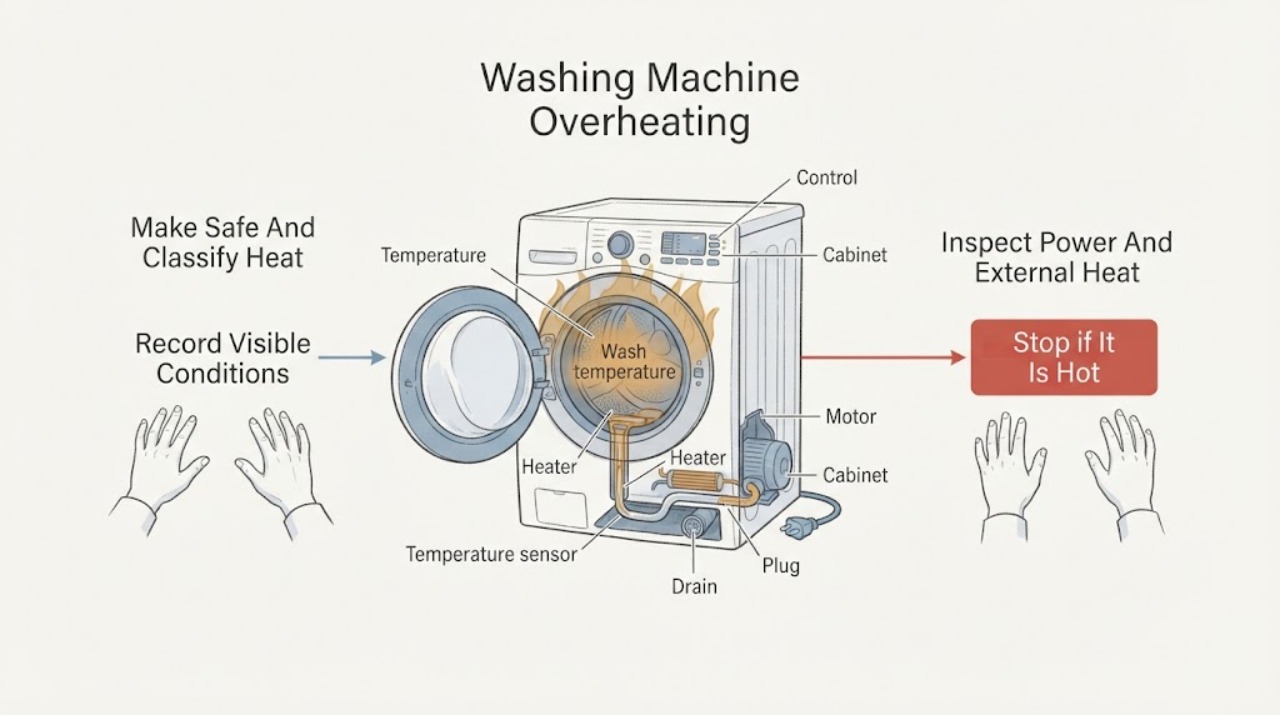
First separate normal heat in the selected wash water from abnormal heat at the cabinet, plug, cord, socket, or control area. Stop the washer, keep clear of steam and hot water, and isolate power only from a dry safe position if there is smoke, a burning or melting smell, a spark, a repeated trip, visible melting, or water near electrical equipment. When the machine is cool and dry, record the programme and temperature, the point in the cycle where heat appears, any code, and whether the drum drains and turns. Make only external, model-specific checks for the inlet, drain path, load, and visible movement; do not open the cabinet, test live parts, or keep restarting a washer that is abnormally hot.
Work through in order
Diagnostic checks
Use only checks that match the exact appliance or system and its official guide.
-
Check 1
Press stop and keep clear of the door, steam, and hot water. Classify the heat without touching a hot area: note whether it is only wash water or door glass, or whether the cabinet, plug, cord, socket, or control area is abnormally hot. If there is smoke, burning or melting odor, a spark, visible damage, a repeated trip, or water near electrical equipment, isolate power only from a dry safe position and leave the washer off.
Expected result: Heat is limited to a selected hot programme and water, or it is concentrated at the cabinet, plug, cord, socket, or control area; a hazard sign may also be present.
Next step: For normal programme heat with no hazard, allow the washer to cool before the next checks. For abnormal external heat or any hazard sign, keep power isolated when safe and arrange qualified repair; do not touch, open, or re-run the appliance.
Stop if: Stop for smoke, flame, burning or melting odor, sparks, scorching, a hot or damaged plug or socket, repeated trips, uncontrolled heating, or water near electrical equipment.
Why this matters
Why: Hot water can be an expected programme result, while localized external electrical heat or a hazard sign indicates a fault that must not be tested again. Steam and hot water also create a scalding risk even when no electrical fault is present.
-
Check 2
After the washer is cool, record the exact model, selected programme, temperature setting, load type, and cycle stage when heat appeared. Note whether the heat occurs during filling, washing, draining, spinning, or after the washer stops, and whether the drum was turning and the programme advanced.
Expected result: Heat occurs only on a high-temperature programme, during a particular stage, after the cycle pauses, or even with no selected heating stage; the drum may also stop or the programme may stall.
Next step: Use the timing and setting to choose the relevant branch and give the exact details to a technician. Do not repeat a cycle solely to reproduce the heat, especially if the machine or plug was unusually hot.
Stop if: Stop if the washer remains hot after stopping, the door is locked over hot water, or any smoke, odor, spark, trip, leak, or abnormal noise appears.
Why this matters
Why: Heat in the water on a selected hot programme is a different lead from cabinet or control heat. A pause or stalled programme alongside unexpected heat raises concern about heater control, temperature sensing, drainage, or another model-specific fault.
-
Check 3
With the washer cool, dry, and disconnected from power, look without dismantling at the plug, cord, socket face, and accessible control surround. Look for discoloration, softened plastic, scorching, a loose connection, moisture, or a heat trail. Do not touch a suspected hot or damaged part, use an extension lead to bypass it, or perform a live voltage test.
Expected result: The plug, socket, cord, or control surround is discolored, softened, wet, or damaged; or all visible electrical surfaces look normal.
Next step: Leave a damaged or wet supply path unused and arrange qualified electrical or appliance assessment. If the visible supply path is normal, proceed only with cool, dry, non-invasive water and load checks.
Stop if: Stop for discoloration, melting, scorch marks, a loose or wet socket, exposed conductors, smoke, sparks, or a repeated circuit trip.
Why this matters
Why: Localized damage or heat at the supply path can indicate a dangerous connection or appliance fault and cannot be cleared by a reset. A normal visual check does not rule out an internal heating or control fault.
-
Check 4
When the washer is cool and power is safely isolated, inspect the visible water inlet hose, tap connections, drain hose, standpipe or waste connection, and floor around the appliance. If the drum is empty and the model handbook permits it, follow the handbook's filter procedure with a container and towels; do not remove a filter with hot or retained water.
Expected result: The washer has restricted supply, a kinked or displaced drain hose, standing water, a blocked-looking filter route, a leak, or no visible water-path issue.
Next step: Correct only an obvious external hose position when it is dry and safe, following the model handbook. Keep the washer off and request service for retained water, an internal wet point, a damaged hose, or any need for deeper access.
Stop if: Stop for hot or retained water, rapid leakage, sewage-contaminated water, water near electricity, a locked door, or any need to open a wet filter, hose, pump, or cabinet.
Why this matters
Why: Poor drainage can leave hot water in the appliance and make a programme pause or appear abnormal. A leak or retained hot water changes the safe access boundary; it does not justify opening the cabinet or guessing at a pump fault.
-
Check 5
Without restarting the washer, review the last load and observe the drum only after it is cool and empty or safely accessible: note whether the load was tightly packed, the machine rocked, the drum failed to turn, or a motor hum or abnormal mechanical noise occurred. Do not force the drum or remove panels.
Expected result: The load was overloaded or badly distributed, the machine moved, the drum did not turn, or the load and visible movement were normal.
Next step: Follow the handbook's load and leveling guidance only when the floor and electrical area are dry and safe. If the drum remains stalled, the motor area is unusually hot, or the symptom returns, stop using the washer and request repair.
Stop if: Stop for severe rocking, a stalled drum with burning odor, smoke, sparks, repeated trips, scraping or impact noise, or any need to reach into moving or powered machinery.
Why this matters
Why: An overloaded or unbalanced load can interrupt a programme and increase motor effort, but it does not explain a hot plug, melting, smoke, or control-area heat. A stalled drum with heat or a repeated pause needs model-specific diagnosis.
-
Check 6
Record every displayed or flashing code exactly, along with the model and whether the programme paused, failed to heat, pumped continuously, or stopped turning. Compare it with the exact Hotpoint handbook or model support page; do not infer a code from a generic light pattern and do not clear it before recording.
Expected result: The display shows a model-specific code, the code matches a heater or temperature-sensing family, the programme is paused, or no code is present.
Next step: Provide the exact code, model, programme, temperature, timing, and safety symptoms to qualified service. Follow only a reset explicitly allowed by the exact handbook, and do not repeatedly reset a washer that becomes hot or hazardous.
Stop if: Stop for a heater or sensor code with uncontrolled heat, a persistent code, a locked door with hot water, smoke, odor, sparks, a trip, or any request to bypass a safety device.
Why this matters
Why: Hotpoint's published examples associate F03 with temperature sensing and F07, F08, and F15 with heating or heater-control faults, while F02 concerns the motor circuit. The exact model still controls the interpretation, and no code does not rule out a dangerous fault.
-
Check 7
Only when the washer is cool and dry, the external supply and water paths are sound, no hazard was found, and the handbook permits it, decide whether one short normal check with an empty drum is appropriate. Stay nearby, do not touch the cabinet or controls if they heat abnormally, and stop at the first recurrence; skip the check when the original heat was localized to an electrical area or remained after stopping.
Expected result: The brief check remains normal, the same heat returns at a known stage, or abnormal heat, odor, noise, water, or an electrical symptom returns.
Next step: Keep the washer out of service for any recurrence and arrange qualified appliance repair. Supply the model, code, programme, temperature, cycle stage, load, visible heat location, and all safe observations.
Stop if: Stop immediately for any abnormal heat, smoke, burning or melting odor, sparks, trip, leak, hot plug or control area, unusual noise, or steam that cannot be safely managed.
Why this matters
Why: A normal brief check does not certify the appliance. A repeatable stage helps service separate programme heat from heater, sensor, drain, motor, or control trouble; a returning hazard means further operation is unsafe.
Use your observations
Decision map
Find the observation that best matches what you see, then follow the next safe action.
-
PATH 01Next step
What you see
The plug, cord, socket, cabinet, or control area is abnormally hot, discolored, melting, smoking, sparking, or tripping the circuit.
Do this next
Arrange qualified service and follow the exact model guidance.
Why this path and its safety boundary
Why it matters: Stop immediately. Do not touch or re-energize the washer; isolate power only from a dry safe position and arrange urgent qualified electrical or appliance help.
-
PATH 02Next step
What you see
Heat is limited to water, door glass, or steam during a selected high-temperature programme, with no abnormal cabinet or electrical heat and no fault indication.
Do this next
Arrange qualified service and follow the exact model guidance.
Why this path and its safety boundary
Why it matters: Allow the washer to cool and confirm the programme and temperature in the exact handbook. Do not assume that hot water proves the heater is safe if any odor, uncontrolled heating, or other symptom appears.
-
PATH 03Next step
What you see
A model-specific indication accompanies a pause, failed heating, or unexpected heat, especially an error in the temperature-sensing or heater family.
Do this next
Arrange qualified service and follow the exact model guidance.
Why this path and its safety boundary
Why it matters: Record the exact code and model, keep the washer off, and arrange qualified diagnosis. Hotpoint's code guidance treats F03, F07, F08, and F15 as service-relevant fault areas rather than user-adjustable settings.
-
PATH 04Next step
What you see
The programme pauses with hot or retained water, drains continuously, leaks, or the drain hose or filter route appears restricted.
Do this next
Arrange qualified service and follow the exact model guidance.
Why this path and its safety boundary
Why it matters: Do not open a filter or door against hot or retained water. Keep power and water isolated safely, use only the exact handbook's safe drain procedure, and request repair if the external route does not resolve the issue.
-
PATH 05Next step
What you see
The drum fails to turn, the programme stalls around movement, the load was tightly packed or unbalanced, or a motor-related indication is present.
Do this next
Arrange qualified service and follow the exact model guidance.
Why this path and its safety boundary
Why it matters: Keep the washer off until cool. Review load and leveling guidance without opening the machine; a repeated stall, motor-area heat, odor, noise, or code needs qualified service.
-
PATH 06Next step
What you see
The visible water path is normal but the plug, cord, socket, cabinet, or control area is unusually warm or the washer loses power.
Do this next
Arrange qualified service and follow the exact model guidance.
Why this path and its safety boundary
Why it matters: Do not substitute an extension lead, repeatedly reset the breaker, or test live parts. Leave the appliance isolated and arrange qualified electrical and appliance assessment.
-
PATH 07Next step
What you see
The cause remains unclear, the symptom returns after one safe external review, or there is no model-specific guidance for the observed code.
Do this next
Arrange qualified service and follow the exact model guidance.
Why this path and its safety boundary
Why it matters: Stop using the washer and provide the exact model, programme, temperature, code, heat location, timing, load, water level, and safety symptoms to qualified repair. Do not guess at a heater, sensor, motor, pump, or control replacement.
Helpful context
Understand the symptom
Make an overheating washer safe first
Press stop and keep hands, children, and pets away from hot water, steam, the drum opening, and the cabinet. If there is smoke, a burning or melting odor, a spark, a hot or discolored plug, a repeated circuit trip, or water around electrical equipment, do not run another cycle. From a dry safe position, isolate power at the plug or electrical panel only when doing so does not require touching wet equipment; otherwise keep clear and arrange urgent qualified help. Never open the cabinet or probe the controls while energized.
Normal hot water is not the same as an overheated appliance
A high-temperature programme can produce hot water, warm door glass, and steam when the door is eventually opened. That is different from a cabinet, plug, cord, socket, or control area that becomes abnormally hot, smells of burning plastic, changes color, or stays hot after the cycle stops. Record the selected programme and temperature, whether the heat appeared during filling, washing, draining, or spinning, and whether the drum was turning and emptying normally. This timing is a clue, not proof that a particular component has failed.
Use external checks and the exact model handbook
When the washer is cool, dry, and safely isolated, inspect only visible hoses, the drain route, the seal, dispenser, plug, and cord. Check the model handbook before touching a filter or changing a programme because Hotpoint access and codes vary by model. If the drum contains hot water, do not force the door or remove a filter. Do not tip the washer, bypass a door lock, perform live electrical tests, or replace an internal heater, sensor, pump, or control board from a symptom alone.
Stop conditions
Stop immediately for smoke, flame, sparks, an electrical smell, melting or scorching, a hot or damaged plug or socket, repeated trips, uncontrolled heating, a locked door with hot water inside, rapid water leakage, or any need to work inside the cabinet. Keep the washer out of service until qualified repair has established whether the problem is electrical, heating, drainage, motor-related, or caused by another fault.
Safety boundary
Stop conditions
- Smoke, flame, sparks, a burning or melting odor, scorch marks, visible melting, or a hot or damaged plug, cord, socket, or control area.
- A repeated circuit trip, uncontrolled heating, or heat that remains abnormal after the washer is stopped.
- Hot or retained water behind a locked door, rapid leakage, water near electrical equipment, or a need to reach into pooled water.
- A stalled drum with burning odor, severe rocking, impact noise, or any need to remove panels or work near energized parts.
- Any need to bypass a door lock, perform a live electrical test, tip the washer, or remove a wet filter, pump, hose, heater, sensor, or control.
- The overheating symptom returns after one safe external review or its source cannot be identified from the model handbook.
Only after diagnosis
Potential parts
- temperature sensor
Consider this category only when the exact model documentation or qualified diagnosis links the symptom or a model-specific code to temperature sensing.
Confirm the full model identifier and connector or mounting details before selecting any replacement; do not infer fit from appearance. - washing machine heater assembly
Consider this category only after a qualified check or exact model guidance identifies a heater or heater-control fault; abnormal cabinet or supply heat is not proof of a heater failure.
Confirm the exact model, heater shape, rating, sensor opening, and safe replacement procedure before sourcing a part. - drain pump or filter-path component
Consider this category only when retained water or a drain-stage fault is confirmed and the exact model identifies the failed component.
Confirm model, pump configuration, hose routing, and safe water-removal procedure; do not open a wet appliance based on a symptom alone.
When checks do not resolve it
Need a professional?
The plug, cord, socket, cabinet, or control area is hot, damaged, discolored, melting, smoking, or associated with a trip., A Hotpoint heater, temperature-sensing, motor, or control code persists, or the programme pauses with abnormal heat., The washer retains hot water, will not drain, leaks, or has a locked door that cannot be safely opened under the exact model instructions., The drum stalls, rocks severely, makes abnormal noise, or the machine becomes hot around the motor or cabinet., The cause is unclear or the overheating returns after a safe, external inspection.
Common questions
FAQ
Is a Hotpoint washing machine supposed to feel hot during a hot wash?
Hot water, warm door glass, and steam can occur on a selected high-temperature programme. A cabinet, plug, socket, cord, or control area that becomes abnormally hot, smells of burning plastic, discolors, or stays hot after stopping is not a normal heat check; keep the washer off and arrange qualified help.
What should I do if my Hotpoint washer smells like burning?
Stop the cycle and do not run it again. If it is dry and safe, isolate power from a dry position; otherwise keep clear. Smoke, sparks, melting, a hot plug or socket, or repeated trips require urgent qualified electrical or appliance help, not a reset or cabinet inspection.
Can a blocked drain make a Hotpoint washing machine overheat?
A restricted drain can leave water in the washer and make a programme pause or pump run abnormally, but it does not prove that a heater or motor is overheating. When the machine is cool, use only the exact handbook's safe external drain or filter procedure; never open a filter against hot or retained water.
What Hotpoint codes can be related to heat or heating control?
Hotpoint's published guidance lists F03 for temperature sensing and F07, F08, and F15 for electronic, heater, or heater-control fault areas. Codes vary by model, so record the exact code and model and use the matching handbook; do not assume a code identifies a replaceable part.
Can I run one more cycle to confirm the overheating?
Do not repeat a cycle when heat was localized to the cabinet or electrical supply, or when there was an odor, smoke, spark, trip, melting, leak, or abnormal noise. Only a brief model-approved check is reasonable after the washer is cool and dry, the visible routes are safe, and no hazard was found; stop at the first recurrence.
Read the exact guide
Official sources
- Washing Machine Error Codes Troubleshooting Guide - Hotpoint - HotpointHotpoint · Hotpoint washing machine temperature-sensing, heater, motor, drain, and control fault-code guidance
- Washing Machine Troubleshooting - Quick fixes & Tips - Hotpoint - HotpointHotpoint · Hotpoint washing machine power isolation, water supply, drain, load, door, and safe troubleshooting guidance
- Hotpoint's Washing Machine Cleaning GuideHotpoint · Hotpoint washing machine seal, dispenser, filter, unplugging, water capture, and model-specific cleaning guidance
Community feedback
Share a repair observation
Share a plain-text repair observation. Accepted observations are published automatically; this page may take a moment to update.