
On this page
Start here
Quick answer
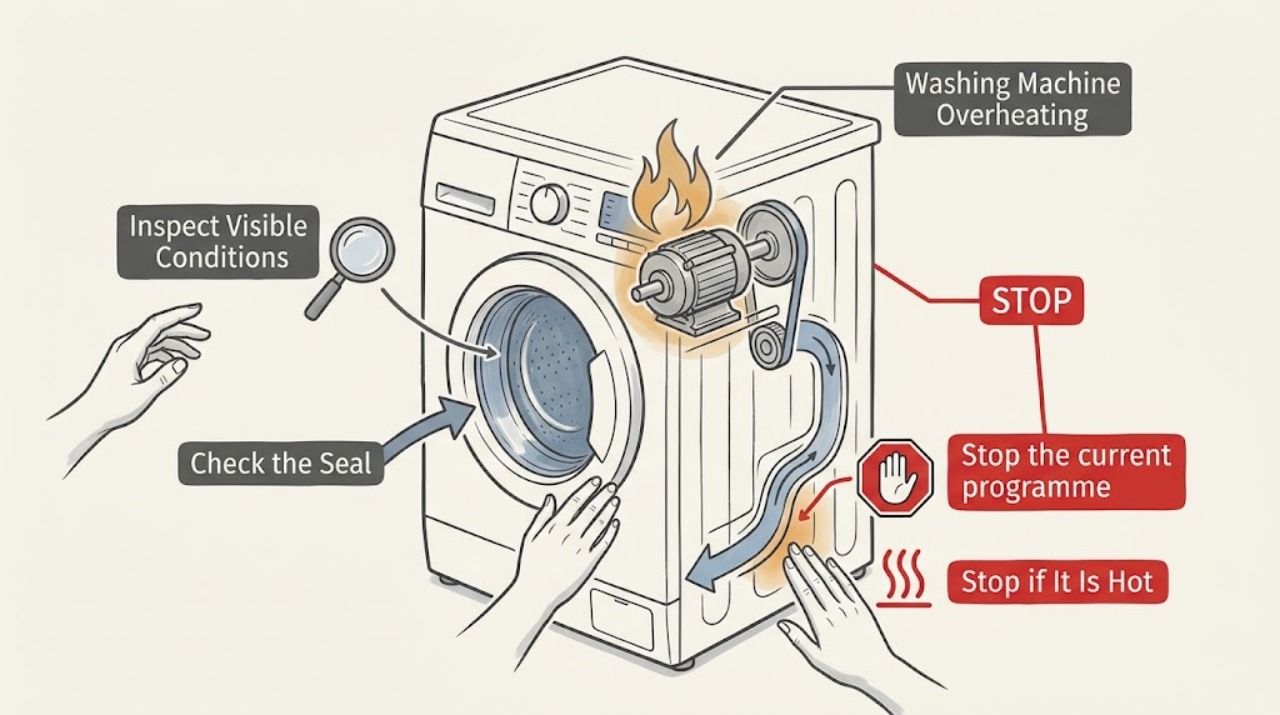
If a Beko washing machine feels unusually hot, smells like burning, smokes, or trips power, stop the cycle immediately, disconnect it only if this can be done safely, and arrange qualified service. If there is no burning symptom, first separate a normal warm wash from an overheating fault: check the selected cycle and water connection, reduce an overloaded load, inspect the accessible door seal and drum for trapped items, and clean the filter and detergent residue according to the model manual. Beko identifies the motor and transmission as possible sources of overheating and advises professional help for mechanical or electrical faults. Do not open the cabinet, bypass a safety device, or keep restarting a machine that is overheating.
Work through in order
Diagnostic checks
Use only checks that match the exact appliance or system and its official guide.
-
Check 1
Stop the current programme and classify the symptom from outside the machine: note whether the warmth is limited to a hot wash, or whether there is a burning odor, smoke, scorching, a very hot casing, unusual noise, or a tripped power device.
Expected result: Only the door or water is warm after a selected hot programme, or an overheating warning sign is present.
Next step: For any burning odor, smoke, scorching, or repeated trip, stop use and arrange qualified service immediately. If the symptom is only expected programme warmth, continue with the low-risk load, seal, filter, and connection checks after the machine cools.
Why this matters
Why: Expected process heat can occur during a hot wash, but burning odor, smoke, scorching, abnormal heat, or repeated power trips indicates a possible mechanical or electrical fault.
-
Check 2
Check the power connection without opening the appliance: make sure the plug is fully seated in a suitable wall socket, do not use an extension socket, and observe whether the socket or breaker stays stable.
Expected result: The wall socket is stable and the machine powers normally, or the socket, plug, cord, or breaker shows heat damage or will not remain on.
Next step: If there is damage, arcing, a burning smell, or a repeated trip, stop and obtain qualified electrical or appliance service. Do not replace wiring or repeatedly reset the breaker as a test.
Why this matters
Why: A stable supply makes a simple connection issue less likely; heat damage or an unstable circuit can be an electrical hazard and can also make the appliance appear to overheat.
-
Check 3
After the machine has cooled and there is no burning symptom, compare the load with the exact Beko model's capacity guidance, remove excess items, and redistribute the remaining laundry; check that no item is trapped between the door and seal.
Expected result: The drum was overloaded or unbalanced, or the load was within the model guidance and the door seal area is clear.
Next step: If the load was the only issue and no overheating sign remains, run one supervised programme using the model guidance. If heat, odor, abnormal noise, or a stalled drum returns, stop immediately and arrange service.
Why this matters
Why: Overloading can stress the drum and contribute to poor operation, while an item caught at the seal can interfere with closure and cause leaks or cycle problems; a correct load makes those causes less likely.
-
Check 4
Verify that the washing machine is connected to the water feed required by the exact Beko model, inspect the inlet hose for kinks or leaks, and look for a blocked or damaged drain hose without disconnecting a water-filled connection unsafely.
Expected result: The connection matches the manual and hoses are clear, or the hose is kinked, leaking, incorrectly connected, or the machine is being supplied in a way the model does not permit.
Next step: Correct only an accessible hose position or connection described in the manual. If there is a leak, damaged fitting, or uncertain plumbing, stop use and call a qualified appliance technician or plumber.
Why this matters
Why: Incorrect water setup can cause malfunction or damage, and restricted inlet or drain flow can extend cycles and leave the machine working abnormally; a correct connection removes that setup cause but does not prove the motor or controls are sound.
-
Check 5
With the appliance stopped and safely disconnected as directed by the manual, inspect the accessible pump filter, detergent drawer, drum opening, and door seal for lint, hair, coins, residue, or other debris; clean only user-accessible areas using the model instructions.
Expected result: A filter, drawer, drum, or seal contains residue or an object, or all accessible areas are clear.
Next step: Remove only safely reachable debris, refit the filter or drawer correctly, and perform one supervised test only if there has been no burning odor or smoke. If the machine remains hot, stops, leaks, or smells burnt, stop and arrange service.
Why this matters
Why: Beko links clogged filters, residue, trapped objects, and drainage issues with poor operation and unpleasant odors; a clear accessible path makes a simple blockage less likely but cannot clear an internal drive fault.
-
Check 6
From outside the cabinet during a permitted supervised test, note whether the drum rotates normally, struggles, stalls, or makes grinding or high-pitched noise; stop at once if heat or odor increases.
Expected result: The drum rotates smoothly, rotates with difficulty, stops while the controls remain on, or the machine produces abnormal noise or renewed heat.
Next step: If movement is difficult, the drum stalls, abnormal noise appears, or heat returns, stop use and arrange qualified service. Do not open the cabinet or attempt to repair the motor, transmission, wiring, control board, or safety system.
Why this matters
Why: Beko identifies the motor and transmission as critical to drum movement and notes that faults in these components can include difficulty moving the drum and overheating. Sound and motion narrow the symptom but do not identify an exact part.
Use your observations
Decision map
Find the observation that best matches what you see, then follow the next safe action.
-
PATH 01Next step
What you see
The only warmth is expected programme heat, with no burning odor, smoke, scorching, abnormal noise, or power trip.
Do this next
Check the model's cycle and loading guidance, then monitor one supervised cycle; stop if the symptom changes into abnormal heat or odor.
-
PATH 02Next step
What you see
The plug, socket, cord, or breaker shows heat damage, instability, or repeated trips.
Do this next
Stop using the washing machine and obtain qualified electrical or appliance service. Do not keep resetting the circuit or repair wiring yourself.
-
PATH 03Next step
What you see
The machine was overloaded, unbalanced, or has a clogged accessible filter, drawer, seal, or drum area and no burning symptom is present.
Do this next
Correct the accessible condition according to the exact Beko manual and perform only one supervised retest. Escalate if overheating or abnormal operation returns.
-
PATH 04Next step
What you see
The water connection or drain path is kinked, leaking, incorrectly configured, or blocked.
Do this next
Stop the machine, correct only an accessible setup issue described by the manual, and arrange appliance or plumbing service for leaks or uncertain connections.
-
PATH 05Next step
What you see
The drum struggles, stalls, grinds, or the machine becomes hot again after the simple checks.
Do this next
Stop use and arrange qualified service for a motor, transmission, control, sensor, or other internal diagnosis; do not open the cabinet.
-
PATH 06Next step
What you see
There is smoke, a burning smell, visible scorching, a leak near power, exposed wiring, or another immediate hazard.
Do this next
Stop the cycle, keep clear of the appliance, and obtain qualified appliance or electrical assistance before using it again.
Helpful context
Understand the symptom
Treat burning heat as a stop signal
A warm door after a hot programme is not enough to prove a fault. Burning plastic, rubber, or electrical odor; smoke; visible scorching; an unusually hot casing; repeated power trips; or a machine that becomes hotter while the drum stops are different. Stop the cycle and do not run another test. Keep clear of smoke or water near an electrical connection and use qualified appliance or electrical help.
What can make a Beko machine work harder
Overloading can stress the drum and drive system, while detergent or dirt residue, a clogged filter, or a restricted drain can leave the machine operating poorly. Beko also warns that ventilation and the correct water connection matter. These checks can remove simple causes, but they cannot prove that an internal motor, transmission, control, or sensor is safe.
Keep model differences in view
Beko washing machines use different programmes, filter layouts, controls, and safety systems. Use the exact model manual for temperature, cleaning, reset, and filter instructions. Do not substitute a general button sequence or open a panel because another model appears similar.
Only after diagnosis
Potential parts
- washing-machine motor or transmission component
Only consider a motor or transmission component after a qualified technician confirms abnormal drum movement or overheating with the load, water, drain, and accessible blockage causes excluded.
Confirm the exact Beko model and manufacturer's component information before ordering or replacing any part. - washing-machine control board or temperature sensor
Only consider a control or sensor component when a technician confirms incorrect temperature or cycle control after the power supply and mechanical checks are sound.
Do not infer compatibility from appearance; use the exact Beko model documentation and technician diagnosis. - washing-machine door seal
Only consider a door seal when inspection confirms a tear, deformation, or leak that cannot be corrected by cleaning or correct placement and a technician identifies it as the cause of the operating problem.
Confirm the exact Beko model and manufacturer's fit information before ordering any component.
When checks do not resolve it
Need a professional?
A qualified Beko technician should diagnose overheating that is accompanied by a burning odor, smoke, abnormal drum movement, repeated stopping, power instability, or recurrence after accessible load, filter, seal, and connection checks.
Common questions
FAQ
Is it normal for a Beko washing machine to feel warm during a hot cycle?
Some warmth can be expected during a hot programme, but burning odor, smoke, scorching, abnormal noise, a very hot casing, or repeated power trips are not normal. Stop immediately if any of those signs appear.
What should I do if my Beko washing machine smells like burning?
Stop the cycle and do not restart it. If it can be done safely, disconnect the appliance, keep clear of smoke or damaged wiring, and arrange qualified appliance or electrical service.
Can an overloaded Beko washing machine overheat?
An overloaded or unbalanced load can stress the drum and drive system and cause poor operation. Reduce and redistribute the load only after the machine is cool and there is no burning symptom; recurring heat or noise needs service.
Can a blocked filter cause a Beko washing machine to run abnormally hot?
A blocked filter or drain path can interfere with operation and leave residue or stagnant water. Clean only the model-accessible filter as instructed, then stop and arrange service if heat, odor, leaks, or cycle failures continue.
Read the exact guide
Official sources
- Why does my washing machine smell and how to get rid of itBeko UK · Beko's official guidance on odor causes, ventilation, residue, clogs, overload, filter cleaning, and burning odor escalation.
- How to connect your washing machine to the powerBeko UK · Beko's official power-connection guidance for a suitable wall socket and identifying a possible electrical fault.
- How To Clean A Washing MachineBeko UK · Beko's official cleaning and maintenance guidance for drum, detergent residue, and model-specific cleaning programmes.
- Washing Machine Parts and Components ExplainedBeko UK · Beko's official component guidance on the drum, drain path, motor and transmission, wiring, controls, and sensors.
- How to Solve Problems with Your Washing MachineBeko UK · Beko's official troubleshooting guidance for starting, water supply, pump filter, power, loading, and child-lock issues.
Community feedback
Share a repair observation
Share a plain-text repair observation. Accepted observations are published automatically; this page may take a moment to update.