
On this page
Start here
Quick answer
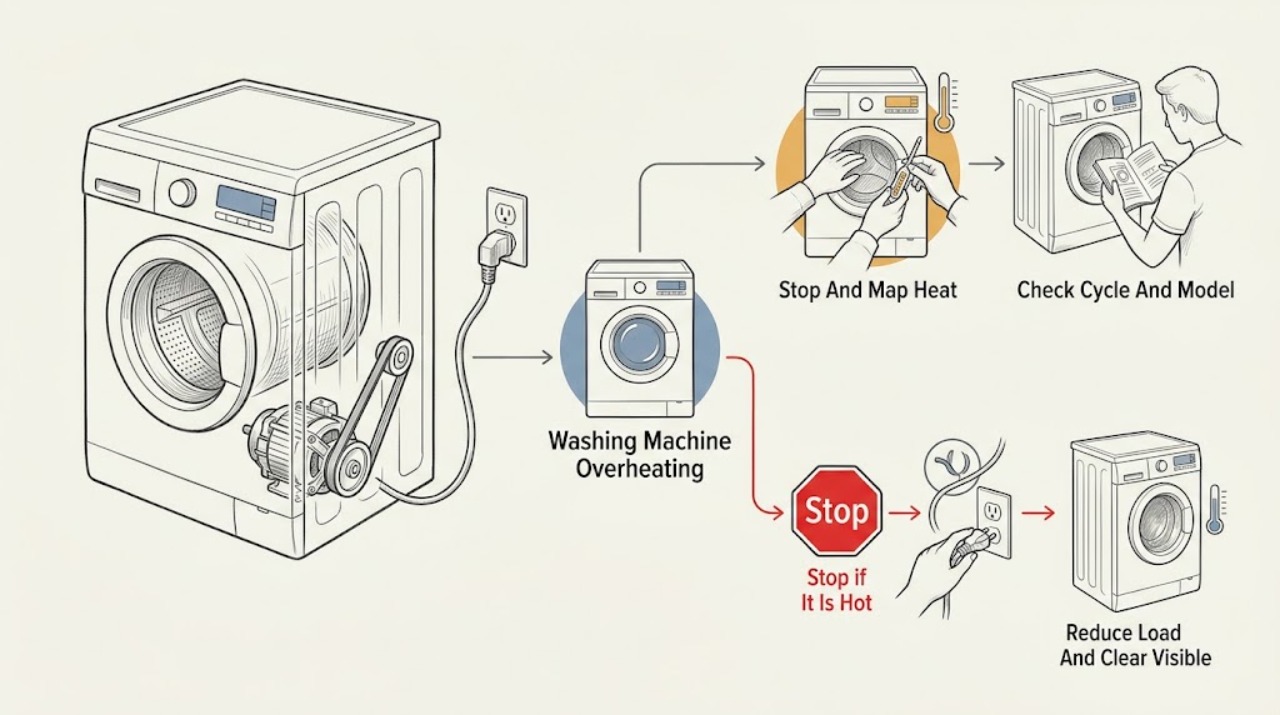
Treat an LG washing machine that is unusually hot, smells of burning, smokes, sparks, trips a breaker, or feels unsafe as stopped until proven otherwise. Some LG models have motor protection that pauses the washer for a few minutes and then restarts, and a new front-load unit may have a mild motor-coil or insulation odor that fades after roughly 10 to 20 full cycles. Those limited behaviors do not make smoke, a hot electrical smell, melted material, a hot plug, repeated trips, water near electricity, or a drum that is mechanically jammed safe. First record the exact model, cycle, stage, display code, load, and whether the heat is at the plug, control panel, door, cabinet, drum, or water. From a dry, safe position, stop the cycle, let accessible surfaces cool, check only the load, visible gasket or filter debris, ventilation, and power connection, and perform at most one model-authorized reset. Do not open the cabinet, bypass a thermal protector, or perform live electrical checks. Persistent heat or any danger sign needs qualified LG appliance or electrical service.
Before you begin
Safety first
- Keep the washer out of service after smoke, burning odor, abnormal heat, arcing, water at electrical parts, shock, or repeated power trips until the appropriate professional clears it.
Work through in order
Diagnostic checks
Use only checks that match the exact appliance or system and its official guide.
-
Check 1
Stop the cycle and, from a safe dry position, disconnect the washer only if the plug and outlet are dry and reachable without contact with water or a hot surface. Keep children away and allow accessible surfaces to cool. Record the exact model, front-load or top-load type, cycle and stage, load size, display code, and the location of heat or odor without opening the cabinet.
Expected result: Classify the event as a short protection pause with no abnormal heat, a hot motor or cabinet, hot plug or outlet, hot door or drum during a confirmed drying or sanitary cycle, burning rubber or electrical odor, smoke, spark, melted material, or water near electricity. Note whether the drum turns normally by its intended controls, but do not force it by hand while hot or powered.
Next step: Use the exact model manual to identify any documented protection or heating behavior. If a stop condition is present, keep the washer isolated and arrange qualified service; do not restart it to collect more evidence.
Stop if: Stop immediately for smoke, burning or hot electrical smell, visible spark or arc, melted plastic, shock, water at electrical parts, an unusually hot plug or outlet, a repeated breaker trip, or a drum that is seized or striking the cabinet.
Why this matters
Why: Location and timing separate a possible model-protection response or combo heating phase from a power-contact, drive, heater, or control fault. Smoke, sharp odor, arcing, or heat at the supply connection is not a routine washer temperature complaint.
-
Check 2
Compare the recorded stage with the exact LG model's manual: ordinary wash or spin, a high-temperature wash, a sanitary cycle, or a drying phase on a confirmed washer-dryer combo. Check the panel for a code such as LE, CE, tE, HE, dHE, PF, or another code, and write it exactly as displayed rather than assigning a meaning from another model.
Expected result: Determine whether heat appears only during a documented high-temperature or drying phase, follows motor movement or spin, occurs while the unit is idle, or accompanies a code and a stop. Note whether the motor pauses briefly and then resumes without odor or unusual heat.
Next step: Follow only the matching model guide. If the code returns, the pause repeats, or the heat is not explained by the confirmed cycle, leave the unit off and provide the code and stage to service.
Stop if: Stop for a code associated with overheating, over-current, heater failure, smoke, burning odor, abnormal heat, water near power, or repeated power interruption.
Why this matters
Why: LG documentation distinguishes model-specific motor protection, heating errors, over-current, and drying behavior. A short protection pause is different from a persistent hot motor, over-current code, or a heater or control error; code meanings can vary by model and product type.
-
Check 3
With the washer unplugged and cool, remove a heavy or tightly packed load and inspect only accessible areas: the door gasket, drum opening, lint or pump-filter access described by the model manual, and the visible space around the wash plate on an applicable top-load model. Remove only a loose, visible item with an appropriate tool; do not reach into hidden drive or heater areas.
Expected result: Record whether the washer was overloaded, whether laundry or a small rubber object was trapped, whether a coin or foreign object is visible, or whether the drum or wash plate remains obstructed or difficult to move under the model's safe instructions.
Next step: Correct only a clearly excessive load or visible item, then allow the washer to cool and perform no more than one model-authorized test. If the drum remains obstructed, the noise or heat persists, or a part is hidden behind a panel, request service.
Stop if: Stop for a jammed drum, sharp metal, exposed wiring, a damaged gasket, melted rubber, smoke, hot odor, or any need to remove a panel or bypass a safety device.
Why this matters
Why: LG links overload, trapped objects, motor strain, and debris in the gasket, filter, or tub with motor or burning-rubber symptoms on applicable models. A clear accessible area with persistent heat points toward an internal drive, motor, heater, sensor, or control issue rather than a user-removable obstruction.
-
Check 4
Only when everything is cool and dry, inspect the plug, cord, outlet face, and accessible connection for looseness, discoloration, deformation, moisture, or heat damage. Confirm the washer is connected directly to an appropriate wall outlet rather than a power strip. Do not remove the outlet cover, use an extension lead, or perform an energized meter check.
Expected result: Classify the connection as cool and secure, loose, discolored, warm or hot, wet, damaged, or repeatedly tripping the circuit. Note whether other high-power appliances share the circuit, but do not keep switching the breaker to test the washer.
Next step: If the connection is cool and sound, retain the observation for one model-authorized check only. If it is loose, hot, discolored, wet, damaged, or trips again, leave the washer disconnected and arrange qualified electrical inspection before use.
Stop if: Stop for any wet electrical area, hot or discolored plug or outlet, buzzing or arcing, damaged cord, shock, smoke, or a repeated breaker trip.
Why this matters
Why: LG explains that a loose plug can generate heat at the contact point and that a power strip can overload when high-power devices share it. Heat or damage at the supply point can be an electrical fault even when the washer itself has not yet shown a code.
-
Check 5
If the appliance is a confirmed LG washer-dryer combo, compare the heat and odor with the exact drying or sanitary-cycle instructions; if it is a standalone washer, skip this branch. Check that the load, lint or dust, gasket and tub condition match the model's care guidance. Do not operate a drying heater or sanitary program merely to reproduce a burning smell.
Expected result: Record whether the heat occurred only in a named drying or high-temperature phase, whether the drum or gasket was hot without smoke, whether lint or foreign material was visible, or whether the odor was electrical, rubber-like, chemical, or getting stronger.
Next step: For a mild, model-documented initial odor with no danger signs, follow the exact care instructions and monitor without repeated testing. For persistent or worsening odor, smoke, scorching, or unexplained heat, stop and request service.
Stop if: Stop for smoke, sharp electrical or rubber odor, scorched fabric, melted gasket, abnormal surface heat, water near electricity, spark, or a drying cycle that will not stop.
Why this matters
Why: LG says a combo washer may produce heat and a slight initial odor during drying or sanitary operation, but it also identifies persistent electrical or burning-rubber odor as a reason for service. A standalone washer does not inherit the combo heater explanation.
-
Check 6
After the washer is cool, dry, unloaded or correctly loaded, and free of any stop condition, perform at most one reset using the exact model's documented control sequence. Run one short, supervised ordinary cycle or the model's specified test; remain nearby and do not reset a breaker to continue a dangerous cycle.
Expected result: Record whether the washer runs without unusual heat, whether the motor pauses once and recovers as the manual describes, whether a code returns, or whether heat, odor, smoke, noise, leakage, or power interruption recurs.
Next step: Stop after this one supervised attempt. Leave the washer out of service and arrange qualified LG appliance or electrical service if the symptom returns or the cause remains uncertain.
Stop if: Stop immediately for smoke, burning smell, hot plug, spark, abnormal heat, water near electricity, violent movement, a jam, or a repeated trip.
Why this matters
Why: A single clean run after a clear load or temporary protection event can support a transient explanation. Recurring heat, a returning code, a repeated protective pause, or any danger sign indicates a component, power, or installation fault that needs diagnosis.
Use your observations
Decision map
Find the observation that best matches what you see, then follow the next safe action.
-
PATH 01Next step
What you see
The washer pauses for a few minutes and restarts once, with no odor, smoke, abnormal heat, code, or power symptom, and the exact model manual documents motor protection.
Do this next
Reduce an excessive load, monitor one ordinary cycle, and stop if the pause repeats or any heat or odor appears.
Why this path and its safety boundary
Why it matters: The pause may be the model's motor-protection response rather than a dangerous overheating event.
-
PATH 02Next step
What you see
A heavy or tangled load, visible foreign object, or unbalanced condition appears during spin and the washer cools normally after stopping.
Do this next
Unload or redistribute only as the model guide directs, clear an accessible object, and make one supervised test; arrange service if heat or noise returns.
Why this path and its safety boundary
Why it matters: Load or obstruction can strain the drive and cause heat, noise, or protective behavior.
-
PATH 03Next step
What you see
The plug or outlet is hot, loose, discolored, wet, buzzing, damaged, or the breaker trips again.
Do this next
Leave the washer disconnected and obtain qualified electrical inspection before reuse. Do not use a power strip or extension lead to bypass the issue.
Why this path and its safety boundary
Why it matters: The supply connection may be generating heat or has an electrical fault independent of the washer's internal components.
-
PATH 04Next step
What you see
The appliance is a confirmed washer-dryer combo and the heat occurs only during a documented drying or sanitary phase, with a mild initial odor and no smoke, scorching, or electrical symptom.
Do this next
Follow the model care instructions, clean only the accessible gasket or lint area as directed, and monitor without repeating a smell-producing cycle.
Why this path and its safety boundary
Why it matters: LG describes heat at the drum and gasket during applicable combo cycles; the exact model still controls the expected behavior.
-
PATH 05Next step
What you see
Heat persists in ordinary wash or spin, a code returns, the motor is hot or jammed, the drum strikes, or the washer overheats again after one reset.
Do this next
Keep the washer out of service and arrange qualified LG appliance diagnosis with the exact model, code, cycle stage, load, and observations.
Why this path and its safety boundary
Why it matters: An internal motor, drive, bearing, heater, sensor, wiring, control, or installation fault is more likely than a temporary pause.
Helpful context
Understand the symptom
A protective pause is not the same as an overheating appliance
LG's WM4080 owner manual says a motor-protection device may stop the washer for a few minutes and then restart to prevent motor overheating. A short pause with no odor, smoke, abnormal heat, or electrical symptom can therefore be a protection response on a model with that design. The manual is model-specific, so do not assume every LG washer behaves identically. If the pause repeats, the motor is hot, the drum is hard to turn, the load is jammed, or the washer smells or looks damaged, leave it off and arrange service.
Drying or sanitary heat applies only to a confirmed combo model
LG notes that a front-load washer-dryer can create heat during drying or sanitary cycles, and that the hot drum and door gasket may produce a slight odor, especially during initial use. That information does not establish that a standalone washer should become very hot. Confirm whether the appliance is a washer-dryer combo and identify the exact model before treating a warm cycle as expected. Smoke, a sharp electrical or rubber odor, melted material, scorching, or heat that is rising is a stop condition on either type.
Power and water make heat more urgent
LG says a loose plug connection can generate heat at the contact point and recommends connecting the washer directly to a wall outlet rather than a power strip. A wet appliance, cord, outlet, or floor adds shock risk. Stop from a safe dry position; do not touch a wet plug or inspect live wiring. If a breaker trips again after a cool-down or the outlet or plug is discolored, leave the washer out of service for qualified electrical and appliance inspection.
Only after diagnosis
Potential parts
- drive motor or motor protection component
Consider this only after a qualified diagnosis links recurring motor heat, a motor-protection event, an overload code, or a seized drive to the motor rather than the load, object, bearing, wiring, or control.
Confirm the complete LG model and revision; do not select a motor from an overheating symptom alone. - drive or drum-support component
Consider this only when qualified inspection finds a persistent mechanical scrape, grinding, excessive play, or drum obstruction after load and visible-object checks are clear.
Fitment and repair method vary by model; keep the cabinet closed until the technician identifies the failed assembly. - temperature sensor or heater assembly
Consider this only for a confirmed combo or heated model when a model-specific heating or temperature code and professional diagnosis identify the sensor or heater as the cause.
Heating assemblies are model-specific and require safe isolation and exact fit verification; do not test live.
When checks do not resolve it
Need a professional?
Safety scope: Keep the washer out of service after smoke, burning odor, abnormal heat, arcing, water at electrical parts, shock, or repeated power trips until the appropriate professional clears it.
Common questions
FAQ
Can an LG washer stop because its motor is too hot?
Some LG models document a motor-protection device that stops the washer for a few minutes and then restarts. Treat that as a limited model-specific behavior only when there is no odor, smoke, abnormal heat, jam, code, or power symptom. If the pause repeats or the motor remains hot, stop and arrange service.
Is a burning smell from an LG washer always dangerous?
LG notes that a mild odor can occur from new motor coils or, on applicable washer-dryer models, hot gasket and heater conditions during early drying or high-temperature use. That does not make smoke, a sharp electrical or rubber odor, scorching, melting, or rising heat safe. Stop for those signs and request service.
Could an overloaded LG washer overheat?
An excessive or tangled load can strain the drive and contribute to motor protection or unbalanced operation. Unload or redistribute the load only after the washer is cool and isolated, then make no more than one model-authorized test. Repeated heat, a jam, or a returning code needs diagnosis.
What does a hot plug or outlet mean on an LG washer?
LG warns that a loose plug can generate heat at the contact point and recommends a direct wall outlet rather than a power strip. Leave the washer disconnected if the plug or outlet is hot, loose, wet, discolored, damaged, buzzing, or repeatedly trips; have a qualified electrician inspect it before reuse.
When should I stop troubleshooting an LG washer that is overheating?
Stop for smoke, burning or hot odor, melted material, abnormal heat, sparks or arcing, shock, a hot or wet electrical connection, water near power, a jammed or violently moving drum, or a repeated breaker trip. Keep the washer out of service and arrange qualified appliance or electrical help.
Read the exact guide
Official sources
- LG Washer – Troubleshooting an Electrical or Burning Rubber SmellLG USA Support · LG front-load washer odor guidance; do not generalize a mild new-unit odor to smoke, heat damage, or a different product type.
- WM4080 2023 Owner's ManualLG · The WM4080 model manual; use motor-protection details only when the user's model has the same documented behavior.
- LG Front Load Washer - Error Code List(New)LG USA Support · LG front-load error-code guidance; codes and reset procedures vary by model.
- [LG Front Load Washer] Burning Smell During UseLG USA Support · Applicable only when the appliance and selected cycle have the described heating or drying function; models and details vary.
- LG Washer - Troubleshooting Noises During the CycleLG USA Support · General LG washer noise guidance; use the applicable front-load or top-load branch for the exact product.
- [LG Front Load Washer] Washer powers off during useLG USA Support · LG front-load washer power guidance; electrical work remains a qualified-professional task.
Community feedback
Share a repair observation
Share a plain-text repair observation. Accepted observations are published automatically; this page may take a moment to update.