
On this page
Start here
Quick answer
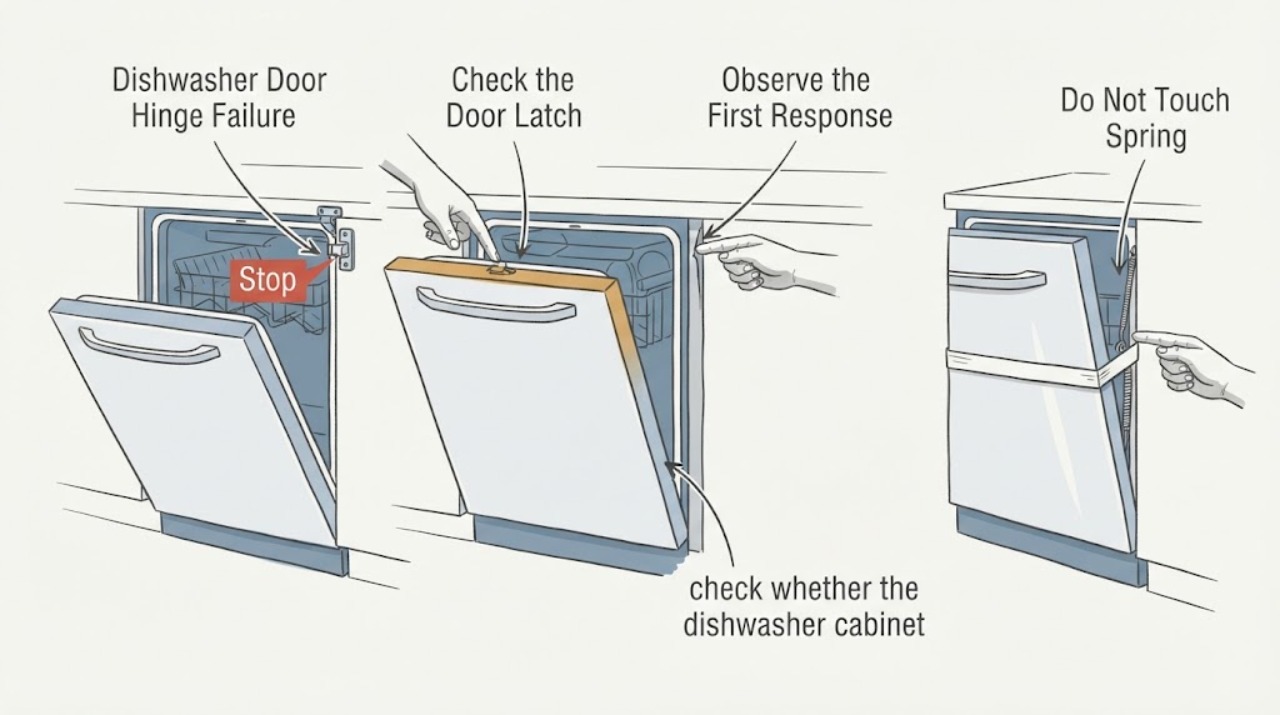
Treat an Asko dishwasher door that drops, rubs, sits out of square, or will not remain safely open as a mechanical and installation issue until the exact model is identified. Stop loading or running it, support the door without putting fingers into the hinge gap, and look only for visible misalignment, an obstruction, or a cabinet that has shifted. Do not pull an integrated dishwasher out alone, remove the door panel, replace both hinges from a generic parts listing, or test the appliance with a loose door. ASKO's installation instructions require qualified handling for appliance connections and emphasize two-person handling, leveling, anti-tip support, and a safe water shutoff. Arrange model-specific service if the door falls, the hinge or spring is bent, the latch no longer aligns, the cabinet moves, or the dishwasher cannot be kept safely closed.
Before you begin
Safety first
- Do not pull out an integrated dishwasher alone, remove the door panel, work under the appliance, handle a loaded spring or cable, run the appliance with a loose door, or perform electrical, water, or drainage connection work without qualified help.
Work through in order
Diagnostic checks
Use only checks that match the exact appliance or system and its official guide.
-
Check 1
Stop the dishwasher and remove dishes only if the door can be moved without force. Keep the door supported in a stable position and keep hands, children, and pets away from the hinge gap and a door that can fall. Do not start another cycle to see whether the latch still holds.
Expected result: The door drops, springs upward, rubs, twists, cannot stay open, or can be closed and latched without abnormal force.
Next step: Leave the dishwasher unused and arrange model-specific service if the door is unstable or cannot latch normally. Do not hold it open by hand while operating the dishwasher.
Why this matters
Why: A falling, twisting, or unstable door is a stop-use condition, but the movement does not identify whether the hinge, spring/cable balance, latch, or cabinet alignment is responsible.
-
Check 2
With the appliance empty and unpowered, inspect only the visible door edges, gasket, latch area, and cabinet gaps. Look for a hinge or mounting area that is visibly bent, a loose screw head, a displaced seal, an obstruction, or one side of the door sitting higher than the other. Do not remove the inner or outer door panel.
Expected result: A visible obstruction or seal displacement is present, the door is visibly skewed or damaged, or the accessible surfaces look normal.
Next step: Remove only a loose, accessible obstruction without force and recheck the closed-door fit once. For bent hardware, a loose mounting area, or persistent skew, stop and provide photos to qualified service rather than tightening hidden hardware.
Why this matters
Why: An obstruction or seal position can affect alignment, while a skewed or damaged door supports a service inspection. A normal exterior view does not clear a concealed hinge, spring, cable, or mounting fault.
-
Check 3
From outside, check whether the dishwasher cabinet has shifted, rocks, contacts the countertop, or sits visibly out of level. Do not pull an integrated dishwasher forward or adjust feet while it is connected; do not work under the unit alone.
Expected result: The cabinet moves or leans, the door catches on surrounding cabinetry, or the unit appears stable and level from its accessible position.
Next step: Leave a shifted or unstable unit unused and have two qualified people or an authorized technician inspect its mounting, anti-tip support, and door balance. Do not improvise a shim or continue running it while the cabinet moves.
Why this matters
Why: Installation movement or leveling can change door alignment and load the hinge area, but an external lean does not prove that the hinge itself has failed.
-
Check 4
Record whether the latch engages squarely, whether the door leaks at the front, and whether the machine has a separate water or electrical symptom. If water is present, use the accessible shutoff only when it can be reached safely and keep power away from wet areas.
Expected result: The latch misses, the door leaks, water or electrical connections are exposed, or the door closes and seals normally despite the reported movement.
Next step: Do not run the dishwasher with a missed latch or leak. Shut off water and power only through safe, accessible controls and arrange qualified service for any connection or leak issue.
Why this matters
Why: A missed latch or front leak increases the risk of continued use; the door movement may be affecting sealing but does not identify the failed part. A normal seal does not rule out a hinge or balance problem.
-
Check 5
Read the complete rating-plate model and serial information before searching for a hinge, spring, cable, latch, or door assembly. Record the market and whether the unit is fully integrated, panel-ready, or freestanding; do not order a part from a generic Asko hinge listing.
Expected result: A complete model identity is available, or only the Asko brand and a general dishwasher description are known.
Next step: Give the exact model, serial, door behavior, photos, and any leak or mounting observations to Asko support or qualified service. Keep the dishwasher out of use if the door is unstable.
Why this matters
Why: Door hardware and installation arrangements vary by model and panel configuration. The community report does not provide enough identity to establish a compatible part or safe removal sequence.
-
Check 6
Do not remove the door, hinge spring, cable, panel, or mounting screws as a first test. If a technician confirms a hinge or balance component, ask for the exact model-specific procedure and whether the door must be supported by two people before any repair.
Expected result: The suspected failure is concealed or the door requires disassembly to verify it, or a qualified provider has confirmed the exact failed assembly.
Next step: Keep the unit isolated and use qualified model-specific service for concealed hardware, door removal, or balance adjustment. Do not substitute a different model's service manual.
Why this matters
Why: A suspected hinge failure is not enough to justify a generic replacement sequence; an unsupported door or spring can move suddenly and the wrong part can change balance or sealing.
Use your observations
Decision map
Find the observation that best matches what you see, then follow the next safe action.
-
PATH 01Next step
What you see
The door drops, rises unexpectedly, twists, or cannot remain safely open or latched.
Do this next
Stop using the dishwasher and arrange model-specific service. Do not hold the door during a cycle or attempt a generic hinge replacement.
Why this path and its safety boundary
Why it matters: This is consistent with a door-balance or alignment fault, but it does not distinguish hinge, spring/cable, latch, or cabinet mounting failure.
-
PATH 02Next step
What you see
The dishwasher rocks, leans, contacts the countertop, or the door alignment changes when the cabinet moves.
Do this next
Keep the appliance unused and have qualified, two-person service inspect leveling, anti-tip support, and door balance. Do not pull out or resecure an integrated unit alone.
Why this path and its safety boundary
Why it matters: Mounting or leveling may be contributing to the door problem; a hinge diagnosis cannot be made while the installation is unstable.
-
PATH 03Next step
What you see
The latch misses, the door no longer seals, water leaks at the front, or water reaches an electrical area.
Do this next
Stop the cycle, use a safe accessible water shutoff, keep power away from wet areas, and arrange qualified appliance service. Do not run another test cycle.
Why this path and its safety boundary
Why it matters: Continued operation could allow water or electrical damage, regardless of which mechanical part is responsible.
-
PATH 04Next step
What you see
The owner can describe an apparent hinge failure but cannot provide the complete Asko model and serial identity.
Do this next
Obtain the rating-plate information or have Asko service identify the unit before selecting a hinge, spring, cable, latch, or door assembly.
Why this path and its safety boundary
Why it matters: The symptom is credible, but compatible hardware and a safe door-removal procedure remain unscoped.
Helpful context
Understand the symptom
The exact supplied Reddit post establishes the problem identity: the author says an older Asko dishwasher door hinge appears to have failed and is considering replacing both hinges. The post does not identify a model or report a verified repair, so it supports symptom framing only. A hinge, spring or cable, latch, cabinet alignment, or installation issue can produce similar door behavior and cannot be separated by the title alone.
ASKO's opened installation instructions for a different named dishwasher model provide the relevant safety boundary: use two people for handling, level and secure the unit, keep the water shutoff accessible, and use qualified professionals for electrical, water, and drainage connections. They do not establish a universal Asko hinge design or a compatible replacement part for an unidentified dishwasher.
Only after diagnosis
Potential parts
- model-specific dishwasher door hinge or door-balance assembly
Consider this only after qualified inspection confirms a bent or failed hinge or balance component and the complete model identity is known.
Do not infer fit from the Asko brand or from the community post; confirm the model, market, panel configuration, and manufacturer or authorized-service fit information.
When checks do not resolve it
Need a professional?
Arrange qualified Asko appliance service for an unstable, misaligned, leaking, or non-latching door, or for any hinge, spring, cable, panel, or mounting work.
Safety scope: Do not pull out an integrated dishwasher alone, remove the door panel, work under the appliance, handle a loaded spring or cable, run the appliance with a loose door, or perform electrical, water, or drainage connection work without qualified help.
Have this ready
- Provide the complete model and serial information, market, photos of the door alignment and hinge area, whether the door drops or rubs, latch and seal behavior, cabinet movement, and any water leak.
Common questions
FAQ
Does an Asko dishwasher door that drops prove the hinge is broken?
No. A spring or cable, latch, door alignment, mounting, leveling, or hinge can produce similar movement. Stop using an unstable door and have the exact model inspected before ordering a part.
Can I replace both Asko dishwasher hinges using a generic online procedure?
Do not assume that. The supplied report has no model, and ASKO installation arrangements and door configurations vary. Get the complete model and a model-specific procedure or qualified service; support the door and do not work on a spring or cable under tension.
Should I run the dishwasher if the door still closes but feels uneven?
No if the door rubs, drops, misses the latch, leaks, or the cabinet moves. A door that appears to close is not proof that the hinge or balance is safe under a loaded, heated cycle.
Read the exact guide
Official sources
- Asko dishwasher repairReddit r/Appliances · Exact community report for an Asko dishwasher with an apparent door-hinge failure; not an authoritative repair manual
- Installation instructionsASKO · ASKO DOD651PHXXLS dishwasher installation and safety instructions only; not an exact hinge procedure for the unidentified community appliance
Community feedback
Share a repair observation
Share a plain-text repair observation. Accepted observations are published automatically; this page may take a moment to update.