
On this page
Start here
Quick answer
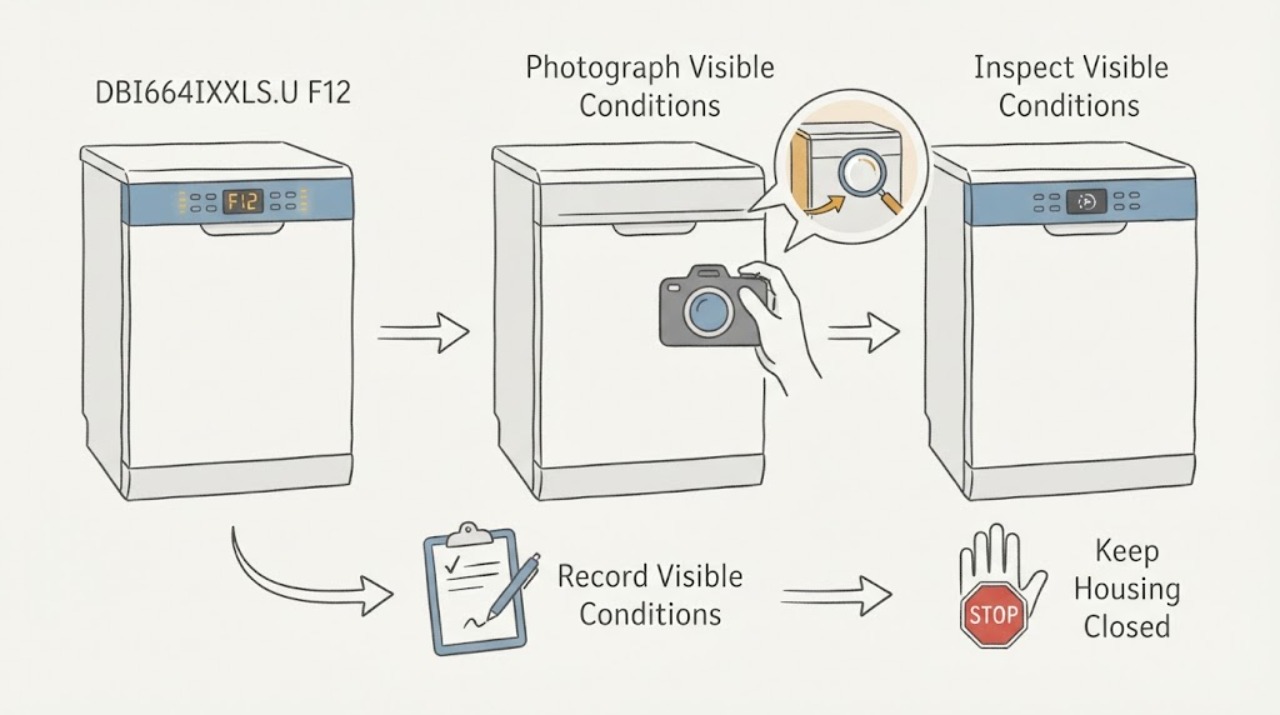
ASKO's official dishwasher error guidance uses F12 for a water-inlet fault, but F12 does not prove that the inlet valve itself has failed or that it is discontinued. The exact DBI664IXXLS.U is a US 40 Series built-in dishwasher; its official model sheet specifies a visible water connection and an inlet-pressure range of 4.2–140 psi, while the installation instructions require an accessible shutoff and kink-free hoses. Because the unit stopped after only two loads, first document the exact display and complete model, then make only safe external checks: confirm the water valve is open, look for a visible kink, leak, or installation issue, and note whether the cabinet filled before stopping. Do not pull out the integrated dishwasher, disconnect the hose, measure pressure, open panels, or order a valve from F12 alone. If the error returns, the machine never fills, or there is any leak, leave water and power off as appropriate and use ASKO or authorized service while the new-appliance warranty may still apply.
Before you begin
Safety first
- Do not pull out the integrated dishwasher, disconnect water or drain hoses, open panels, enter service mode, perform live or pressurized tests, bypass a water-safety device, or order an inlet valve from F12 alone. Keep water and power off as appropriate for a leak, electrical symptom, or uncontrolled fill.
Work through in order
Diagnostic checks
Use only checks that match the exact appliance or system and its official guide.
-
Check 1
Photograph the complete display and the rating or serial label that is safely visible without moving the integrated dishwasher. Record whether it says exactly F12, whether it is flashing or accompanied by another message, the selected program, and whether the machine stopped while filling, washing, or draining. Record the complete model as DBI664IXXLS.U only if the label confirms that suffix and market.
Expected result: The display is exactly F12 and the label confirms DBI664IXXLS.U, or the code, suffix, region, or appliance identity is uncertain or different.
Next step: Use the exact regional manual or give the photograph and label details to ASKO service. If the identity remains uncertain, keep the appliance off rather than applying a code table from another model.
Stop if: Do not slide out the dishwasher just to find a label, enter service mode, or clear a code repeatedly.
Why this matters
Why: ASKO uses more than one water-related code and publishes model-family-specific instructions. A partial model, a different code, or a status light cannot safely establish the F12 water-inlet interpretation.
-
Check 2
From the accessible adjacent cabinet, check that the dishwasher's water shutoff is open and look at the visible inlet hose for a sharp bend, crushing, abrasion, or a wet connection. Do not loosen the connection, pull the dishwasher forward, or handle a hose that is under pressure.
Expected result: The shutoff is closed, the hose is visibly kinked or damaged, the connection is wet, or the visible supply arrangement looks normal.
Next step: If the connection is dry and the valve is a normal accessible shutoff, open it fully and document the change. If there is any leak or hose damage, close the valve and keep the dishwasher off while arranging qualified service.
Stop if: Do not detach the inlet hose, remove an inlet safety device, test pressure, or reach behind the installed unit.
Why this matters
Why: A closed valve or installation-damaged hose can explain an inlet fault without proving a failed valve. A dry, open, visually normal supply route does not rule out an internal inlet or control problem.
-
Check 3
Use the event record rather than a repeated test: note whether the first and second loads filled, whether the spray arms were wet afterward, whether the tub is dry or retains water, and at what point F12 appeared. If the dishwasher is still connected and a leak, electrical odor, or unusual sound is present, switch it off and isolate power only from a safe, dry position.
Expected result: The tub never filled, it filled and then stopped, water remains after stopping, the spray arms were dry, or a leak or electrical symptom occurred.
Next step: Give the timeline and photographs to authorized ASKO service or the installer. Close the water valve for a leak and leave the machine off when the event cannot be safely distinguished from an installation or internal fault.
Stop if: Do not run another load solely to listen for the valve, watch the water level, or reproduce F12.
Why this matters
Why: No fill and dry spray arms support an inlet-path branch; retained water is also a drainage observation; a leak or electrical symptom overrides ordinary troubleshooting. None of these observations identifies a valve or control board by itself.
-
Check 4
Check only the visible drain and cabinet installation conditions: look for a crushed drain hose, an obvious sink-connection leak, or water on the floor, without loosening plumbing or moving the unit. Record whether the machine stopped with a full tub or an empty tub.
Expected result: The tub is full, the drain route is visibly kinked or leaking, the floor is wet, or the tub is empty and the only repeatable message is F12 during the fill stage.
Next step: Do not alter an inaccessible drain connection. For visible water, close the water valve and isolate power safely; otherwise provide the observations to service and follow the exact manual for the confirmed model.
Stop if: Do not pull out an integrated dishwasher, disconnect drain plumbing, or use a reset to mask retained water or a leak.
Why this matters
Why: A full tub or drain problem is not interchangeable with a water-inlet fault, even if the machine stopped at a similar time. An empty tub with F12 during filling keeps the inlet branch active but still does not select a valve.
-
Check 5
Prepare a warranty or service handoff before considering any part. Include the full model and serial details, purchase or installation date, both load dates, the exact code and timing, water-valve and hose observations, tub water level, any leak, and the installer or service work already performed. Ask the provider to state what was tested and what evidence supports a proposed repair.
Expected result: The dishwasher is newly installed or within its warranty period, the installer can revisit the connections, the code returns with normal visible supply conditions, or someone proposes an inlet valve solely from F12.
Next step: Pause independent parts purchasing and ask ASKO or the authorized installer for a model-specific diagnosis and warranty decision. Request confirmation of current part availability only from that official service channel, not from the error code.
Stop if: Do not buy a substitute valve, splice wiring, bypass a water-safety device, or authorize a part without exact model and test evidence.
Why this matters
Why: A new-appliance timeline makes installation and warranty review a priority. F12 can direct a technician to the inlet system, but the code cannot establish part fit, failure, or discontinued status.
Use your observations
Decision map
Find the observation that best matches what you see, then follow the next safe action.
-
PATH 01Next step
What you see
The exact label confirms DBI664IXXLS.U, the display is exactly F12, the accessible shutoff was closed or a visible hose kink was found, and there is no leak.
Do this next
Correct only the plainly visible valve or hose-position issue, document it, and stop if F12 returns. Use ASKO or authorized service while warranty coverage is available.
Why this path and its safety boundary
Why it matters: This is a plausible external water-supply or installation condition and is a different first branch from replacing an inlet valve. It is not proof that the correction will clear the fault.
-
PATH 02Next step
What you see
The valve is open and the visible hose route is dry and kink-free, but the dishwasher did not fill or F12 returns after the first two loads.
Do this next
Leave the integrated dishwasher in place and arrange model-specific ASKO service or an installer warranty visit. Ask for the test result that supports any proposed component before authorizing it.
Why this path and its safety boundary
Why it matters: The visible installation checks did not isolate the inlet fault. The remaining possibilities include supply conditions or internal water-inlet/control behavior, but F12 still does not identify a valve or establish that it is discontinued.
-
PATH 03Next step
What you see
The dishwasher stopped with retained water, a visibly kinked or leaking drain route, or water on the floor rather than a clearly observed fill-stage F12.
Do this next
Close the water valve, isolate power only if safe, keep the dishwasher off, and arrange qualified appliance or plumbing service. Do not pull out the built-in unit or keep cycling it.
Why this path and its safety boundary
Why it matters: This is a drainage or leak branch, not evidence that the inlet valve caused the stop. Water damage and overflow risk take priority over code interpretation.
-
PATH 04Safety boundary
What you see
The code is not exactly F12, the suffix or market does not match, or there is smoke, burning odor, a hot connection, exposed wiring, a repeated breaker trip, or an active leak.
Do this next
Stop using the dishwasher. Disconnect power only from a safe, dry position and close the water valve for a leak; use emergency help for active fire or dangerous smoke and qualified service for other hazards.
Why this path and its safety boundary
Why it matters: The DBI664IXXLS.U F12 water-inlet path is not established, and the safety symptom exceeds an external check. A similar-looking code must not be translated into an inlet-valve diagnosis.
Safety stop: No restart, repeated breaker reset, panel removal, service-mode sequence, hose disconnection, or live/pressurized test.
Helpful context
Understand the symptom
What F12 tells you
ASKO's official dishwasher error table labels F12 as a water-inlet fault and points the owner toward the water valve, inlet path, and professional service when the problem persists. That is a system-level report: it does not establish a failed inlet valve, a pressure-switch failure, a control fault, or a discontinued part. The exact DBI664IXXLS.U operating instructions and market should govern the final procedure, especially because the unit stopped after just two loads.
Why the exact model and installation matter
The opened ASKO product sheet names DBI664IXXLS as a 40 Series dishwasher with a 115 VAC supply, a dedicated 15 amp circuit, a visible water connection, and a stated inlet-pressure range. ASKO's matching installation instructions group DBI664IXXLS with the DBI664 family and require accessible water and drain connections, kink-free hoses, and a leak check. These documents confirm the product family and installation context; they do not make a valve replacement safe for an owner.
A two-load failure is an installation timeline
Stopping after two loads does not prove that the second load damaged a valve. It can expose a valve that was not fully opened, a hose that became pinched when the integrated unit was pushed into place, a connection that began to leak, or a supply problem that only appeared under a fill demand. Record what happened on each load—whether it filled, when F12 appeared, and whether water was left in the tub—so the installer or service provider can separate installation evidence from an internal diagnosis.
When checks do not resolve it
Need a professional?
Call ASKO or the authorized installer for a recurring F12, no-fill condition, a new-installation failure, a visible leak, or any diagnosis that requires access behind the unit. Ask the official service channel to confirm current part availability rather than treating a user report that a valve is discontinued as established fact.
Safety scope: Do not pull out the integrated dishwasher, disconnect water or drain hoses, open panels, enter service mode, perform live or pressurized tests, bypass a water-safety device, or order an inlet valve from F12 alone. Keep water and power off as appropriate for a leak, electrical symptom, or uncontrolled fill.
Have this ready
- Provide DBI664IXXLS.U exactly as printed if confirmed, serial and market details, installation and purchase timing, both load dates, the exact F12 display, fill and stop timing, tub water level, visible shutoff and hose findings, drain observations, leak or electrical symptoms, and any prior installer visit.
Common questions
FAQ
Does F12 mean the ASKO inlet valve must be replaced?
No. ASKO's official dishwasher guidance calls F12 a water-inlet fault, which can direct service toward the inlet path, but the display does not prove a failed valve or establish compatibility or availability. Check only the visible shutoff and hose route, then request a model-specific diagnosis.
What should I check after DBI664IXXLS.U stops after two loads?
Record the exact F12 display and complete label first. From the adjacent cabinet, check that the water shutoff is open and look for a visible kink, wet connection, or damaged hose; note whether either load filled and whether water remains. Do not pull out the integrated dishwasher or disconnect plumbing.
Can I check the water pressure myself?
No. ASKO's consumer cleaning guidance sends water-pressure verification to a plumber, and the DBI664IXXLS installation documents give the permitted range. Do not disconnect the hose or perform a pressurized test as a user troubleshooting step.
How do I know whether the valve is discontinued?
F12 cannot answer an availability question. Give the exact model, suffix, serial details, and service index or documentation to ASKO or authorized service and ask them to confirm the current repair path. Do not substitute a valve based on appearance, a partial model, or a generic listing.
Should I keep restarting it to see whether F12 clears?
No. After the safe external check, stop if F12 returns or the dishwasher does not fill. Repeated restarts can turn an unresolved fill or leak condition into water damage; leave the unit in place and arrange service or an installer warranty visit.
Read the exact guide
Official sources
- 40 Series DBI664IXXLS dishwasher product specificationsASKO · Official ASKO-hosted product sheet opened directly. It identifies DBI664IXXLS and documents the US electrical supply, water connection, drain connection, and inlet-pressure specification for this exact product family.
- ASKO DBI664IXXLS dishwasher installation instructionsASKO · Official ASKO-hosted installation PDF opened directly for the exact DBI664IXXLS family. It requires qualified electrical, water, and drainage connections, an accessible water valve, kink-free hoses, leak checks, and power/water isolation during installation.
- ASKO dishwasher operating instructions with error messagesASKO · Official ASKO-hosted dishwasher operating-instructions PDF opened directly. Its error table labels F12 as a water-inlet fault and directs the owner to check the valve/filter or contact service; the PDF is a general ASKO dishwasher reference, so the exact DBI664IXXLS.U manual and market remain controlling for any model-specific procedure.
Community feedback
Share a repair observation
Share a plain-text repair observation. Accepted observations are published automatically; this page may take a moment to update.