
On this page
Start here
Quick answer
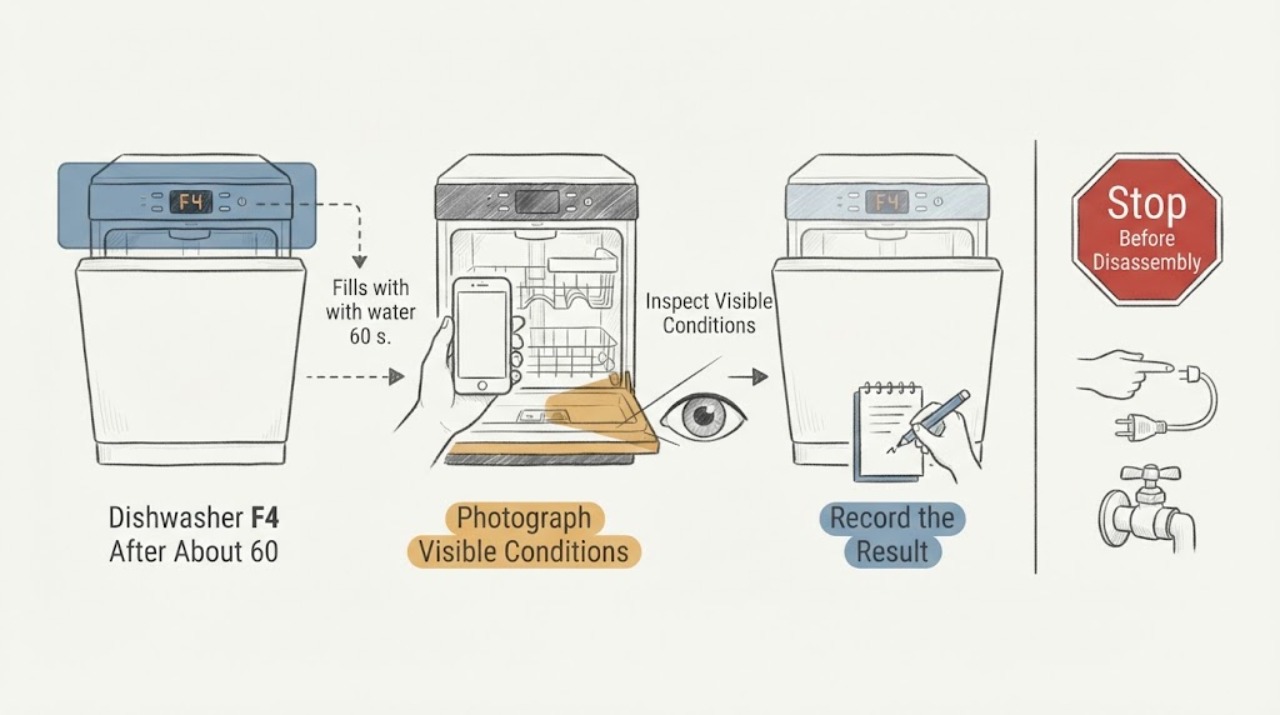
An ASKO 3350 that fills for about 60 seconds and then stops with F4 should not be diagnosed from the timing alone. ASKO's opened US cleaning guide places F4 in its no-water section: verify the accessible water shutoff is open, document the code, and use the guide's five-second Start/Stop reset only once if the unit is dry and there is no leak or other hazard. If F4 returns, stop repeating the cycle and arrange service. The exact D3350 community report matches the roughly 60-second fill-then-F4 sequence but also reports behavior unlike the guide, so that timing is a service clue—not proof of an inlet valve, flow sensor, pressure device, pump, or float failure. Do not pull out the dishwasher, tilt it, enter service mode, disconnect plumbing under pressure, or perform live tests.
Work through in order
Diagnostic checks
Use only checks that match the exact appliance or system and its official guide.
-
Check 1
Before pressing reset, photograph the display and record the exact model label or paperwork, market if known, selected program, startup drain behavior, the time from Start to F4, whether water visibly enters, and whether the unit goes silent, beeps, or continues pumping. Do not slide an integrated dishwasher out to find a label.
Expected result: The display is a stable F4 after about 60 seconds, F4 appears at another point, the code is unreadable, or the appliance behavior does not match the expected sequence.
Next step: Keep the photo and timing record. Use the water-inlet branch only for a stable F4 on the identified appliance; if the display or model is uncertain, arrange service rather than borrowing a code table from another ASKO platform.
Why this matters
Why: The exact code and stage are more useful than a generic F4 translation. The official guide's F4 path is no-water, but the exact D3350 report shows that a 60-second fill-then-stop pattern may not behave like the guide's general description.
-
Check 2
With the dishwasher off and the floor dry, look at the normally accessible water shutoff and the visible supply connection without disconnecting the hose. Confirm the shutoff is open only if it turns normally and there is no leak, kink, damaged fitting, or water near electrical parts.
Expected result: The valve is closed, the visible connection or hose is kinked or leaking, the supply looks normal, or the supply cannot be safely inspected.
Next step: Open a normally accessible valve only when dry and intact. For a leak, damaged connection, uncertain supply, or normal visible supply with returning F4, turn water and power off as safely accessible and arrange qualified service; do not measure pressure or detach the hose.
Why this matters
Why: A closed or visibly restricted supply can explain a no-water F4 path. An open-looking valve does not prove adequate pressure or an internal inlet component, and a leak changes the task to a safety stop.
-
Check 3
If there is no leak, standing water near electrical parts, smoke, odor, or continuously running pump, follow the ASKO guide's F4 owner action once: document the code, hold Start/Stop for five seconds, and observe without entering service mode or repeating the sequence. Do not run another full cycle solely to reproduce the failure.
Expected result: F4 clears and the controls return normally, F4 returns after the reset, the machine remains silent or unresponsive, or a hazard appears.
Next step: For a returning code or abnormal response, stop resetting and arrange authorized service with the timing and display record. For a leak, continuous pump, smoke, burning odor, hot plug, or water near electrical parts, isolate water and power only from a safe dry position and seek urgent qualified help.
Why this matters
Why: A one-time clear can remove a transient state but does not establish that the inlet, flow sensing, level sensing, drain, or control system is healthy. A returned F4 is the guide's service boundary; a hazard overrides the reset path.
-
Check 4
Compare the actual 60-second timeline with the exact D3350 report without copying its internal checks: note whether the dishwasher performs an initial drain, fills visibly, stops filling at roughly one minute, leaves water in the tub, or becomes quiet after F4. Do not pull the machine out, remove panels, tilt it, or touch the pan, float, pump, valve, wiring, or pressure system.
Expected result: The unit fills then stops around 60 seconds with no visible leak, fills little or not at all, leaves standing water, runs a pump continuously, or behaves differently from the report.
Next step: Send the technician the exact sequence, code photo, model/serial information, and any safe visible water or leak observation. Do not order a valve, flow meter, pump, float, or sensor from the timing alone.
Why this matters
Why: A fill-then-stop timeline separates what the user can observe from the unresolved internal cause. The exact community report shows that this symptom can persist even when a user believes supply, drain, and power checks are normal; it does not prove the commenters' component theories.
-
Check 5
Prepare the service handoff: list prior resets, the program and cycle stage, whether the code returns every attempt, visible water level, any leak or pump behavior, and the market/model label. State explicitly that the unit stops after approximately 60 seconds of filling and that the code may be F4 from the exact display.
Expected result: The sequence is repeatable, intermittent, changed after a repair or reset, or cannot be reproduced safely.
Next step: Leave the dishwasher off until the exact manual and internal diagnosis are confirmed. Use authorized ASKO service or a qualified appliance technician; do not continue cycles to obtain a clearer code.
Why this matters
Why: A repeatable time and stage are diagnostic evidence for the technician, but an intermittent result or changed behavior makes a guessed component even less reliable. The official guide directs a returning F4 to service.
Use your observations
Decision map
Find the observation that best matches what you see, then follow the next safe action.
-
PATH 01Next step
What you see
F4 appears consistently on the identified ASKO 3350/D3350 after about 60 seconds of visible filling, with no leak, standing water near electrical parts, or continuous pump.
Do this next
Verify only the safe visible shutoff/connection, follow the guide's five-second reset once if appropriate, and arrange service if F4 returns. Give the technician the exact timing and display photo.
Why this path and its safety boundary
Why it matters: This matches the exact community timing report and the official ASKO guide's F4 no-water category, but neither source proves which internal inlet, level, flow, drain, or control element is responsible.
-
PATH 02Next step
What you see
The supply valve is visibly closed or the hose/connection is kinked but dry and intact.
Do this next
Correct only the normally accessible condition, then stop rather than repeatedly testing. If F4 remains or the connection leaks, turn water and power off safely and call service.
Why this path and its safety boundary
Why it matters: A visible supply-side restriction is more plausible than a proven internal component failure, but the code should not be assumed cleared until the exact model's behavior is confirmed.
-
PATH 03Next step
What you see
The valve appears open, the visible supply is normal, or F4 returns after the single documented reset; the appliance fills for about 60 seconds and stops again.
Do this next
Stop resetting and arrange authorized ASKO service with the model, market, code photo, timing, and water-level observations. Do not disconnect plumbing, enter service mode, or order parts from F4 alone.
Why this path and its safety boundary
Why it matters: The owner-level water check did not resolve the fault. The exact timing is useful for service but does not identify a valve, flow meter, pressure sensor, pump, float, or control board.
-
PATH 04Next step
What you see
Water is leaking, the pump runs continuously, there is water near electrical parts, smoke, burning odor, a hot plug, damaged wiring, or repeated breaker trips.
Do this next
Stop using the dishwasher. Turn water and power off only from a dry, safely accessible position, keep clear, and arrange urgent qualified appliance or electrical service. Do not tilt, open, reset, or restart the machine.
Why this path and its safety boundary
Why it matters: This is a water-containment or electrical/fire stop boundary, not an ordinary F4 fill diagnosis.
Helpful context
Understand the symptom
F4 is a model-generation and timing question before it is a parts question. The official ASKO US cleaning guide is a general owner guide and tells owners to consult the product use-and-care guide for further information. It lists F4 under no water, while the exact D3350 community report describes a startup drain check, about 60 seconds of filling, then F4 and silence. Because the observed behavior did not match the guide's general description, do not translate the code into a valve, sensor, pump, or float verdict.
The safe user contribution is a clean timeline: what the display says, whether water really enters, whether water remains or leaks, and what happens after the single model-appropriate reset. If the code returns, stop trying to make it run and give that record to an authorised ASKO technician.
When checks do not resolve it
Need a professional?
Arrange authorized ASKO or qualified appliance service when F4 returns after the single model-appropriate reset, the visible supply is normal, the code timing differs from the exact manual, or diagnosis would require moving the dishwasher, opening panels, testing pressure, accessing a pump/valve/float, or touching wiring. Stop immediately for a leak, continuously running pump, water near electrical parts, smoke, burning odor, hot plug, damaged cord, or repeated breaker trip.
Common questions
FAQ
What does F4 mean on an ASKO 3350 dishwasher?
ASKO's opened US cleaning guide places F4 under No water to dishwasher and tells the owner to verify the shutoff, document F4, use the five-second Start/Stop reset once, and contact service if it returns. Because the exact D3350 timing report does not fully match the guide's described behavior, do not use F4 alone to identify an inlet valve, flow sensor, pump, float, or control fault.
Why does my ASKO fill for about 60 seconds and then stop with F4?
That timing is a useful service clue, and an exact ASKO 3350 report describes the same sequence, but it is not a component diagnosis. Check only the safely accessible water shutoff and connection, record whether water enters and remains, use the documented reset once if safe, and arrange service if F4 returns.
Can I disconnect the inlet hose or inspect the float to clear F4?
Not as an owner-level step for this situation. Disconnecting plumbing, moving or tilting an integrated dishwasher, accessing the pan or float, entering service mode, and testing wiring can create leak or electrical hazards. Leave those checks to qualified service, especially when the code returns after the visible supply check.
Read the exact guide
Official sources
- Asko Dishwasher 3350 F4 Error code.Reddit r/appliancerepair · Exact-model community report for an ASKO Dishwasher 3350/D3350. It is used only for the reported approximately 60-second fill-to-F4 timing and mismatch with the manual description, not for internal repair instructions or component conclusions.
- ASKO Dishwasher Cleaning GuideASKO · Opened official ASKO US owner guide used as a scoped reference for the assigned ASKO 3350/D3350 dishwasher F4 condition; the guide says to consult the product use-and-care guide for further information and does not establish every old-model behavior.
Community feedback
Share a repair observation
Share a plain-text repair observation. Accepted observations are published automatically; this page may take a moment to update.