
On this page
Start here
Quick answer
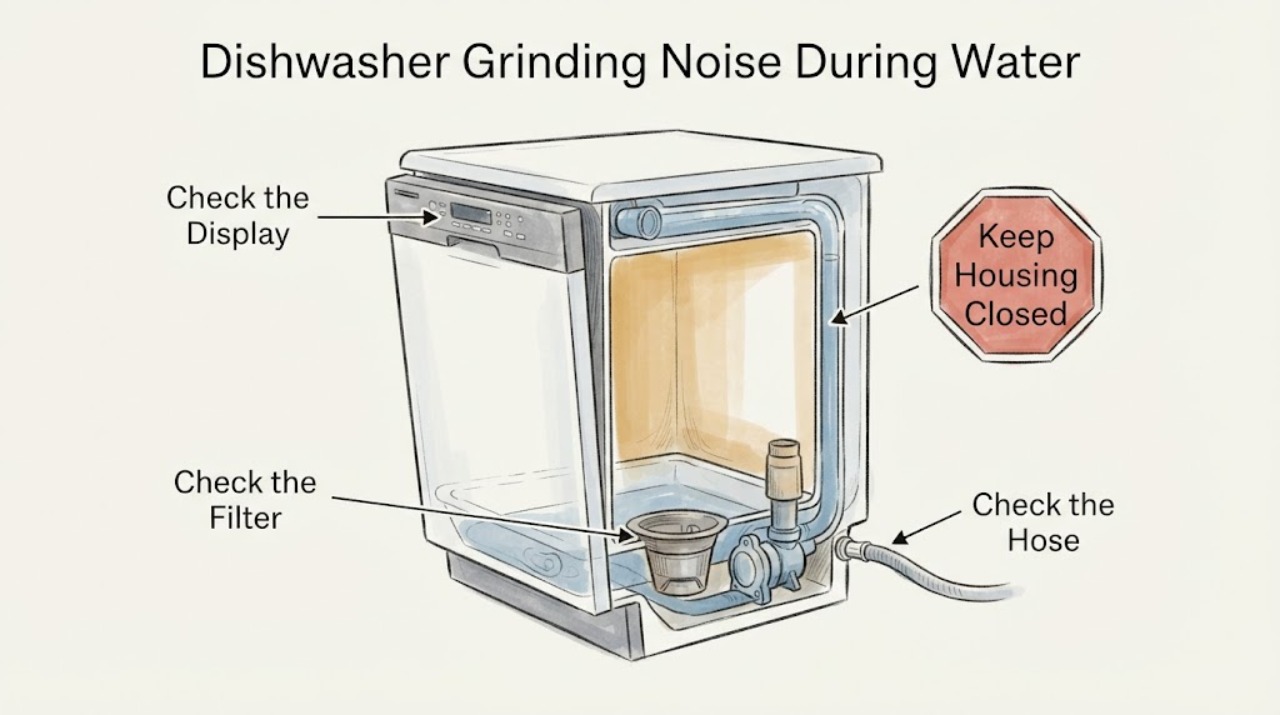
A grinding sound that is heard while an Asko dishwasher adds water should be separated by timing and location before anyone names an inlet valve or pump. The exact community report has no model number and only records the sound during filling; the replies disagree about whether it is the inlet valve, pump, or another sound source. Start with the user-visible checks supported by Asko's cleaning guide: turn the unit off, clean and reinstall the filters, verify the water shutoff is open, and note whether the machine has a drain or fill fault. Do not reach into a running sump, remove the pump or inlet valve, or keep cycling the dishwasher if the noise is accompanied by a leak, burning odor, continuous drain-pump operation, or an error. If the grinding remains after the filter and supply checks, use the exact model's manual and arrange service.
Work through in order
Diagnostic checks
Use only checks that match the exact appliance or system and its official guide.
-
Check 1
Cancel or stop the program using the normal control, keep the door closed while the unit is operating, and listen only from outside the appliance. If there is a leak, burning odor, exposed wiring, or a drain pump that runs continuously, turn power and water off as the Asko guide directs.
Expected result: The sound stops when the cycle is stopped, continues with the dishwasher idle, or is accompanied by water on the floor, odor, smoke, or continuous pumping.
Next step: For any leak, odor, smoke, or continuous drain-pump condition, leave the unit out of service and contact Asko Customer Care or a qualified appliance technician. Otherwise record the exact phase and continue only with the unpowered filter and supply checks below.
Stop if: Do not reach into the sump, remove the toe kick, or open electrical covers while the unit is connected or wet.
Why this matters
Why: A sound tied to the fill phase is different from a pump that runs while the appliance is idle. Water, electrical, or continuous-pump symptoms are stop conditions and do not justify repeated test cycles.
-
Check 2
With power off and the tub safe to access, remove the lower rack and clean the user-accessible filter basket, fine filter, and filter cover as shown in the Asko cleaning guide. Reinstall every filter component in its original position; do not probe the pump with a sharp tool.
Expected result: The filter area contains glass, food, a hard object, or buildup; the filters are clean and correctly seated; or the grinding remains after reassembly.
Next step: Remove only visible debris while the appliance is unpowered, reinstall the filters, and use the exact model manual for any additional approved cleaning. If the noise returns, stop opening the sump and arrange service rather than ordering a pump by guess.
Why this matters
Why: Debris or a mis-seated filter can change the sound and can contribute to drainage trouble, but cleaning the filter does not prove that the inlet valve or pump is defective. A persistent grinding noise after a clean, correctly reinstalled filter needs model-specific diagnosis.
-
Check 3
Check the dishwasher's external water shutoff and the visible inlet hose for a closed valve, sharp kink, or obvious crush point. Do not disconnect a pressurized hose or pull out an integrated unit to inspect hidden plumbing; use the model manual or a plumber for supply testing.
Expected result: The shutoff is closed, the hose is visibly kinked, the unit fills normally but grinds, or no water enters the machine.
Next step: Correct only a clearly closed valve or accessible kink, then compare the noise timing under the exact manual's normal cycle. If the supply is normal or the sound persists, stop testing and request service; do not adjust a valve or replace it without model-specific evidence.
Why this matters
Why: ASKO's guide lists an open shutoff and a verified supply-pressure range for a no-water condition. That guidance does not establish that a grinding sound is caused by the inlet valve, and a normal fill does not rule out a pump or foreign-object noise.
-
Check 4
Find the exact Asko model number and open its official manual before any further diagnosis. Record whether the sound is present during fill, circulation, or drain, whether the cycle completes, and any displayed code; do not use a generic Asko code or part list for a different model.
Expected result: The model-specific manual identifies a documented user check, or no model-specific explanation covers the grinding noise.
Next step: Follow only the exact model's documented user checks. If no documented check resolves the noise, send the model, phase, video/audio description, water behavior, and filter findings to Asko service.
Why this matters
Why: Asko dishwasher designs and service procedures vary by model. The opened community report has no model and its commenters disagree about the sound source, so it cannot support a component-level conclusion.
Use your observations
Decision map
Find the observation that best matches what you see, then follow the next safe action.
-
PATH 01Next step
What you see
The noise is present only while the appliance is filling, with a clear filter area and no leak or error.
Do this next
Use the exact model manual and arrange service if the sound is new, harsh, or persistent. Do not replace an inlet valve from the timing alone.
Why this path and its safety boundary
Why it matters: The symptom is phase-specific, but the opened sources do not identify whether the sound is the inlet valve, pump, hose resonance, or another mechanism.
-
PATH 02Next step
What you see
The filter area contains debris and the noise changes or disappears after the filters are cleaned and correctly reinstalled.
Do this next
Keep the filters installed and follow the model manual's cleaning interval. If grinding returns, stop opening the sump and request service.
Why this path and its safety boundary
Why it matters: The observation supports a user-accessible debris or filter condition, but it does not prove which internal moving part was affected.
-
PATH 03Next step
What you see
The noise persists after the documented filter and external supply checks, or the pump runs continuously, leaks, or the appliance displays a fault.
Do this next
Turn power and water off for the continuous-pump or leak conditions and arrange Asko-authorized service with the exact model, phase, code, and observations. Do not open the base or perform live electrical testing.
Why this path and its safety boundary
Why it matters: The remaining problem is outside the safe evidence scope of this model-free page; a pump, inlet path, control, or plumbing issue cannot be selected from the symptom alone.
Helpful context
Understand the symptom
The timing matters more than the word grinding
A dishwasher can make different sounds while the inlet valve opens, the circulation system starts, or the drain pump runs. The opened Asko case confirms only that the sound was noticed while water was being added; its replies are guesses, not a diagnosis. Listen only from outside the closed appliance and write down whether the sound starts before water enters, changes as the tub fills, continues after filling, or occurs during drain-out.
Model scope is still unresolved
No Asko model was supplied in the community post. Use Asko's model-specific manual lookup before applying any cycle, pressure, filter or part instruction that is not present in the general cleaning guide. The checks below are limited to the accessible filter, water-supply and stop-service boundaries supported by the opened official guide.
Common questions
FAQ
Is a grinding noise during fill definitely a bad Asko inlet valve?
No. The exact community post has no model and its replies disagree about the inlet valve, pump, or another source. Check the documented filter and visible supply conditions, then use the exact model manual or service instead of ordering an inlet valve from the sound alone.
Can I keep running the dishwasher to identify the grinding sound?
Do not repeatedly run it if the noise is harsh or is accompanied by a leak, burning odor, fault, or continuous pump operation. Turn power and water off for the continuous-pump condition and contact service as ASKO's guide directs.
What should I do before asking Asko for service?
Find the exact model, note whether the noise occurs during fill, circulation, or drain, record any code, and report whether filters were clean and the visible shutoff and hose were normal. Do not open the base or attempt a live test.
Read the exact guide
Official sources
- Asko DishwasherReddit r/Appliances · Exact post opened. It has no model number and its replies disagree about the source, so it supports only symptom timing and the need to avoid component guessing.
- Dishwasher CleaningASKO · Opened the official ASKO USA-hosted PDF. It is a general cleaning/troubleshooting guide, not a model-specific manual; the article uses only its accessible filter, visible supply, and service-boundary guidance and does not transfer a component diagnosis.
- User manualsASKO · Opened the official ASKO manual portal. It asks users to search by product code or model name and select the local market; it supports the instruction to locate the exact manual, not any unseen model-specific repair procedure.
Community feedback
Share a repair observation
Share a plain-text repair observation. Accepted observations are published automatically; this page may take a moment to update.